UK Clothing Retailer Next Ups Profit Outlook Again

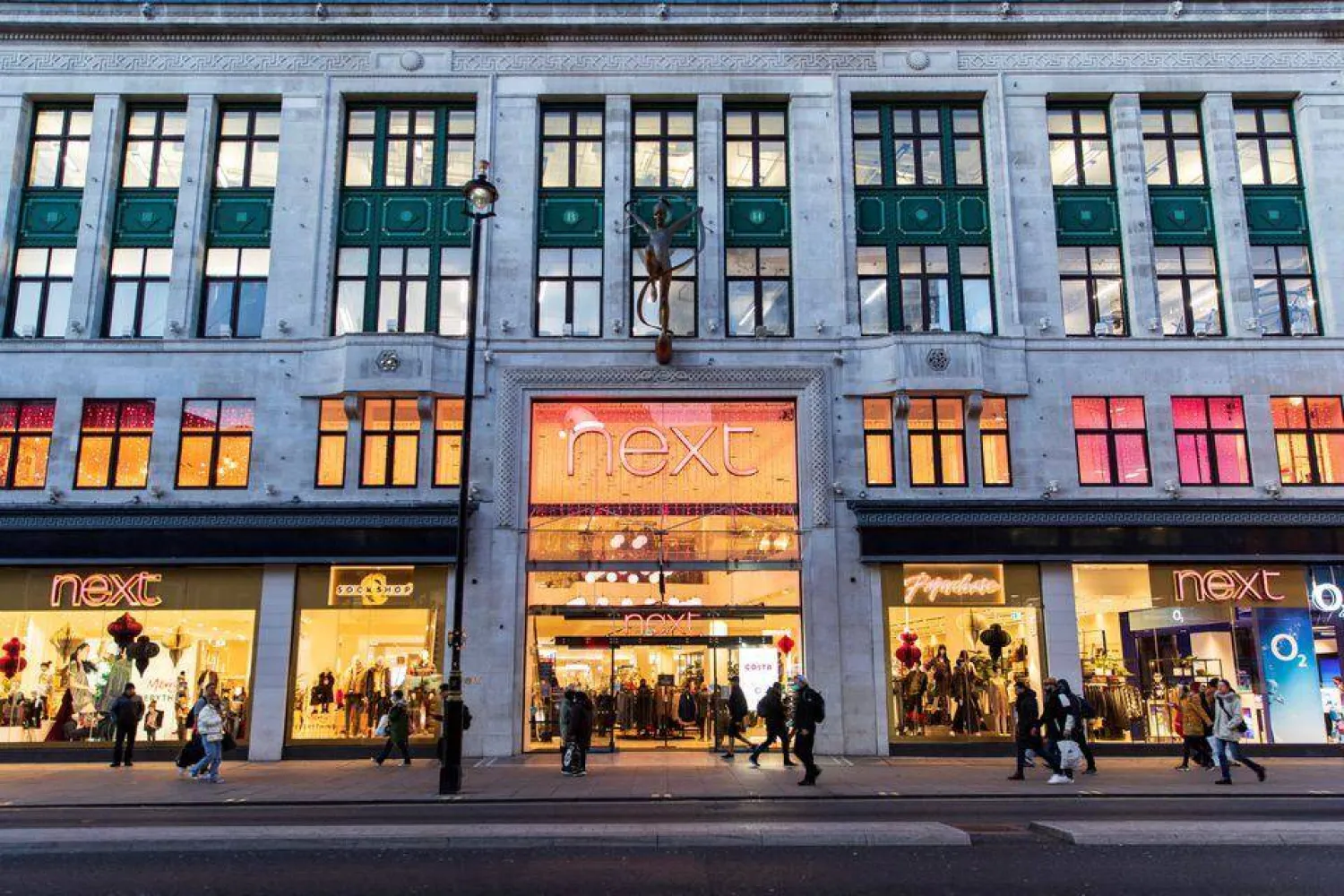
People walk past a store of clothing retailer Next, in London, Britain, December 2, 2021. REUTERS/May James
TT

UK Clothing Retailer Next Ups Profit Outlook Again

People walk past a store of clothing retailer Next, in London, Britain, December 2, 2021. REUTERS/May James

British clothing retailer Next on Thursday raised its profit forecast for the year to end-January 2024 for the fifth time in eight months as it reported a better-than-expected rise in Christmas sales.
The group, which trades from about 460 stores in the UK and Ireland and has an online presence in over 70 countries, did, however, caution that difficulties with access to the Suez Canal, if they continued, were likely to cause some delays to stock deliveries in the early part of the year.
Next is often considered a useful gauge of how British consumers are faring.
Britain's shoppers have been hit by a rise in borrowing costs which stand at a 15-year high and by rapid inflation which dropped below 4% in the latest data but has outpaced growth in wages for much of the past two years.
Despite that, Next said full-price sales rose 5.7% in the nine weeks to Dec. 30, Reuters reported.
Sales in stores rose 0.6% year on year, while online sales were up 9.1%, benefiting from service improvements.
It said it now expected pretax profit before exceptional items for the year to January 2024 of 905 million pounds ($1.15 billion), above previous guidance of 885 million and the 870.4 million it made in 2022/23.
The group also gave guidance for its 2024/25 year, forecasting a rise in full-price sales up 2.5%, total group sales up 6.0% and profit up 5% to 960 million pounds.
"On the face of it, the consumer environment looks more benign than it has for a number of years, albeit there are some significant uncertainties," Next said.
It said positive factors were wages rising faster than prices and zero inflation in its selling prices.
However, risk factors were a weakening employment market, the expiration of consumers' fixed-rate mortgages and supply chain risks.
Shares in Next have risen by 36% over the last year.
Separately on Thursday, British sportswear retailer JD Sports Fashion lowered its full-year profit forecast.



Nike’s Turnaround Put to Test as Middle East Conflict Poses New Risks

A man walks past Nike booth with installation of shoes at the 8th China International Import Expo (CIIE) venue in Shanghai, China, November 5, 2025. (Reuters)
TT

Nike’s Turnaround Put to Test as Middle East Conflict Poses New Risks

A man walks past Nike booth with installation of shoes at the 8th China International Import Expo (CIIE) venue in Shanghai, China, November 5, 2025. (Reuters)

Nike's efforts to steady its business ‌face a fresh setback, with executives cautioning that unrest in the Middle East could further complicate the turnaround, while the sportswear giant still struggles to regain traction in China.

The company on Tuesday warned of a sharp drop in current-quarter sales and slower-than-expected progress on its turnaround, as higher trade-related costs squeeze its margins and cautious consumers rein in spending.

Shares of the company slumped 10% to $47.35 in premarket trading on Wednesday and were on track to open at their lowest in over a ‌decade.

On an earnings ‌call, Chief Financial Officer Matthew Friend said ‌the ⁠conflict in the ⁠Middle East had already disrupted shopping behavior in parts of Europe, the Middle East and Africa, contributing to softer store traffic and weaker sportswear sales.

"The Middle East conflict is compounding the pressure, with Nike flagging traffic disruption and elevated inventory across EMEA," said Josh Gilbert, market analyst at eToro.

Nike CEO Elliott Hill, ⁠who took the helm in 2024, has ‌been looking to steady the company ‌as it grapples with several challenges, including a sluggish digital business, ‌stubborn excess inventory and intensifying competition from Chinese sportswear brands.

To boost ‌margins and bolster investor confidence, Hill has moved to rein in promotions, sharpen product innovation and refocus the business on core franchises such as running.

The efforts showed some signs of improvement in the ‌reported quarter, with the running category growing over 20%, but analysts still see a long road ⁠ahead for ⁠Nike.

At least eight brokerages cut their price target on the stock.

"We are turning at least somewhat frustrated, with seemingly slower than planned pace of recovery," Oppenheimer analyst Brian Nagel said.

The company's forward price-to-earnings multiple, a common benchmark for valuing stocks, is 25.47, compared with 13.54 for Adidas and Under Armour's ratio of 25.72, according to LSEG data.

"These earnings show Nike is keeping pace at a steady jog, but it keeps tripping over hurdles along the way," eToro's Gilbert added.

"Patience is clearly the price of admission."


From Plastic Jars to Transport, Iran War Drives up Beauty Industry Costs

Visitors browse stalls at the beauty industry Cosmoprof trade show, in Bologna, Italy, March 26, 2026. Picture taken with a mobile phone. (Reuters)
TT

From Plastic Jars to Transport, Iran War Drives up Beauty Industry Costs

Visitors browse stalls at the beauty industry Cosmoprof trade show, in Bologna, Italy, March 26, 2026. Picture taken with a mobile phone. (Reuters)

The Iran war is seeping into the cosmetics supply chain, pushing up the cost of everything from plastic jars and lipstick tubes to transport, and reminding the beauty industry that even a tub of face cream depends on fragile global trade routes.

Cost pressures were a recurring theme last week at one of the sector's largest trade fairs in the northern Italian city of Bologna, as executives watched Iran's blockade of the vital Strait of Hormuz shipping route approach a fifth week.

The Cosmoprof fair drew 3,100 exhibitors from 68 countries and 255,000 visitors from 150 nations, ranging from companies seeking packaging solutions to retailers scouting new products.

Cosmetics companies are primarily worried about higher raw material and transport costs due to rising oil prices ‌and disrupted shipping, five ‌industry executives told Reuters.

"We are beginning to see cost increases driven ‌by ⁠energy price inflation, compounded ⁠by delivery delays," said Simone Dominici, CEO of Italian cosmetics group Kiko, who estimates additional logistics-related costs of about 1.5 million euros ($1.7 million) for the group over the year.

Kiko, which sells lipsticks starting at 5 euros and mascaras from 7.5 euros, operates more than 1,000 stores worldwide.

"With so many containers stuck in the Middle East, there is a tighter container availability ... and goods are not being moved efficiently," Dominici said, adding that higher prices for some chemical components and packaging - much of it sourced from the ⁠Far East - would add further pressure.

As the Iran crisis upends supply ‌chains, Yonwoo, a container maker for L'Oreal and K-beauty firms, ‌said it was scrambling to secure stocks of plastic resin to manufacture the pots used for skincare and cosmetics.

ALTERNATIVE ‌ROUTES

Beyond higher costs, the industry could also face softer demand from consumers whose purchasing power ‌is being eroded by inflation, Dominici said.

"It's the perfect storm," he warned.

Milan-listed Intercos and privately owned Ancorotti Group, among Italy's largest contract manufacturers in the sector, said they had not yet faced major supply shortages but cited higher logistics costs, longer delivery times and rising raw material prices as challenges.

"Lead times have lengthened as routes have ‌become longer and ports more congested. What once took eight weeks now can take 12 to 14 weeks," said Ancorotti Chief Executive Roberto ⁠Bottino.

Some clients have turned ⁠to rail transport to reach Asia, Bottino added.

Ancorotti Group makes around 220 million euros in revenues per year from selling products to beauty brands worldwide.

Bottino said it was difficult to imagine supply-chain cost increases not ultimately being passed downstream.

"Middle East customers value quality and are willing to pay a premium for added value, so being unable to access these markets can have a negative impact," said Fabio Franchina, chairman of haircare products maker Framesi.

Franchina said the company's distributor in the region was exploring alternative delivery routes.

"They are looking at ... (options such as) shipping to Jeddah and then moving goods by road instead of routing them through Gulf ports," he said.

Some goods are currently being shipped by air rather than by sea, he added, further lifting costs.

Italy produced 18 billion euros of cosmetics in 2025, including 8.4 billion euros in exports, according to industry body Cosmetica Italia, making the country the world's fifth-largest exporter of beauty products and one of the leading producers of hair dyes, eye make-up and fragrances.


Judge Lifts Judicial Control on 2 Italian Fashion Firms in Worker Exploitation Case

A woman walks her dog at the CityLife Shopping District in Milan, on March 25, 2026. (Photo by Stefano RELLANDINI / AFP)
TT

Judge Lifts Judicial Control on 2 Italian Fashion Firms in Worker Exploitation Case

A woman walks her dog at the CityLife Shopping District in Milan, on March 25, 2026. (Photo by Stefano RELLANDINI / AFP)

An Italian judge has lifted the judicial control imposed by Milan prosecutors on two Italian fashion firms over alleged worker exploitation, court documents seen by Reuters showed, meaning a court-appointed administrator need no longer monitor the two firms' operations.

It is the first time a judge has not upheld such a measure in a series of similar cases involving the high-end fashion sector.

Milan prosecutors had placed the two firms under investigation on March 17, along with their two directors and three Chinese nationals ⁠who owned two ⁠workshops to which the brands had subcontracted production.

In a 25-page ruling seen on Monday, Judge Roberto Crepaldi said "the conditions do not exist" for placing Alberto Aspesi and Dama Spa, owner of the Paul & Shark brand, under judicial oversight.

He added it had not been proven that ⁠the two companies' directors were complicit in the crime of labor exploitation.

The judge said the exploitation and underpayment of migrant workers had been established, but he attributed responsibility to the two subcontracting workshops rather than to the two client companies. Milan prosecutors said they would file an appeal on Tuesday over the judge's decision, asking a court to confirm the judicial oversight measure.

A three-judge panel will then decide whether to uphold the lower court ⁠judge's ruling ⁠or reimpose judicial control.

Being placed under investigation does not imply guilt or mean the case will go to trial.

Aspesi and Dama have not commented on the case, while the lawyer for Dama's director said he ruled out any criminal liability for his client, Andrea Dini.

The March 17 move had brought to seven the number of high-end brands put under various forms of judicial administration because of suspected labor violations, while another 13 have been subject to inspections - cases that have tainted the sector's image.