


US, Britain Strike Yemen in Reprisal for Houthi Attacks on Shipping

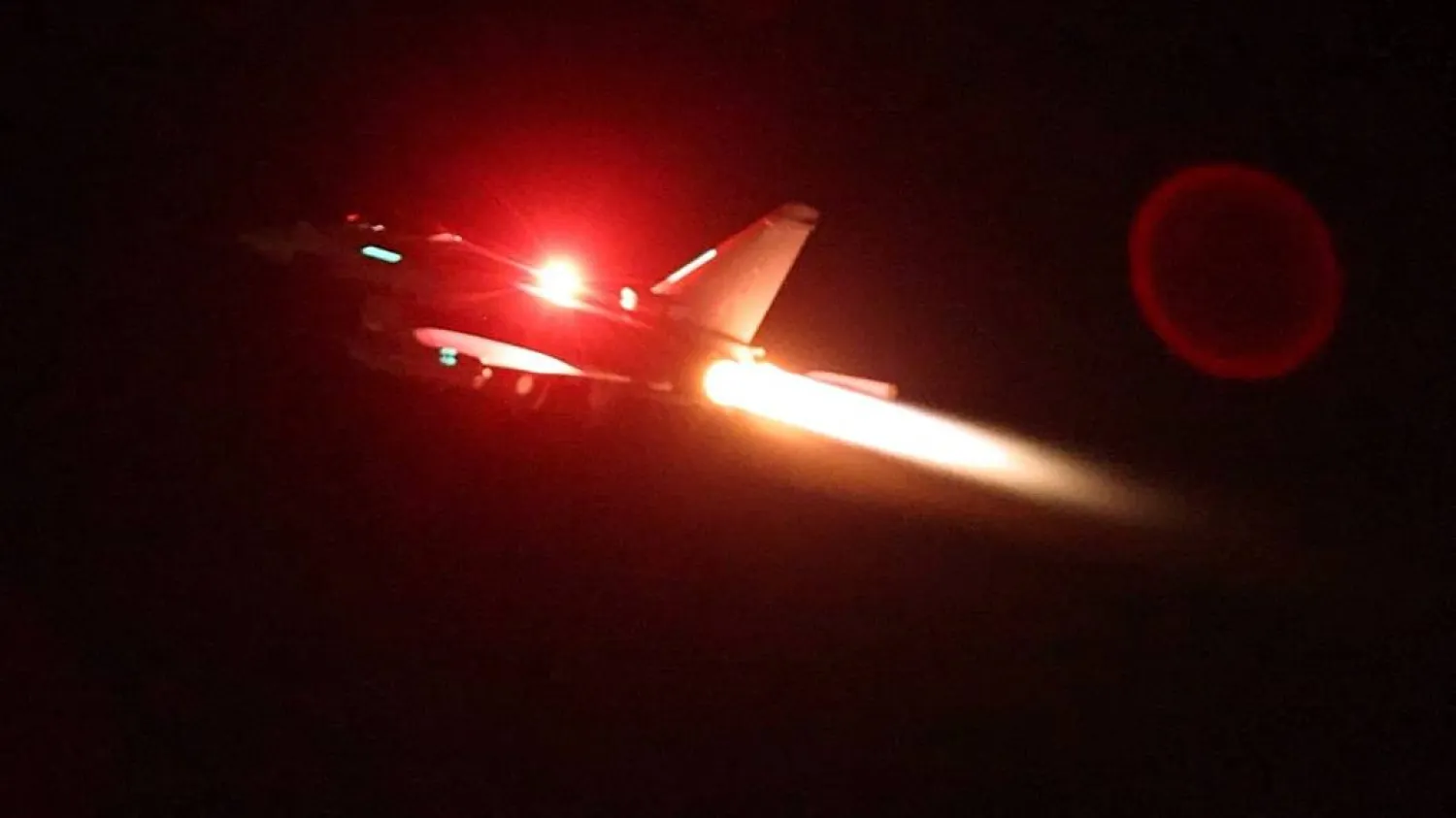
An RAF Typhoon aircraft takes off to join the US-led coalition from RAF Akrotiri to conduct air strikes against military targets in Yemen, aimed at the Iran-backed Houthi militia that has been targeting international shipping in the Red Sea, in Cyprus, in this handout picture released on January 12, 2024. UK MOD/Handout via REUTERS
TT

US, Britain Strike Yemen in Reprisal for Houthi Attacks on Shipping

An RAF Typhoon aircraft takes off to join the US-led coalition from RAF Akrotiri to conduct air strikes against military targets in Yemen, aimed at the Iran-backed Houthi militia that has been targeting international shipping in the Red Sea, in Cyprus, in this handout picture released on January 12, 2024. UK MOD/Handout via REUTERS

US and British warplanes, ships and submarines launched dozens of air strikes across Yemen overnight in retaliation against Houthi militias for months of attacks on Red Sea shipping that the Iran-backed fighters cast as a response to the war in Gaza.

Witnesses confirmed explosions at military bases near airports in the capital Sanaa and Yemen's third city Taiz, a naval base at Yemen's main Red Sea port Hodeidah and military sites in the coastal Hajjah governorate.

"These targeted strikes are a clear message that the United States and our partners will not tolerate attacks on our personnel or allow hostile actors to imperil freedom of navigation," US President Joe Biden said.

The Houthis, who staged a coup against the legitimate government in 2014, said five of their fighters had been killed in a total of 73 air strikes. They vowed to retaliate and continue their attacks on shipping, which they say are intended to support Palestinians against Israel.

"We saw a large fire from where the attack took place. It was half an hour of terror," said Kheloud, a Sanaa resident who awoke to loud explosions from the direction of the airport.

By mid-afternoon, crowds had gathered in central Sanaa and other cities. Drone footage on the Houthis' al-Masirah TV showed hundreds of thousands of people carrying Palestinian and Yemeni flags, chanting slogans denouncing Israel and the United States in a response to a speaker on a giant screen.

"Your strikes on Yemen are terrorism," said Mohammed Ali al-Houthi, member of the Houthi Supreme Political Council.  

The commander of US air operations in the Middle East, Air Force Lieutenant-General Alex Grynkewich, said 60 targets at 16 locations had been hit using more than 100 precision-guided munitions.

A US official said the targets had been chosen to weaken the Houthis' ability to attack: "We were going after very specific capability in very specific locations with precision munitions."

In a poor country only just emerging from nearly a decade of war that brought millions to the brink of famine, people fearing an extended new conflict queued at petrol stations.

"There is a lot of worry that the fuel shortages will repeat themselves and food supplies will be scarce," said Ali Ahmad, 52. "We are rushing to fuel our car and we bought flour and rice in case of any emergency because we are expecting the Houthis to respond and an escalation to take place."

Price of oil jumps

The price of oil rose sharply on concern that supplies could be disrupted, with Brent crude up $2 on Friday.

Commercial ship tracking data showed at least four oil tankers diverting from the Red Sea.

INTERTANKO, an oil tanker industry body, sent a note to members saying the US-led Combined Maritime Forces had advised ships to "stay well away from Bab al-Mandab", the mouth of the Red Sea where 15% of global seaborne trade passes.

"The threat period for shipping is expected to last for several days," said the note, seen by Reuters.

Britain's defense ministry said there were indications that "the Houthis' ability to threaten merchant shipping has taken a blow". Officials said no further action was planned for now.

The strikes follow months of raids by the militias, who have boarded ships they claimed were Israeli or heading for Israel.

The United States and some of its allies deployed a naval task force to the area in December, and recent days saw increasing escalation. US helicopters sank three Houthi boats on New Year's Eve, killing Houthis attempting to board a ship. On Tuesday, the United States and Britain shot down 21 missiles and drones in what they called the biggest attack yet.

Iran, which supports armed groups around the Middle East including both the Houthis and the Hamas militants that control Gaza, condemned the US and British attacks.

Iran-backed armed groups have increased attacks on US targets in several countries since Hamas militants attacked Israel on Oct. 7, killing 1,200 people and precipitating the war in Gaza, which has so far killed more than 23,000.

Fears of escalation

Houthi attacks have forced commercial ships to take a longer, costlier route around Africa, creating fears of a new bout of inflation and supply chain disruption.

Carmaker Tesla said delays to parts shipments from Asia due to Red Sea unrest had forced it to shut its factory in Germany for two weeks, the first big manufacturer to make such an announcement.

Washington has had to weigh its determination to keep the shipping lane open against the risk of spreading unrest in a region on edge over the Gaza war.

Whether the strikes will in fact deter further attacks on shipping will depend on how the Houthis respond, said Tobias Borck, a Middle East security export at Britain's Royal United Services Institute.

The Houthis wanted to portray themselves as champions of the Palestinian cause and foes of the West, but were mainly concerned about retaining power.

The United States accused Iran of providing the Houthis with military capabilities and intelligence to carry out their attacks.

"We believe that they have been certainly involved in every phase of this," a senior US official told reporters.



Mokha after Houthi Takeover: Looting, Poverty, Fear and Displacement

Houthi militia members returning from Mokha to Sanaa escort a convoy believed to be carrying looted goods and detainees (AP) 
TT

Mokha after Houthi Takeover: Looting, Poverty, Fear and Displacement

Houthi militia members returning from Mokha to Sanaa escort a convoy believed to be carrying looted goods and detainees (AP) 

Since the Houthis seized the western Yemeni coastal city of Mokha a week ago, widespread looting has targeted homes, private property, government facilities and humanitarian organizations, while deteriorating basic services and soaring prices have added to pressure on residents, thousands of whom have fled fearing Houthi reprisals.

Local sources reported that Houthis raided dozens of homes and apartments, in Al-Hali neighborhood, seizing furniture, appliances and other belongings and transporting them out of Mokha by truck. Government offices were also subjected to looting directed by senior leaders, with their contents taken to unknown locations.

According to the sources, the Houthi militia entered the city’s airport and initially tried to remove some items before masked gunmen, believed to belong to Houthi intelligence services, arrived, prevented the removal of the looted property and took control of the entire civilian facility, barring other armed men from the site and its surroundings.

Another group of masked men in civilian clothes appeared, based on their look, bags and actions, to be an engineering team tasked with dismantling equipment and packing it into special boxes and bags.

The masked men left several hours later in three small vehicles with tinted windows. When the earlier group returned, the sources recounted, the airport had been stripped of equipment, files and records.

They also described the looting of records, files and computers from Mokha’s local authority headquarters, along with contents from the city’s branch of the Central Bank of Yemen. It was not known where the items were taken.

Houthi leaders also targeted homes belonging to officers in the National Resistance forces, while raids extended to the homes of civilian employees. Residents recounted that Houthi members justified some of the looting by claiming the properties belonged to people linked to forces led by Presidential Leadership Council member Tareq Saleh.

Aid and Services Hit

Relief and charity workers reported that the Houthi militia seized the offices of humanitarian organizations and charities and transported their contents outside the city under the supervision of unidentified individuals believed to belong to Houthi security and intelligence agencies.

The UN Office for the Coordination of Humanitarian Affairs condemned the seizure of a humanitarian compound housing UN agencies and international organizations in Mokha, reporting that Houthi members confiscated eight vehicles belonging to the city’s UN humanitarian center after storming it.

Multiple rights sources estimated that raids on humanitarian organizations and charities affected around 18,000 families that had been receiving food assistance from the United Nations and local organizations, as poor households face worsening living conditions.

Houthi military operations, looting and seizures also halted support for 30 health facilities across six coastal districts: Mokha, Dhubab, Al-Wazi’iyah and Mawza in Taiz, and Hays and Al-Khawkhah in Hodeidah, affecting medicines, medical supplies and staff salaries.

Loss of Security

More than 1,500 humanitarian workers have been left without jobs or sources of income after several organizations suspended or halted operations, amid disrupted services and rising prices.

Mokha residents complained that electricity had been almost completely cut off since the Houthi takeover. The price of a household gas cylinder rose from about $3.50, or 5,400 Yemeni rials, to $11.60, or 18,000 rials, based on the exchange rate in government-held areas of 1,550 rials to the dollar.

The Houthis have begun imposing the exchange rate used in areas under their control, 535 rials to the dollar, while banning banknotes issued by the Central Bank in Aden and replacing them with old, worn banknotes or newly introduced alternative coins approved by the group. Many residents of Mokha and Yemen’s western coast rely on fishing and daily manual work.

Marsadak, the Media Freedoms Observatory affiliated with the Studies and Economic Media Center, announced that 117 journalists, media workers and employees of media organizations were displaced in September. It noted that most had left their homes fearing arrest or abduction, while others reported raids on journalists’ homes and the looting of their contents.

The developments have left Mokha residents facing a crisis extending beyond the loss of property, with displacement and fears of arrest compounded by deteriorating services and the disruption of some humanitarian assistance as the city grapples with the consequences of its sudden transition to Houthi control.


Yemeni Army Thwarts Houthi Attempts to Consolidate Gains in West

Yemeni army forces battle the Houthis in a war of attrition on the Taiz fronts (Military Media) 
TT

Yemeni Army Thwarts Houthi Attempts to Consolidate Gains in West

Yemeni army forces battle the Houthis in a war of attrition on the Taiz fronts (Military Media) 

Yemeni government forces have repelled Houthi attempts to seize strategic high ground east of Bab al-Mandab and west of Taiz, as the group seeks to consolidate its control of the strait, Mayyun Island and the western coast by securing key mountain positions and supply routes.

The Kahboub and Al-Wazi’iyah fronts saw heavy fighting over the past 24 hours, accompanied by airstrikes targeting Houthi gatherings and vehicles. Government military sources said the forces had thwarted attacks and attempted advances, inflicting casualties and equipment losses.

At Kahboub, in the highlands separating Lahj and Taiz and overlooking Bab al-Mandab, the Yemeni army announced it had repelled a Houthi attack lasting more than three hours, breaking the assault three times and forcing the attackers to retreat.

Government forces are also seeking to secure positions in the Kahboub mountain range, including Jabal San Sanfa, and open the Al-Nabiyah route linking coastal areas around Ras al-Ara with the highlands. The positions are particularly important because they overlook roads leading to the coast and areas surrounding the strait.

In Al-Wazi’iyah, west of Taiz, the Houthis sent reinforcements and attempted to advance toward new high ground, while government forces responded with ground attacks and airstrikes.

A military source in the Taiz command said the clashes killed 30 Houthis and wounded more than 60 others, while six combat vehicles and two tanks were destroyed.

Local sources reported that warplanes struck Houthi vehicles and gatherings in the Al-Dharifah area, while armed forces spokesman Col. Majed al-Nazili said government forces targeted Houthi supplies and positions in Mokha and on several Taiz fronts.

Preventing Consolidation

The operations are part of government forces’ efforts to prevent the Houthis from turning their control of Bab al-Mandab, Mayyun Island and the western coast into an entrenched military reality. After seizing those coastal positions, the group needs to secure the surrounding territory, particularly high ground controlling routes between the coast and the interior.

The Kahboub and Al-Wazi’iyah mountains form part of the highland belt separating the coast from inland areas, making control of them important to protecting or threatening coastal positions. The Houthis are therefore seeking to capture additional peaks and elevated positions, while government forces are working to keep the area contested, preventing the group from consolidating its defenses and expanding its control.

Clashes have also intermittently spread to the southern and western outskirts of Taiz, particularly around Jabal Jardad toward Al-Shamayatayn district via the Rasn axis, as well as Al-Rahidah, Al-Dimnah and Mafraq Al-Dhikrah, accompanied by airstrikes on Houthi positions.

Civilian Toll

In Al-Wazi’iyah, Houthi shelling of Al-Turairah village in the Al-Dharifah subdistrict killed three children Friday, according to official sources. They were Nour al-Din Yaqoub Abdo al-Dharafi, 4; Asawer Fahd Mohammed Ghanem al-Dharafi, 14; and Tala Mohammed Ahmed al-Dharafi, 2.

In Marib, cautious fighting continued on the western and southern fronts, with government forces using artillery, snipers, drones and warplanes to target Houthi positions and movements.

Brig. Gen. Akram al-Adimi, commander of the 13th Infantry Brigade, said his forces had neutralized dozens of Houthi fighters and seized weapons and equipment.

On the political front, Presidential Leadership Council Chairman Rashad al-Alimi, during a meeting with French Ambassador to Yemen Catherine Corm-Kammoun, affirmed that government forces were capable of regaining the initiative on the western coast, pointing to continuing operations in Taiz, Marib, Lahj, Al-Jawf, Hajjah, Al-Bayda and Al-Dhalea.

Al-Alimi said the repositioning of forces and strengthening of their capabilities were aimed at preventing any temporary battlefield gain from becoming a fait accompli or a platform for threatening waterways, stressing that the state was working to secure its territory, coastline and territorial waters.


Sudanese Army Repels Blue Nile Attack, Advances in Kordofan

Sudanese army troops take part in a military parade in Gedaref (AFP) 
TT

Sudanese Army Repels Blue Nile Attack, Advances in Kordofan

Sudanese army troops take part in a military parade in Gedaref (AFP) 

Fighting between the Sudanese army and the paramilitary Rapid Support Forces (RSF) has spread from the Kordofan fronts to the Blue Nile region, where local authorities reported repelling an attack on Al-Kaili in Kurmuk locality, while the army announced it had retaken 11 areas in North Kordofan after battles with the RSF.

Authorities in Kurmuk reported that army forces prevented the RSF from entering Al-Kaili, adding that the attacking force had crossed from Ethiopian territory.

The army, for its part, said a preemptive attack south of the area killed a number of RSF fighters and destroyed nine combat vehicles.

The route taken by the attacking force and the casualties reported by the army could not be independently verified.

In North Kordofan, the army announced Thursday that it had retaken 11 areas west of El Obeid, including Kajmar, Sharshar, Al-Qulay’at and Awlad Hazmah, as well as the area surrounding Al-Mazrub.

Sudan’s official news agency SUNA reported the army’s announcement that it had “liberated several areas” in the state.

According to the military, its forces fought battles with the RSF and carried out sweeping operations in areas into which they had advanced. There was no independent confirmation, however, that the army controlled all the locations it listed.

The developments come amid escalating fighting on several fronts across Kordofan.

According to military sources, army forces and their allies had advanced around the city of Bara and moved toward Sodari in the northwestern part of North Kordofan, while other sources reported the recapture of Al-Farshaya in South Kordofan and Al-Mamsouka in West Kordofan.

Pro-army platforms reported fighting west of Bara and indicated that army forces had entered villages where RSF fighters had been stationed.

At the same time, reports emerged that eight people had been killed and others wounded in an attack in North Kordofan attributed to the RSF, although sufficient independent details about the circumstances were not available.

Sodari is militarily significant because of its location along routes linking North Kordofan with Darfur, making control of surrounding roads important for the movement of troops and supplies westward.

Fighting in recent months has altered the map of territorial control around Bara and along the Export Road linking Khartoum and El Obeid.

In South Kordofan, military operations have focused on routes linking Kadugli, Dilling and El Obeid.

Field sources indicated that the recapture of Al-Farshaya, if confirmed, could improve army movements along the Dilling axis. They also reported movements toward Al-Dibaybat, along roads leading to West Kordofan.

The army has expanded its area of control in North Kordofan in recent months following heavy fighting in which it regained control of Bara, Umm Sayala, Jabra al-Sheikh, Jireikh, Umm Qirfa and other areas, allowing it to reopen the Export Road linking Khartoum and El Obeid.