


How Does AI Infiltrate the World of Beauty?

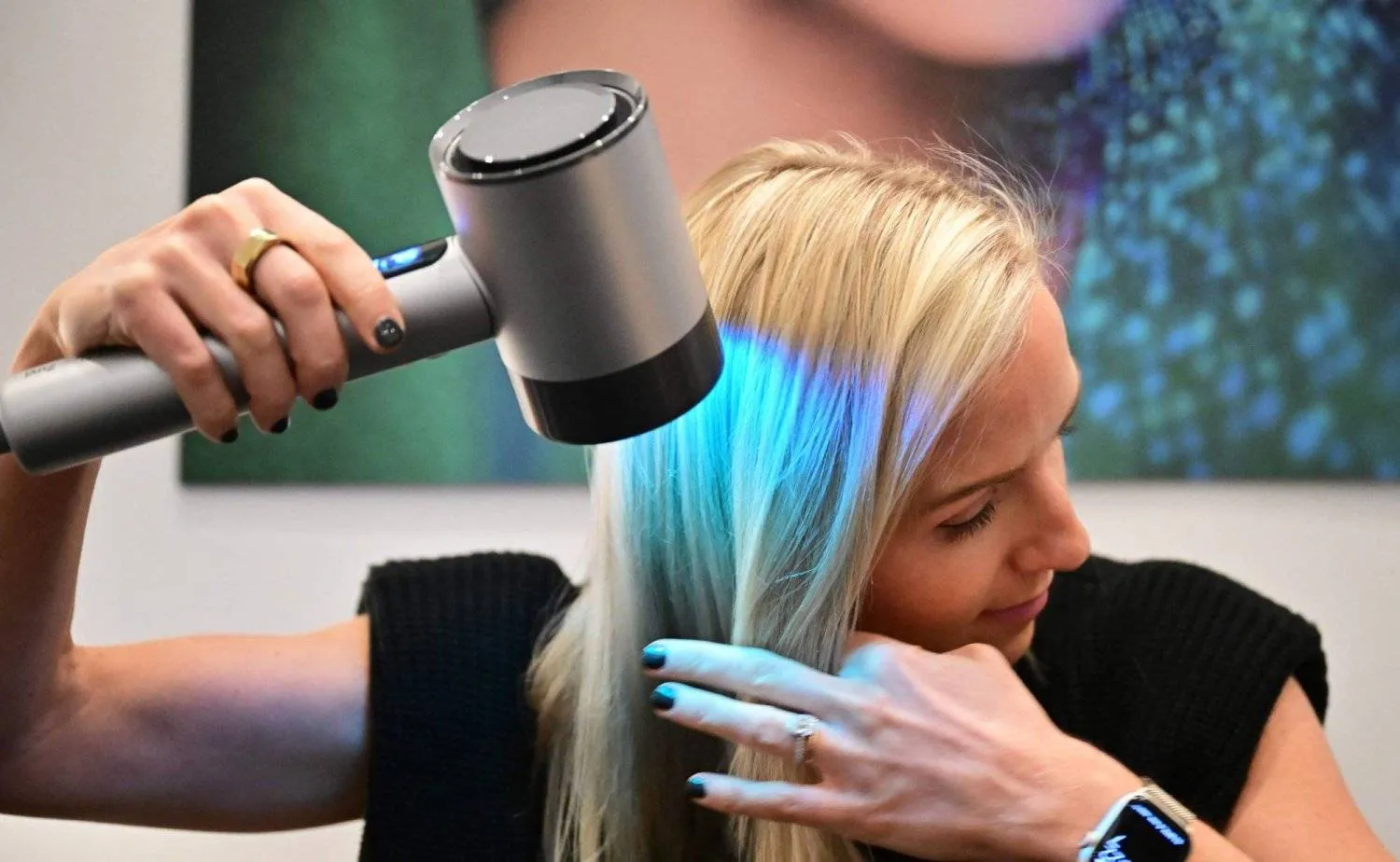
A woman demonstrates usage of Airlight Pro hairdryer, which uses patented infrared light technology, on January 7, 2024 at the 2024 Consumer Electronics Show (CES) in Las Vegas, Nevada. (Photo by Frederic J. BROWN / AFP)
TT

How Does AI Infiltrate the World of Beauty?

A woman demonstrates usage of Airlight Pro hairdryer, which uses patented infrared light technology, on January 7, 2024 at the 2024 Consumer Electronics Show (CES) in Las Vegas, Nevada. (Photo by Frederic J. BROWN / AFP)

The beauty sector is harnessing tech innovations to make its services accessible to everyone, not only to wealthy consumers. For instance, artificial intelligence is now offering a perfect nail polish at home and providing personal skincare recommendations, according to AFP.

The Nimble manicure salon calls itself the world's first device to combine AI and complex robotics. Nimble can varnish all ten fingernails and dry them in just 25 minutes and its available anytime, without the hassle of making an appointment.

The device, an eight-kilo white box with a special door for the hand, is on display this week at the Las Vegas Consumer Electronics Show (CES), the tech industry's annual hub.

According to its creators, the device uses high-resolution micro-cameras and 3D imaging to determine nail shape, size and curvature. Then a small robotic arm, guided by AI algorithms, applies the requisite three coats, with a blow dry after each applied layer.

When it goes on sale in March, more than thirty colors will be available in capsules costing $10 each. The unit costs $599.

AI, a key factor in the consumer tech innovations, has infiltrated the makeup and skincare sectors as well.

“Beauty is essential since the upright man,” L'Oreal CEO Nicolas Hieronimus noted during the Consumer Electronics Show (CES), which kicked off on Tuesday.

Hieronimus said that technology helps L'Oreal “build a stronger connection” with its customers. And when it comes to beauty, technology “provides wholesome experiences” and enables people “to express their identities,” he added.

“Beauty helps boost self-confidence and appreciation,” Hieronimus noted.

Before over 2,000 attendees and the livestreaming viewers, Hieronimus presented a demo of ‘Beauty Genius’, a free app that serves as an AI-based ‘virtual personal advisor’.

Hieronimus described the app as “the first beauty advisor” that recommends skincare and makeup products that suit the user’s skin. It also gives tips, answers questions about various problems such as acne and hair loss, and allows its user to test the recommended products virtually.

Virtual experiences

The app also guides customers who are overwhelmed by a physical shop's rows of foundations with similar shades and varied textures, or creams with seemingly endless specificities.

This is also the aim of the program Beautiful AI, created by Perfect Corp, which combines generative AI and virtual reality to perform live skin analyses, 3D hairstyle or jewelry trials and make recommendations.

In a study published in May, consulting firm McKinsey put the global beauty industry -- which includes skin- and hair care, perfume and make-up -- at $430 billion in 2022 and forecast it to reach $580 billion by 2027. The industry's internet sales almost quadrupled between 2015 and 2022.

Korea's Prinker, a specialist in ephemeral, customizable tattoos for skin and hair, is unveiling a similar product that will apply makeup this year.

The device will also put AI to work with a biometric 3D scanner to map facial features and then recommend the right contours, "printing" the corresponding powders to the face.

Companies are also bringing beauty personalization tech to hair care.

This week, L'Oréal presents the world premiere of a connected hairdryer that can be customized via an app, taking hair type into account and automatically adapting power and heat distribution.

The Airlight Pro uses infrared light to dry the hair, allowing it to preserve the hair's moisture. It also offers energy savings of 31 percent compared with a conventional appliance, explained Adrien Chretien, head of augmented beauty development at L'Oreal. The Airlight Pro is due to go on sale in April.

Another product scheduled for launch later this year is Colorsonic, a hair coloring device that uses cartridges that last for three months.



AlUla Manara Team Hosts Lyrid Meteor Shower Observation

The event utilized AlUla’s exceptionally clear skies and low light pollution - SPA
TT

AlUla Manara Team Hosts Lyrid Meteor Shower Observation

The event utilized AlUla’s exceptionally clear skies and low light pollution - SPA

AlUla Manara team hosted an educational astronomy evening yesterday near the iconic Arch Rock, aimed at promoting astrotourism and scientific awareness. The event utilized AlUla’s exceptionally clear skies and low light pollution to provide residents and visitors with an immersive celestial experience, SPA reported.

The evening featured the Lyrid meteor shower, an annual phenomenon caused by debris from Comet Thatcher entering Earth's atmosphere. Under expert guidance, attendees observed the shower and used advanced telescopes to explore the cosmos.

The program included interactive scientific discussions on the historical role of astronomy in navigation and timekeeping, as well as its contributions to modern science.

This initiative is part of AlUla’s strategic effort to become a premier global destination for astrotourism. By blending education with entertainment, AlUla Manara continues to showcase the governorate’s unique natural landscape and foster a deeper connection between the community and the universe.


Norway Plans to Ban Social Media Use by Children Under 16

FILE PHOTO: Instagram, TikTok, Snapchat, YouTube, Facebook, Twitch and Reddit applications are displayed on a mobile phone ahead of new law banning social media for users under 16 in Australia, in this picture illustration taken on December 9, 2025. REUTERS/Hollie Adams/Illustration/File Photo
TT

Norway Plans to Ban Social Media Use by Children Under 16

FILE PHOTO: Instagram, TikTok, Snapchat, YouTube, Facebook, Twitch and Reddit applications are displayed on a mobile phone ahead of new law banning social media for users under 16 in Australia, in this picture illustration taken on December 9, 2025. REUTERS/Hollie Adams/Illustration/File Photo

Norway said on Friday it would present a bill in parliament by year-end to ban children from using social media until they turn 16, making technology companies responsible for the task of age verification.

Several European nations seeking to rein in children's ⁠use of social media ⁠after Australia took the lead with a world-first ban on under-16s last December.

"We are introducing this legislation because we want a childhood where ⁠children get to be children," Reuters quoted Prime Minister Jonas Gahr Stoere as saying in a statement.

"Play, friendships, and everyday life must not be taken over by algorithms and screens. This is an important measure to safeguard children's digital lives."

The government did not say ⁠which ⁠applications would be targeted.

Australia's ban covers Meta apps such as Instagram and Facebook as well as TikTok, Snapchat, Google's YouTube and Elon Musk's X, formerly Twitter.

Norway will introduce its bill in parliament by the end of 2026, the minority Labour government said.


'Cretaceous Kraken' Prowled the Seas During the Age of Dinosaurs

An artist's reconstruction of a finned octopus of the species Nanaimoteuthis haggarti that reached a length estimated at up to 18.6 meters (61.02 feet) and lived about 86 to 72 million years ago during the Cretaceous Period, released on April 23, 2026. Yohei Utsuki/Department of Earth and Planetary Sciences, Hokkaido University/Handout via REUTERS
TT

'Cretaceous Kraken' Prowled the Seas During the Age of Dinosaurs

An artist's reconstruction of a finned octopus of the species Nanaimoteuthis haggarti that reached a length estimated at up to 18.6 meters (61.02 feet) and lived about 86 to 72 million years ago during the Cretaceous Period, released on April 23, 2026. Yohei Utsuki/Department of Earth and Planetary Sciences, Hokkaido University/Handout via REUTERS

The Kraken is a huge tentacled sea monster from Norse folklore that drags ships and sailors down into the deep. During the age of dinosaurs, new research shows, there existed a creature as close to a real-life Kraken as you could possibly get - an enormous octopus that prowled the seas as an apex predator.

Scientists said fossils of beaks - the soft-bodied invertebrate's hard jaw structure - indicate that an octopus species named Nanaimoteuthis haggarti that lived about 86 to 72 million years ago during the Cretaceous Period ranged from 22 to 61 feet (6.6 to 18.6 meters) long.

"These animals were remarkable. With their large bodies, long arms, powerful jaws and advanced behavior, they represent what could be described as a real 'Cretaceous Kraken,'" said paleontologist Yasuhiro Iba of Hokkaido University in Japan, lead author of the research published on Thursday in the journal Science.

"For roughly the past 370 million years, marine ecosystems have been thought to be dominated by large vertebrate predators - first fishes and ⁠sharks, then marine ⁠reptiles and later whales. Our study shows that giant invertebrates, namely octopuses, also functioned as apex predators in the Cretaceous sea," Reuters quoted Iba as saying.

Iba said Nanaimoteuthis haggarti is one of the largest invertebrates on record.

"Until now, the largest-known invertebrate has been the modern giant squid, which can reach about 12 meters (39 feet) in total length," Iba said.

The intense wear observed on the beaks is consistent, the researchers said, with repeated crushing of hard structures such as bones and shells, indicative of a predator that hunted large fish, shelled tentacled creatures, clams and other sizable prey.

"In the largest specimens, about 10% of the ⁠total jaw length appears to have been lost due to wear. This is more severe than what is typically seen in modern octopuses and cuttlefishes that feed on hard prey," Iba said.

The beaks were shaped like those of certain deep-sea octopuses alive today that swim with the help of fins, leading the researchers to conclude that these Cretaceous octopuses also bore fins.

The numerous beak fossils studied in the research came from Japan and Canada's Vancouver Island. The researchers reexamined previously known specimens and discovered new fossils as well.

The researchers also studied the beaks of a close relative called Nanaimoteuthis jeletzkyi that lived about 100 to 72 million years ago. It was not quite as big, ranging from 9 to 25 feet (2.8 to 7.7 meters) long, but also was an active predator.

Because octopuses are soft-bodied animals, they seldom fossilize well. The beak, the only rigid part of the octopus body, is made of a hard and durable material ⁠called chitin, also found in ⁠the exoskeletons of crabs, lobsters and insects.

Guided by modern-day octopus anatomy, the researchers were able to estimate the size of the Cretaceous octopuses based on the dimensions of the beaks.

"Octopuses are not simply biting predators. They use long, flexible arms to capture prey and powerful jaws to process it. As body size increases, their ability to control large prey with their arms and to process it with their jaws also increases," Iba said.

"In addition, octopuses are among the most intelligent invertebrates. In our fossils, the jaws show asymmetric wear, suggesting lateralized behavior - favoring one side over the other, something like handedness. This indicates not only strength, but also advanced and flexible behavior," Iba said.

These octopuses shared the Cretaceous seas with other large predators including marine reptiles called mosasaurs and plesiosaurs that reached up to around 50 feet (15 meters) long as well as sharks rivaling today's great white in size.

"These giant octopuses likely occupied the same ecological tier and may have competed with marine reptiles and sharks within the same ecosystem," Iba said. "Their existence changes how we view ancient oceans. Instead of ecosystems dominated solely by vertebrate predators, we now see that giant invertebrates such as octopuses also occupied the very top of the food web."