Vietnam’s Incense Village Turns into Instagram Hotspot 

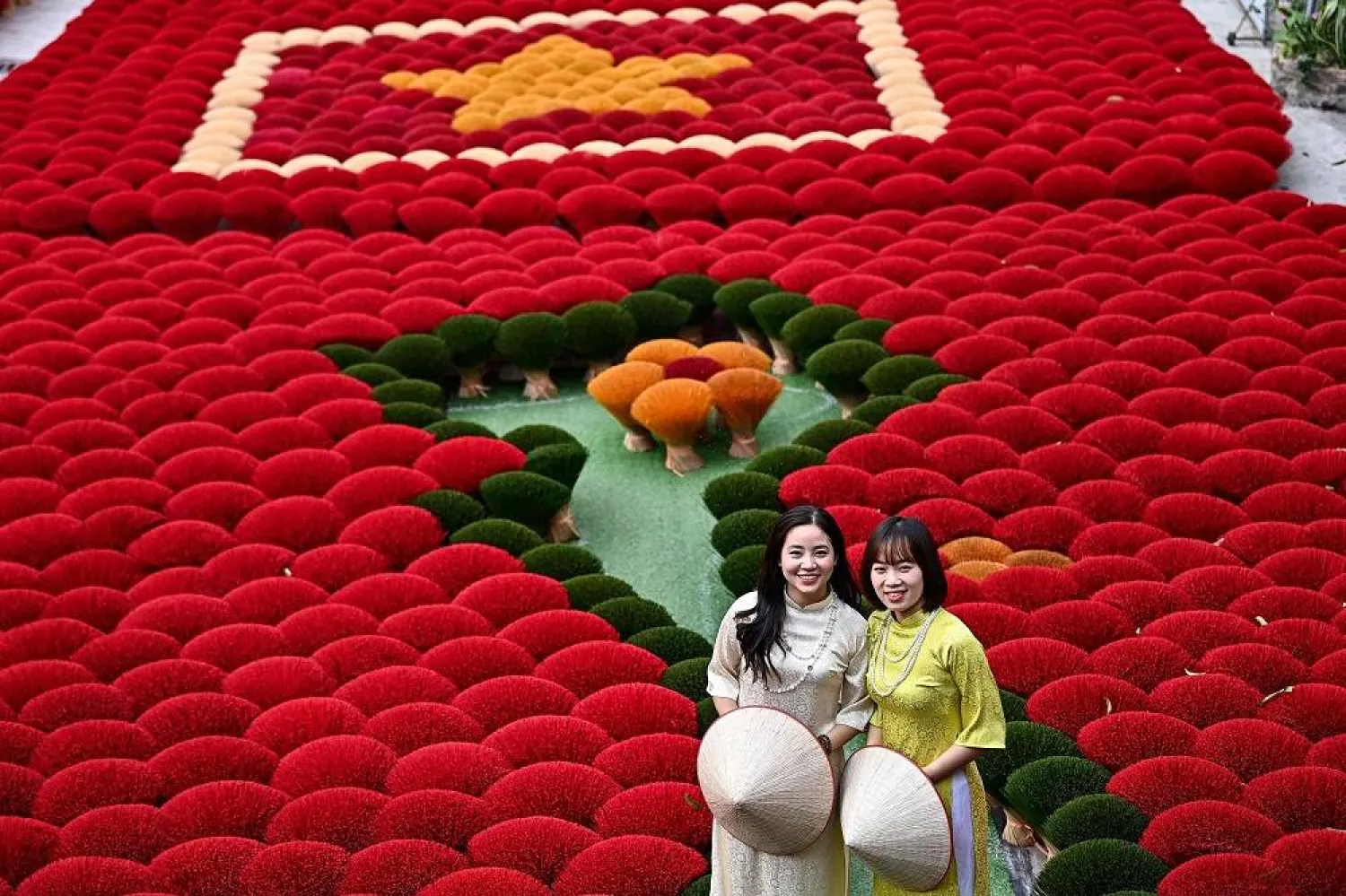
In this photo taken on January 20, 2024 tourists pose in front of incense sticks arranged in the form of a Vietnamese map and flag in a courtyard in the village of Quang Phu Cau on the outskirts of Hanoi. (AFP)
TT

Vietnam’s Incense Village Turns into Instagram Hotspot 

In this photo taken on January 20, 2024 tourists pose in front of incense sticks arranged in the form of a Vietnamese map and flag in a courtyard in the village of Quang Phu Cau on the outskirts of Hanoi. (AFP)

In a tiny village in northern Vietnam, Dang Thi Hoa ties up a bundle of freshly dried incense sticks ahead of Lunar New Year and watches a line of tourists waiting to pose for pictures.

Three generations of Dang Thi Hoa's family have been dyeing incense sticks scarlet red, or magenta pink, ahead of the new year celebrations -- known as Tet in Vietnam.

But Hoa, and many other families living and working in the "incense village" of Quang Phu Cau, now also make sticks in yellow, blue and green, catering to visitors eager to snap shots for Instagram.

In front of one village temple, hundreds of bundles of multi-colored sticks were laid to dry in the sun -- arranged in the form of a giant Vietnamese map.

"Our village has become a hotspot for tourists," said Hoa, 45, who has been crafting incense sticks for three decades.

The villagers make a healthy sum from the selfie snappers.

For 50,000 VND ($2), tourists can spend as long as they like taking pictures with a workshop's sticks -- which themselves cost just 50 cents for a pack of 20.

At a nearby home, a metal stairway has been erected to allow shots from above.

Nguyen Huu Long told AFP that he was extremely busy, with orders pouring in ahead of Tet, when worshippers gather at temples to light incense or burn sticks on ancestral altars at home.

But even at his workshop's peak busy season, he ensures someone is available to chaperone the visitors.

"I assign one or two people to help visitors find the best angle for photos -- and to make sure they don't mess up the drying of the sticks," Long, 58, told AFP.

The tourists seem appreciative.

"The place is very nice, very colorful, and it's really an Instagram-worthy place," said Catherine Caro from the Philippines.

Quang Phu Cau, on the outskirts of Hanoi, is among several villages across Vietnam involved in the ancient incense stick trade, with many families living down its small alleys involved in the dying, drying or whittling down of the bamboo bark.

The full work sequence includes hacking down bamboo branches to feed into a whittling machine, dipping the thin strips into buckets of colorful dye, before leaving the sticks fanned out on the street like bouquets to air dry.

"I am proud of our family's traditional craft... and also feel happy as our village has become more well known," said Hoa.

"I am also earning more," she said, happily.


Scientists Unravel the History of Cotton Domestication

FILE PHOTO: Cotton is ready to be harvested as it covers a field in Minturn, South Carolina November 24, 2012. REUTERS/Randall Hill/File Photo
TT

Scientists Unravel the History of Cotton Domestication

FILE PHOTO: Cotton is ready to be harvested as it covers a field in Minturn, South Carolina November 24, 2012. REUTERS/Randall Hill/File Photo

Cotton, the world's most profitable nonfood crop, is used more than any other natural fiber. Known for its comfort and durability, it has been utilized since antiquity in fabrics and other goods. Four species are grown commercially, but one is dominant, accounting for about 90% of global production.

Scientists have now unraveled the domestication history of this important species - called Gossypium hirsutum, or upland cotton - with some genomic sleuthing.

They determined that it was first domesticated in Mexico in the northwestern part of the Yucatan peninsula. The region at the time was populated by Stone Age farmers, long before the Maya civilization flourished there.

Iowa State University botanist and evolutionary biologist Jonathan Wendel said this domestication occurred at least 4,000 years ago, and perhaps up to 7,000 years ago.

The researchers pinpointed where domestication occurred by comparing the genomes of the domesticated species to wild cotton species found in the Yucatan, Florida and the Caribbean islands of Puerto Rico and Guadeloupe.

The domesticated species most closely matched wild Yucatan cotton, Reuters reported.

"Wild cotton plants are woody, multibranched shrubs or small trees, long-lived, with relatively sparse flowering ⁠and smaller flowers, fruits ⁠and seeds than under cultivation," said Wendel, co-senior author of the study published on Monday in the journal Proceedings of the National Academy of Sciences.

"Members of some human groups must have taken an interest in the wild forms," Wendel said, setting in motion the process of domestication from which the modern crop form arose over thousands of years of slow and gradual improvement.

"Early farmers saw potential in this sprawling plant with hairy seeds as a source for soft materials. Early weavers could spin fiber by hand and use it for weaving cloth, fish nets, ropes and other goods," Iowa State University geneticist and evolutionary biologist and study co-senior author Corrinne Grover said.

Upland cotton ⁠was introduced to the rest of the world following the Spanish conquests in the Americas in the 16th century. China, India, the United States and Brazil are now the world's leading cotton producers.

"Research is showing that the process of domestication, of transforming these short, coarse and brownish fibers into the fine, white and superior textile we know today likely involves many genes operating in a complex symphony," Grover said.

"The fibers themselves are just single-celled seed hairs, but are among the most exaggerated and remarkable cells in plants," Wendel said.

The study found that the domesticated cotton plant possesses far less genetic diversity - the variety of genetic characteristics within a species - than its wild counterparts. Less genetic diversity can lower the ability of a species to adapt to environmental changes such as exposure to diseases.

"We know that domestication often leads to a loss of genetic diversity as early farmers were selecting for valuable traits, and then to further reductions as crop improvement intensified the selection pressure," Grover said.

"Here, we can see what this means globally ⁠for the cotton genome, and how ⁠it compares to what still remains in the wild. This wild diversity is important because traits that were inadvertently lost - certain pest resistance, for example - may be valuable in incorporating into our modern cultivars," Grover said.

Another cotton species - Gossypium barbadense, or extra-long staple cotton - was domesticated in the Americas, in Peru or Ecuador, at roughly the same time as upland cotton, and now constitutes approximately 5% of world cotton production. Two other domesticated species - Gossypium arboreum from the Indian subcontinent and Gossypium herbaceum from sub-Saharan Africa and the Arabian Peninsula - make up the rest.

Cotton far exceeds other fiber crops such as flax, jute and hemp in production.

"The demand for cotton, while varying year to year, remains high and appears to be on a general upward trend," Grover said.

The invention of the cotton gin, a machine that automated the separation of seeds from cotton fibers, in the United States at the end of the 18th century dramatically increased processing speeds and made cotton farming highly profitable. This drove an expansion of slavery in the US South amid increased demand for labor to plant, pick and harvest the valuable crop.

"Cotton has a complicated history, most notably its association with slavery, exploitation of Indigenous peoples and imperial expansion. But it is also an enduring crop, one that is woven into the lives of people worldwide," Grover said.


African Ants at the Center of International Smuggling … Queen Sold for Over $1,000

Ants become the center of an international smuggling trade (AFP) 
TT

African Ants at the Center of International Smuggling … Queen Sold for Over $1,000

Ants become the center of an international smuggling trade (AFP) 

Kenyan ant expert Dino Martins gushes over the red and black insects that have become the center of an international smuggling trade.

Martins has been visiting the network of nests of these Giant African Harvester Ants outside Nairobi for 40 years.

“They're big and bold... They're the tigers of the ant world,” the entomologist told AFP.

“Each nest here has just one queen and she is the mother who founded this nest 40, 50 or even 60 years ago,” he said.

Martins was shocked when he learned that thousands of queens from this Messor cephalotes species were being harvested and shipped abroad in syringes and test tubes to be sold for hundreds of dollars each.

The trade came to light in Kenya last year when two Belgian teenagers were arrested in possession of nearly 5,000 queen ants, and accused of “biopiracy.”

Kenyan authorities fear a new form of poaching, focused less on ivory and furs, and more on insects, reptiles and rare plants.

The judge even compared it to the slave trade.

“Imagine being violently removed from your home and packed into a container with many others like you... It almost sounds as if the reference above is to the slave trade,” he said in his ruling.

The Belgians were handed a fine of around $8,000, but as more cases have emerged, sentences have hardened: last month a Chinese national was sentenced to one year in prison for attempting to traffic 2,000 ants.

On several European websites, the queens go for around 200 euros ($230).

Colonies can take 20-30 years to produce new queens. They provide all manner of services to the ecosystem: dispersing grass seeds, aerating the soil, and providing food for animals like pangolins.

Martins also considers the smuggling trade unethical simply because “ants have feelings.”

The trade “exploded” with the arrival of the internet, said Jerome Gippet, a researcher at the Swiss University of Fribourg.

Formerly the interest of a few passionate individuals, it eventually gave way to sophisticated networks of collectors, intermediaries and smugglers.

A study Gippet published in 2017 found more than 500 ant species -- a third of the total -- were sold online. More than 10% were potentially invasive with uncertain impacts on foreign ecosystems.

“I'm not advocating for a ban on the ant trade. It's very useful in educational terms, in terms of reconnecting with nature, or simply providing enjoyment... But it has to be done responsibly,” he said.


Jackson Pollock Work Sells for $181 Mn

American painter Jackson Pollock at his studio in East Hampton, N.Y., in 1953. (Archive via Getty Images)
TT

Jackson Pollock Work Sells for $181 Mn

American painter Jackson Pollock at his studio in East Hampton, N.Y., in 1953. (Archive via Getty Images)

A Jackson Pollock painting sold for a record $181.2 million on Monday at Christie's in New York, leading a blockbuster day at the auction house.

With its black drips of paint accented by touches of red on a huge canvas spanning over three meters (nine feet), Pollock's "Number 7A, 1948" sold for $181.2 million, including fees.

According to ARTnews, the sale makes it the fourth most expensive work ever sold at auction.

The previous auction record for the abstract expressionist painter was $61.2 million, set in 2021. Other works by him have been sold privately for up to $200 million.

"It is with this work that Pollock finally frees himself from the shackles of conventional easel painting and produces one of the first truly abstract paintings in the history of art," Christie's said in a statement.

"Danaide," a bronze head sculpted around 1913 by Romanian-born artist Constantin Brancusi, sold for $107.6 million, topping its previous record of $71.2 million set in 2018.

"No. 15 (Two Greens and Red Stripe)" by American painter Mark Rothko sold for $98.4 million, while Catalan artist Joan Miro's "Portrait of Madame K." was bought for $53.5 million.

The sales smashed previous records for Rothko ($86.9 million) and Miro ($37 million) set in 2012.

Monday's eye-watering auction follows a string of records set at Sotheby's in November last year.

Austrian master Gustav Klimt's "Portrait of Elisabeth Lederer", which he painted between 1914 and 1916, sold for $236.4 million, becoming the second most expensive work ever sold at auction.

"The Dream (The Bed)" (1940), a self-portrait by Mexican artist Frida Kahlo, sold for $54.7 million, setting a record for the price of a painting by a woman.

The most expensive painting ever sold at auction remains the "Salvator Mundi," (Savior of the World), a Renaissance work attributed to Leonardo da Vinci, which was bought for $450 million in 2017.