Fighting Focuses on Gaza's Khan Yunis after Deadly Shelling Hits UN Shelter

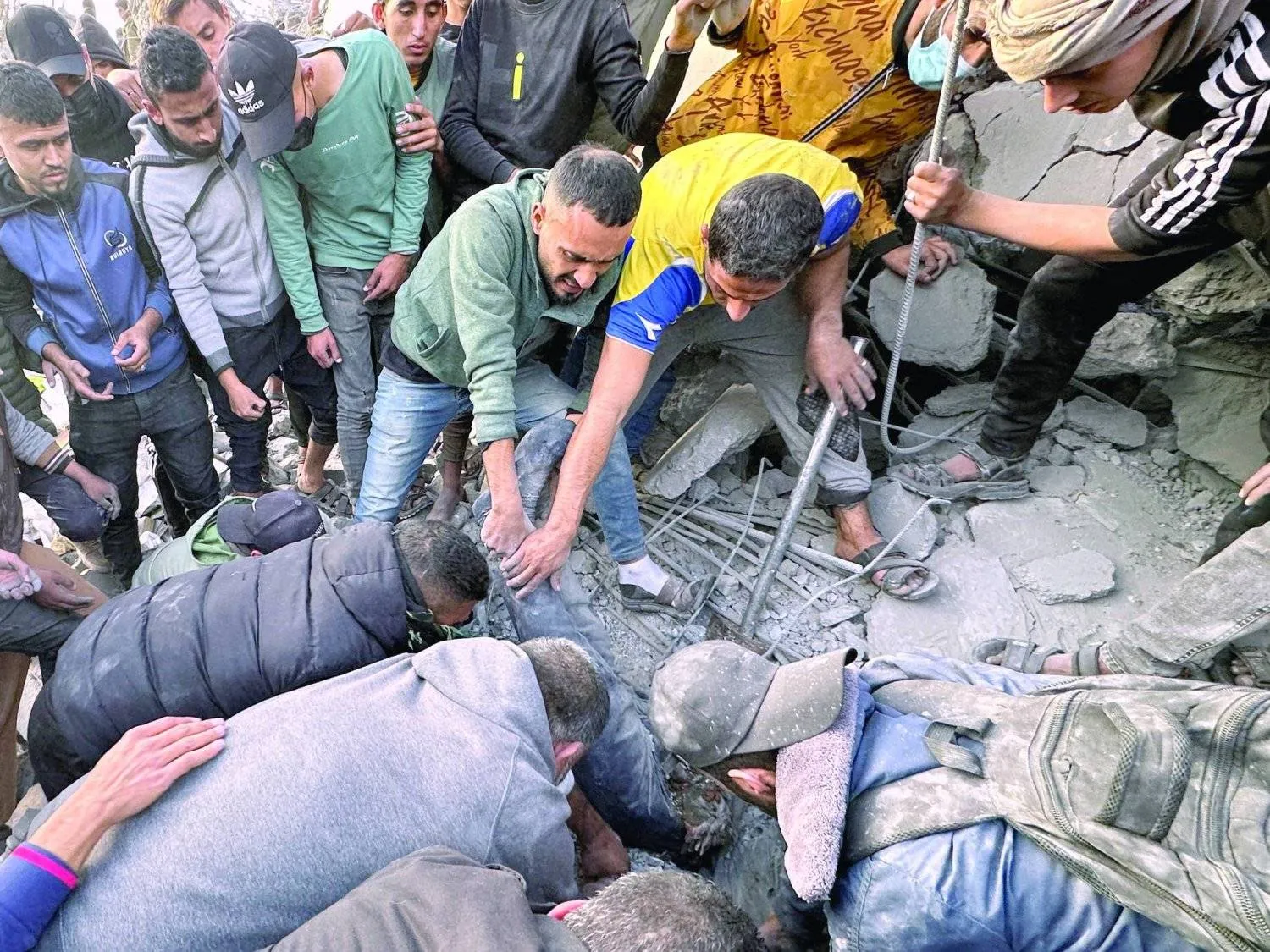
Palestinians inspect the damage after a strike on a mosque, which had been reduced to rubble - Reuters
TT

Fighting Focuses on Gaza's Khan Yunis after Deadly Shelling Hits UN Shelter

Palestinians inspect the damage after a strike on a mosque, which had been reduced to rubble - Reuters

Israeli air strikes and ground operations were focused Thursday on the Gazan city of Khan Yunis, where the UN said nine people were killed by tank shelling at one of its shelters the day before.

The deadly incident came after the Israeli army said it had encircled the city, where footage released by the military showed soldiers engaged in urban combat amid ruined buildings.

Hamas's press office also reported fierce clashes in the center and west of Khan Yunis, while its health ministry counted multiple deaths overnight from strikes in the city and elsewhere in the territory.

It said four children were killed in the Nuseirat camp in an early morning bombardment on Thursday.

Wednesday's attack on the UN shelter for displaced people saw the site hit by two tank rounds, killing nine and injuring 75, said Thomas White, the Gaza head of the UN agency for Palestinian refugees, UNRWA.

UNRWA chief Philippe Lazzarini said the number of dead was likely to rise.

"Once again a blatant disregard of basic rules of war," Lazzarini said on the social media platform X, adding that the compound had been clearly marked as a UN facility and its coordinates had been shared with Israeli authorities.

James McGoldrick, interim UN humanitarian coordinator for the Palestinian territories, told reporters that "buildings were ablaze" at the shelter in the aftermath of the strike, AFP reported.

"Many people are trying to flee the scene but unable to do so," he said.

The United States condemned the attack, with State Department spokesman Vedant Patel saying "civilians must be protected and the protected nature of UN facilities must be respected".

The Gaza war began with Hamas's unprecedented October 7 attack. In response, Israel has carried out a relentless military offensive that has killed at least 25,700 people in Gaza, about 70 percent of them women and children, according to the health ministry in the Hamas-run territory.

In the southern border town of Rafah on Wednesday, Palestinians inspected the damage after a strike on a mosque, which had been reduced to rubble.

"We headed to Rafah based on (Israeli) instructions that it is a safe zone, only to discover that it is just like other areas," Mohammed Barbakh, who had been displaced from Khan Yunis, told AFP.

The government of Prime Minister Benjamin Netanyahu has faced mounting calls for a ceasefire, with domestic pressure intensifying after 24 soldiers were killed Monday in the army's deadliest single day since it launched ground operations in Gaza.

Citing Israeli officials, the New York Times said 21 of those soldiers were killed in an operation to demolish part of a Palestinian neighbourhood in order to create a "buffer zone" inside Gaza along the Israeli border.

In Tel Aviv, Israeli protesters carried a banner saying "Stop the bloodshed" and blocked a road during a demonstration to demand a deal for the release of the hostages held by Hamas.

"We came to say to the government, 'It's enough.' We want all the hostages back home, we want a ceasefire now," said protester Sapir Sluzker Amran.

"There is no military solution, only a diplomatic solution -- only agreements will bring the hostages back."

Netanyahu, however, has been adamant the war will continue, telling parliament on Wednesday that the fighting would persist until the "aggression and evil" of Hamas were destroyed.

"This is a war for our home," he said.


Israel Strikes East Lebanon, Says Targeting Hezbollah Arms

Smoke rises from the site of an Israeli strike that targeted the southern Lebanese village of Kfar Tebnit on May 21, 2026. (AFP)
TT

Israel Strikes East Lebanon, Says Targeting Hezbollah Arms

Smoke rises from the site of an Israeli strike that targeted the southern Lebanese village of Kfar Tebnit on May 21, 2026. (AFP)

Israel struck a mountainous area in eastern Lebanon on Monday, according to Lebanese state media, with the Israeli military saying it was targeting a shipment of weapons headed for Hezbollah.

"Enemy aircraft launched a strike at dawn against the Al-Shaara region, in the highlands of the Anti-Lebanon mountain range, without resulting in victims or damage," Lebanon's official National News Agency (NNA) said.

The Israeli military said it "struck a weapons shipment transferred from Syria to Lebanon, intended for the Hezbollah terrorist organization".

Hezbollah, which is backed by Iran, emerged badly weakened from two successive wars with Israel since 2023.

The ousting in 2024 of Syrian president Bashar al-Assad, a key ally of the group, cut off a major weapons route.

Hezbollah lawmakers have nonetheless maintained that the group is rebuilding its military capacities, as fighting with Israel has wound down since June.

In October, Lebanese security forces seized a half-ton of explosives transported in a truck from east Lebanon towards Beirut.

Hezbollah acknowledged ownership of the explosives, saying they were intended for "resistance" against Israel.

Lebanese authorities have announced a plan to disarm Hezbollah, but the group has refused to lay down its weapons.


US Envoy Says Lebanon’s Hezbollah Should Disarm ‘Voluntarily'

Lebanese President Joseph Aoun receives US envoy Mike Waltz at the Baabda presidential palace on Monday. (NNA)
TT

US Envoy Says Lebanon’s Hezbollah Should Disarm ‘Voluntarily'

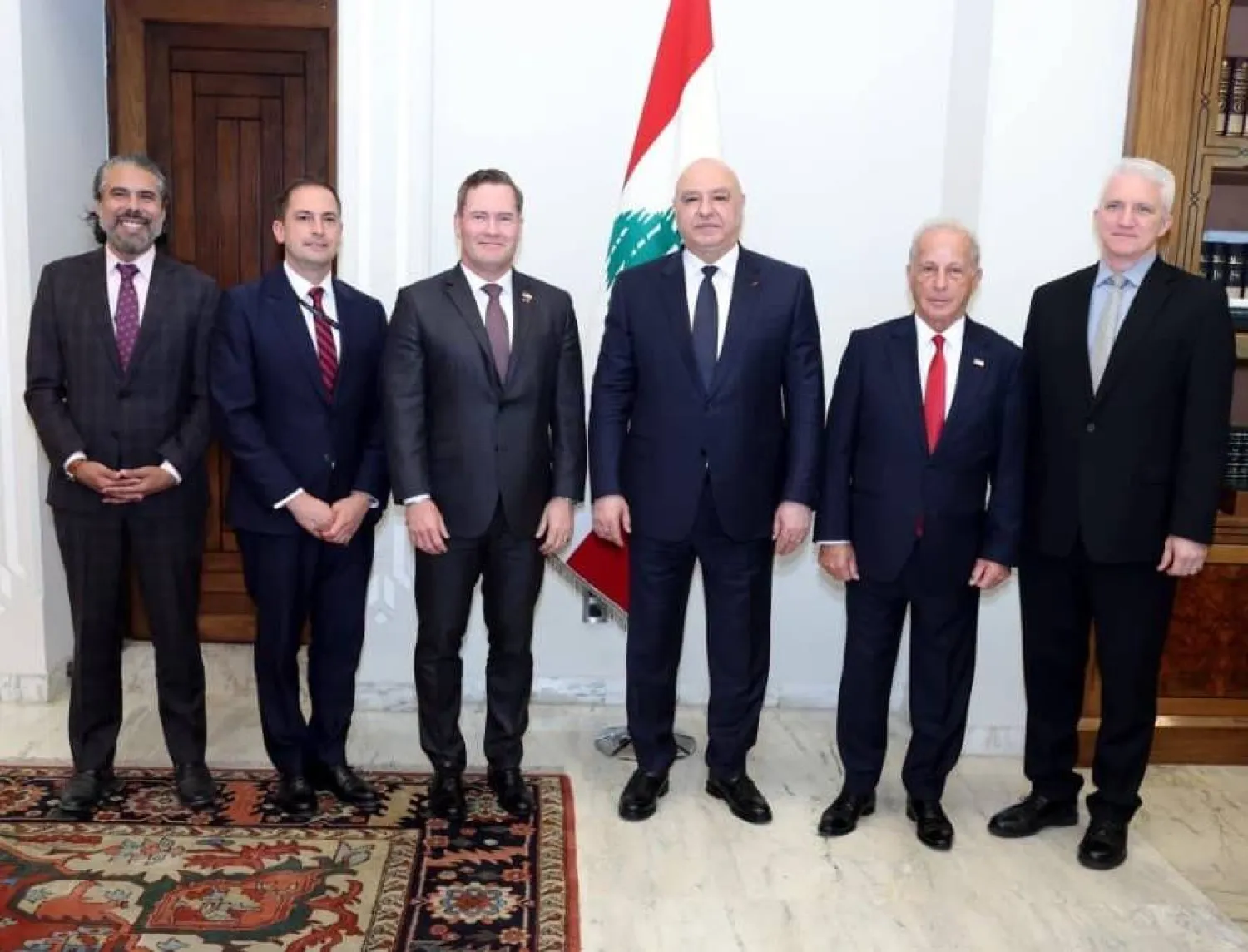
Lebanese President Joseph Aoun receives US envoy Mike Waltz at the Baabda presidential palace on Monday. (NNA)

Iran-backed Hezbollah should "voluntarily" lay down its weapons and hand them over to the Lebanese state, visiting US envoy Mike Waltz said on Monday, adding that "no country can have two armies". 

"I think the message should be loud and clear, that Lebanese sovereignty must be fully restored," said Waltz, who is the US ambassador to the United Nations. 

"And the mechanism to do that will be the Lebanese armed forces." 

Waltz held separate talks in Lebanon with President Joseph Aoun and Prime Minister Nawaf Salam.

Hezbollah, which has fought successive wars with Israel, is under pressure to disarm. 

It was the only armed group that refused to hand over its weapons after Lebanon's civil war ended in 1990. 

"I appreciate every Lebanese soldier that steps forward to defend their country, to restore their sovereignty, to defend their people. This is a unique opportunity in history to do that, one," Waltz said. 

"And two, to Hezbollah and to their Iranian backers, no country can have two armies. I hope and pray Hezbollah will disarm. They should do that voluntarily." 


Syria Needs EU Support to Ensure Stability, Kallas Says

High Representative of the European Union for Foreign Affairs Kaja Kallas speaks prior to the Foreign Affairs Council meeting in Brussels, Belgium, 16 November 2026. (EPA)
TT

Syria Needs EU Support to Ensure Stability, Kallas Says

High Representative of the European Union for Foreign Affairs Kaja Kallas speaks prior to the Foreign Affairs Council meeting in Brussels, Belgium, 16 November 2026. (EPA)

European Union foreign ministers will discuss on Monday elevating their relationship with Syria as the war-torn country needs urgent support to ensure stability amid ‌escalating tensions ‌in the ‌region, ⁠the bloc's foreign policy ⁠chief said.

"We really see that Syria needs a lot of investments, to build ⁠up institutions and ‌its ‌reforms," Kaja Kallas ‌told reporters ahead of ‌a monthly foreign ministers meeting in Brussels.

"On the European side we ‌want to see Syrian refugees return but ⁠they ⁠need conditions to return. There's a lot we can do together because the stability of Syria is in our interest and the interest of region."