


4 Patients Die as Oxygen Runs Out in Gaza Hospital Seized by Israeli Forces, Officials Say 

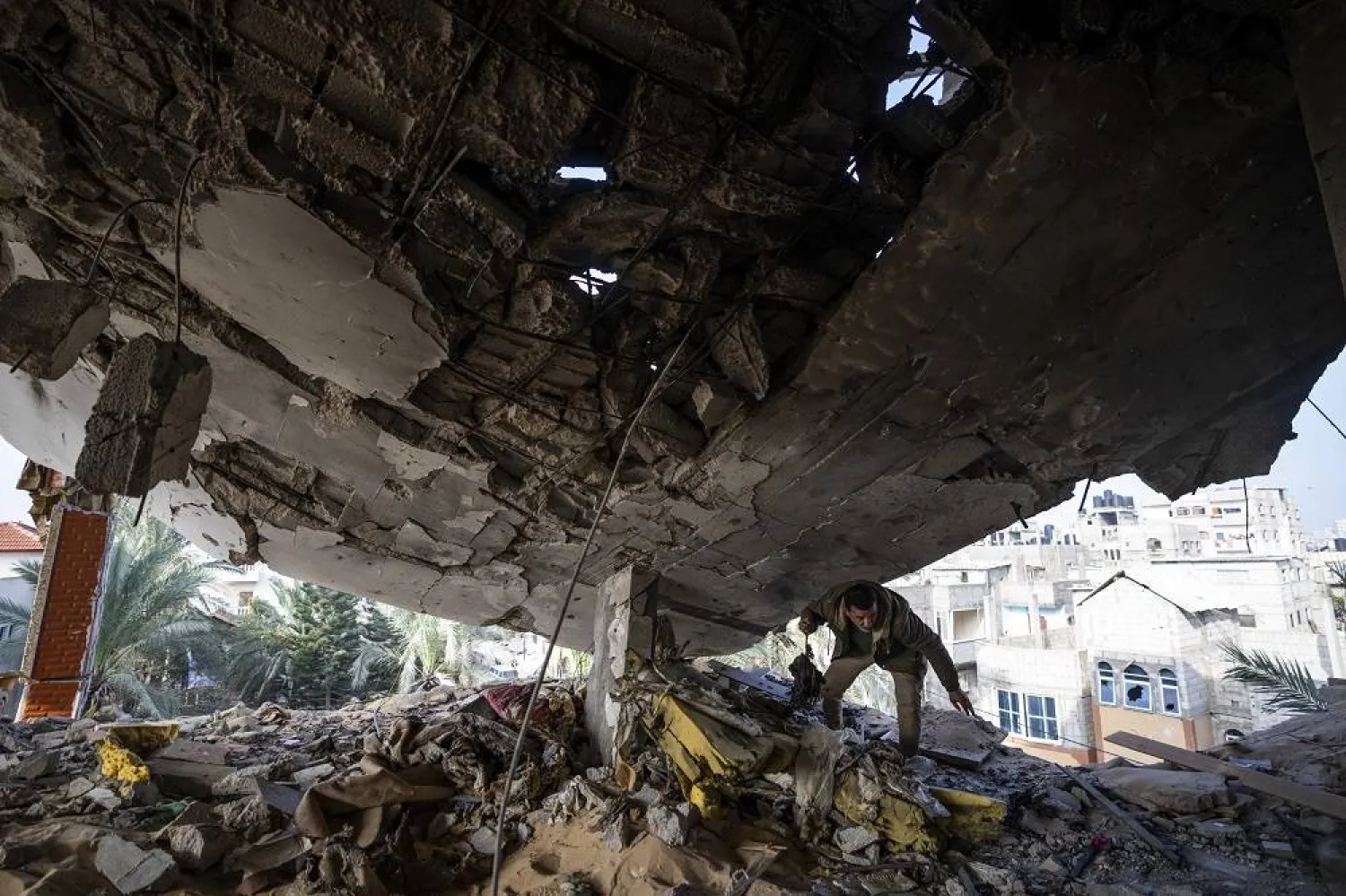
A Palestinian salvages belongings after an Israeli strike in Rafah, Gaza Strip, Saturday, Feb.10, 2024. (AP)
TT

4 Patients Die as Oxygen Runs Out in Gaza Hospital Seized by Israeli Forces, Officials Say 

A Palestinian salvages belongings after an Israeli strike in Rafah, Gaza Strip, Saturday, Feb.10, 2024. (AP)

The storming by Israeli troops of southern Gaza's main hospital brought chaos to hundreds of staff and patients inside, as health officials Friday said four people in intensive care died after their oxygen cut off. Troops were searching the facility, where the military said it believes the remains of hostages abducted by Hamas might be located.

The raid came after troops had besieged Nasser Hospital in the southern city of Khan Younis for nearly a week, with staff, patients and others inside struggling under heavy fire and dwindling supplies, including food and water. Hours before troops seized the hospital Thursday, Israeli fire killed a patient and wounded six others inside the complex, staff said.

Negotiations over a ceasefire in Gaza, meanwhile, appear to have stalled, and Israeli Prime Minister Benjamin Netanyahu on Friday pushed back hard against the US vision for after the war — particularly its calls for the creation of a Palestinian state. After speaking overnight with President Joe Biden, Netanyahu wrote on X that Israel will not accept “international dictates regarding a permanent settlement with the Palestinians.”

He said that if other countries unilaterally recognize a Palestinian state, it would give a “reward to terrorism.” Netanyahu has repeatedly rejected creation of a Palestinian state.

Netanyahu has vowed to continue the offensive and expand it to the Gaza city of Rafah, near Egypt, until Hamas is destroyed and scores of hostages taken during the militants’ Oct. 7 attack are freed. In their phone call, Biden again cautioned Netanyahu against moving forward with a military operation in Rafah before coming up with a “credible and executable plan” to ensure the safety of Palestinian civilians, the White House said.

With the war showing no sign of ending, the risk of a broader conflict grew as Israel and Lebanon’s Hezbollah militant group had deadliest exchange of fire along the border since the start of the Israel-Hamas war. Israel launched airstrikes into southern Lebanon for a second day on Thursday after killing 10 civilians and three Hezbollah fighters on Wednesday in response to a rocket attack that killed an Israeli soldier and wounded several others.

SCENES OF PANIC IN HOSPITAL Nasser Hospital was the latest in a series of hospitals Israeli forces have besieged and stormed during the war, claiming Hamas was using them for military purposes. The assaults have gutted Gaza’s health sector as it struggles to treat a constant stream of people wounded in daily bombardments.

Israeli troops, tanks and snipers have surrounded Nasser Hospital for at least a week, with food, water and supplies inside dwindling and fire from outside killing several people inside, according to health officials.

Troops moved into the hospital Thursday after the military said it had “credible intelligence” that Hamas had held hostages there and that the hostages’ remains might still be inside. Rear Adm. Daniel Hagari, the chief military spokesperson, said forces were conducting a “precise and limited” operation there and would not forcibly evacuate medics or patients.

Later Thursday, Hagari said troops were still searching the hospital. He said dozens of militants were arrested from the hospital grounds, including three who participated in the Oct. 7 attack. He also said troops found grenades and mortar shells, and that Israeli radar determined that militants fired mortars from the hospital grounds a month ago. The claims could not be independently confirmed.

A released hostage told The Associated Press last month that she and over two dozen other captives had been held in Nasser Hospital.

International law prohibits the targeting of medical facilities, though they can lose those protections if they are used for military purposes. Even then, Israel must take precautions and follow principles of proportionality, the UN Human Rights Office said, adding that “as the occupying power” Israel has the duty to maintain medical facilities.

As they searched, troops ordered the more than 460 staff, patients and their relatives to move into an older building in the compound that isn’t equipped to treat patients, the Gaza Health Ministry said. They were “in harsh conditions with no food or baby formula” and severe water shortages, it said.

Four patients in the intensive care unit died early Friday because electricity was cut, stopping oxygen supplies for them, the ministry said. It had earlier warned that six patients in the ICU and three infants in incubators were in danger because fuel for generators was on the verge of running out. “The Israeli occupation is responsible for the lives of patients and staff as the compound now is under its full control,” the ministry said.

Raed Abed, a wounded patient who was among those who left the hospital Wednesday, said days of siege had left the facility with no water or food, “Garbage is everywhere. Sewage has flooded the emergency ward.”

Still suffering from a severe stomach wound, Abed said he and others waited outside for hours as troops made those leaving pass by five at a time, arresting some and making them strip to their underwear, he said. Finally, he walked for kilometers until he reached the border town of Rafah, where he was put in a hospital. Lying in a bed there, he wheezed in pain from his wound as he spoke.

NO END IN SIGHT TO THE WAR The war began when Hamas militants on Oct. 7 burst out of Gaza and attacked several Israeli communities, killing some 1,200 people and taking another 250 hostage. More than 100 captives were freed during a cease-fire in November in exchange for 240 Palestinian prisoners. Around 130 hostages remain in Gaza, a fourth of whom are believed to be dead.

Israel responded to the Hamas attack with one of the deadliest and most destructive military campaigns in recent history.

At least 28,663 Palestinians have been killed, mostly women and children, and more than 68,000 wounded, according to Gaza’s Health Ministry, which does not distinguish between civilians and combatants. Some 80% of the population has been driven from their homes, and a quarter are starving amid a worsening humanitarian catastrophe. Large areas in northern Gaza, the first target of the offensive, have been completely destroyed.

Israeli media reported that CIA Director William Burns flew to Israel to meet with Netanyahu to discuss efforts for a ceasefire.

Hamas says it will not release all the remaining captives until Israel ends its offensive, withdraws and frees Palestinian prisoners, including top militants.

Netanyahu has rejected those demands and says Israel will soon expand its offensive into Rafah, Gaza’s southernmost city. Over half of Gaza’s population of 2.3 million has sought refuge in Rafah after fleeing fighting elsewhere.

Multiple airstrikes hit Rafah overnight, destroying homes where families were sheltering and killing at least 11 people, according to health officials.



Tunisia, Libya, and Algeria Discuss Ways to Secure Shared Borders

Libyans from various regions, along with organizations and activists, gather in front of the International Organization for Migration (IOM) to demand that they take action to resettle irregular migrants and refugees, in the capital Tripoli on June 16, 2026. (Photo by Mahmud Turkia / AFP)
TT

Tunisia, Libya, and Algeria Discuss Ways to Secure Shared Borders

Libyans from various regions, along with organizations and activists, gather in front of the International Organization for Migration (IOM) to demand that they take action to resettle irregular migrants and refugees, in the capital Tripoli on June 16, 2026. (Photo by Mahmud Turkia / AFP)

Security officials from Tunisia, Libya, and Algeria have held talks in Tripoli on strengthening cooperation to secure their shared borders.

According to Libya’s Interior Ministry of the Tripoli-based government, Tuesday’s meeting discussed ways to enhance cooperation in border security, combat cross-border organized crime, tackle terrorism, and curb illegal migration.

Security authorities in the three countries are working along their shared borders to counter irregular migration from sub-Saharan African countries, as well as smuggling operations and the risks of militant infiltration.

The Libyan ministry said in a statement that the three countries are keen to strengthen joint security cooperation and to develop operational mechanisms to be highly ready in confronting cross-border security threats and challenges, thus contributing to enhanced security and stability and protecting the shared interests of the region’s peoples.

The ministry explained on its Facebook page that the meeting “addressed ways to enhance cooperation among the three countries in securing borders and combating cross-border organized crime, in a way that strengthens security and stability in the region.”

It stressed that the meeting comes within the framework of ongoing efforts by the three countries to consolidate security and stability, strengthen partnership and security integration, and help protect shared borders while combating various forms of organized crime.

The joint Libyan-Algerian-Tunisian task force responsible for securing the shared borders was established in January 2025.

Its formation came as part of an agreement between the interior ministers of the three states to raise the level of security coordination, unify efforts to control the borders, combat cross-border organized crime, and address illegal migration.


Egyptian Program to Develop Abrams Tanks Alarms Israel

The M1A1 Abrams tank. (Egyptian Ministry of Military Production)
TT

Egyptian Program to Develop Abrams Tanks Alarms Israel

The M1A1 Abrams tank. (Egyptian Ministry of Military Production)

Former military officers have confirmed that Egypt is working with the United States to boost its armored forces by introducing technological upgrades and modern combat specifications to a large number of M1A1 Abrams tanks, raising alarm in Israel.

According to Israel’s Nziv.net platform, there are major Israeli concerns about a shift in the regional balance of power after Washington recently approved a huge deal to upgrade 555 Abrams tanks out of 1,130 American tanks in the Egyptian army.

The military factory in the Abu Zaabal area north of Cairo, the only facility authorized outside the United States to produce components of this model, will oversee the development project at a cost of around $4.69 billion.

The M1A1 Abrams tank is the Egyptian army’s main battle tank, with a top speed of 20 miles, according to data from the Egyptian Ministry of Military Production.

National security expert Mohamed Abdel Wahed told Asharq Al-Awsat that this was not the first time Egypt develops these tanks. It did so in the 1980s through a joint military production agreement with the United States.

The latest agreement to develop the tanks was signed in 2024. It called for refurbishing the existing vehicles instead of replacing them with new ones that would have come at a higher cost.

“Egypt is developing this tank and capitalizing on its global reputation. The development involves incorporating modern technology to boost its capabilities,” Abdel Wahed explained.

Former Egyptian intelligence official Gen. Mohammed Rashad told Asharq Al-Awsat: “The upgrades include installing a higher-caliber gun to increase the firing range to 105 mm, upgrading the aiming and targeting systems to use lasers, reinforcing the tank’s armor against close-quarters combat and anti-tank weapons, installing a recoil suppressor on the tank’s gun to maintain stability and aiming accuracy, and fitting the tank with a high-powered engine to boost speed and maneuverability.”

“These capabilities make the Egyptian Armored Corps one of the most advanced and lethal armies in the region, with high combat capabilities in all circumstances, which is a direct cause for concern in Tel Aviv,” he explained.

Abdul Wahed added: “Egypt is manufacturing 90 percent of the components for this tank. Localizing military technology and industries in Egypt is very important.”

Israeli media has over the past two years frequently reported about Tel Aviv’s concern over what it described as “the detection of the construction of massive logistical infrastructure and fuel depots in the Sinai Peninsula.”

They alleged that these measures would allow Egyptian forces to move rapidly and extensively eastward, forcing Israel to maintain close and continuous monitoring of the deployment and movement of Egyptian forces despite the peace treaty between them.

Egypt has repeatedly denied the allegations, saying its work in Sinai has development purposes and any deployment of the military aims to protect the border and national security.

Rashad said the Israeli concerns over the Egyptian military’s upgrades and tanks program stem from its “fear that the Egyptian armored forces will become capable of matching Israel’s.”

Tel Aviv constantly boasts about its capabilities that are a result of continuous upgrades to weapons and combat equipment, he added, noting that its military ranks seventh globally in the manufacture and export of weapons and combat equipment.


Several Israeli Strikes Hit South Lebanon

Smoke rises following an Israeli strike on southern Lebanon, as seen from the Israeli side of the border in the Upper Galilee, northern Israel, 16 June 2026, after the announcement of a US-Iran mediated preliminary framework to end regional military hostilities. EPA/ATEF SAFADI
TT

Several Israeli Strikes Hit South Lebanon

Smoke rises following an Israeli strike on southern Lebanon, as seen from the Israeli side of the border in the Upper Galilee, northern Israel, 16 June 2026, after the announcement of a US-Iran mediated preliminary framework to end regional military hostilities. EPA/ATEF SAFADI

Israeli forces on Wednesday carried out airstrikes on several areas in south Lebanon, state media reported, despite a peace deal in the Middle East war that includes Lebanon.

Lebanon's National News Agency said Israeli warplanes launched raids targeting the Nabatieh al-Fawqa area and the eastern outskirts of neighboring town Kfar Tebnit.

The Israelis also launched a drone strike on the town of Ansariyeh in the Zahrani area, NNA reported.

US President Donald Trump on Tuesday issued a rare public rebuke of Israel's military tactics in Lebanon targeting Hezbollah, saying it was unnecessary to bomb entire apartment buildings to hunt militants.

Trump, who in recent days had expressed his displeasure over Israeli attacks in Beirut that he said could have endangered his peace deal with Iran, said Israel has been fighting Hezbollah for "too long.”

"Too many people have been killed. You don't have to knock down an apartment house every time you're looking for somebody, because there are a lot of people in those apartment houses, and they're not all Hezbollah," Trump said at the G7 summit ⁠in France.

His complaint comes ⁠at a moment of rising tensions with Israeli Prime Minister Benjamin Netanyahu, who has remained a key political ally despite occasional ups and downs between the two leaders over the years.