Belgium Joins Aid Airdrop Efforts for Gaza

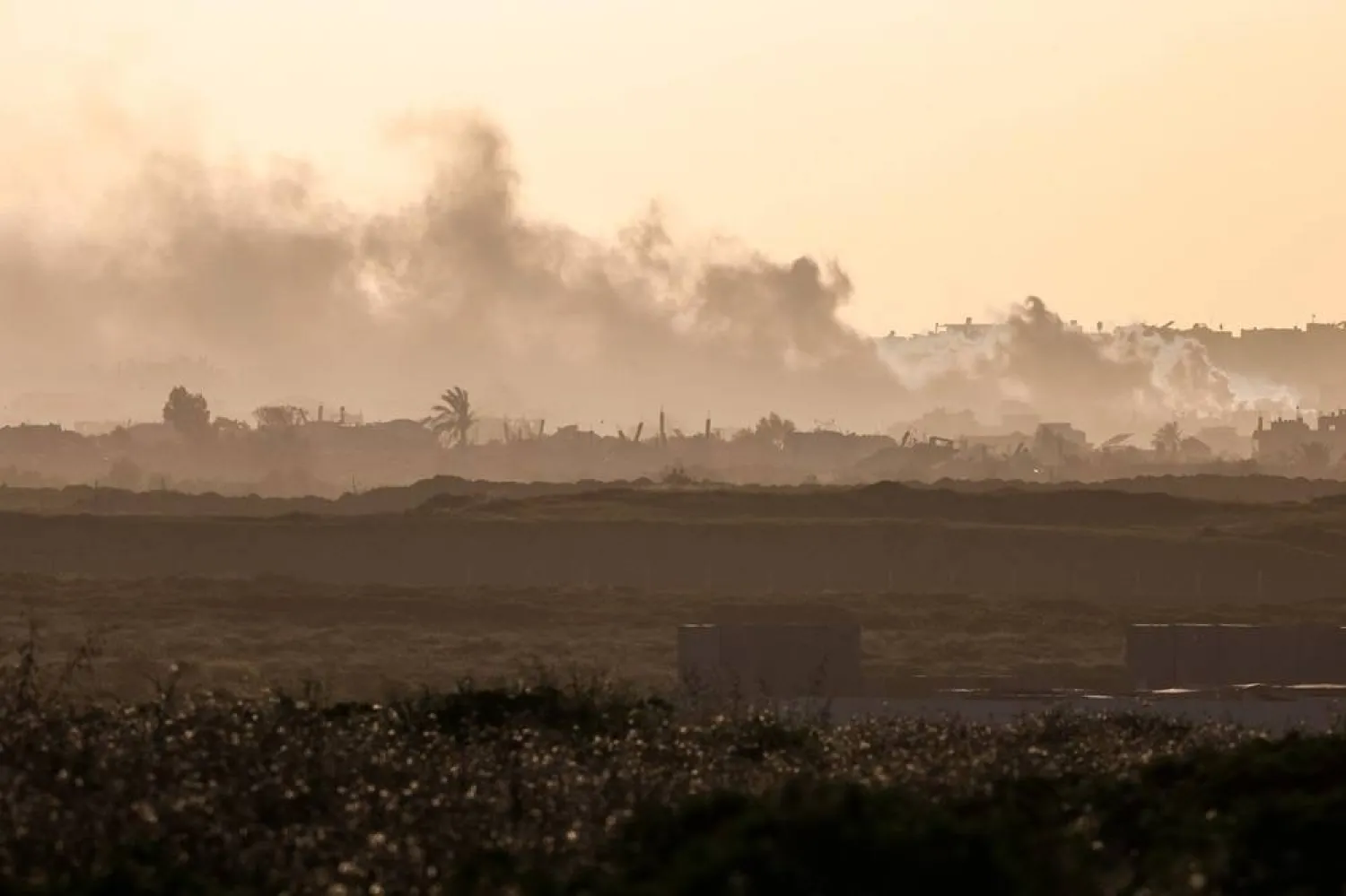
This picture taken from a position in southern Israel near the border with the Gaza Strip shows smoke billowing in Gaza following Israeli bombardment on March 4, 2024, amid continuing battles between Israel and the Palestinian group Hamas. (AFP)
TT

Belgium Joins Aid Airdrop Efforts for Gaza

This picture taken from a position in southern Israel near the border with the Gaza Strip shows smoke billowing in Gaza following Israeli bombardment on March 4, 2024, amid continuing battles between Israel and the Palestinian group Hamas. (AFP)

Belgium has decided to airdrop aid into Gaza and dispatched a military transport plane on Monday to begin delivering emergency support, after US cargo aircraft dropped food over the weekend.

The foreign ministry said that “due to the difficulties of access and the complex situation on the ground, the Belgian government has approved an airdrop operation for emergency aid.”

Belgian Defense Minister Ludivine Dedonder in a post on X, formerly Twitter, said “40 military personnel will be deployed to carry out several drops in the coming days.”

The A400M transport plane was due to travel first to Jordan, which is coordinating efforts to supply aid by air, and from there be used to drop food and “hygiene products” into Gaza.

Since the war began, Israel has barred entry of food, water, medicine and other supplies, except for a trickle of aid entering the south from Egypt at the Rafah crossing and Israel’s Kerem Shalom crossing.

The UN says a quarter of Gaza’s 2.3 million people face starvation. Aid officials have said that airdrops are not an efficient means of distributing aid and are a measure of last resort.


Lebanon: Post-Ali al-Taher…Israeli Political Pressure Mounts

(FILES) A photograph taken from the southern Lebanese area of Nabatieh shows smoke as it rises from the site of Israeli strikes that targeted the hilltops of the mountainous area of the strategic Ali al-Taher Ridge on August 14, 2026. (Photo by AFP)
TT

Lebanon: Post-Ali al-Taher…Israeli Political Pressure Mounts

(FILES) A photograph taken from the southern Lebanese area of Nabatieh shows smoke as it rises from the site of Israeli strikes that targeted the hilltops of the mountainous area of the strategic Ali al-Taher Ridge on August 14, 2026. (Photo by AFP)

Israel’s announcement that it has established what it called “operational control” over Ali al-Taher ridge marks a new phase in southern Lebanon, raising questions that go beyond the site’s fate: what comes next militarily, and how the development could shape forthcoming negotiations.

The Israeli military said troops from its 36th Division had gained “operational control” above and below ground in the area. It said Hezbollah fighters had been killed and others had fled, while operations continued to destroy underground facilities.

Israeli Prime Minister Benjamin Netanyahu said the ridge no longer posed a threat to Israel. Defense Minister Israel Katz said Israeli forces would not withdraw from what he described as a “security zone” in southern Lebanon until Hezbollah was disarmed.

He said control of the Ali al-Taher ridge marks the end of a phase in consolidating Israeli control over this area.

Hezbollah questions Israel’s claim

Ihab Hamadeh, an MP from Hezbollah’s Loyalty to the Resistance parliamentary bloc, questioned whether Israel had secured full control of Ali al-Taher.

He said the continuing bombardment contradicted claims of complete control on the ground and that Israel had released no images showing its forces entering the facility or seizing the weapons it said were there.

Mahmoud Qamati, deputy head of Hezbollah’s political council, said Israel had tried to portray Ali al-Taher as a “vast military facility” when it was, in fact, “a collection of defensive positions.”

Separately, Israel’s Maariv newspaper quoted an Israeli military source as saying 15 bodies had been found inside tunnels in the area.

Leverage in Rome

Academic and political researcher Hayat Hariri told Asharq Al-Awsat that the developments at Ali al-Taher were far from routine.

“What happened at Ali al-Taher ridge was not an ordinary military development, as some in Hezbollah and among its allies are trying to portray it,” she said.

“Nor can it be placed in the same category as sites that witnessed previous confrontations, because Ali al-Taher’s importance lies in its strategic location and its impact on the broader battlefield in southern Lebanon.”

Hariri said operational control of the ridge would give Israel influence over a broad swathe of southern Lebanon.

“The ridge overlooks Nabatieh and the Marjayoun plain as far as the Upper Galilee, giving it considerable military and strategic importance,” she said.

“More dangerously, any advance beyond Ali al-Taher could make it easier to move toward Iqlim al-Tuffah, Jabal al-Rayhan and the Jezzine district.”

“If Israel continues along this path, then, in my assessment, it is moving toward entrenching a buffer zone stretching from Naqoura to the western Bekaa and geographically linked to the Syrian theater — a vision Israel has discussed in various forms since 2023.”

Hariri said the battlefield developments, led by those at Ali al-Taher, would give Israel additional leverage over Lebanon in the anticipated negotiations in Rome.

“Israel will try to argue that the Lebanese state was unable to push Hezbollah to hand the site over to the Lebanese army and that the Israeli military was the force that completed the mission on the ground,” she said.

“If Israel succeeds in establishing its narrative that the Lebanese state remains unable to address Hezbollah’s weapons and deployment, it may gain additional room to act, though that would not necessarily mean heading toward an all-out war.”

Hariri said the development would increase political pressure on the Lebanese state and give Israel a new bargaining chip in the next round of talks in Rome.

“Even the delay in negotiations can be read in light of the developments at Ali al-Taher,” she said. “Before going to the negotiating table, Israel wants to strengthen its position on the ground and try to impose a new security and political reality in southern Lebanon, then negotiate from that position.”

Limits of a military advance

Retired Brigadier General Khalil al-Jamil, a former commander of the Lebanese army’s South Litani Sector, told Asharq Al-Awsat that the fall of Ali al-Taher represented the loss of an important strategic position, but said Israel’s claim of control required closer scrutiny.

“My assessment is that Israel has not yet secured the entire site,” Jamil said. “It has begun establishing control over the surface and moving across it, while continuing to strike the tunnels and facilities beneath it.”

“What Israel calls operational control means, at this stage, that its forces can move across the ridge, its bulldozers are operating there, and it has established fire control over the surrounding area and begun entering parts of the site.

“It does not necessarily mean Israel has entered and fully secured every tunnel and underground facility.”

Jamil said Ali al-Taher was particularly important to the Nabatieh area.

“To the west, it overlooks Nabatieh and its surroundings, including Shoukin, Mayfadoun, Kfar Jouz and Kfar Rumman,” he said. “To the east, it overlooks the valley stretching toward Iqlim al-Tuffah and Jezzine and as far as Khardali.

“Controlling it, therefore, expands the area Israel can monitor and dominate with fire.”

Jamil said, however, that higher ground remained nearby, most notably al-Rayhan, Sujud, and Jabal al-Rafi, all of which overlook Ali al-Taher and the surrounding area.

“What happened is an Israeli military achievement and a loss for Hezbollah, but it is not a strategic loss on a scale that would mean the collapse of the front,” he said.


Asharq Al-Awsat Reveals Details of Operation to Kidnap Senior Hamas Official

Locals gather at the site of an Israeli airstrike in Gaza City, 01 September 2026.  EPA/MOHAMMED SABER
Locals gather at the site of an Israeli airstrike in Gaza City, 01 September 2026. EPA/MOHAMMED SABER
TT

Asharq Al-Awsat Reveals Details of Operation to Kidnap Senior Hamas Official

Locals gather at the site of an Israeli airstrike in Gaza City, 01 September 2026.  EPA/MOHAMMED SABER
Locals gather at the site of an Israeli airstrike in Gaza City, 01 September 2026. EPA/MOHAMMED SABER

Sources in Hamas have revealed new details about the operation to kidnap the group's senior security official, Moeen al-Arabid, last Tuesday by an Israeli special forces unit that carried out a rare operation deep inside Hamas-controlled territory west of Gaza City.

The operation killed Samah al-Arabid, the abductee's wife, and wounded two of his sons, his daughter, and two of his bodyguards. Two children who were in the area when the Israeli special forces unit carried out the operation were also killed.

How the operation began

Sources familiar with the investigation told Asharq Al-Awsat that the security operation began about two months ago, when officers from Israel's Shin Bet security agency posed as representatives of an international aid organization that would provide assistance to Palestinians by setting up small businesses, including stalls selling vegetables, drinks and other goods in the target area, specifically along what is known as Villas Street in the Katiba neighborhood, west of Gaza City.

According to the sources, Shin Bet used Palestinian operatives, including women, to run the project and supply them with vegetables every day, presenting them as aid from the organization. The proceeds from the sales were supposedly to benefit those participating in the project.

The operatives later asked them to monitor certain homes and track the movements of specific individuals in the area, including al-Arabid.

The sources said it later emerged that those running the project had been collaborating with Shin Bet. On the day of the operation, new individuals appeared at some of the stalls, while others had been there since the previous day selling vegetables. They were later identified as Shin Bet operatives who had arrived in the area and concealed their weapons inside the stalls. When the operation began, they took part in the attack before disappearing and withdrawing from the area.

This was not the first time Israel has used the cover of international organizations to conduct operations inside the Gaza Strip. A similar incident occurred when an Israeli special forces unit infiltrated Al-Shifa Hospital in March 2024 before military reinforcements arrived at the site. That operation subsequently continued for two weeks, during which Hamas members and operatives from its various security and military branches were killed or captured, including commanders from the Al-Qassam Brigades.

Prior presence

Regarding the latest operation west of Gaza City, the sources said the Israeli special forces operatives do not appear to have entered the area beforehand except for several brief visits, apparently to gain a clearer picture of the area and finalize plans for the operation.

Instead, they relied on surveillance carried out by the collaborators. According to the investigation so far, those collaborators apparently did not know the precise objective of the operation or the actual plan. Some also documented on camera whatever their Israeli handlers instructed them to record.

The investigation indicates that some of the Shin Bet operatives who carried out the operation had been in the area one or two days earlier in moving vehicles. At least one of those vehicles was later targeted and destroyed by Israeli aircraft after the operation.

Zero hour

When the attack began, the special forces unit attempted to catch al-Arabid off guard by opening fire on him as he emerged from his home with one of his bodyguards. He managed to fire back, while the Israeli forces fired rounds containing an anesthetic agent at him.

Another bodyguard opened fire on the force, while two of al-Arabid's sons and his wife also fired at the attackers. All were subsequently wounded by gunfire. At the same time, a small quadcopter drone dropped a bomb on the house.

The attack killed his wife and critically wounded one of his sons. His other son's eye had to be surgically removed. He had been due to get married that same day. Other members of the family and bodyguards were also wounded.

According to the injured people interviewed as part of the investigation, al-Arabid attempted to escape through the rear of the house during the ensuing clashes. He was surprised by another Israeli force waiting there. Although wounded and crawling, he continued to fire at them. They then detonated a stun grenade near him before taking him captive.

One source said the initial denial that al-Arabid had been abducted resulted from his son's insistence that his father had managed to escape. The family did not know that another Israeli force was positioned at the rear of the house and had captured him, leading to confusion in the initial reports about what had happened.

The investigation found that after al-Arabid fled, the Israeli special forces searched the wounded in an attempt to establish his identity before leaving them behind. Some were bleeding at the scene, including his wife. The force later captured him in the street behind the house as he attempted to escape despite his injuries.

Arrests of collaborators

According to one source, at least 36 suspects have been arrested so far and are being questioned over suspected involvement in assisting the Israeli special forces unit. The source said some of those arrested have confessed to collaborating with Israel, while investigations are still underway.

In an account broadly consistent with information provided to Asharq Al-Awsat sources, Gaza's Al-Hares security platform reported that three collaborators, including a woman, had been arrested. They allegedly posed as an international relief organization to facilitate movement in the area and gather intelligence.

Their confessions reportedly indicated that the special forces unit arrived at the scene only hours before the operation was exposed and had no prior presence in the area. They also said the outbreak of clashes prompted the special forces to call for assistance from Israeli aircraft.

Hamas previously arrested dozens of suspects following a similar operation in 2018, when an Israeli special forces unit infiltrated the Gaza Strip and conducted extensive activities there for several months.

Another abduction attempt

Separately, Al-Quds Brigades, the armed wing of Islamic Jihad, said early Friday that armed groups had attempted to abduct one of its members on Al-Jameiza Street in the town of al-Qarara, northeast of Khan Younis.

The group said the armed men entered the area with support from Israeli drones. They were discovered, triggering clashes that left several members of the group dead or wounded.

It said Israeli drones intervened to assist the special forces in withdrawing from the area. Members of the force then killed one of the Al-Quds Brigades members, Fadi al-Abadala, after shooting him and leaving him at the scene.

A field source told Asharq Al-Awsat that al-Abadala arrived at Nasser Medical Complex with his hands bound, indicating that the abduction had apparently succeeded. The source said he may have been interrogated before the abduction attempt and subsequently executed, adding that the investigation into the incident is ongoing.


Iraq’s Maliki Joins Chorus Rejecting Militia Disarmament

Members of Iraq’s Kataib Hezbollah carry the group’s flag in central Baghdad. (File photo - AFP)
TT

Iraq’s Maliki Joins Chorus Rejecting Militia Disarmament

Members of Iraq’s Kataib Hezbollah carry the group’s flag in central Baghdad. (File photo - AFP)

State of Law Coalition leader Nouri al-Maliki has joined a growing chorus of critics of Iraqi Prime Minister Ali al-Zaidi’s government program, unanimously approved by parliament, to restrict arms to state control.

Less than a month after the State Administration Coalition, comprising leading Shiite, Sunni and Kurdish forces, gave Zaidi full authority to determine how to handle the issue after Sept. 30 — when the remaining US troops are due to leave Iraq — armed factions, notably Kataib Hezbollah and Harakat al-Nujaba, rejected the deadline. They argue that their weapons are “ideological” and tied to the Iran-led “Axis of Resistance.”

Maliki joined them Wednesday, declaring in televised remarks that “there will be no handover of weapons” after Sept. 30.

Instead, he advocated “regulation and containment” of weapons through a mechanism still under discussion.

Maliki pointed that distinctions could be drawn among heavy, medium and light arms.

His position came despite an earlier warning from the State Administration Coalition that any armed activity outside state authority after Sept. 30 would be dealt with under the counterterrorism law.

Shifting Terms

A visit to Iraq by Iranian parliament speaker Mohammad Bagher Ghalibaf further complicated the process amid indications that Tehran was unwilling to see all factions surrender their weapons.

The government subsequently agreed to a Shiite Coordination Framework committee that would begin talks with armed groups after the end of September to persuade them to establish a mechanism for “regulating weapons, not disarming them,” as Maliki put it.

Maliki serves on the three-member committee alongside former Prime Minister Mohammed Shia al-Sudani and Badr Organization leader Hadi al-Amiri.

While Sudani has made no statement on surrendering weapons, Amiri and Maliki have taken turns, using terms such as “regulating,” “freezing” or “deferring” weapons rather than “disarmament.”

Maliki’s comments followed Amiri’s description two days earlier of the 2019 Tishreen protests as a “sedition” intended to topple the Shiite political system.

Amiri also identified the “resistance” as the so-called “third party” that carried out killings of protesters, leaving thousands dead or wounded, mostly from poor Shiite neighborhoods in Baghdad and central and southern provinces.

Political observers viewed his remarks as a deliberate message that armed factions “were, and remain, the ones protecting the political system when it is threatened.”

Akram al-Kaabi, secretary-general of Harakat al-Nujaba, meanwhile said US President Donald Trump was “deluded” if he believed he could achieve a victory in Iraq after failing to do so in Iran.

The government has maintained that the deadline for surrendering weapons remains unchanged and coincides with the US withdrawal, saying armed groups could be compelled to comply once the American presence ends and there is no longer justification for carrying arms.

Saleh al-Arbawi, head of the Wa’i Movement, told Asharq Al-Awsat that any handover could be circumvented or merely symbolic, saying armed groups follow “a transnational ideology and leadership” and have received no order to relinquish their weapons.

The government, he said, faces either confrontation or potentially lengthy dialogue and compromise. He added that the wider the current conflict becomes, the more difficult restricting arms to state control will be.