


Why Are Clocks Set Forward in the Spring? Thank Wars, Confusion and a Hunger for Sunlight 

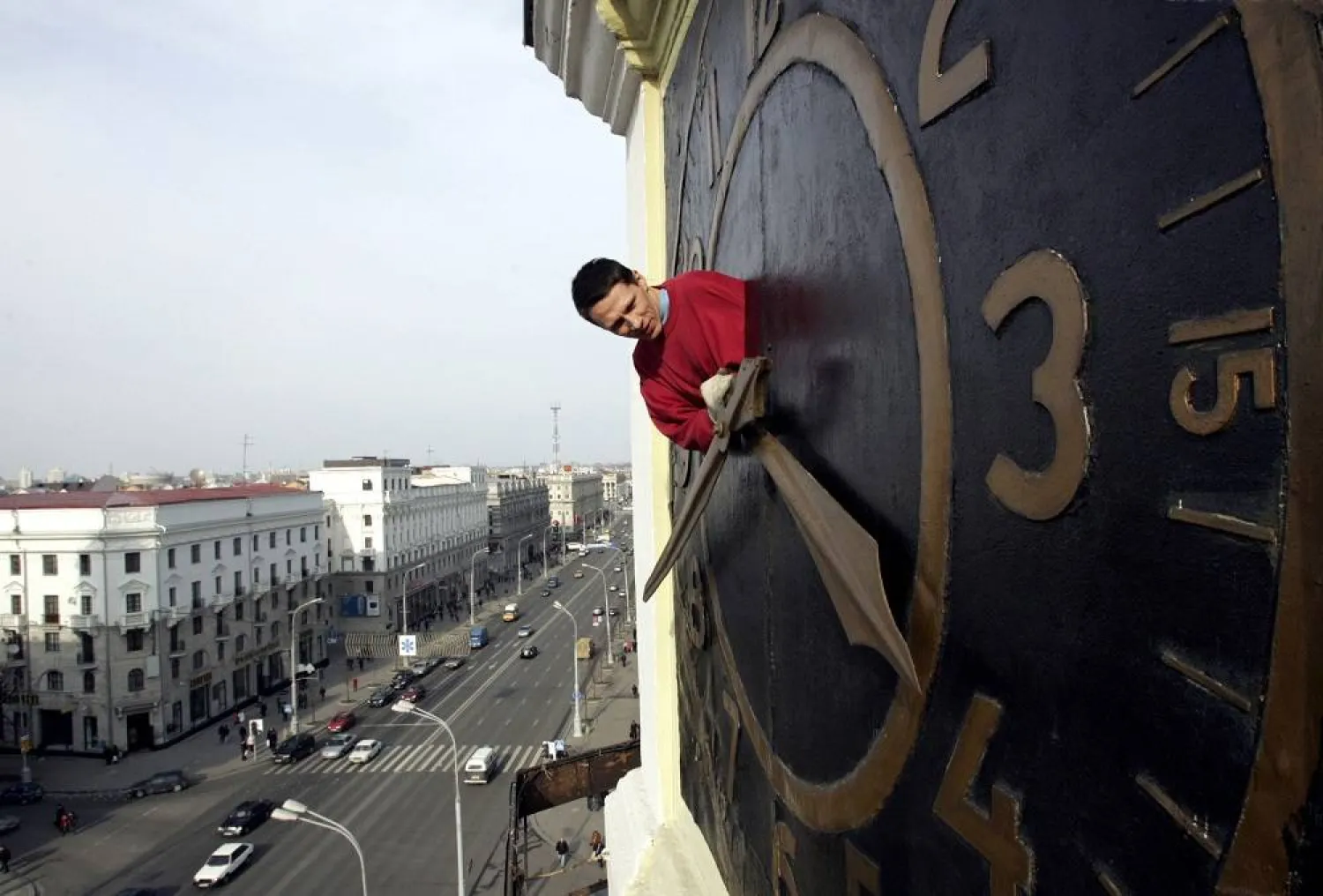
Technician Oleg Ryabtsev performs maintenance work on a clock in Minsk, Belarus, Saturday, March 29, 2008. (AP)
TT

Why Are Clocks Set Forward in the Spring? Thank Wars, Confusion and a Hunger for Sunlight 

Technician Oleg Ryabtsev performs maintenance work on a clock in Minsk, Belarus, Saturday, March 29, 2008. (AP)

Once again, most Americans will set their clocks forward by one hour this weekend, losing perhaps a bit of sleep but gaining more glorious sunlight in the evenings as the days warm into summer.

Where did this all come from, though?

How we came to move the clock forward in the spring, and then push it back in the fall, is a tale of that spans over more than a century — one that's driven by two world wars, mass confusion at times and a human desire to bask in the sun for a long as possible.

There's been plenty of debate over the practice, but about 70 countries — about 40% of those across the globe — currently use what Americans call daylight saving time.

While springing the clocks forward "kind of jolts our system," the extra daylight gets people outdoors, exercising and having fun, says Anne Buckle, web editor at timeanddate.com, which features information on time, time zones and astronomy.

"The really, really awesome advantage is the bright evenings, right?" she says. "It is actually having hours of daylight after you come home from work to spend time with your family or activities. And that is wonderful."

Here are some things to know so you'll be conversant about the practice of humans changing time:

HOW DID THIS ALL GET STARTED? In the 1890s, George Vernon Hudson, an astronomer and entomologist in New Zealand, proposed a time shift in the spring and fall to increase the daylight. And in the early 1900s, British home builder William Willett, troubled that people weren't up enjoying the morning sunlight, made a similar push. But neither proposal gained enough traction to be implemented.

Germany began using daylight saving time during World War I with the thought that it would save energy. Other countries, including the United States, soon followed suit. During World War II, the US once again instituted what was dubbed "war time" nationwide, this time year-round.

In the United States today, every state except Hawaii and Arizona observes daylight saving time. Around the world, Europe, much of Canada and part of Australia also implement it, while Russia and Asia don’t currently.

INCONSISTENCY AND MASS CONFUSION After World War II, a patchwork of timekeeping emerged across the United States, with some areas keeping daylight saving time and others ditching it.

"You might have one town has daylight saving time, the neighboring town might have daylight saving time but start it and end it on different dates and the third neighboring town might not have it at all," says David Prerau, author of the book "Seize the Daylight: The Curious and Contentious Story of Daylight Saving Time."

At one point, if riders on a 35-mile (56-kilometer) bus ride from Steubenville, Ohio, to Moundsville, West Virginia, wanted their watches to be accurate, they'd need to change them seven times as they dipped in and out of daylight saving time, Prerau says.

So in 1966, the US Congress passed the Uniform Time Act, which says states can either implement daylight saving time or not, but it has to be statewide. The act also mandates the day that daylight saving time starts and ends across the country.

Confusion over the time change isn't just something from the past. In the nation of Lebanon last spring, chaos ensued when the government announced a last-minute decision to delay the start of daylight saving time by a month — until the end of the Muslim holy month of Ramadan. Some institutions made the change and others refused as citizens tried to piece together their schedules. Within days, the decision was reversed.

"It really turned into a huge mess where nobody knew what time it was," Buckle says.

WHAT WOULD IT BE LIKE IF WE DIDN'T CHANGE THE CLOCKS? Changing the clocks twice a year leads to a lot of grumbling, and pushes to either use standard time all year, or stick to daylight saving time all year often crop up.

During the 1970s energy crisis, the US started doing daylight saving time all year long, and Americans didn't like it. With the sun not rising in the winter in some areas till around 9 a.m. or even later, people were waking up in the dark, going to work in the dark and sending their children to school in the dark, Prerau says.

"It became very unpopular very quickly," Prerau says.

And, he notes, using standard time all year would mean losing that extra hour of daylight for eight months in the evenings in the United States.

A NOD TO THE EARLY ADOPTERS In 1908, the Canadian city of Thunder Bay — then the two cities of Fort William and Port Arthur — changed from the central time zone to the eastern time zone for the summer and fall after a citizen named John Hewitson argued that would afford an extra hour of daylight to enjoy the outdoors, says Michael deJong, curator/archivist at the Thunder Bay Museum.

The next year, though, Port Arthur stayed on eastern time, while Fort William changed back to central time in the fall, which, predictably, "led to all sorts of confusion," deJong says.

Today, the city of Thunder Bay is on eastern time, and observes daylight saving time, giving the area, "just delightfully warm, long days to enjoy" in the summer, says Paul Pepe, tourism manager for Thunder Bay Community Economic Development Commission.

The city, located on Lake Superior, is far enough north that the sun sets at around 10 p.m. in the summer, Pepe says, and that helps make up for their cold dark winters. Residents, he says, tend to go on vacations in the winter and stay home in the summer: "I think for a lot of folks here, the long days, the warm summer temperatures, it's a vacation in your backyard."



Culture Ministry Continues Preparations in Historic Jeddah to Welcome Visitors during Ramadan 

Historic Jeddah has emerged as a leading cultural tourism destination during Ramadan. (SPA)
TT

Culture Ministry Continues Preparations in Historic Jeddah to Welcome Visitors during Ramadan 

Historic Jeddah has emerged as a leading cultural tourism destination during Ramadan. (SPA)

The Saudi Ministry of Culture is continuing its efforts to revitalize Historic Jeddah in preparation for welcoming visitors during the holy month of Ramadan, offering cultural programs, events, and heritage experiences that reflect the authenticity of the past.

The district has emerged as a leading cultural tourism destination at this time of year as part of the “The Heart of Ramadan” campaign launched by the Saudi Tourism Authority.

Visitors are provided the opportunity to explore the district’s attractions, including archaeological sites located within the geographical boundaries of the UNESCO World Heritage-listed area, which represent a central component of the Kingdom’s urban and cultural heritage.

The area also features museums that serve as gateways to understanding the city’s rich heritage and cultural development, in addition to traditional markets that narrate historical stories through locally made products and Ramadan specialties that reflect authentic traditions.

These initiatives are part of the ministry’s ongoing efforts to revitalize Historic Jeddah in line with the objectives of Saudi Vision 2030 and aiming to transform it into a vibrant hub for arts, culture, and the creative economy, while preserving its tangible and intangible heritage.


Thousands of Animals, Rare Specimens Stolen from Sudan Museum

Skulls of several mammals before the destruction (Asharq Al-Awsat)
TT

Thousands of Animals, Rare Specimens Stolen from Sudan Museum

Skulls of several mammals before the destruction (Asharq Al-Awsat)

“Everything is over.” With that short and painful phrase, a Sudanese government official summed up the loss of nearly a century and a half of history after war destroyed the headquarters of the Sudan Natural History Museum in central Khartoum, stripping the country of thousands of taxidermied and live endangered animals, as well as rare reference specimens.

In the first days after fighting erupted in April 2023, activists on social media called for food and water to be provided to save the live animals. When that proved impossible, cages were opened, and the animals fled, even though some of the reptiles were venomous snakes.

The museum, officially affiliated with the University of Khartoum, lies about one kilometer from the Sudanese army’s general command headquarters in central Khartoum.

Its close proximity led to severe damage from clashes and shelling between the Sudanese army and the Rapid Support Forces, which later took control of the surrounding area for more than a year.

Dr. Othman Ali Haj Al-Amin, Dean of the Faculty of Science at the University of Khartoum, said: “We lost thousands of taxidermied animals, birds, and reptiles that are more than 150 years old.”

“It is most likely that the live animals were stolen or looted and did not die,” he added. “We did not find remains or skeletons of those animals inside the museum.”

Al-Amin broke down in tears as he described to Asharq Al-Awsat the scale of devastation inflicted on one of the world’s oldest natural history museums.

“We lost about 2,000 taxidermied animal specimens, in addition to more than 600 endangered reference specimens that were on display, and nearly all geological records, including animal, plant, and rock fossils,” he said.

“The greatest loss was around 100 species representing all families of animals, birds, and reptiles that had been cared for and preserved for decades.”

Among them were fossil bird specimens collected between 1885 and 1945 that cannot be replaced, as well as a Kordofan giraffe, an endangered subspecies.

The war also claimed “the oldest crocodile, which had lived in the museum for many years and had been cared for since it was an egg,” along with numerous reptiles, including venomous snakes, scorpions, and a Nile monitor lizard.

A taxidermied lioness was recovered and transferred to the university’s veterinary faculty.

Asharq Al-Awsat learned that the International Committee of the Red Cross attempted in those early days to evacuate civilians, including university students who were trapped inside the museum for weeks, as well as to move live and taxidermied animals. The effort failed due to intense fighting in the heart of Khartoum.

According to the Sudanese official, the preserved specimens were collected in the mid-19th century by British army officers.

During World War II, they were transferred from the Sudan National Museum to the Natural History Museum next to the University of Khartoum, which has managed them since its establishment in 1929.

Al-Amin said the museum housed specimens illustrating biodiversity from across Sudan, including South Sudan before its secession, as well as samples gifted to Sudan by international museums.

The Sudan Natural History Museum included multiple sections, among them halls displaying rare bird species, another devoted to animal skulls preserved for decades, a section for medicinal and aromatic plants, geological rock samples collected from ancient eras and environments, and enclosures for live animals.

The dean said restoring the museum to its original state would require many years of work and significant funding. He voiced pessimism about recovering the rare animals, historical specimens, and old records lost during the war.

Many live animals were likely deliberately killed or died of hunger and thirst, he said, while taxidermied animals and rare rock and herb specimens — painstakingly collected, sorted, and classified over many years by researchers — were looted.

The Natural History Museum was a scientific and cultural institution dedicated to the study of biodiversity and natural specimens, and one of the oldest museums in Sudan.


Once a National Obsession, Traditional Korean Wrestling Fights for Survival 

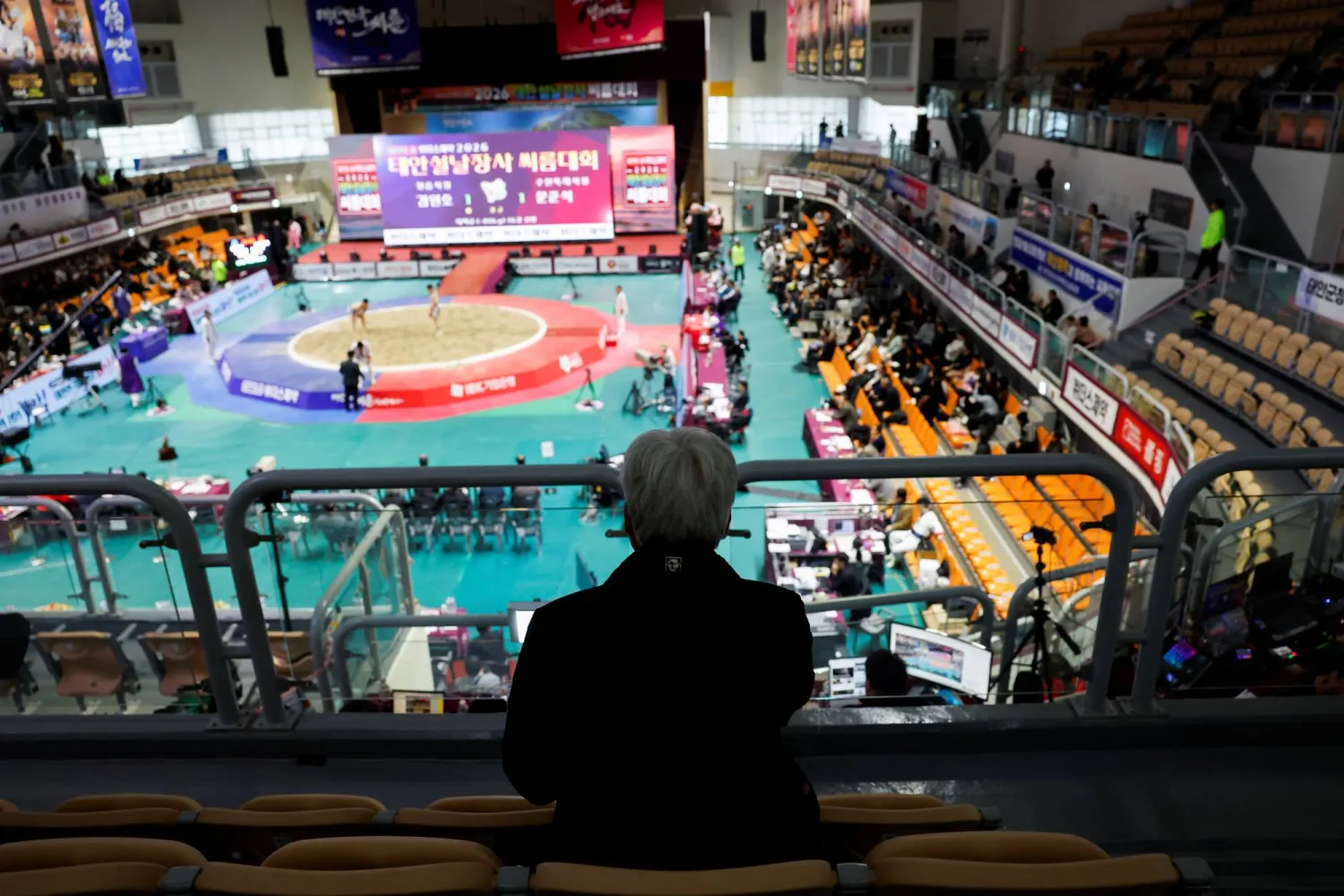
An elderly spectator watches a ssireum match during a Lunar New Year Ssireum championship at the Taean Complex Indoor Gymnasium in Taean, South Korea, February 14, 2026. (Reuters)
TT

Once a National Obsession, Traditional Korean Wrestling Fights for Survival 

An elderly spectator watches a ssireum match during a Lunar New Year Ssireum championship at the Taean Complex Indoor Gymnasium in Taean, South Korea, February 14, 2026. (Reuters)

As South Korea's global cultural influence expands in areas such as music, film and television, one form of entertainment struggling to attract attention even at home is Korea's traditional style of wrestling, known as ssireum.

Ssireum - pronounced like "see room" - had its heyday in the 1980s and early 1990s, when there were as many as eight professional teams and the top wrestlers became household names. Since then, it has been squeezed by tighter budgets and a public quick to move on to new trends.

Twenty-year-old Lee Eun-soo, who began training at the age ‌of nine, is ‌taking part in this year's Lunar New Year ‌tournament, ⁠the showcase event ⁠for the more than 1,500-year-old sport.

Lee lamented that at his former high school, the ssireum team currently has no members and there is talk of disbanding it.

"I once tried to imagine my life if I hadn’t done ssireum," Lee said. "I don’t think I could live without it."

A ssireum match involves two wrestlers facing off in an ⁠eight-meter (26.25 ft) sandpit ring, gripping each other by a ‌cloth belt called a "satba" and using ‌strength, balance, timing and stamina to force the opponent to the ground.

Ssireum ‌was inscribed on UNESCO's Representative List of the Intangible Cultural Heritage ‌of Humanity in 2018, but that international recognition has not translated into commercial success. Its relative obscurity contrasts with the high profile of Japan's sumo, another centuries-old form of wrestling.

Unlike sumo, which is supported by ‌a centralized professional ranking system and six major annual tournaments - or Olympic wrestling, with its global reach - ⁠ssireum remains ⁠largely domestic.

"Sport is something people won't come to watch if they don’t know the wrestlers or even the sport itself," said Lee Tae-hyun, a former ssireum wrestler and Professor of Martial Arts at Yong In University, who has promoted the sport overseas and believes it has commercial potential with the right backing.

Lee Hye-soo, 25, a spectator at the Lunar New Year tournament, said many Koreans are now unfamiliar with ssireum.

"My grandfather liked watching ssireum, so I watched it with him a lot when I was young," she said.

"I like it now too, but I think it would be even better if it became more famous."