


UN Says E-waste from Trashed Electric Devices Is Piling up and Recycling Isn’t Keeping Pace

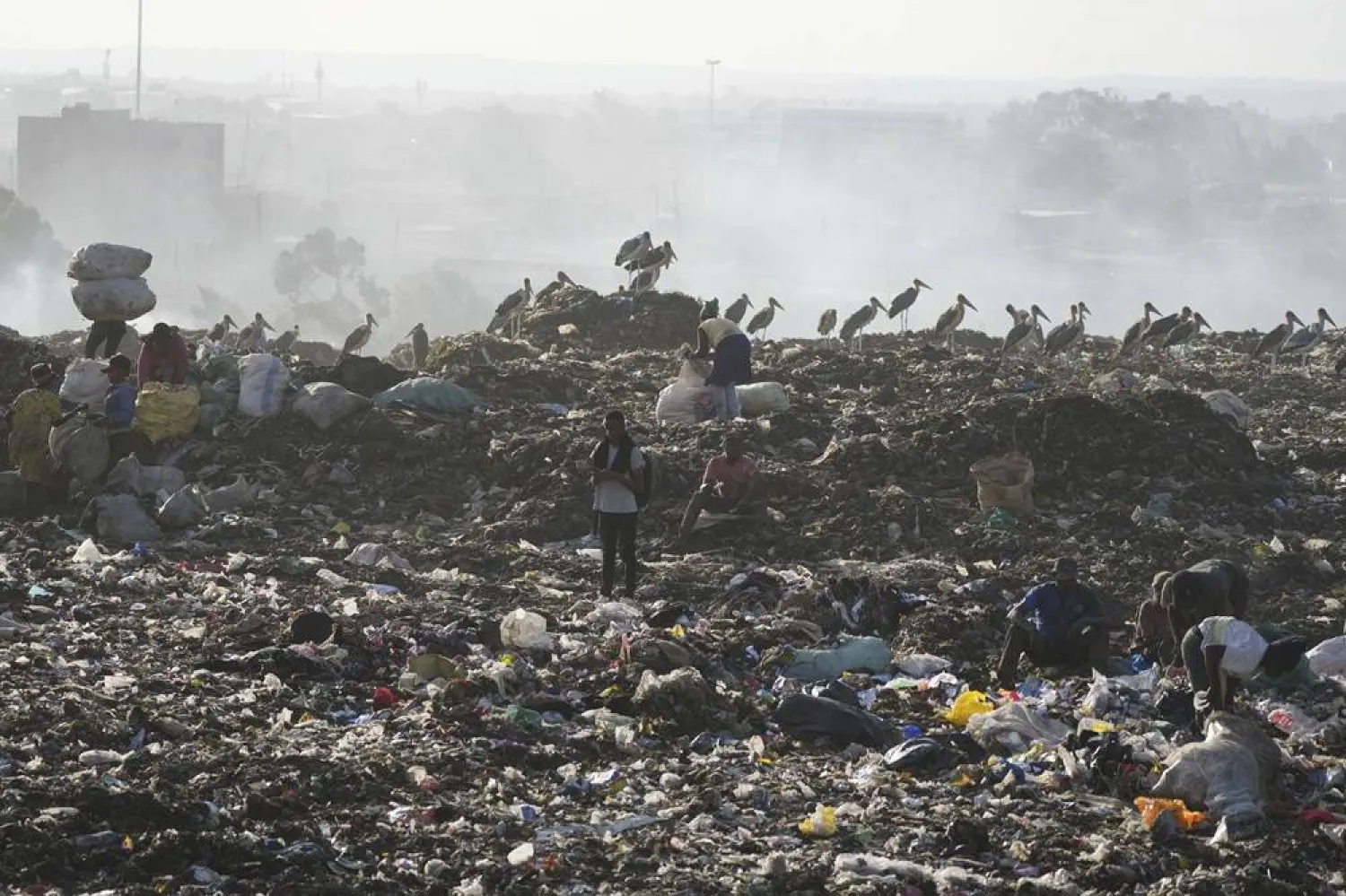
People scavenge recyclable materials for a living, past Marabou storks feeding on a mountain of garage at Dandora, the largest garbage dump in the capital Nairobi, Kenya Wednesday, March 20, 2024. (AP)
TT

UN Says E-waste from Trashed Electric Devices Is Piling up and Recycling Isn’t Keeping Pace

People scavenge recyclable materials for a living, past Marabou storks feeding on a mountain of garage at Dandora, the largest garbage dump in the capital Nairobi, Kenya Wednesday, March 20, 2024. (AP)

UN agencies have warned that waste from electronics is piling up worldwide while recycling rates remain low and are likely to fall even further.

The agencies were referring to "e-waste," which is defined as discarded devices with a plug or battery, including cellphones, electronic toys, TVs, microwave ovens, e-cigarettes, laptop computers and solar panels. It does not include waste from electronic vehicles, which fall into a separate category.

In a report released Wednesday, the UN’s International Telecommunications Union and research arm UNITAR said some 62 million tons of "e-waste" was generated in 2022, enough to fill tractor-trailers that could be lined up bumper to bumper around the globe. It’s on track to reach 82 million tons by 2030.

Metals — including copper, gold and iron — made up half of the 62 million tons, worth a total of some $91 billion, the report said. Plastics accounted for 17 million tons and the remaining 14 million tons include substances like composite materials and glass.

The UN says 22% of the e-waste mass was properly collected and recycled in 2022. It is expected to fall to 20% by the end of the decade because of "staggering growth" of such waste due to higher consumption, limited repair options, shorter product life cycles, growing "electronification" of society, and inadequate e-waste management infrastructure, the agencies said.

They said some of the discarded electronic devices contained hazardous elements like mercury, as well as rare Earth metals coveted by tech industry manufacturers. Currently, only 1% of the demand for the 17 minerals that make up the rare metals is met through recycling.

About half of all e-waste is generated in Asia, where few countries have laws on e-waste or collection targets, according to the report. Recycling and collection rates top 40% in Europe, where per-capita waste generation is highest: nearly 18 kilograms (39 pounds).

In Africa, which generates the least of any of the five big global regions, recycling and collection rates hover at about 1%, it said.

"The latest research shows that the global challenge posed by e-waste is only going to grow," said Cosmas Luckyson Zavazava, head of the ITU telecommunication development bureau. "With less than half of the world implementing and enforcing approaches to manage the problem, this raises the alarm for sound regulations to boost collection and recycling."

For some, e-waste represents a way to earn cash by rummaging through trash in the developing world to find coveted commodities, despite the health risks.

At the Dandora dumpsite where garbage collected from the Kenyan capital of Nairobi ends up — even though a court declared it full over a generation ago — scavengers try to earn a living by picking through rubbish for e-waste that can be sold to businesses as recycled material.

Steve Okoth hopes the flow continues so he can eke out an income, but he knows the risks.

"When the e-waste comes here, it contains some powder which affects my health," he said, adding that when electronic devices heat up, they release gases and he "can’t come to work because of chest problems."

However, Okoth said they don't have any other options: "We are now used to the smoke because if you don’t go to work you will not eat."

Recycling plants, like Nairobi’s WEEE center, have collection points across Kenya, where people can safely get rid of old electric equipment.

"We take inventory of the items," said Catherine Wasolia, WEEE's chief operating officer, to check for data on submitted devices and wipe them clean. Then they test each to assess if "it can be reused or repurposed."

E-waste expert George Masila worries about the impact of electronic waste on soil.

"When you have all this e-waste — either in the dumpsites or mercilessly deposited anywhere else — it could have major effects on the soil," Masila said. "Every year it rains and water flows and attracts all these elements that are deposited into the environment. You have water getting contaminated."

He said greater recycling and re-use of such materials, "are some of the things we should be considering."

Report authors acknowledged that many people in the developing world pay their bills through harvesting such e-waste, and called for them to be trained and equipped to make such work safer.

"We must try to support these people trying to find their niche," said Ruediger Kuehr, senior manager of the sustainable cycles program at UNITAR.



British Man Makes Artwork in Size of Human Blood Cell

David A Lindon's latest sculpture is the same size as a human blood cell, mould spores, bacteria, talcum powder or a fog droplet (David A Lindon)
TT

British Man Makes Artwork in Size of Human Blood Cell

David A Lindon's latest sculpture is the same size as a human blood cell, mould spores, bacteria, talcum powder or a fog droplet (David A Lindon)

A micro artist said he has beaten his own world record by creating the smallest handmade sculpture ever.

David A Lindon, from Bournemouth, Dorset, says his latest sculpture, The Yellow Smiley Face, is “invisible to the human eye,” with measurements of only 11.037 by 12.330 microns, according to BBC.

Lindon said his artwork lived on a first-class stamp on a micro dot on the eye of the late Queen.

It has now broken his previous smallest handmade sculpture world record, The Lego Brick.

Lindon, who has 12 Guinness World Records in total, is known for his work creating miniature pieces of art, including three microscopic re-creations of Van Gogh masterpieces on a watch mechanism which sold for £90,000.

The Red Lego Brick measures 0.02517mm by 0.02184mm.

“My Yellow Smiley Face artwork is half the size of my Red Lego Brick artwork, which in turn was already four times smaller than the previous record,” the artist said.

He said it was the same size as either a human blood cell, mould spores, bacteria, talcum powder and a fog droplet.

Other of Lindon's tiny creations include unique animals crafted within the eye of a needle, from a blue whale to a delicate peacock butterfly.

“I probably am completely bonkers,” he jokes.

The stamp where Yellow Smiley Face lives is mounted on a glass tower and housed inside a sealed glass box.


Israel Cleared to Stay in Eurovision; Spain, Ireland and Others Quit in Protest

Pro-Palestinian protestors hold a flag and a banner outside the RTE (Radio Telefis Eireann) Irish public service broadcaster television studios as demonstrators call for an Irish boycott of the 2026 Eurovision Song Contest if there is Israeli participation, in Dublin, Ireland, November 1, 2025. (Reuters)
TT

Israel Cleared to Stay in Eurovision; Spain, Ireland and Others Quit in Protest

Pro-Palestinian protestors hold a flag and a banner outside the RTE (Radio Telefis Eireann) Irish public service broadcaster television studios as demonstrators call for an Irish boycott of the 2026 Eurovision Song Contest if there is Israeli participation, in Dublin, Ireland, November 1, 2025. (Reuters)

Israel was cleared on Thursday to enter the 2026 Eurovision Song Contest by the organizer, prompting Spain, the Netherlands, Ireland and Slovenia to withdraw over the Gaza war and plunging the competition into one of the biggest rows in its history.

The broadcasters who had threatened to boycott the event cited the death count in Gaza and accused Israel of flouting rules meant to guard the contest's neutrality. Israel accuses its critics of mounting a global smear campaign against it.

After a meeting in Geneva, the European Broadcasting Union, or EBU, decided not to call a vote on Israel's participation, saying it had instead passed new rules aimed at discouraging governments from influencing the contest, Reuters said.

Right after that announcement by the contest organizer, the Dutch, Spanish, Irish and Slovenian broadcasters said they would withdraw, meaning singers from their countries would not compete in the contest that draws millions of viewers worldwide.

Ben Robertson, a Eurovision expert from fan website ESC Insight, said the contest's integrity was at its lowest ebb.

"Never in the history of the contest have we had such a vote, and such a split, between the member broadcasters of the European Broadcasting Union," he said.

Both the Israeli government and opposition leaders celebrated the country's inclusion.

Golan Yochpaz, CEO of Israeli broadcaster KAN, likened the efforts to exclude Israel to a form of "cultural boycott."

Rounding on the countries withdrawing, Foreign Minister Gideon Saar said on X: "The disgrace is upon them."

IRELAND SAYS ITS PARTICIPATION 'UNCONSCIONABLE'

The Eurovision Song Contest dates back to 1956 and reaches around 160 million viewers, according to the EBU - more than the almost 128 million recorded for this year's US Super Bowl, according to figures from Nielsen.

Israel's participation has divided opinion in the competition that has a history of entanglement in national rivalries, international issues and political voting.

Its 2025 entrant, Yuval Raphael, was at the Nova music festival, a target of the October 7, 2023 attack by Palestinian group Hamas on Israel that triggered the Gaza war.

A total of 1,200 people were killed and 251 taken hostage in the assault by Hamas, according to Israeli tallies. More than 70,000 people have been killed in Gaza in the ensuing conflict, according to health authorities in the enclave.

Irish broadcaster RTE said it felt "Ireland's participation remains unconscionable given the appalling loss of lives in Gaza and the humanitarian crisis there which continues to put the lives of so many civilians at risk".

Jose Pablo Lopez, head of Spanish state broadcaster RTVE said on X: "What happened in the EBU Assembly confirms that Eurovision is not a song contest but a festival dominated by geopolitical interests and fractured."

RTV Slovenija said it together with Spain, Montenegro, the Netherlands, Türkiye, Algeria and Iceland requested a secret vote on Israel's participation, but it was not held.

Icelandic public broadcaster RUV said its board will make a decision on Wednesday on whether to participate in the next Eurovision, which will be held in Vienna in May.

"I feel sad that other countries are not going to compete next year," said 33-year-old Tel Aviv Eurovision fan Jurij Vlasov, adding the Netherlands' song this year was his favorite.

In Austria, which backed Israel, Eurovision fans welcomed its inclusion, even as some in Spain took the opposite view.

"Why should the population, or a part of the population, not participate?," said Vienna resident Bernhard Kleemann. "If countries decide not to participate because they condemn the government and the prime minister, that's their decision."

"BORN FROM THE ASHES OF THE SECOND WORLD WAR"

Instead of voting on Israel, the EBU said its members backed rules intended to discourage governments and third parties from disproportionately promoting songs to sway voters after allegations that Israel unfairly boosted its 2025 entrant.

"This vote means that all EBU Members who wish to participate in the Eurovision Song Contest 2026 and agree to comply with the new rules are eligible to take part," it said.

Israel's President Isaac Herzog thanked his country's supporters, saying he hoped the song contest would continue to champion "culture, music, friendship between nations".

Germany, a major Eurovision backer, had signaled it would not take part if Israel was barred. Germany's culture minister Wolfram Weimer told the Bild newspaper he welcomed the decision.

"Israel belongs to the Eurovision Song Contest like Germany belongs to Europe," he said.

Martin Green, the contest's director, said EBU members showed they wanted to protect the neutrality of the competition.

"Eurovision was born from the ashes of the Second World War," he said. "It was designed to bring us together, and it will hit bumps in the road, and we have a complicated world, but we hope it's a temporary situation, and we'll move forward."


Study Says African Penguins Starved En Masse Off South Africa

Yellow-eyed penguins fights in their colony in Katiki Point, on the southern end of the Moeraki Peninsula in New Zealand's South Island, about 80 kilometers north of Dunedin on November 12, 2025. (Photo by Sanka VIDANAGAMA / AFP)
TT

Study Says African Penguins Starved En Masse Off South Africa

Yellow-eyed penguins fights in their colony in Katiki Point, on the southern end of the Moeraki Peninsula in New Zealand's South Island, about 80 kilometers north of Dunedin on November 12, 2025. (Photo by Sanka VIDANAGAMA / AFP)

Endangered penguins living off South Africa's coast have likely starved en masse due to food shortages, a study said Friday, with some populations dropping by 95 percent in just eight years.

Fewer than 10,000 breeding pairs of the small, black and white African Penguin are left globally, according to scientists, and the species was listed as critically endangered last year by the International Union for Conservation of Nature (IUCN).

Two of the most important breeding colonies near Cape Town had collapsed between 2004 and 2011, with some 62,000 birds estimated to have died, the study by the UK's University of Exeter and the South African Department of Forestry, Fisheries and the Environment said.

In those eight years, sardine populations in South African waters -- a main food source for penguins -- were consistently below 25 percent of their peak abundance, Agence France Presse quoted co-author and biologist Richard Sherley as saying.

This drop in sardine stocks was due to fishing practices combined with environmental causes such as changes in water temperatures and salinity.

This "appears to have caused severe food shortage for African penguins, leading to an estimated loss of about 62,000 breeding individuals", Sherley said.

The global population of the species had declined by nearly 80 percent in the past 30 years, the scientists said.

Conservationists say that at the current rate of population decrease, the bird could be extinct in the wild by 2035.

For 10 years, authorities have imposed a commercial fishing ban around six penguin colonies, including Robben and Dassen islands, the two sites observed in the study.

Other initiatives underway include artificial nests and creating new colonies.

The birds are a strong attraction for tourists to South Africa, with thousands of people visiting colonies each year.

But the pressure from tourism also disturbs the birds and causes enhanced stress.