Even in the Age of Google Earth, People Still Buy Globes

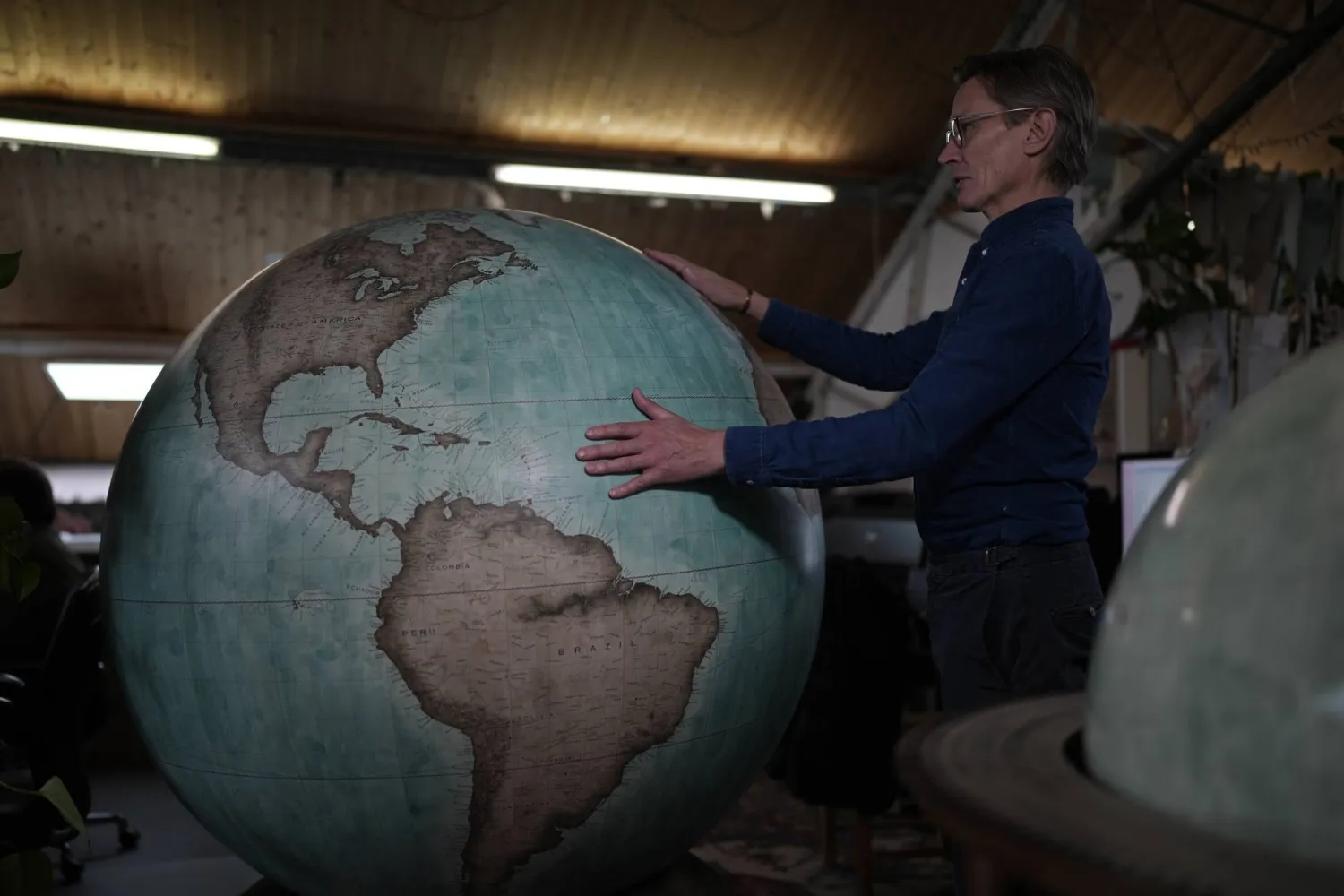
Peter Bellerby, the founder of Bellerby & Co. Globemakers, holds a globe at a studio in London, Tuesday, Feb. 27, 2024. (AP Photo/Kin Cheung)
TT

Even in the Age of Google Earth, People Still Buy Globes

Peter Bellerby, the founder of Bellerby & Co. Globemakers, holds a globe at a studio in London, Tuesday, Feb. 27, 2024. (AP Photo/Kin Cheung)

Find a globe in your local library or classroom and try this: Close the eyes, spin it and drop a finger randomly on its curved, glossy surface.
You’re likely to pinpoint a spot in the water, which covers 71% of the planet. Maybe you’ll alight on a place you’ve never heard of — or a spot that no longer exists after a war or because of climate change. Perhaps you’ll feel inspired to find out who lives there and what it's like. Look carefully, and you'll find the cartouche — the globemaker's signature — and the antipode ( look it up ) of where you're standing right now, The Associated Press reported.
In the age of Google Earth, watches that triangulate and cars with built-in GPS, there's something about a globe — a spherical representation of the world in miniature — that somehow endures, AP said.
London globemaker Peter Bellerby thinks the human yearning to “find our place in the cosmos” has helped globes survive their original purpose — navigation — and the internet. He says it's part of the reason he went into debt making a globe for his father's 80th birthday in 2008. The experience helped inspire his company, and 16 years later is keeping his team of about two dozen artists, cartographers and woodworkers employed.
“You don’t go onto Google Earth to get inspired,” Bellerby says in his airy studio, surrounded by dozens of globes in various languages and states of completion. “A globe is very much something that connects you to the planet that we live on.”
Or, as Scottish-born American explorer John Muir wrote in 1915: “When we contemplate the whole globe as one great dewdrop, striped and dotted with continents and islands, flying through space with other stars all singing and shining together as one, the whole universe appears as an infinite storm of beauty.”
BUILDING A GLOBE AMID BREAKNECK CHANGE? Beyond the existential and historical appeal, earthly matters such as cost and geopolitics hover over globemaking. Bellerby says his company has experience with customs officials in regions with disputed borders such as India, China, North Africa and the Middle East.
And there is a real question about whether globes — especially handmade orbs — remain relevant as more than works of art and history for those who can afford them. They are, after all, snapshots of the past — of the way their patrons and makers saw the world at a certain point in time. So they're inherently inaccurate representations of a planet in constant flux.
“Do globes play a relevant role in our time? If so, then in my opinion, this is due to their appearance as a three-dimensional body, the hard-to-control desire to turn them, and the attractiveness of their map image,” says Jan Mokre, vice president of the International Coronelli Society for the Study of Globes in Vienna. “Perhaps a certain nostalgia effect also plays a role, just as old cars and mechanical watches still exert a certain attraction on people.”
Joshua Nall, Director of the Whipple Museum of the History of Science in Cambridge, says a globe remains a display of “the learning, the erudition, the political interests of its owner.”
“Sadly, I think globe usage probably is declining, perhaps particularly in the school setting, where digital technologies are taking over,” Nall says. “I think now they’re perhaps more becoming items of overt prestige. They’re being bought as display pieces to look beautiful, which of course they always have been.”
HOW, AND HOW MUCH? Bellerby's globes aren't cheap. They run from about 1,290 British pounds (about $1,900) for the smallest to six figures for the 50-inch Churchill model. He makes about 600 orbs a year of varying size, framing and ornamentation.
Creating them is a complex process that starts with the construction of a sphere and progresses to the application of fragile petal-shaped panels, called “gores,” that are fitted together around the sphere's surface. Artists perched around Bellerby's London studio painstakingly blend and apply paint — dreamy cobalt and mint for the oceans, yellow, greens and ochre for the landscape.
The imagery painted on the globes runs the gamut, from constellations to mountains and sea creatures. And here, The Associated Press can confirm, be dragons.
WHO BUYS A GLOBE THESE DAYS? Bellerby doesn't name clients, but he says they come from more socioeconomic levels than you'd think — from families to businesses and heads of state. Private art collectors come calling. So do moviemakers.
Bellerby says in his book that the company made four globes for the 2011 movie, “Hugo.” One globe can be seen in the 2023 movie “Tetris," including one, a freestanding straight-leg Galileo model, which features prominently in a scene.
And yes, some of the planet's wealthiest people buy them.



Winter at Tantora Festival Kicks Off in AlUla

The 2025–2026 season features a diverse array of immersive experiences - SPA
TT

Winter at Tantora Festival Kicks Off in AlUla

The 2025–2026 season features a diverse array of immersive experiences - SPA

The Winter at Tantora Festival launched yesterday in AlUla Governorate and will run until January 10, 2026, marking the beginning of the winter season with a rich program that celebrates the region’s deep-rooted agricultural and historical heritage.

The festival derives its name from the Tantora, a traditional mudbrick sundial located in the heart of AlUla’s Old Town. For centuries, local farmers and residents relied on this stone marker to tell time, manage water distribution rights, and signal the start of the winter planting season, SPA reported.

The 2025–2026 season features a diverse array of immersive experiences. "Old Town Nights" offers an atmospheric evening of heritage storytelling and fine dining at the historic AlUla Fort, while the "AlManshiyah Carnival" creates a festive space for families with traditional games and parades.

Music remains a central pillar of the festival, with performances set against AlUla’s most iconic backdrops. The "Shorfat Tantora" (Tantora Balconies) series brings live music to the rooftops of the AlJadidah Arts District, while major concerts are scheduled at the Maraya mirrored hall and the Thanaya open-air amphitheater.

These events are part of the broader AlUla Moments calendar, supporting the goals of Saudi Vision 2030 to highlight the Kingdom's heritage and establish AlUla as a premier global destination.


Warm Weather and Low Snowpack Bedevil Western Ski Resorts

Only a small percentage of lifts were open and snow depths were well below average at Lake Tahoe resorts, just one example of warm weather causing well-below-average snowpack in almost all of the West. -File Photo/The AP news
TT

Warm Weather and Low Snowpack Bedevil Western Ski Resorts

Only a small percentage of lifts were open and snow depths were well below average at Lake Tahoe resorts, just one example of warm weather causing well-below-average snowpack in almost all of the West. -File Photo/The AP news

Ski resorts are struggling to open runs, walk-through ice palaces can’t be built, and the owner of a horse stable hopes that her customers will be satisfied with riding wagons instead of sleighs under majestic Rocky Mountain peaks. It’s just been too warm in the West with not enough snow.

Meanwhile, the Midwest and Northeast have been blanketed by record snow this December, a payday for skiers who usually covet conditions out West, The AP news reported.

In the Western mountains where snow is crucial for ski tourism — not to mention water for millions of acres (hectares) of crops and the daily needs of tens of millions of people — much less snow than usual has piled up.

“Mother Nature has been dealing a really hard deck,” said Kevin Cooper, president of the Kirkwood Ski Education Foundation, a ski racing organization at Lake Tahoe on the California-Nevada line.

Only a small percentage of lifts were open and snow depths were well below average at Lake Tahoe resorts, just one example of warm weather causing well-below-average snowpack in almost all of the West.

In Utah, warmth has indefinitely postponed this winter’s Midway Ice Castles, an attraction 45 minutes east of Salt Lake City that requires cold temperatures to freeze water into building-size, palatial features. Temperatures in the area that will host part of the 2034 Winter Olympics have averaged 7-10 degrees (3-5 degrees Celsius) above normal in recent weeks, according to the National Weather Service.

Near Vail, Colorado, Bearcat Stables owner Nicole Godley hopes wagons will be a good-enough substitute for sleighs for rides through mountain scenery.

“It’s the same experience, the same ride, the same horses,” Godley said. “It’s more about, you know, just these giant horses and the Western rustic feel.”

In the Northwest, torrential rain has washed out roads and bridges and flooded homes. Heavy mountain snow finally arrived late this week in Washington state but flood-damaged roads that might not be fixed for months now block access to some ski resorts.

In Oregon, the Upper Deschutes Basin has had the slowest start to snow accumulation in records dating to 1981. Oregon, Idaho and western Colorado had their warmest Novembers on record, with temperatures ranging from 6-8.5 degrees (2-4 degrees Celsius) warmer than average, according to the National Oceanic and Atmospheric Administration.

Continued warmth could bring yet another year of drought and wildfires to the West. Most of the region except large parts of Colorado and Oregon has seen decent precipitation but as rain instead of snow, pointed out NOAA drought information coordinator Jason Gerlich.

That not only doesn’t help skiers but farmers, ranchers and people from Denver to Los Angeles who rely on snowpack water for their daily existence. Rain runs off all at once at times when it's not necessarily needed.

“That snowpack is one of our largest reservoirs for water supply across the West,” Gerlich said.

Climate scientists agree that limiting global warming is critical to staving off the snow-to-rain trend.

In the northeastern U.S., meanwhile, below-normal temperatures have meant snow instead of rain. Parts of Vermont have almost triple and Ohio double the snowfall they had this time last year.

Vermont’s Killington Resort and Pico Mountain, had about 100 trails open for “by far the best conditions I have ever seen for this time of year,” said Josh Reed, resort spokesman who has lived in Killington for a decade.

New Hampshire ski areas opening early include Cannon Mountain, with over 50 inches (127 centimeters) to date. In northern Vermont, Elena Veatch, 31, already has cross-country skied more this fall than she has over the past two years.

“I don’t take a good New England winter for granted with our warming climate,” Veatch said.

Out West, it's still far too early to rule out hope for snow. A single big storm can “turn things around rather quickly,” pointed out Gerlich, the NOAA coordinator.

Lake Tahoe's snow forecast over Thanksgiving week didn't pan out but Cooper with the ski racing group is eyeing possibly several feet (1-2 meters) in the long-term forecast.

“That would be so cool!” Cooper said.


Trump Urges 2028 Astronaut Moon Landing in Sweeping Space Policy Order

FILE PHOTO: US President Donald Trump poses on the red carpet for the 2025 Kennedy Center Honors at the John F. Kennedy Center for the Performing Arts in Washington, D.C., US, December 7, 2025. REUTERS/Jeenah Moon/File Photo
TT

Trump Urges 2028 Astronaut Moon Landing in Sweeping Space Policy Order

FILE PHOTO: US President Donald Trump poses on the red carpet for the 2025 Kennedy Center Honors at the John F. Kennedy Center for the Performing Arts in Washington, D.C., US, December 7, 2025. REUTERS/Jeenah Moon/File Photo

President Donald Trump enshrined the US goal to put humans back on the moon by 2028 and defend space from weapon threats in a sweeping executive order issued on Thursday, the first major space policy move of his administration's second term.

The order, issued hours after billionaire private astronaut and former SpaceX customer Jared Isaacman was sworn in as NASA's 15th administrator, also reorganized national space policy coordination under Trump's chief science adviser, Michael Kratsios, Reuters reported.

Titled "ENSURING AMERICAN SPACE SUPERIORITY," the order calls on the Pentagon and US intelligence agencies to create a space security strategy, urges efficiency among private contractors and seeks demonstrations of missile-defense technologies under Trump's Golden Dome program.

It appeared to ‌cancel the White ‌House's top space policy-coordinating body, the National Space Council, a ‌panel ⁠of cabinet members that ‌the president revived during his first term and has considered axing this year.

But an adminitration official said it would not be cancelled and suggested it would live on under the White House's Office of Technology Policy with a different structure in which the president, rather than the vice president, would be chairman.

The goal to land humans on the moon by the end of Trump's second term in 2028 bears resemblance to the president's 2019 directive in his first term to make a lunar return by 2024, putting the ⁠moon at the center of US space exploration policy with a timeline many in the industry regarded as unrealistic. Development and testing ‌delays with NASA’s Space Launch System and SpaceX’s Starship gradually pushed ‍that landing target date back.

NASA's goal had been ‍2028 under former president Barack Obama.

A 2028 astronaut moon landing would be ‍the first of many planned under NASA's Artemis effort to build a long-term presence on the lunar surface. The US is in competition with China, which is targeting 2030 for its first crewed moon landing. The order on Thursday called for "establishment of initial elements of a permanent lunar outpost by 2030," reinforcing NASA's existing goal to develop long-term bases with nuclear power sources.

At the start of his second term, Trump had repeatedly talked about sending missions to Mars as Elon Musk, a major donor ⁠who has made sending humans to the Red Planet a priority for his company SpaceX, served a stint as a close adviser and powerful government efficiency czar. But lawmakers in Congress this year have slowly put the moon back in focus, pressuring then-NASA nominee Isaacman to stick with the agency's moon program on which billions of dollars have been spent.

The White House, in a government efficiency push led by Musk, slashed NASA's workforce by 20% and has sought to cut the agency's 2026 budget by roughly 25% from its usual $25 billion, imperiling dozens of space-science programs that scientists and some officials regard as priorities.

Isaacman, who plans to give his first agency-wide address to NASA employees on Friday, has said he believes the space agency should try to target both the moon and Mars simultaneously while prioritizing a lunar return in ‌order to beat China.

The 2028 moon-landing target depends heavily on the development progress of SpaceX's giant Starship lander, which has been criticized by NASA's former acting administrator for moving too slowly.