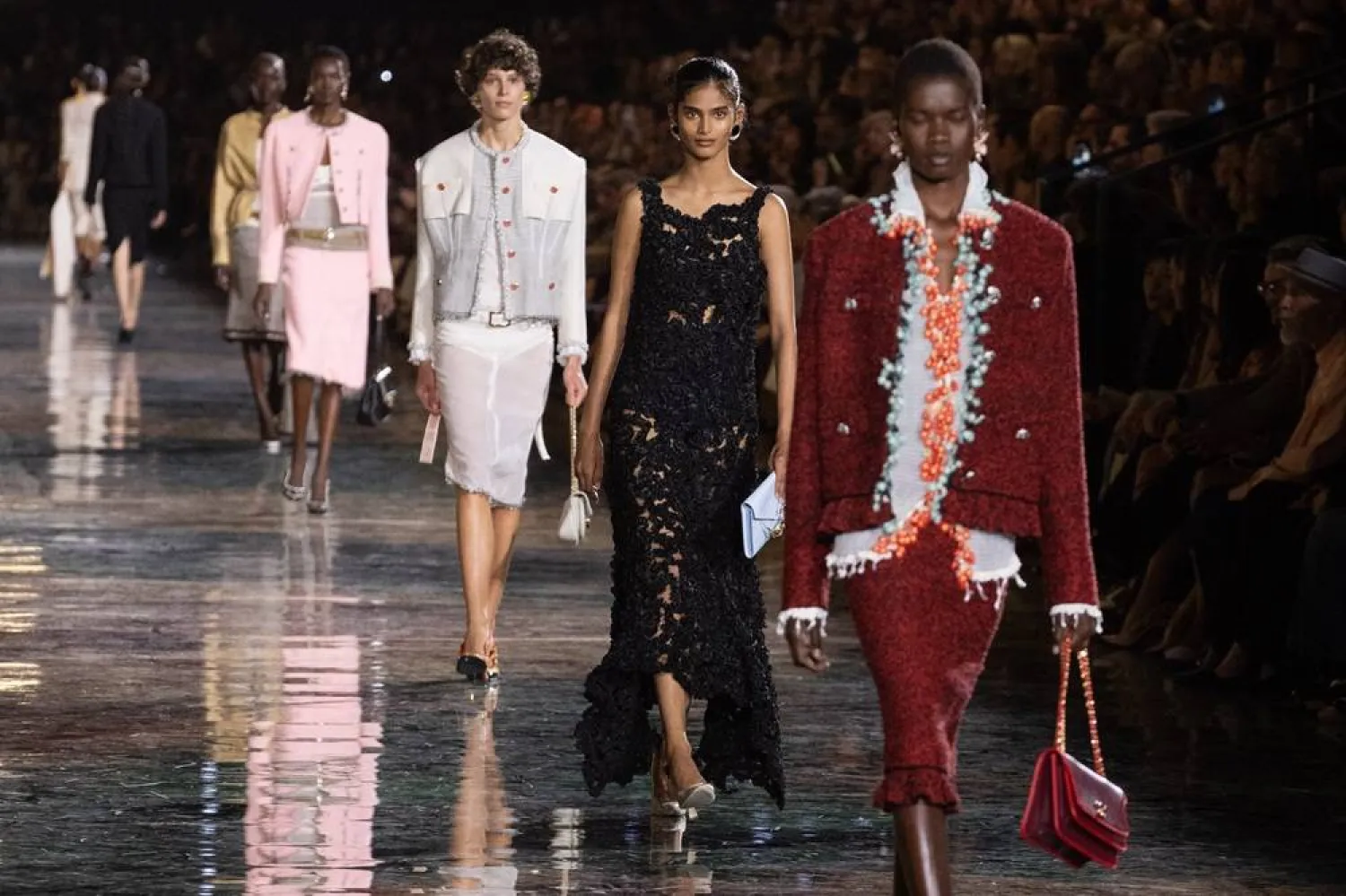
Saudi Arabia’s Fashion Industry Valued at $24 Billion in Q1 2024

Visitors are seen at an exhibition organized by the Saudi Fashion Commission in Riyadh in March. (SPA)
TT

Saudi Arabia’s Fashion Industry Valued at $24 Billion in Q1 2024

Visitors are seen at an exhibition organized by the Saudi Fashion Commission in Riyadh in March. (SPA)

The total value of the fashion industry in Saudi Arabia reached SAR 92.3 billion ($24.6 billion) during the first quarter of 2024, with local fashion accounting for SAR 46.9 billion ($12.5 billion), according to a report by the General Authority for Small and Medium Enterprises (Monsha’at).

The value of spending on imported brands amounted to SAR 27.4 billion ($7.3 billion), increasing the expected cumulative growth of the fashion sector by 48 percent between 2021 and 2025.

In its report for the first quarter of 2024, Monsha’at highlighted the importance of the fashion sector in the Kingdom and the great investment opportunities available to entrepreneurs.

In his opening letter of the report, CEO of the Fashion Commission Burak Cakmak said the future of fashion in Saudi Arabia will witness further progress and prosperity thanks to the Kingdom’s designers and the visions of its entrepreneurs that will leave an impact on the global fashion scene.

The report featured an interview with Saud Al-Sabhan, Deputy Governor for Entrepreneurship at Monsha’at, who emphasized the Authority’s role in supporting entrepreneurs and owners of SMEs through various programs and initiatives.

CEO and Founder of MAGNiTT Philip Bahoshy said the Kingdom continued to excel in the volume of venture capital investments at the beginning of 2024, with investments worth a total of SAR 900 million ($240 million).

He added that Saudi Arabia has the largest share of the volume of venture capital investments in the Middle East and North Africa region, at 65 percent.

The report reviewed success stories of male and female entrepreneurs in the field, including Princess Deemah bint Mansour bin Saud al-Saud, the founder of Personage, designer Mohammed Khoja, co-founder of Hindamme, and others.


Naomi Osaka Shows off Another Fashion Creation Before Reaching 3rd Round at Wimbledon

Naomi Osaka of Japan arrives in court for her Women's Singles second round match against Anastasia Gasanova of Russia at the Wimbledon Championships in London, Britain, 01 July 2026. (EPA)
TT

Naomi Osaka Shows off Another Fashion Creation Before Reaching 3rd Round at Wimbledon

Naomi Osaka of Japan arrives in court for her Women's Singles second round match against Anastasia Gasanova of Russia at the Wimbledon Championships in London, Britain, 01 July 2026. (EPA)

Naomi Osaka had a new look to show off before winning her second-round match at Wimbledon.

Osaka, whose fashion reveals have become an event of their own at Grand Slam tournaments, wore a less elaborate outfit for her walk-on than the “Kill Bill” inspired kimono for her opening-round match on Monday.

This all-white outfit featured a wide belt and a long train behind her. It drew plenty of attention as she made the walk from the locker room to No. 2 Court, trailed by photographers and fans wanting to take their own photos. The four-time major winner took off the latest ensemble as she began warming up for her match against qualifier Anastasia Gasanova.

She went on to quickly dispatch Gasanova 6-3, 6-2.

“I'm just trying to mix it up a little bit,” Osaka said about her outfit, adding she had been worried that a loss might have ruined her daughter Shai's third birthday on Thursday.

“I just wanted to be here for longer, I didn't want to make her get on a plane on her birthday,” Osaka said.

Osaka's match was among the early starts on the outside courts as the second round got underway.


Nike Stumbles as China Woes, Cautious Outlook Temper Turnaround Hopes

World Cup uniform kits designed by Nike are displayed at its headquarters in Beaverton, Ore., on June 22, 2026. (AP)
TT

Nike Stumbles as China Woes, Cautious Outlook Temper Turnaround Hopes

World Cup uniform kits designed by Nike are displayed at its headquarters in Beaverton, Ore., on June 22, 2026. (AP)

Nike shares fell ‌3.5% in pre-market trading on Wednesday after its latest quarterly results failed to revive investor hopes of a swift turnaround under CEO Elliot Hill.

A cautious sales outlook and weak China demand overshadowed a modest fourth-quarter revenue beat, which also dragged down shares of European peers Adidas and Puma, dropping more than 1% each.

Investors were awaiting Nike's results to see if Hill's nearly two-year turnaround was reaping significant results.

The world's largest sportswear maker has been struggling to regain momentum after losing market share to rivals, as ‌well as rebuild ‌wholesale relationships, and clear older lifestyle inventory. The ‌stock ⁠has already fallen ⁠about 35% this year.

The sportswear giant's fourth-quarter revenue fell 1%, with double-digit sales declines in China, which did little to reassure investors.

Nike also projected a further revenue drop through the first half of fiscal 2027 as it navigates tariff pressures, geopolitical uncertainty and cautious consumer spending.

"Revenue declines through H1 mean no ⁠earnings growth until at least H2'27 as Nike prioritizes ‌marketplace health over near-term sales — a ‌good decision for the company but not for rapid recovery of ‌the stock," Bernstein analysts said.

CHINA REMAINS A DRAG

China revenue ‌would likely stay under pressure as Nike works with retail partners to clear excess inventory, outgoing finance chief Matthew Friend said.

Greater China accounts for about 15% of Nike's annual revenue and is its third-largest market ‌after North America and Europe, the Middle East, and Africa.

Some analysts said Nike's China reset ⁠shows some ⁠signs of progress, but near-term sales are likely to remain subdued as the company focuses on rebuilding growth through a more premium, sports-led approach.

Nike plans to launch more than a dozen footwear styles, Hill said, adding that it will take time for those products to deliver consistent results, which some analysts expect to help the company's turnaround in 2027.

The company, however, pointed to early progress, citing stronger World Cup marketing, faster product launches and improving football demand after an April slowdown, while forecasting a slightly positive first-quarter gross margin.

The company's forward price-to-earnings multiple is 21.95, compared with 16.81 for Adidas, according to LSEG data.


French Parliament Adopts Bill to Regulate Fast Fashion

This photograph shows the logo of Asian e-commerce giant Shein in its stall at the Bazar de l'Hotel de Ville (BHV) department store in Paris on November 4, 2025, on the eve of the opening of its first physical store at BHV in Paris. (AFP)
TT

French Parliament Adopts Bill to Regulate Fast Fashion

This photograph shows the logo of Asian e-commerce giant Shein in its stall at the Bazar de l'Hotel de Ville (BHV) department store in Paris on November 4, 2025, on the eve of the opening of its first physical store at BHV in Paris. (AFP)

The French parliament on Monday passed a bill aimed at curbing the rise of fast fashion, targeting major Asian e-commerce platforms, such as Shein and Temu.

The legislation, first tabled two-and-a-half years ago, seeks to regulate so-called "ultra-fast fashion" companies, known for selling large volumes of lower quality clothing at rock-bottom price.

Easy to order and replace, fast fashion items contribute to pollution from the textile industry, which accounts for nearly 10 percent of global greenhouse gas emissions.

The Senate passed the bill Monday after the lower house National Assembly did last week.

It imposes a per-item fee for producing textile en masse that will increase over time, and a ban on advertising for ultra-fast fashion brands, including by social media influencers.

Lawmakers hope to rein in Asian e-commerce companies that have exploded in popularity in France in recent years.

Trade Minister Serge Papin last week said the bill would target the main players, including three companies, which he said are driving the surge in ultra-fast fashion.

"Their names, which were still unknown three years ago... are now on everyone's lips in France: Temu, Shein and AliExpress," he said at the time.

But some have criticized the legislation for sparing European and French companies, such as Zara and Kiabi, with some leftist lawmakers in both chambers abstaining during the vote.

Green Party lawmaker Charles Fournier said last week the original bill had been "considerably scaled back", arguing that brands, such as Zara and H&M "have not become models of sustainable fashion".

Stop Fast Fashion, a coalition of organizations, also criticized what it called as a "greatly watered-down" version compared to the one originally put forward.

- Advertising ban doubts -

Anne-Cecile Violland, the center-right member of parliament who proposed the bill, said they needed legislation that could be passed "very quickly and be operational".

"We're coming down very hard on Shein, and that's the first step," she told AFP, adding she understood the disappointment.

The legislation targets ultra-fast fashion based on two criteria: the volume of clothing placed on the market and the cost of repairing garments relative to their purchase price.

The per-item fee will vary on a set scale according to how each brand scores on both these standards.

The levy could reach up to 20 euros ($23) per item by 2030, though the cap remains at 50 percent of the product's pre-tax price.

Part of these penalties will go towards collection and recycling infrastructure.

The legislation also requires ultra-fast fashion companies to display messages on their websites promoting more moderate consumption, including reusing and repairing clothing.

A ban on advertising, including by influencers, is a central plank of the bill, though questions remain over how it could be enforced.