

At a factory in Zhejiang province on China’s eastern coast, two mounds of discarded cotton clothing and bed linens, loosely separated into dark and light colors, pile up on a workroom floor. Jacket sleeves, collars and brand labels protrude from the stacks as workers feed the garments into shredding machines.
It’s the first stage of a new life for the textiles, part of a recycling effort at the Wenzhou Tiancheng Textile Company, one of the largest cotton recycling plants in China, The Associated Press reported.
Textile waste is an urgent global problem, with only 12% recycled worldwide, according to fashion sustainability nonprofit Ellen MacArthur Foundation. Even less — only 1% — are castoff clothes recycled into new garments; the majority is used for low-value items like insulation or mattress stuffing.
Nowhere is the problem more pressing than in China, the world’s largest textile producer and consumer, where more than 26 million tons of clothes are thrown away each year, according to government statistics. Most of it ends up in landfills.
And factories like this one are barely making a dent in a country whose clothing industry is dominated by “fast fashion” — cheap clothes made from unrecyclable synthetics, not cotton. Produced from petrochemicals that contribute to climate change, air and water pollution, synthetics account for 70% of domestic clothing sales in China.
China's footprint is worldwide: E-commerce juggernaut brands Shein and Temu make the country one of the world’s largest producers of cheap fashion, selling in more than 150 countries.
To achieve a game-changing impact, what fashion expert Shaway Yeh calls “circular sustainability” is needed among major Chinese clothing brands so waste is avoided entirely.
“You need to start it from recyclable fibers and then all these waste textiles will be put into use again,” she said.
But that is an elusive goal: Only about 20% of China’s textiles are recycled, according to the Chinese government — and almost all of that is cotton.
Chinese cotton is not without a taint of its own, said Claudia Bennett of the nonprofit Human Rights Foundation. Much of it comes from forced labor in Xinjiang province by the country's ethnic Uyghur minority.
"One-in-five cotton garments globally is linked to Uyghur forced labor,” Bennett said.
In May, the US blocked imports from 26 Chinese cotton traders and warehouses to avoid goods made with Uyghur forced labor. But because the supply chain is so sketchy, Uyghur cotton is used in garments produced in other countries that don't bear the “made-in-China” label, Bennett said.
“Many, many, many clothing brands are linked to Uyghur forced labor through the cotton," she said. They "hide behind the lack of transparency in the supply chain.”
While China is a global leader in the production of electric cars and electric-powered public transit and has set a goal of achieving carbon neutrality by 2060, its efforts in promoting fashion sustainability and recycling textiles have taken a back seat.
According to a report this year from independent fashion watchdog Remake assessing major clothing companies on their environmental, human rights and equitability practices, there's little accountability among the best-known brands.
The group gave Shein, whose online marketplace groups about 6,000 Chinese clothing factories under its label, just 6 out of a possible 150 points. Temu scored zero.
Also getting zero were US label SKIMS, co-founded by Kim Kardashian, and low-price brand Fashion Nova. US retailer Everlane was the highest-scorer at 40 points, with only half of those for sustainability practices.
China’s domestic policy doesn’t help.
Cotton recycled from used clothing is banned from being used to make new garments inside China. This rule was initially aimed at stamping out fly-by-night Chinese operations recycling dirty or otherwise contaminated material.
But now it means the huge spools of tightly woven rope-like cotton yarn produced at the Wenzhou Tiancheng factory from used clothing can only be sold for export, mostly to Europe.
Making matters worse, many Chinese consumers are unwilling to buy used items anyway, something the Wenzhou factory sales director, Kowen Tang, attributes to increasing household incomes.
“They want to buy new clothes, the new stuff,” he said of the stigma associated with buying used.
Still, among younger Chinese, a growing awareness of sustainability has contributed to the emergence of fledgling “remade” clothing businesses.
Thirty-year-old designer Da Bao founded Times Remake in 2019, a Shanghai-based brand that takes secondhand clothes and refashions them into new garments. At the company's work room in Shanghai, tailors work with secondhand denims and sweatshirts, stitching them into funky new fashions.
The venture, which began with Da Bao and his father-in-law posting their one-off designs online, now has a flagship store in Shanghai’s trendy Jing’an District that stocks their remade garments alongside vintage items, such as Levi’s and Carhartt jackets.
The designs are “a combination of the past style and current fashion aesthetic to create something unique,” Bao said.
Zhang Na has a fashion label, Reclothing Bank, that sells clothes, bags and other accessories made from materials such as plastic bottles, fishing nets and flour sacks.
The items' labels have QR codes that show their composition, how they were made and the provenance of the materials. Zhang draws on well-established production methods, such as textile fibers made from pineapple leaf, a centuries-old tradition originating in the Philippines.
“We can basically develop thousands of new fabrics and new materials,” she said.
Reclothing Bank began in 2010 to give “new life to old things,” Zhang said of her store in a historic Shanghai alley with a mix of Western and Chinese architecture. A large used clothes deposit box sat outside the entrance.
“Old items actually carry a lot of people’s memories and emotions,” she said.
Zhang said she has seen sustainability consciousness grow since she opened her store, with core customers in their 20s and 30s.
Bao Yang, a college student who dropped by the store on a visit to Shanghai, said she was surprised at the feel of the clothes.
“I think it’s amazing, because when I first entered the door, I heard that many of the clothes were actually made of shells or corn (husks), but when I touched the clothes in detail, I had absolutely no idea that they would have this very comfortable feel,” she said.
Still, she conceded that buying sustainable clothing is a hard sell. “People of my age are more addicted to fast fashion, or they do not think about the sustainability of clothes," she said.
Recycled garments sold at stores like Reclothing Bank have a much higher price tag than fast-fashion brands due to their costly production methods.
And therein lies the real problem, said Sheng Lu, professor of fashion and apparel studies at the University of Delaware.
“Studies repeatedly show consumers are not willing to pay higher for clothing made from recycled materials, and instead they actually expect a lower price because they see such clothing as made of secondhand stuff,” he said.
With higher costs in acquiring, sorting and processing used garments, he doesn't see sustainable fashion succeeding on a wide scale in China, where clothes are so cheap to make.
“Companies do not have the financial incentive,” he said.
For real change there needs to be “more clear signals from the very top," he added, referring to government targets like the ones that propelled China's EV industry.
Still, in China "government can be a friend to any sector,” Lu said, so if China's communist leaders see economic potential, it could trigger a policy shift that drives new investment in sustainable fashion.
But for now, the plastic-wrapped cones of tightly-wound cotton being loaded onto trucks outside the Wenzhou Tiancheng factory were all headed to overseas markets, far from where their recycling journey began.
“Fast fashion definitely is not out of fashion” in China, Lu said.


China's Landfills Brim with Textile Waste as Fast Fashion Reigns
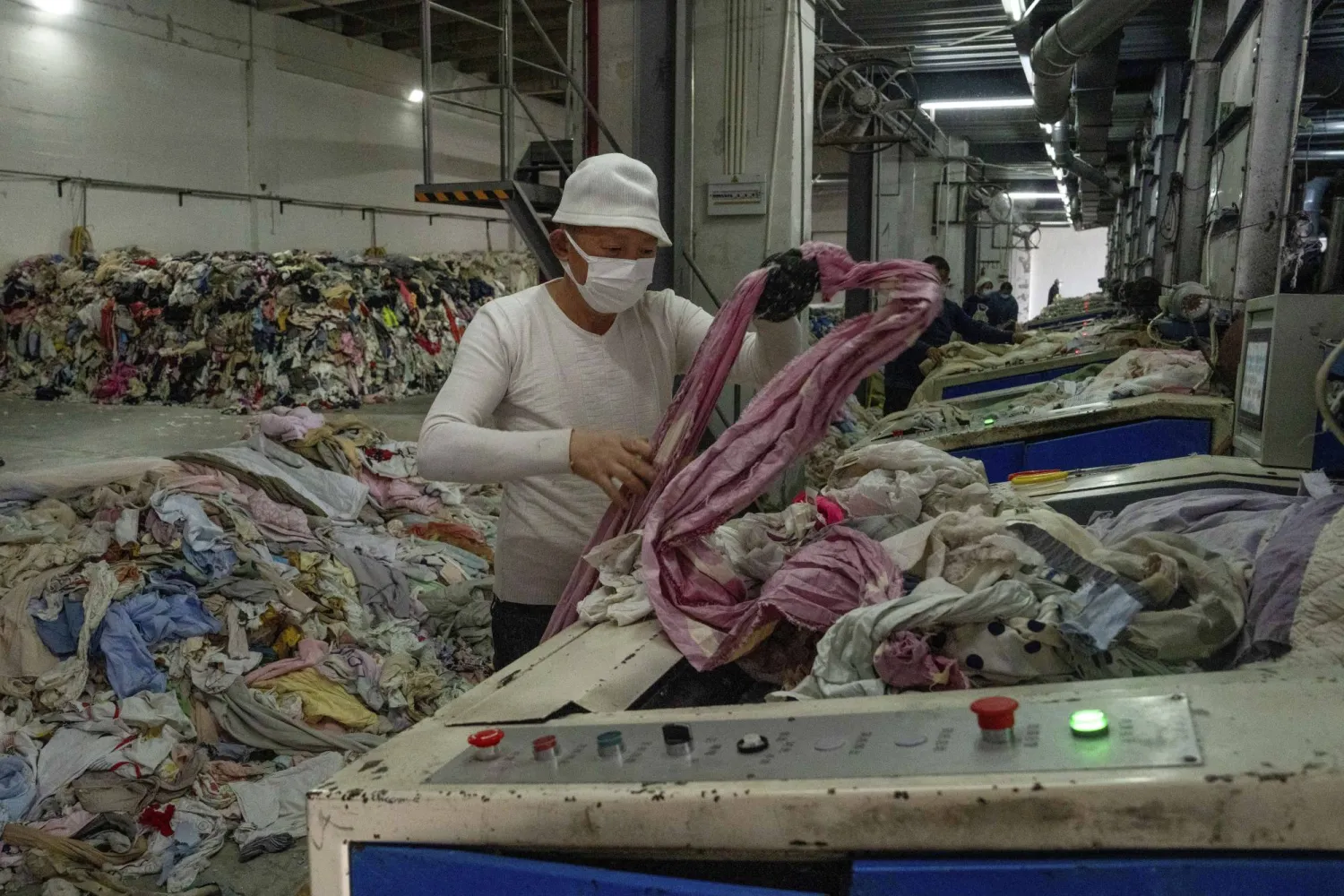
A worker feeds discarded textiles to a shredding machine at the Wenzhou Tiancheng Textile Company in eastern China's Zhejiang province on March 20, 2024. (AP Photo/Ng Han Guan)

China's Landfills Brim with Textile Waste as Fast Fashion Reigns
A worker feeds discarded textiles to a shredding machine at the Wenzhou Tiancheng Textile Company in eastern China's Zhejiang province on March 20, 2024. (AP Photo/Ng Han Guan)



لم تشترك بعد
انشئ حساباً خاصاً بك لتحصل على أخبار مخصصة لك ولتتمتع بخاصية حفظ المقالات وتتلقى نشراتنا البريدية المتنوعة
