World's Rarest Whale Washes Up on New Zealand Beach

A handout photo taken on July 5, 2024 and received on July 16 from the New Zealand Department of Conservation shows rangers Jim Fyfe (L) and Tumai Cassidy walking beside what appears to be the carcass of a rare spade-toothed whale after it was discovered washed ashore on a beach near Taieri Mouth in New Zealand's southern Otago province. (Photo by Handout / New Zealand Department of Conservation / AFP)
TT

World's Rarest Whale Washes Up on New Zealand Beach

A handout photo taken on July 5, 2024 and received on July 16 from the New Zealand Department of Conservation shows rangers Jim Fyfe (L) and Tumai Cassidy walking beside what appears to be the carcass of a rare spade-toothed whale after it was discovered washed ashore on a beach near Taieri Mouth in New Zealand's southern Otago province. (Photo by Handout / New Zealand Department of Conservation / AFP)

The body of a spade-toothed whale -- a species so rare it has never been seen alive -- appears to have washed up on a New Zealand beach, scientists say.

The remains of the obscure, five-meter (16.4 foot) long, beaked creature were found near a river mouth in southern Otago province on July 4, government researchers said.

It was identified by marine-mammal experts from New Zealand's Department of Conservation and the national museum, Te Papa, as a male spade-toothed whale.

A DNA investigation has been launched to confirm its classification, the scientists said.

"Spade-toothed whales are one of the most poorly known large mammalian species of modern times," said the conservation department's coastal Otago operations manager, Gabe Davies.

"Since the 1800s, only six samples have ever been documented worldwide, and all but one of these was from New Zealand," Davies said in a statement Monday.

"From a scientific and conservation point of view, this is huge."

The find was fresh enough to offer the first opportunity for a spade-toothed whale to be dissected, the conservation department said.

The species is "so rare next to nothing is known about them", it said.

- 'International importance' -

The body of the whale has been placed in cold storage and genetic samples have been sent to the University of Auckland as curators of the New Zealand Cetacean Tissue Archive.

It may take several weeks or months for the DNA to be processed and a final identification confirmed.

"The rarity of the whale means conversations around what to do next will take more time because it is a conversation of international importance," the conservation department said.

The species was first described in 1874 from just a lower jaw and two teeth collected from the Chatham Islands off the east coast of New Zealand.

That sample, along with skeletal remains of two other specimens found in New Zealand and Chile, enabled scientists to confirm a new species.

Marine scientist Vanessa Pirotta said researchers would study the whale's stomach contents, genetics, and how this sample compared to previous ones.

This could shine light on the whales' behavior, their population and why they are so rare, Pirotta told AFP, describing the discovery as "like hitting the jackpot".

Because so few specimens have been found and there have been no live sightings, little is known about the spade-toothed whale and it is classified as "data deficient" under New Zealand's Threat Classification System.

The first intact specimen was from a mother and calf stranding in Bay of Plenty in 2010, the New Zealand conservation department said.

A further stranding in 2017 in Gisborne added one more specimen to the collection.


Massive Asteroid Set to Pass ‘Close’ to Earth

The rare asteroid is expected to “safely pass” within 20,000 miles of Earth in 2029 (Shutterstock)
TT

Massive Asteroid Set to Pass ‘Close’ to Earth

The rare asteroid is expected to “safely pass” within 20,000 miles of Earth in 2029 (Shutterstock)

An asteroid named after a god of chaos is heading toward Earth — but there is no need to panic just yet, according to The Independent.

The massive rock is arriving for a historic flyby rather than a disaster, according to NASA. The encounter is still a few years away, but when it finally arrives, it will be so close that spotting it won’t even require a telescope.

Known as 99942 Apophis, the rare asteroid is expected to “safely pass” within 20,000 miles of Earth in 2029, representing one of the closest approaches ever recorded for a celestial object of this size.

“Even though Apophis does not pose any immediate risk to Earth, an asteroid of its size passing so close to our planet is a very rare event,” NASA astronomers stated. “Scientists across the globe are excited to use this opportunity to study Apophis in detail.”

At roughly 1,115 feet wide, the asteroid will pass closer to Earth than the satellites orbiting in geosynchronous altitude, according to NASA.

It will be the closest approach of an asteroid of this size that humans have ever been aware of in advance, according to the European Space Agency.

The rare timing of the flyby — falling on Friday, April 13, in many parts of the world, has already sparked a mix of excitement and superstition across social media.

The asteroid was named after the ancient Egyptian god of evil and destruction. The name was proposed by its discoverers — astronomers Roy Tucker, David Tholen and Fabrizio Bernardi of the Kitt Peak National Observatory near Tucson, Arizona — because Apophis is the Greek name for the Egyptian god known as Apep.

NASA reports that an asteroid of this scale passes this close to Earth only once every few thousand years on average, making it a potentially unprecedented event in recorded human history.


Elusive Wolf in South Korea Captured, Returned to Zoo after 9 Days on the Run

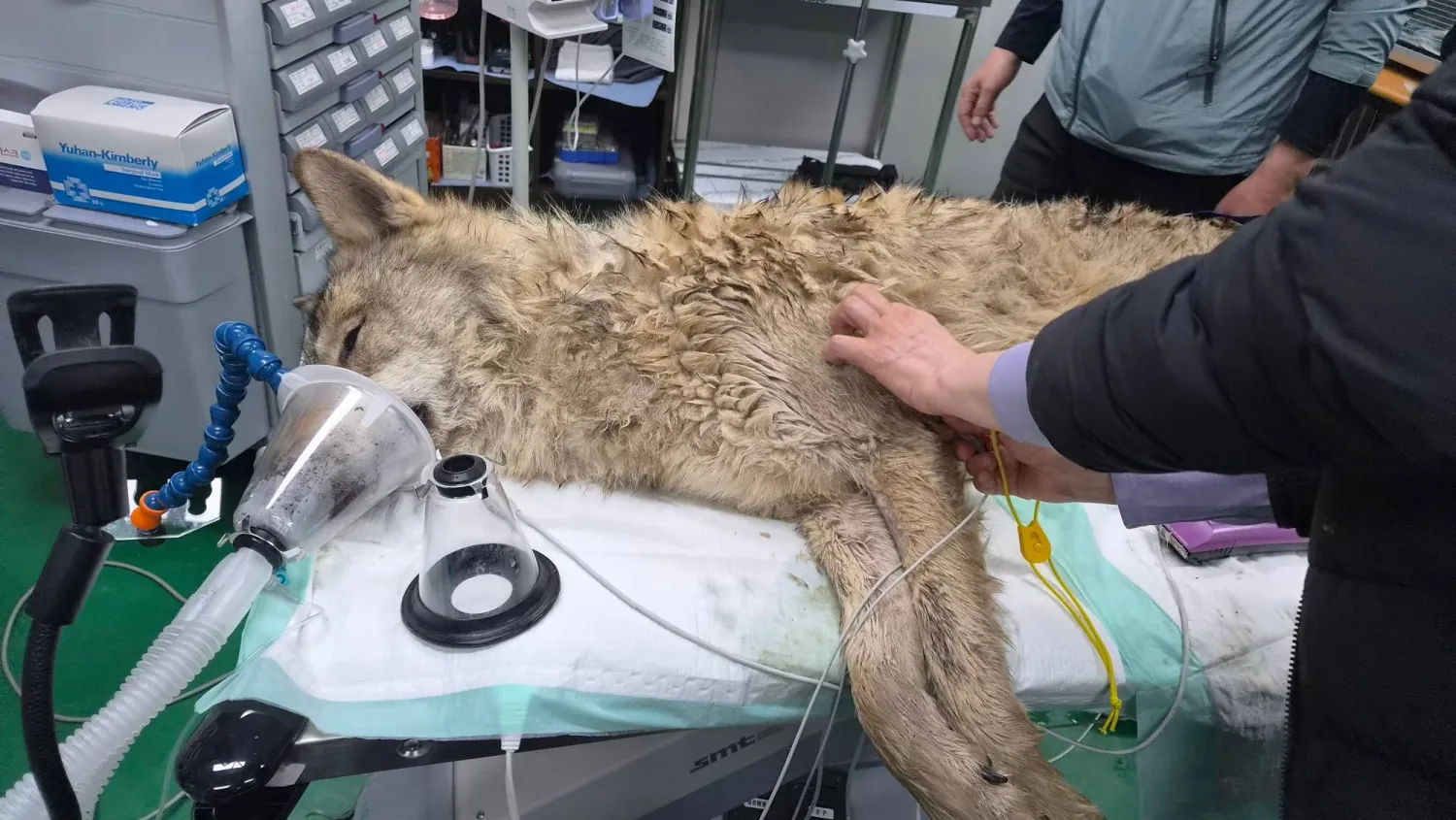
In this photo provided by Daejeon Municipality, a veterinarian examines the condition of the male wolf, named Neukgu, at Daejeon O-World theme park in Daejeon, South Korea, Friday, April 17, 2026. (Daejeon Municipality via AP)
TT

Elusive Wolf in South Korea Captured, Returned to Zoo after 9 Days on the Run

In this photo provided by Daejeon Municipality, a veterinarian examines the condition of the male wolf, named Neukgu, at Daejeon O-World theme park in Daejeon, South Korea, Friday, April 17, 2026. (Daejeon Municipality via AP)

A wolf that escaped from a zoo in the South Korean city of Daejeon was recaptured on Friday after nine days on the run, bringing to a close a saga that gripped the public as the elusive animal evaded earlier capture attempts.

After a number of sightings following the escape of the 2-year-old male wolf, the animal, named Neukgu, was spotted near a highway interchange about 4 km (2.5 miles) from the zoo on Thursday, according to a zoo official.

A search team then successfully recaptured Neukgu at 12:44 a.m. on Friday (1544 GMT on Thursday) using a tranquilizer gun operated by a veterinarian, Reuters reported.

Neukgu was ⁠transported back to ⁠the O-World zoo and was undergoing a health check, the official said, adding his vital signs were normal though vets found and removed a fishing hook from his stomach.

The zoo and an associated theme park were closed after his escape and will take some time to reopen, the official said.

Daejeon Mayor Lee Jang-woo ⁠welcomed the wolf's safe return and thanked the search party, pledging in a Facebook post to "prepare measures for animal welfare and civil safety in the process of reorganizing (the zoo)."

Neukgu's escape in Daejeon, about 170 km (105 miles) south of the capital Seoul, had captured the nation's attention.

South Korean online message boards were abuzz with news of the recapture, with some posts calling Neukgu an "honorary ambassador for the zoo" and vowing to visit him once it reopened.

Neukgu appeared to have slipped out of the zoo last week ⁠by burrowing under ⁠a fence, a zoo official said at the time.

A nearby elementary school was closed as a precaution, while more than 100 personnel searched for the animal, in an effort that included the use of drones equipped with thermal imaging cameras.

The episode even spawned a cryptocurrency meme coin named "Neukgu", which appeared on decentralized cryptocurrency exchanges a week ago.

President Lee Jae Myung also weighed in on the social media platform X last week, urging authorities to ensure a safe outcome.

Born in 2024, Neukgu is part of a program to restore the Korean wolf, a species considered extinct in the wild.


Madinah Tops Saudi Cities in Hotel Occupancy in 2025

The hospitality sector in Madinah recorded a strong performance in 2025. (SPA)
TT

Madinah Tops Saudi Cities in Hotel Occupancy in 2025

The hospitality sector in Madinah recorded a strong performance in 2025. (SPA)

The hospitality sector in Madinah recorded a strong performance in 2025, ranking first among cities in Saudi Arabia in hotel occupancy rates, the Saudi Press Agency said on Friday.

The figures reflect growing demand for the destination and the continued growth in tourism activity associated with visits to the Prophet’s Mosque and the region’s historical landmarks.

The growth is supported by continued development in tourism infrastructure and increased investment in accommodation.

It also reflects ongoing efforts to enhance the experience of visitors and Umrah performers, in line with Saudi Vision 2030 goals to develop the tourism sector and improve service quality for pilgrims and visitors to the Prophet’s Mosque.