Saudi Interior Ministry Highlights Successful Efforts at Countering Narcotics

Deputy Interior Minister of Saudi Arabia Dr. Nasser bin Abdulaziz Al-Dawood. (SPA)
TT

Saudi Interior Ministry Highlights Successful Efforts at Countering Narcotics

Deputy Interior Minister of Saudi Arabia Dr. Nasser bin Abdulaziz Al-Dawood. (SPA)

Deputy Interior Minister of Saudi Arabia, Dr. Nasser bin Abdulaziz Al-Dawood, said on Tuesday that the Kingdom implemented a comprehensive security campaign that successfully dealt with drug-related crimes.
He said the campaign entailed coordinated security plans involving all concerned parties.
Dawood, who led the Kingdom's delegation to the 2nd Baghdad International Conference on Countering Narcotics 2024 held in Iraq on Monday, stressed the need to strengthen efforts among the participating nations to control the spread of narcotics and to discuss mechanisms to stop drug trafficking.
He emphasized that countering smuggling and drug trafficking fall in the Kingdom’s Vision 2030 top priorities.
Dawood highlighted the Kingdom's commitment to dealing with the dangers posed by drugs to the security and stability of society by harnessing national capabilities to raise the society's awareness to this threat.



Saudi Arabia Affirms Peace Requires Ceasefire, Establishing Palestinian State on 1967 Borders

Saudi Arabia's Permanent Representative to the UN Ambassador Dr. Abdulaziz Al-Wasil. File Photo/Saudi Foreign Ministry
TT

Saudi Arabia Affirms Peace Requires Ceasefire, Establishing Palestinian State on 1967 Borders

Saudi Arabia's Permanent Representative to the UN Ambassador Dr. Abdulaziz Al-Wasil. File Photo/Saudi Foreign Ministry

The Kingdom of Saudi Arabia stressed the seriousness of the situation in the region, renewing its condemnation of Israeli attacks on Palestine and Lebanon.

This came in a speech by Permanent Representative of the Kingdom to the United Nations Dr. Abdulaziz Alwasil, in which he reiterated the Kingdom’s condemnation of Iranian attacks on civilian facilities and the resulting human and material damage, SPA reported.

The Kingdom affirmed its rejection of altering the historical and legal status quo of Jerusalem and its Islamic holy sites, and its condemnation of illegal settlement activities for violating international law and undermining the prospects for peace.

The Kingdom stressed that achieving peace requires a ceasefire, preventing displacement, withdrawal from Gaza, and the establishment of a Palestinian state on the 1967 borders.


Saudi Arabia Reaffirms Commitment to NPT at Eleventh Review Conference

The Saudi flag. Asharq Al-Awsat
TT

Saudi Arabia Reaffirms Commitment to NPT at Eleventh Review Conference

The Saudi flag. Asharq Al-Awsat

Saudi Arabia has reaffirmed the importance of the Treaty on the Non-Proliferation of Nuclear Weapons (NPT) as a fundamental pillar of the global non-proliferation regime, stressing full implementation of its provisions and balance among its three pillars.

The stance was made by the Kingdom’s Permanent Representative to the United Nations, Dr. Abdulaziz Alwasil, at the general debate of the Eleventh NPT Review Conference in New York.

The Kingdom called on nuclear-weapon states to honor their disarmament pledges, affirming that the only guarantee against nuclear weapons use is their complete elimination.

It also affirmed the inherent right of States Parties to peaceful uses of nuclear energy in accordance with the treaty. It underscored the importance of transparency and cooperation with the International Atomic Energy Agency (IAEA).

The speech addressed Iranian attacks against the Kingdom, targeting civilians and civilian infrastructure, which were condemned by the international community. It stressed the importance of regional security, good neighborliness, non-interference in internal affairs, and Iran's full cooperation with the IAEA.

The Kingdom affirmed that establishing a Middle East zone free of nuclear weapons and other weapons of mass destruction is a collective international responsibility, noting that Israel's refusal to join the treaty remains a major obstacle to this goal.


Jeddah Summit Stresses Importance of Restoring Navigation Security in Hormuz

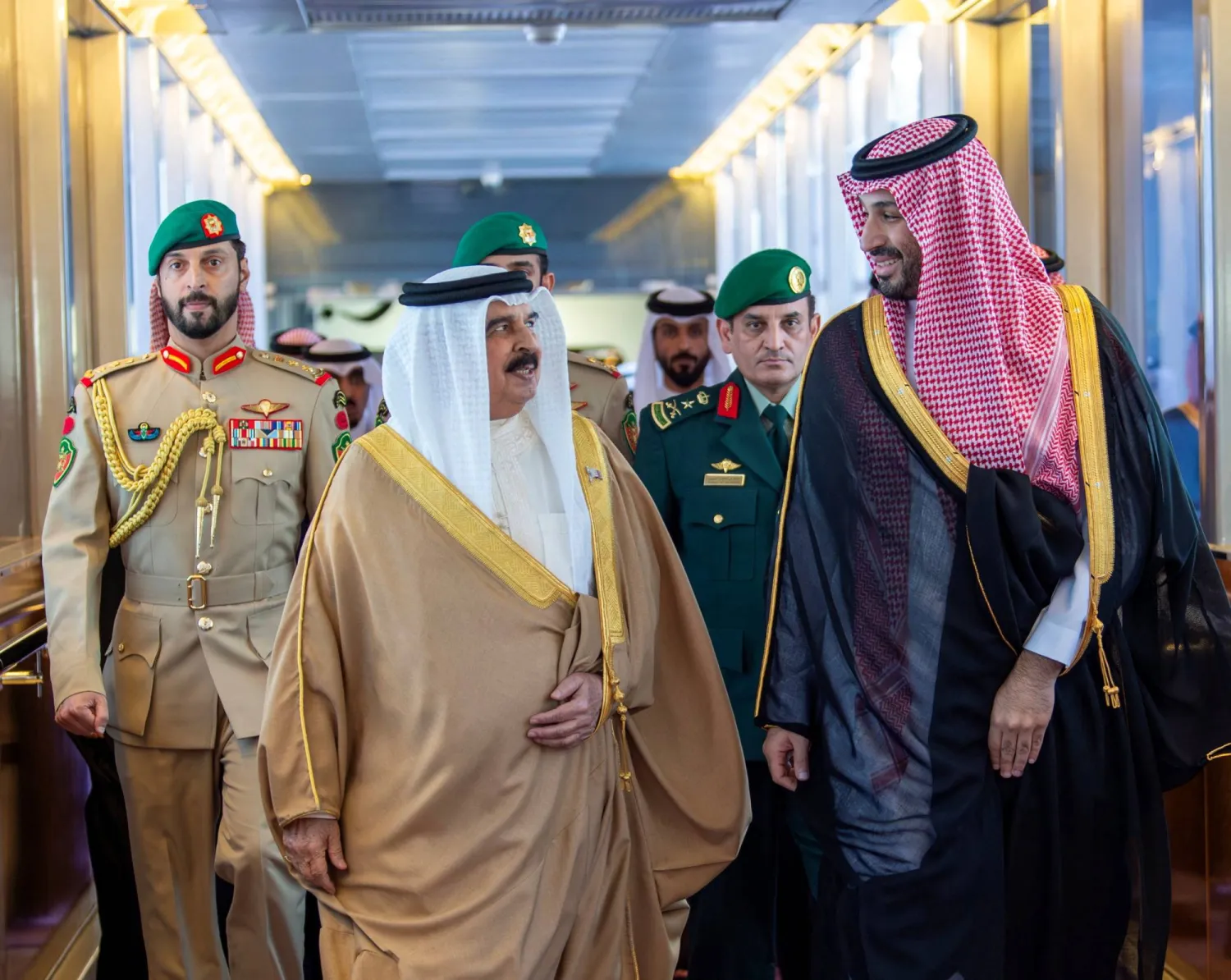
Saudi Crown Prince Mohammed bin Salman receives Bahrain's King Sheikh Hamad bin Isa al-Khalifa ahead of the Gulf Cooperation Council (GCC) meeting in Jeddah, Saudi Arabia, April 28, 2026. Bandar Algaloud/Courtesy of Saudi Royal Court/Handout via REUTERS
TT

Jeddah Summit Stresses Importance of Restoring Navigation Security in Hormuz

Saudi Crown Prince Mohammed bin Salman receives Bahrain's King Sheikh Hamad bin Isa al-Khalifa ahead of the Gulf Cooperation Council (GCC) meeting in Jeddah, Saudi Arabia, April 28, 2026. Bandar Algaloud/Courtesy of Saudi Royal Court/Handout via REUTERS

The Gulf summit, which was chaired on Tuesday by Saudi Crown Prince Mohammed bin Salman, discussed the regional situation.

It affirmed the necessity of restoring navigation security in the Strait of Hormuz and strongly condemned the flagrant Iranian aggressions against the Gulf Cooperation Council (GCC) states and Jordan.

GCC Secretary-General Jasem Albudaiwi affirmed in a statement that the summit was held at the invitation of the Saudi leadership and discussed ways to find a diplomatic path to end the crisis and pave the way for agreements and understandings that address the concerns of the Gulf states and enhance long-term security and stability.

He clarified that the leaders expressed strong condemnation and denunciation of the flagrant Iranian aggressions against the Gulf states and Jordan, emphasizing that these treacherous attacks have led to a sharp loss of confidence by the Gulf states in Iran.

Albudaiwi noted that the leaders praised the ability demonstrated by the Gulf states to deal with the challenges they faced due to this crisis, pointing out that the leaders expressed their categorical rejection of illegal Iranian measures to close the Strait of Hormuz and obstruct navigation in it, affirming the necessity of restoring navigation security and freedom and returning the situation in the Strait to what it was before February 28.

Albudaiwi also highlighted that the leaders of the Gulf states directed the urgency of completing the requirements for achieving access to all joint Gulf projects, including transport and logistics services, along with accelerating the implementation of the GCC railway project.

The Secretary-General of the Council further noted the leaders' affirmation of the importance of promptly taking steps towards establishing an oil and gas pipeline project, a water linkage project between the Gulf states, and moving forward with studying the creation of strategic Gulf reserve areas, in addition to the importance of intensifying military integration among the Council's states and accelerating the completion of the ballistic missile early warning system project.