Italy’s PM in Beirut, Says Europe Wants a ‘Sustainable Ceasefire’ in Gaza and Lebanon

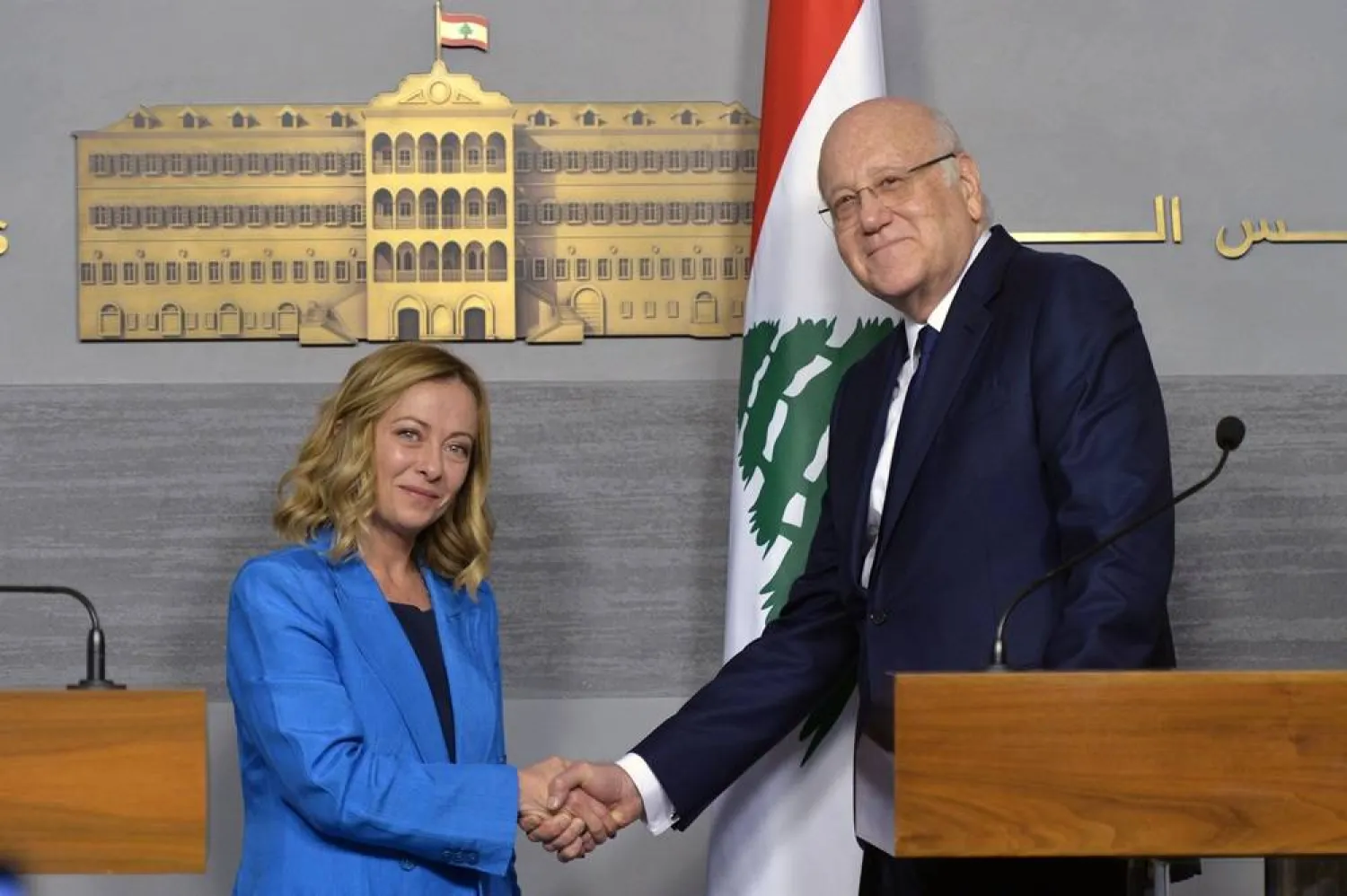
Lebanese caretaker Prime Minister Najib Mikati (R) shakes hands with Italian Prime Minister Giorgia Meloni (L) following a joint press conference at the government palace in Beirut, Lebanon, 18 October 2024. (EPA)
TT

Italy’s PM in Beirut, Says Europe Wants a ‘Sustainable Ceasefire’ in Gaza and Lebanon

Lebanese caretaker Prime Minister Najib Mikati (R) shakes hands with Italian Prime Minister Giorgia Meloni (L) following a joint press conference at the government palace in Beirut, Lebanon, 18 October 2024. (EPA)

Italy’s Prime Minister Giorgia Meloni said European countries are working for a “sustainable ceasefire” in the Gaza Strip and Lebanon.

Speaking in Beirut after meeting Friday with her Lebanese counterpart, Najib Mikati, Meloni said European nations also support negotiations for the release of Israeli hostages held by Hamas in Gaza since October last year.

Mikati said “a diplomatic solution should overcome” war that has intensified in recent weeks into an Israeli invasion of southern Lebanon, and that Israel must agree to a ceasefire.

Meloni added that targeting UN peacekeepers deployed along the Lebanon-Israel border is unacceptable and that both sides must “ensure at all times the safety of each of these soldiers.” She stressed that the peacekeepers will be needed in any post-conflict scenario.

Over the past two weeks, UN posts along the border have been subjected to fire that that has wounded at least five peacekeepers.

Meloni said the peacekeeping force in south Lebanon, known as UNIFIL, must be strengthened and that UNIFIL and Lebanese troops should be the only armed forces in the area south of the Litani river along the border with Israel.

According to a 2006 UN Security Council resolution that ended the 34-day Israel-Hezbollah war in 2006, Hezbollah should have no presence in the area along the border with Israel.


War Disrupts Education in Lebanon, Deepening Inequality Among Students

A child plays during a visit by Lebanon’s Health Minister Rakan Nassereddine to Maroun Abboud Secondary Public School, which is hosting displaced people, following an escalation between Hezbollah and Israel amid the US-Israeli conflict with Iran, in Aley district, Mount Lebanon Governorate, Lebanon, March 15, 2026. (Reuters)
TT

War Disrupts Education in Lebanon, Deepening Inequality Among Students

A child plays during a visit by Lebanon’s Health Minister Rakan Nassereddine to Maroun Abboud Secondary Public School, which is hosting displaced people, following an escalation between Hezbollah and Israel amid the US-Israeli conflict with Iran, in Aley district, Mount Lebanon Governorate, Lebanon, March 15, 2026. (Reuters)

Lebanon’s education system is struggling to survive an unprecedented crisis as war forces hundreds of thousands from their homes. Many schools have been converted into shelters for displaced families, with classrooms transformed into sleeping quarters, while others attempt to continue teaching amid security risks and uncertainty.

The Ministry of Education has placed 1,156 public schools and high schools, along with 75 vocational institutes, at the disposal of the national disaster authority. These include 334 public schools, 40 vocational institutes, and 17 centers affiliated with the Lebanese University.

A ministry source told Asharq Al-Awsat that not all facilities have yet been opened, but they will when the need arises.

An education crisis cell now meets daily to monitor developments and make urgent decisions. Early in the conflict, the ministry issued guidelines allowing schools — both public and private — to choose between in-person and remote learning.

The Secretariat General of Catholic Schools also urged each institution to form its own crisis committee to assess local security conditions and determine how to proceed.

Between classrooms and screens

In relatively safer areas, schools have resumed in-person teaching, while offering remote options for students unable to travel. In more dangerous regions, most schools rely exclusively on distance learning.

The Lebanese University has shifted entirely online, postponing student elections scheduled for later this month.

Yet these measures have exposed stark inequalities. Many students, particularly those living in shelters, lack the conditions or resources to follow lessons, even remotely.

Some parents argue that the ministry’s approach fails to ensure equal access to education. Others insist on continuing their children’s schooling wherever possible.

A mother of two in Bsalim, Mount Lebanon, said: “The Lebanese state did not decide this war, so why should we bear its consequences? We will resist in our own way, by educating our children to build a more aware generation that rejects war.”

She added that remote learning had already proven ineffective during the COVID-19 crisis, especially for younger children.

In contrast, a displaced mother living with her four children in a Beirut school described education as a distant concern.

“We cannot secure safety or food, how can we think about schooling?” she asked, warning that continuing classes while much of the country suffers only deepens injustice. “No place in Lebanon is truly safe,” she remarked.

Schools in limbo

School administrations face difficult choices. One major private school in Baabda, near Beirut’s southern suburbs, briefly reopened before closing again after ten days.

“The situation is extremely sensitive,” a staff member said. “We reassess daily to avoid putting students at risk.”

When classes do resume, faculty attempt to soften the impact of nearby airstrikes, sometimes playing low music to mask the sound of explosions.

Lama al-Tawil, head of the union of parents’ committees in private schools, described the situation as “unclear.” She called the ministry’s plan “flexible and positive,” but stressed that implementation remains the real challenge.

“In-person learning is best for those who can attend safely,” she said, “but remote education is not equally accessible and its effectiveness is limited.”

With roughly 40 school days remaining, authorities may extend the academic year if the conflict continues.

Meanwhile, teachers and families alike are navigating not only a security crisis, but a deepening economic one, hoping flexibility will help prevent a lost generation.



US Federal Jury Convicts Assad-era Syrian Official of Torture

Officers keep watch outside the Department of Justice building in Washington, D.C., US, September 23, 2025. REUTERS/Kevin Lamarque Purchase Licensing Rights
TT

US Federal Jury Convicts Assad-era Syrian Official of Torture

Officers keep watch outside the Department of Justice building in Washington, D.C., US, September 23, 2025. REUTERS/Kevin Lamarque Purchase Licensing Rights

A federal jury in Los Angeles convicted a former Syrian government official, who headed the Damascus Central Prison under the government of ousted Syrian President Bashar al-Assad, of torture, the US Justice Department said on Monday.

Samir Ousman Alsheikh, 73, was convicted on one count of conspiracy to commit torture and three counts of torture for his involvement in the torture of prisoners at Adra Prison as it is colloquially known, in Damascus, the Justice Department said in a statement.

Alsheikh, who headed the prison from ‌2005 to 2008, ‌had pleaded not guilty, according to a court ‌filing. ⁠On Monday, his legal ⁠team said they were "disappointed" with the verdict and that Alsheikh "will pursue all appellate and post-trial relief", reported Reuters.

The jury also convicted Alsheikh of lying to US immigration authorities about his commission of these crimes, fraudulently obtaining a green card and attempting to naturalize as a US citizen, the department added.

He was charged in late 2024 and prosecutors said he ordered subordinates ⁠to inflict severe physical and mental pain and suffering ‌on political and other prisoners. He ‌was sometimes personally involved in such incidents, according to the US Justice Department.

The torture ‌aimed to deter opposition to the Assad government, the department said.

Alsheikh, ‌who held positions in the state security apparatus, was associated with Assad's Syrian Ba'ath Party, and was appointed governor of the province of Deir Ez-Zour by the ousted leader in 2011, prosecutors said.

Alsheikh faces a maximum penalty of ‌20 years in prison for each of the three torture counts and the count of conspiracy to commit ⁠torture, the ⁠Justice Department said.

He faces a maximum penalty of 10 years in prison for each of the immigration and attempted naturalization fraud charges and will remain in US custody pending his sentencing at a date to be determined by court, the department added.

Syrian opposition groups put an end to more than 50 years of rule by the Assad family in late 2024 following a lightning advance. A more than a decade long civil war killed hundreds of thousands, unleashed a refugee crisis and left cities bombed to rubble.

Syrian President Ahmed al-Sharaa, took over after Assad's ouster and has aimed to improve ties with the West.


Israeli Strikes Hit Beirut Neighborhoods, Apartment Block

A man inspects a site of overnight Israeli airstrikes in the southern suburbs of Beirut on March 16, 2026. (Photo by AFP) /
TT

Israeli Strikes Hit Beirut Neighborhoods, Apartment Block

A man inspects a site of overnight Israeli airstrikes in the southern suburbs of Beirut on March 16, 2026. (Photo by AFP) /

Israeli airstrikes rained down on three neighborhoods in Beirut early Tuesday, Lebanese state media reported, as Lebanon said more than one million people had been displaced in two weeks of fighting.

Lebanon was drawn into the Middle East war on March 2 when Tehran-backed Hezbollah militants attacked Israel in response to the killing of Iranian supreme leader Ali Khamenei in US-Israeli strikes, said AFP.

Israel has responded with broad air raids on its northern neighbor and troop incursions into border areas

"A series of raids and artillery shelling targeted southern towns at dawn," Lebanon's National News Agency said.

"Israeli warplanes carried out two airstrikes targeting the Kafaat and Haret Hreik areas" and another airstrike on a residential apartment building in the Doha Aramoun area, NNA added.

An Ethiopian woman was wounded in the strikes, it said, quoting the health ministry.

Israel confirmed it had carried out the attacks, saying it was targeting Hezbollah.

Israel said earlier it had launched a "wide scale wave of strikes" in the Iranian capital Tehran and was also targeting Hezbollah infrastructure in Beirut.

Israeli strikes have killed 886 people, including 67 women and 111 children, since the start of the fresh fighting with Iran-backed Hezbollah, Lebanon's health ministry said Monday, adding that 2,141 others have been wounded.

Lebanese authorities said more than one million people have registered as displaced since March 2, with more than 130,000 people staying in upwards of 600 collective shelters.

The Israeli military has issued sweeping evacuation warnings for southern Lebanon, extending more than 40 kilometers (around 25 miles) from its border.

Defense Minister Israel Katz has warned that displaced Lebanese should not return home "south of the Litani area until the safety of residents in the north (of Israel) is guaranteed".