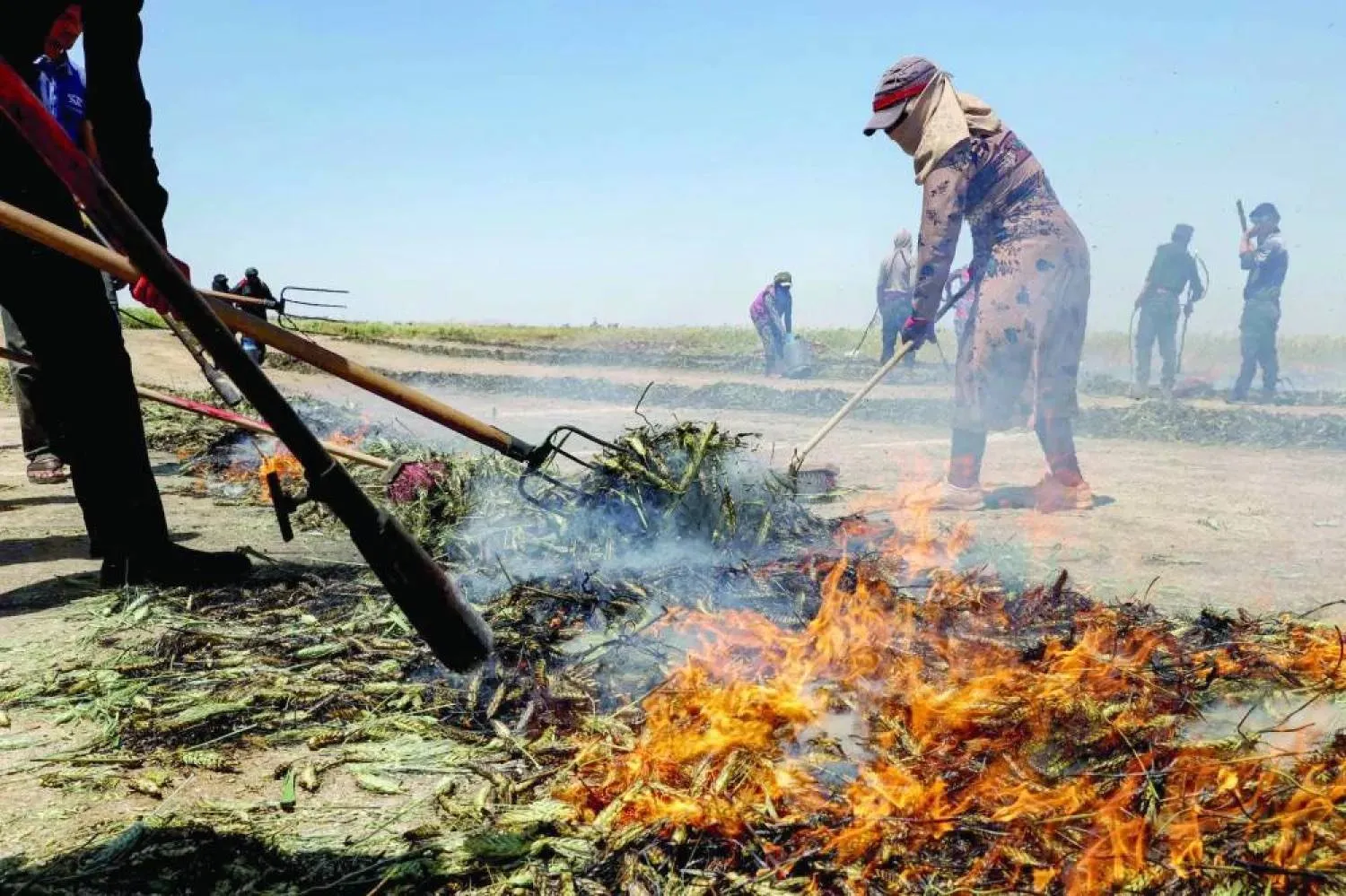
Hundreds of farmers staged protests for a second consecutive day across several Syrian provinces over the government’s wheat purchase price for the current harvest season, denouncing it as unfair and insufficient to cover production costs.
Demonstrators warned the pricing policy would discourage wheat cultivation and called for the dismissal of the economy minister, saying the decision threatened farmers’ livelihoods at a time when Syria is already grappling with deep economic hardship.
The Ministry of Economy and Industry recently set the purchase price for first-grade durum wheat for the 2026 season at 46,000 Syrian pounds per ton in the country’s new currency — about $330 at the exchange rate on the day of the announcement, based on the parallel market rate of 138 pounds to the dollar.
The decision sparked anger among farmers, particularly in eastern and northern Syria — the country’s main wheat-producing region.
Khalil al-Nuaimi, an agricultural engineer and farmer, told Asharq Al-Awsat that growers had pinned high hopes on this year’s harvest following heavy rainfall, after years of drought, war and destruction.
“Farmers were hoping to repay debts and improve their living conditions, but the pricing decision crushed those hopes,” he said.
Al-Nuaimi, who lives in Raqqa province, said most farmers borrow money to finance cultivation and repay loans after the harvest. He added that many rural families postpone major life decisions until the wheat season ends, including engagements, weddings, medical treatment, home repairs and vehicle purchases.
“A decision like this has serious social consequences,” he underlined.
He accused the government of failing to consider the impact of the measure, particularly in eastern and northern Syria, where many residents already feel economically and politically marginalized.
Al-Nuaimi also pointed to what he described as a major discrepancy between production costs and the new pricing policy. He noted that the government had earlier set the price of wheat seed for the 2025-2026 season at $500 per ton, while the official purchase price for harvested wheat was lower.
“This is a gap farmers cannot absorb,” he said, adding that even raising the purchase price to $500 per ton would not fully offset losses because of exchange-rate volatility and grading-based pricing.
He continued that while the government faced a severe economic crisis, “supporting farmers is an essential part of supporting rural development and a cornerstone of the economy in an agricultural country like Syria.”
State media said the government defended the new pricing by arguing it was aligned with global wheat prices and exceeded them by around 10 percent to support local farmers and offset transportation and labor costs.
Following the announcement, hundreds of farmers protested on Sunday and Monday in the provinces of Raqqa, Deir Ezzor, Hasakeh, Daraa, Hama and Idlib, as well as other wheat-growing areas.
Protesters rejected comparisons with international prices, arguing that production conditions in Syria — devastated by years of war and drought — were not comparable to those in other countries.
The conflict and prolonged drought have severely damaged Syria’s agricultural sector, transforming the country from a wheat exporter into a wheat importer.
Eight Kurdish political parties in Hasakeh province also rejected the new pricing, describing it as “unrealistic” and warning of “negative repercussions for food security and economic and social stability.”
Syria needs around 2.55 million tons of wheat annually to meet basic consumption needs and maintain bread supplies.
During the 18-month transitional period, Syria imported around 1.3 million tons of wheat, mainly from Russia and Ukraine. The government is counting on this year’s harvest to fully meet domestic demand.