Monkeys that Escaped US Lab Are Species Used for Human Research Since 1800s

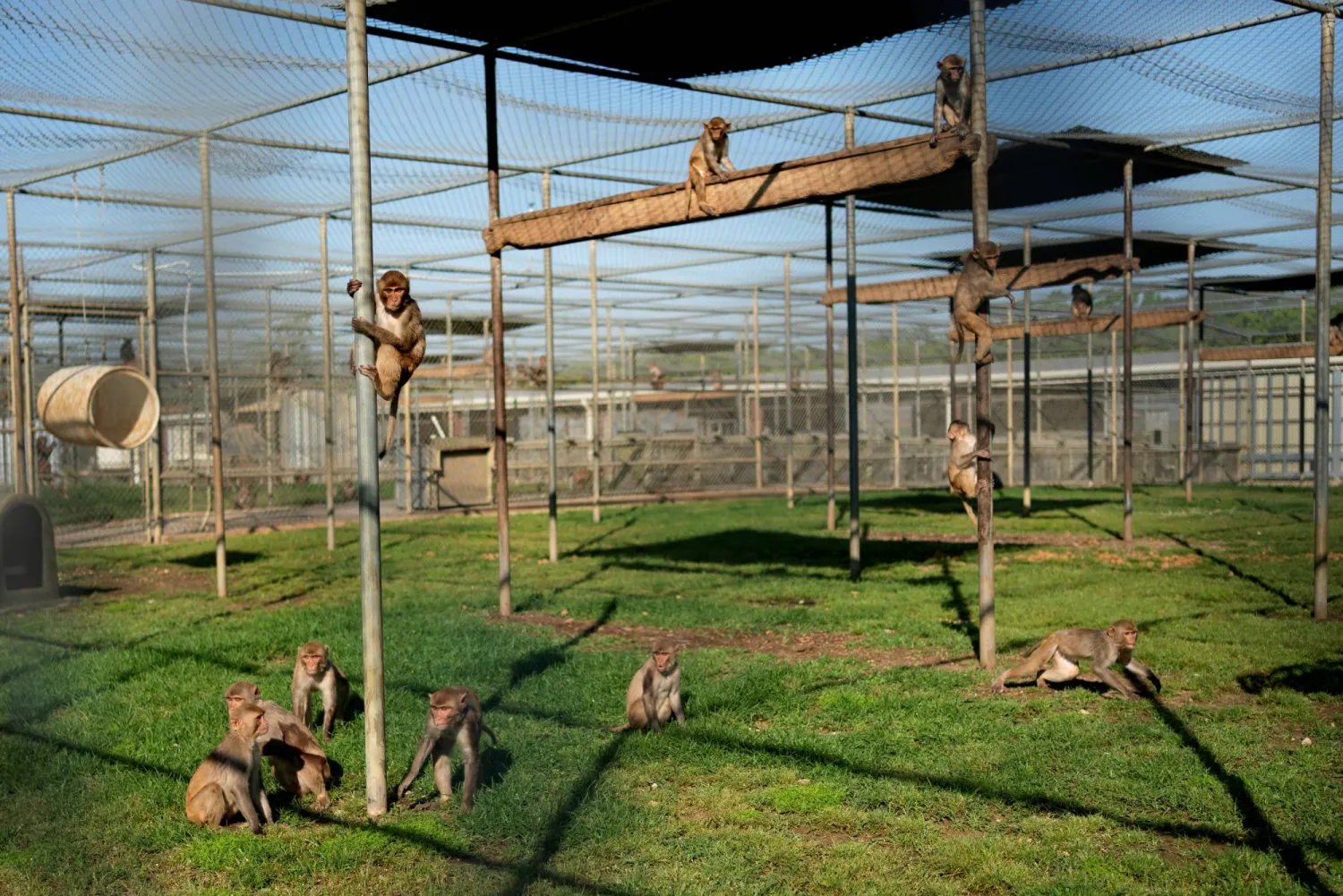
Rhesus macaque monkeys feed at the Tulane National Primate Research Center, where the focus of study has shifted to the coronavirus disease (COVID-19) pandemic, in Covington, Louisiana, US, May 14, 2021. REUTERS/Kathleen Flynn
TT

Monkeys that Escaped US Lab Are Species Used for Human Research Since 1800s

Rhesus macaque monkeys feed at the Tulane National Primate Research Center, where the focus of study has shifted to the coronavirus disease (COVID-19) pandemic, in Covington, Louisiana, US, May 14, 2021. REUTERS/Kathleen Flynn

The 43 rhesus macaque monkeys that escaped a South Carolina medical lab this week are among the most studied animals on the planet. And for more than a century, they have held a mirror to humanity, revealing our strengths and weaknesses through their own clever behaviors, organ systems and genetic code, The Associated Press reported.
The bare-faced primates with expressive eyes have been launched on rockets into space. Their genome has been mapped. They have even been stars of a reality TV show.
Animal rights groups point out that the species has been subjected to studies on vaccines, organ transplants and the impact of separating infants from mothers. At the same time, many in the scientific community will tell you just how vital their research is to fighting AIDS, polio and COVID-19.
In 2003, a nationwide shortage of rhesus macaques threatened to slow down studies and scientists were paying up to $10,000 per animal to continue their work.
“Every large research university in the United States probably has some rhesus macaques hidden somewhere in the basement of its medical school,” according to the 2007 book, “Macachiavellian Intelligence: How Rhesus Macaques and Humans Have Conquered the World."
“The US Army and NASA have rhesus macaques too,” wrote the book's author, Dario Maestripieri, a behavioral scientist at the University of Chicago, “and for years they trained them to play computer video games to see whether the monkeys could learn to pilot planes and launch missiles.”
Research begins in the 1890s Humans have been using the rhesus macaque for scientific research since the late 1800s when the theory of evolution gained more acceptance, according to a 2022 research paper by the journal eLife.
The first study on the species was published in 1893 and described the “anatomy of advanced pregnancy," according to the eLife paper. By 1925, the Carnegie Science Institute had set up a breeding population of the monkeys to study embryology and fertility in a species that was similar to humans.
One reason for the animal's popularity was its abundance. These monkeys have the largest natural range of any non-human primate, stretching from Afghanistan and India to Vietnam and China.
“The other reason is because rhesus macaques, as primates go, are a pretty hardy species,” said Eve Cooper, the eLife research paper's lead author and a biology professor at the University of Colorado-Boulder. “They can live under conditions and they can be bred under conditions that are relatively easy to maintain.”
NASA rockets and the Salk polio vaccine In the 1950s, the monkey's kidneys were used to make the Salk polio vaccine. NASA also used the animals during the space race, according to a brief history of animals in space on the agency's website.
For example, a rhesus monkey named “Miss Sam” was launched in 1960 in a Mercury capsule that attained a velocity of 1,800 mph (1,900 kph) and an altitude of 9 miles (14.5 kilometers) . She was retrieved in overall good condition.
“She was also returned to her training colony until her death on an unknown date,” NASA wrote.
Mapping the human genome In 2007, scientists unraveled the DNA of the rhesus macaque. The species shared about 93% of its DNA with humans, even though macaques branched off from the ape family about 25 million years ago.
In comparison, humans and chimpanzees have evolved separately since splitting from a common ancestor about 6 million years ago, but still have almost 99% of their gene sequences in common.
The mapping of the human genome in 2001 sparked an explosion of work to similarly decipher the DNA of other animals. The rhesus macaque was the third primate genome to be completed.
For those who have studied the behavior of rhesus macaques, the research is just as interesting.
“They share some striking similarities to ourselves in terms of their social intelligence,” said Maestripieri, the University of Chicago professor who wrote a book on the species.
For example, the animals are very family oriented, siding with relatives when fights break out, he told The Associated Press on Friday. But they also recruit allies when they're attacked.
“They're very political,” Maestripieri said. “Most of their daily lives are spent building political alliances with each other. Does that sound familiar?"
Maestripieri was a consultant for a reality show about some rhesus macaques in India called “Monkey Thieves.”
“They basically started following large groups of these rhesus macaques and naming them,” the professor said. “It was beautifully done because these monkeys essentially act like people occasionally. So it’s fascinating to follow their stories.”



Saturn's Moon Titan May Not Have a Buried Ocean as Long Suspected, New Study Suggests

This image made by the Cassini spacecraft and provided by NASA on March 12, 2006, shows two of Saturn's moons, the small Epimetheus and smog-enshrouded Titan, with Saturn's A and F rings stretching across the frame. (NASA via AP)
TT

Saturn's Moon Titan May Not Have a Buried Ocean as Long Suspected, New Study Suggests

This image made by the Cassini spacecraft and provided by NASA on March 12, 2006, shows two of Saturn's moons, the small Epimetheus and smog-enshrouded Titan, with Saturn's A and F rings stretching across the frame. (NASA via AP)

Saturn's giant moon Titan may not have a vast underground ocean after all.

Titan instead may hold deep layers of ice and slush more akin to Earth’s polar seas, with pockets of melted water where life could possibly survive and even thrive, scientists reported Wednesday.

The team led by researchers at NASA's Jet Propulsion Laboratory challenged the decade-long assumption of a buried global ocean at Titan after taking a fresh look at observations made years ago by NASA’s Cassini spacecraft around Saturn.

They stress that no one has found any signs of life at Titan, the solar system’s second largest moon spanning 3,200 miles (5,150 kilometers) and brimming with lakes of liquid methane on its frosty surface, The AP news reported.

But with the latest findings suggesting a slushy, near-melting environment, “there is strong justification for continued optimism regarding the potential for extraterrestrial life,” said the University of Washington’s Baptiste Journaux, who took part in the study published in the journal Nature.

As to what form of life that might be, possibly strictly microscopic, “nature has repeatedly demonstrated far greater creativity than the most imaginative scientists," he said in an email.

JPL’s Flavio Petricca, the lead author, said Titan’s ocean may have frozen in the past and is currently melting, or its hydrosphere might be evolving toward complete freezing.

Computer models suggest these layers of ice, slush and water extend to a depth of more than 340 miles (550 kilometers). The outer ice shell is thought to be about 100 miles (170 kilometers) deep, covering layers of slush and pools of water that could go down another 250 miles (400 kilometers). This water could be as warm as 68 degrees Fahrenheit (20 degrees Celsius).

Because Titan is tidally locked, the same side of the moon faces Saturn all the time, just like our own moon and Earth. Saturn’s gravitational pull is so intense that it deforms the moon’s surface, creating bulges as high as 30 feet (10 meters) when the two bodies are closest.

Through improved data processing, Petricca and his team managed to measure the timing between the peak gravitational tug and the rising of Titan’s surface. If the moon held a wet ocean, the effect would be immediate, Petricca said, but a 15-hour gap was detected, indicating an interior of slushy ice with pockets of liquid water. Computer modeling of Titan’s orientation in space supported their theory.

Sapienza University of Rome’s Luciano Iess, whose previous studies using Cassini data indicated a hidden ocean at Titan, is not convinced by the latest findings.

While “certainly intriguing and will stimulate renewed discussion ... at present, the available evidence looks certainly not sufficient to exclude Titan from the family of ocean worlds," Iess said in an email.

NASA’s planned Dragonfly mission — featuring a helicopter-type craft due to launch to Titan later this decade — is expected to provide more clarity on the moon’s innards. Journaux is part of that team.

Saturn leads the solar system’s moon inventory with 274. Jupiter’s moon Ganymede is just a little larger than Titan, with a possible underground ocean. Other suspected water worlds include Saturn’s Enceladus and Jupiter’s Europa, both of which are believed to have geysers of water erupting from their frozen crusts.

Launched in 1997, Cassini reached Saturn in 2004, orbiting the ringed planet and flying past its moons until deliberately plunging through Saturn’s atmosphere in 2017.


Catch the Ursid Meteor Shower as it Peaks just before Christmas

People look up to the sky from an observatory near the village of Avren, Bulgaria, Aug. 12, 2009. (AP Photo/Petar Petrov, File)
TT

Catch the Ursid Meteor Shower as it Peaks just before Christmas

People look up to the sky from an observatory near the village of Avren, Bulgaria, Aug. 12, 2009. (AP Photo/Petar Petrov, File)

The last major meteor shower of the year, known as the Ursids, peaks soon, bringing glowing streaks to nighttime and early morning skies. Compared to other meteor showers, it's more subdued, but experts say it's still worth a glimpse.

Meteor showers happen when space rocks hit Earth's atmosphere at extremely high speeds and burn up, gaining fiery tails — the end of a “shooting star.” Random meteors are visible from Earth on any given clear night, but more predictable meteor showers happen yearly when Earth passes through streams of cosmic leftovers from comets or asteroids, Reuters reported.

The Ursids peak Sunday night into Monday morning and will be visible until Dec. 26 from the Northern Hemisphere. Skygazers usually see five to 10 meteors per hour during the height and there's a possibility for outbursts of up to 25 meteors per hour, according to the American Meteor Society.

How active a shower will appear from Earth depends on the amount of debris and the moon's brightness, which can blot out glowing meteors. The Ursids feature less space debris than other showers like the Geminids, but the narrow crescent moon won't be much of an obstacle when they peak.

No special equipment is needed to view a meteor shower. To see the Ursids, which hail from a comet called 8P/Tuttle, bundle up and get away from city lights.

“The darker your sky, the better the shower is going to be,” said astronomer Peter Brown with Western University in Canada.

The meteors can be seen over the whole sky, but all the streaks will seem to come from a central point near a constellation for which the shower is named. In this case, that's the constellation Ursa Minor, also known as the Little Dipper.

Once it gets dark, avoid bright lights from cellphones, which will make it harder for your eyes to adjust.


Private Astronaut Jared Isaacman Becomes NASA Chief

NASA's next-generation moon rocket, the Space Launch System (SLS) rocket with its Orion crew capsule perched on top, is seen in the Vehicle Assembly Building (VAB) before it is scheduled to make a slow-motion journey to its launch pad at Cape Canaveral, Florida, US March 16, 2022. REUTERS/Thom Baur
TT

Private Astronaut Jared Isaacman Becomes NASA Chief

NASA's next-generation moon rocket, the Space Launch System (SLS) rocket with its Orion crew capsule perched on top, is seen in the Vehicle Assembly Building (VAB) before it is scheduled to make a slow-motion journey to its launch pad at Cape Canaveral, Florida, US March 16, 2022. REUTERS/Thom Baur

The US Senate confirmed billionaire private astronaut Jared Isaacman to become President Donald Trump's NASA administrator, making an advocate of Mars missions and a former associate of SpaceX CEO Elon Musk the space agency's 15th leader. The vote on Isaacman, who Trump removed and then renamed as NASA administrator nominee this year, passed 67-30, two weeks after he told senators in his second hearing that NASA must pick up the pace in beating China back to the moon this decade, Reuters reported.

Isaacman will lead an agency of 14,000 employees as it invests billions of dollars into its most ambitious space exploration endeavor yet: returning humans to the moon to seed a long-term presence on the surface before eventually sending astronauts to Mars.

NASA WORKFORCE CUT IN EFFICIENCY PUSH

The White House, in its government efficiency push led by Musk, slashed NASA's workforce by 20% and has sought to cut the agency's 2026 budget by roughly 25% from its usual $25 billion, imperiling dozens of space-science programs that scientists and some officials regard as priorities.

Isaacman envisions a revamped focus on sending missions to Mars on top of the Artemis moon effort, as well as a greater dependence on private companies such as SpaceX to save taxpayer money and stimulate private-sector competition.

Of the 67 votes in Isaacman's favor, 16 were from Democrats, joining 51 from Republicans. All 30 votes against his confirmation were from Democrats.

Maria Cantwell, the ranking member of the Senate Commerce Committee that oversees NASA, has criticized the Trump administration's efforts to cut NASA's science unit. She supported Isaacman's confirmation on Wednesday.

"During his nomination process, Mr. Isaacman emphasized the importance of developing a pipeline of future scientists, engineers, researchers, (and) astronauts to support the science and technology development and align with NASA's objectives. I strongly agree," Cantwell said.

Some Democratic senators said during Isaacman's hearing on December 3 they are concerned about Isaacman's closeness to Musk, whose company holds about $15 billion in NASA contracts and could benefit from certain policies Isaacman has advocated.

Musk advocated for Isaacman's nomination when Trump was elected in 2024. Musk had sought to realign the US space program with a greater focus on Mars during his stint as a close adviser to Trump.

Senate Republicans and some Democrats, including Cantwell, have also stressed urgency in NASA's moon race with China, which is aiming to send its astronauts to the lunar surface by 2030. NASA faces a shaky target of 2028 using its Space Launch System rocket and SpaceX's giant Starship rocket, under development, as the lander.

Acting NASA chief Sean Duffy, who also leads the US Transportation Department, congratulated Isaacman on X, wishing Isaacman "success as he begins his tenure and leads NASA as we go back to the Moon in 2028 and beat China."