What to Know About Sinkholes after a US Woman May Have Disappeared into One

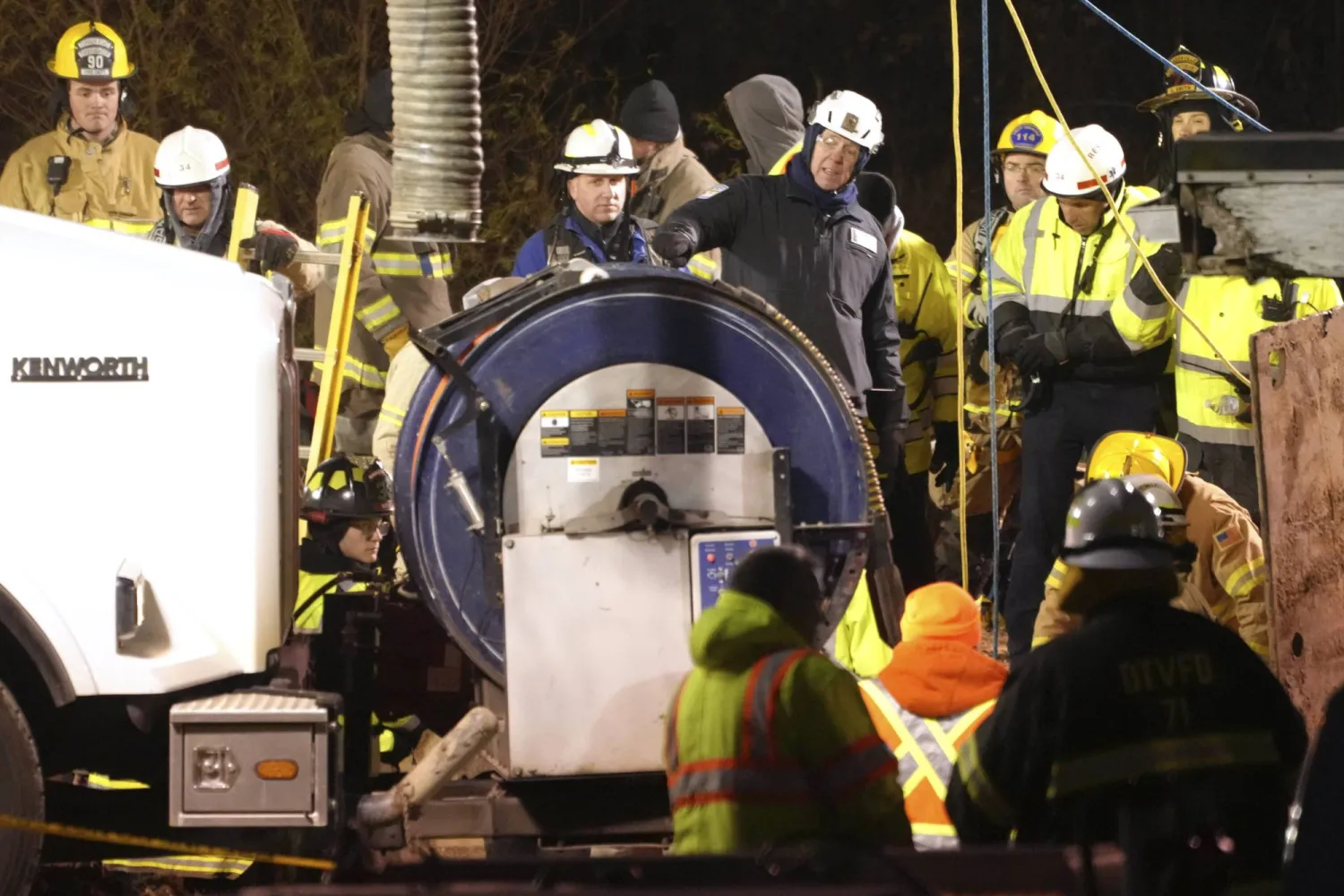
Rescue workers search in a sinkhole for Elizabeth Pollard, who disappeared while looking for her cat, in Marguerite, Pa., Tuesday, Dec. 3, 2024. (AP Photo/Gene J. Puskar)
TT

What to Know About Sinkholes after a US Woman May Have Disappeared into One

Rescue workers search in a sinkhole for Elizabeth Pollard, who disappeared while looking for her cat, in Marguerite, Pa., Tuesday, Dec. 3, 2024. (AP Photo/Gene J. Puskar)

Authorities fear a grandmother in western Pennsylvania who disappeared while looking for her cat may have been swallowed by a sinkhole, The Associated Press reported.
Crews lowered a pole camera with a sensitive listening device into the hole on Tuesday but no sound was detected, while a second camera lowered down showed what could be a shoe.
Police say Elizabeth Pollard's relatives called police at about 1 a.m. to say she hadn’t been seen since Monday evening when she went to search for her cat. They found Pollard’s 5-year-old granddaughter in her parked car near the manhole-sized opening.
Here are some things to know about sinkholes:
What are sinkholes? A sinkhole is an area of ground that has no natural external surface drainage and can form when the ground below the land surface can no longer support the land above, according to the US Geological Survey.
The land usually stays intact for a period of time until the underground spaces just get too big. If there is not enough support for the land above the spaces, then a sudden, dramatic collapse of the land surface can happen.
How common are sinkholes? Sinkholes are most common in what geologists call karst terrain, which involves types of rock including limestone below the land surface that can naturally be dissolved by groundwater circulating through them. They can also happen due to old underground mines.
The most damage from sinkholes in the US tends to occur in Florida, Texas, Alabama, Missouri, Kentucky, Tennessee and Pennsylvania. Florida, for example, is highly susceptible to sinkholes because it sits above limestone.
How big are sinkholes? Sinkholes can range in size from holes that are just a few feet wide to ones that cover a vast area spanning hundreds of acres. Their depth can also vary from just a few inches to more than 100 feet (more than 30 meters). Some are shaped like shallow bowls or saucers, whereas others have vertical walls. Some hold water and form ponds.
Other recent sinkhole incidents In June, a giant sinkhole in southern Illinois swallowed the center of a soccer field built on top of a limestone mine, taking down a large light pole and leaving a gaping chasm where squads of kids often play. No one was hurt.
In 2023, a sinkhole that in 2013 fatally swallowed a man sleeping in his house in suburban Tampa, Florida, reopened for a third time, but it was behind chain-link fencing and caused no harm to people or property. Officials said the sinkhole reopening was not unusual, especially in central Florida with its porous limestone base.
A large sinkhole opened up in 2020 in South Dakota near where a man was mowing his lawn. Testing revealed a large, improperly sealed mine beneath part of the housing subdivision, and a 40-foot-deep (12-meter-deep) pit mine in another corner of the neighborhood, a lawyer for some of the area homeowners said. Since the first giant collapse, more sinkholes have appeared.
A large sinkhole that swallowed oil field equipment and some vehicles in southeastern Texas in 2008 expanded in 2023 when another sinkhole developed and joined the first one.



NASA Counts Down for First Crewed Lunar Mission in Half a Century

NASA's Artemis II lunar flyby mission, with the next-generation moon rocket, the Space Launch System (SLS) rocket and the Orion crew capsule, sits on Pad 39B ahead of the launch of the Artemis II mission at the Kennedy Space Center in Cape Canaveral, Florida, US, March 31, 2026 - Reuters
TT

NASA Counts Down for First Crewed Lunar Mission in Half a Century

NASA's Artemis II lunar flyby mission, with the next-generation moon rocket, the Space Launch System (SLS) rocket and the Orion crew capsule, sits on Pad 39B ahead of the launch of the Artemis II mission at the Kennedy Space Center in Cape Canaveral, Florida, US, March 31, 2026 - Reuters

NASA is set to launch four astronauts as soon as Wednesday evening on a 10-day flight around the moon, marking the most ambitious US space mission in decades and a major step toward returning humans to the lunar surface before China's first crewed landing.

NASA mission managers on Monday polled "go" to launch the Artemis II mission's towering, 322-ft (98-m) Space Launch System (SLS) rocket topped with the astronauts' Orion crew capsule as early as 6:24 p.m. EDT (2224 GMT) on Wednesday.

It will launch from NASA's Kennedy Space Center in Florida just one pad away from where the last moon-bound astronauts of the US Apollo program lifted off more than half a century ago, Reuters reported.

The Artemis II crew includes NASA astronauts Christina Koch, Victor Glover and Reid Wiseman and Canadian astronaut Jeremy Hansen, who landed in Florida from Houston on Friday.

They had been in a two-week quarantine leading up to liftoff and spent time with their families over the weekend at the Kennedy Space Center's beach house, a spot where astronauts rest before blasting off into space.

"Certainly all indications are right now, we are in excellent, excellent shape as we get into count," launch director Charlie Blackwell-Thompson told reporters on Monday.

Weather conditions appeared favorable for an on-time liftoff, with only a 20% chance of souring within the agency's two-hour launch window on Wednesday. If the weather worsens and triggers a scrub, NASA could try again to launch any day until April 6, after which it would wait until April 30 for its next opportunity.

The launch had originally been planned for as early as February 6, and then March 6, until a pesky hydrogen leak prompted NASA to roll the rocket back to its vehicle assembly building for scrutiny.

FARTHEST TRIP IN HISTORY

The Artemis II mission will send the crew on a winding, nearly 10-day journey around the moon and back, sending them some 252,000 miles (406,000 km) into space - the farthest humans have ever traveled.

The current record for the farthest spaceflight at roughly 248,000 miles is held by the three-man crew of the Apollo 13 lunar mission in 1970, which was beset by technical problems after an oxygen tank exploded and was unable to land on the moon as planned.

Humans have not left Earth's orbit since the final Apollo mission in 1972.

NASA launched its first Artemis mission without crew in 2022, sending the gumdrop-shaped Orion spacecraft on a similar path around the moon and back.

Artemis II will pose a greater test of Orion and the SLS rocket. The astronauts on board will test critical life-support systems, crew interfaces and communications. They will also take manual control of Orion in space roughly three hours after launch to test its steering and maneuverability, a key feature should its automated systems fail.

Lockheed Martin builds Orion, while Boeing and Northrop Grumman have led the development of SLS since 2010, a program partly known for its ballooning costs at an estimated $2 billion to $4 billion per launch.

Elon Musk's SpaceX and Jeff Bezos' Blue Origin are racing to develop lunar landers that NASA will use to put its astronauts on the lunar surface.

The Artemis II mission is a key early step in the agency's multibillion-dollar Artemis program that envisions a long-term settlement on the lunar south pole. NASA is pressing hard to land its first crew of astronauts there on the Artemis IV mission by 2028, before China does around 2030.

Artemis III had been set to be the agency's first astronaut moon landing, but new NASA Administrator Jared Isaacman in February added an extra test mission before the landing.


India has Begun its Long-delayed Population Census

FILE - Indians crowd ticket counters at a railway station in Ahmadabad, India, Oct. 23, 2011. (AP Photo/Ajit Solanki, File)
TT

India has Begun its Long-delayed Population Census

FILE - Indians crowd ticket counters at a railway station in Ahmadabad, India, Oct. 23, 2011. (AP Photo/Ajit Solanki, File)

India has begun the world’s largest national population count, which could reshape welfare programs and political representation across the country.

The previous census in 2011 recorded a population of 1.21 billion. It's now estimated to be more than 1.4 billion, making India the most populous nation, The Associated Press reported.

The new census had been planned for 2021 but was postponed due to the COVID-19 pandemic and logistical challenges.

Here’s how India’s census works and why it is significant:

The first phase of the count started Wednesday and will roll out around the country through September. The workers will spend about a month in each area collecting information on homes and available facilities and will document housing stock and living conditions.

The exercise will blend in-person surveys with a digital option where residents can submit information through a multilingual smartphone application that integrates satellite-based mapping.

The second phase to be conducted from September to next April 1 will record more detailed information, like people's social and economic characteristics, including religion and caste.

More than 3 million government workers are expected to be deployed over the course of the year. In 2011, nearly 2.7 million enumerators surveyed more than 240 million households nationwide.

The second phase of the census will attempt a broader accounting of caste beyond historically marginalized groups.

Caste is an ancient system of social hierarchy in India and is influential in defining social standing and deciding who gets access to resources, education and economic opportunity.

There are hundreds of caste groups based on occupation and economic status across India, particularly among Hindus, but the country has limited or outdated data on how many people belong to them.

The last attempt to gather detailed caste information through a census dates to 1931, during British colonial rule. Since independent India’s first census in 1951, it counted only Dalits and Adivasis, members of marginalized groups known as Scheduled Castes and Scheduled Tribes who qualify for certain government benefits.

Successive governments have resisted conducting a full caste count, arguing it could heighten social tensions and trigger unrest.

Population data collected through the census underpins the distribution of government welfare programs and a wide range of public policies.

It could also prompt a redrawing of India’s political map, as seats in the lower house of Parliament and state legislatures may be increased to reflect population growth. A 2023 law reserves one-third of legislative seats for women, so any expansion would raise the number of seats set aside for female representatives.


Pakistan’s Blossom Season Brings Calm in a Troubled World

Commuters ride past apricot blossom trees at Ghanche district in Gilgit-Baltistan region on March 30, 2026. (AFP)
TT

Pakistan’s Blossom Season Brings Calm in a Troubled World

Commuters ride past apricot blossom trees at Ghanche district in Gilgit-Baltistan region on March 30, 2026. (AFP)

The harsh days of winter are over in Pakistan's high north and while snow still tops the towering peaks that dominate the landscape, spring has arrived in the foothills.

But this year, visitors who have come to witness the region's cherry and apricot blossoms see it as the perfect tonic to the war in the Middle East and its knock-on effects.

"There's war going on all over the world right now. It's petrol crisis, this and that, everything has become more expensive, everyone is in a depression," Hatib, 27, from Pakistan's biggest city, Karachi, told AFP.

"But to get out of depression, you need to step outside, go out somewhere for a bit, see places, explore, and relax the mind," he said.

The blossoms that turn bare trees into a vibrant shade of pink carpet the thawing farmland of Gilgit-Baltistan from late March every year, marking renewal and the promise of fruit harvests to come for local people.

"The best part is when these flowers are falling. It literally feels like a dream," Hatib said.

The region, home to about 1.7 million people, has some of the world's highest mountains, including K2, which soars to 8,611 meters (28,251 feet) -- second only to Mount Everest.

The jagged mountain ranges, high-altitude lakes and glaciers of Gilgit-Baltistan are a magnet for the daring and adventurous.

But more sedate visitors can instead take selfies in the orchards of the flowering deep valleys, under a clear blue sky with only the chirrup of birdsong and the bleat of foraging goats to break the surrounding silence.

"No matter how much inflation there is in Pakistan today, no matter how much petrol prices are going up, tourists still don't want to miss the cherry blossom and apricot blossom season," said local visitor Maria Akbar, 29.

"Even if we have to spend extra money, it's not a problem, but we'll enjoy this view."

"Things like cherry blossom and apricot blossom are what make Gilgit-Baltistan unique compared to all other regions," added Junaid Ahmed, 31.

"Tourists from all over the world come to enjoy this season. As you can see around me how beautiful it is, the beautiful view of these cherry and apricot blossoms is right before your eyes."