


Crowds of Syrians Are Still Celebrating Assad’s Fall in Main Damascus Square

Syrian citizens celebrate during the third day of the takeover of the city by the opposition in Damascus, Syria, Tuesday, Dec. 10, 2024. (AP)
TT

Crowds of Syrians Are Still Celebrating Assad’s Fall in Main Damascus Square

Syrian citizens celebrate during the third day of the takeover of the city by the opposition in Damascus, Syria, Tuesday, Dec. 10, 2024. (AP)

In Umayyad Square in Damascus, Syrians celebrated the fall of President Bashar Assad for the third day on Tuesday despite Israeli airstrikes across the country.

The opposition fighters who recently took control of the capital city tried to impose a new rule banning the celebratory gunfire. There were a few violators, and much less deafening gunfire.

Protesters climbed the square's central monument to wave the Syrian revolutionary flag. On the ground, crowds chanted: “Out with Bashar! Out with Bashar!” Assad fled to Russia over the weekend after a lightning opposition offensive toppled his brutal police state.

Demonstrators from different provinces marched in the square in groups, celebrating Assad's fall. Men on motorcycles and horses paraded into the square.

One woman from Idlib province shouted that the Israeli strikes ruined the joy of ousting Assad. “Why are you striking us? We just deposed a tyrant,” she said.

“Give us peace. Leave us alone,” said Ahmed Jreida, 22, a dentist student, when asked about the Israeli airstrikes.

Hamzeh Hamada, 22, said this was the first time he had gone out to a demonstration.

“We want the country to get better, to live in dignity and be like other countries that respect citizens’ rights and where there are no bribes,” he said. “We have suffered a lot from bribes. ... We had to bribe people for very minor things; things that should be our right.”

Abdul-Jalil Diab was taking a stroll with his brothers in another square in western Damascus. He said he came back from Jordan the day Damascus fell. He was there studying German to prepare to move to Germany and said he is now reconsidering his plans. He was ecstatic, saying words can’t describe how he feels.

“We are happy to get rid of the corrupt regime that was based on bribes. The whole country feels better. Everyone is happy and celebrating,” Abdul-Jalil Diab said.

Over 100,000 Worshippers Perform Friday Prayers at Al-Aqsa

Muslim worshippers pray outside the Dome of the Rock at the Al-Aqsa Mosque compound during Friday noon prayers, following 40 days of closure by the Israeli authorities, in Jerusalem's Old City on April 10, 2026. (AFP)
TT

Over 100,000 Worshippers Perform Friday Prayers at Al-Aqsa

Muslim worshippers pray outside the Dome of the Rock at the Al-Aqsa Mosque compound during Friday noon prayers, following 40 days of closure by the Israeli authorities, in Jerusalem's Old City on April 10, 2026. (AFP)

More than 100,000 Muslim worshippers performed Friday prayers at the Al-Aqsa Mosque in east Jerusalem, the holy site's Islamic authority reported, after it reopened the previous day following a truce agreed between the United States and Iran.

Jerusalem's Old City is home to major holy sites for all three Abrahamic religions, which had been shuttered since the start of the war sparked by the US-Israeli attack on Iran on February 28.

Within the Old City lie the Al-Aqsa Mosque for Muslims, the Western Wall for Jews, and the Church of the Holy Sepulchre for Christians -- all located in East Jerusalem, a territory occupied and annexed by Israel.

The sites reopened to worshippers on Thursday, a day after Washington and Tehran declared a two-week ceasefire in the Middle East war.

Muslim worshippers had been unable to access the Al-Aqsa even during the holy month of Ramadan this year.

On Friday, more than 100,000 Muslims performed the weekly Friday prayer at Al-Aqsa, according to the Islamic Waqf, the Jordanian body that administers the site.

AFPTV live footage showed the compound packed with worshippers.

"Hopefully they will not close Al-Aqsa again, and everyone will be able to come to this holy place -whether residents of Jerusalem or from the West Bank," said 30-year-old Mohammad Saaedeh.

Palestinians from the Israeli-occupied West Bank remain subject to strict Israeli restrictions based on age and permit quotas.

"Friday prayer is an obligation for us, but performing it at Al-Aqsa is something entirely different," said Sharif Mohammad, 39, referring to the site's status as Islam's third-holiest shrine.

"It's an indescribable feeling," added Ahmad Ammar, 55.

Beyond the reopening of the holy sites in Jerusalem, the Israeli authorities have lifted most of the restrictions linked to the state of emergency over the war with Iran.

This excludes the country's northern border area near Lebanon, where the war against Iran-backed Hezbollah continues.


Lebanon Says Israeli Attack Killed 13 State Security Personnel in Nabatieh

Flames and smoke engulf part of the site of an Israeli airstrike that targeted the Lebanese State Security Center, in the Southern Lebanese city of Nabatieh on April 10 2026. (AFP)
TT

Lebanon Says Israeli Attack Killed 13 State Security Personnel in Nabatieh

Flames and smoke engulf part of the site of an Israeli airstrike that targeted the Lebanese State Security Center, in the Southern Lebanese city of Nabatieh on April 10 2026. (AFP)

Lebanon's President Joseph Aoun said on Friday that 13 state security ‌personnel ‌were killed ‌in an ⁠Israeli strike on ⁠a governmental building in the southern city ⁠of ‌Nabatieh.

In a ‌statement, Aoun ‌condemned ‌continued Israeli attacks and said targeting ‌state institutions would not ⁠deter ⁠Lebanon from defending its sovereignty.

Naim Qassem, head of Iran-backed armed group Hezbollah, called on the Lebanese state to stop giving "free concessions" to Israel, with the two governments due to begin negotiations next week to end the war that has left nearly 1,900 people in Lebanon dead.

The government banned Hezbollah's military activities at the beginning of the latest war with Israel in March and is moving towards bilateral negotiations with Israel despite the opposition of Hezbollah, which is represented in the cabinet and parliament.

The state-run National News Agency (NNA) said "enemy warplanes launched a series of heavy strikes" on Nabatiyeh, including one in the vicinity of the government complex hitting the State Security office.

An AFP photographer saw extensive damage at the site, where a fire was still raging.

- Diplomatic scramble -

As the government prepared for talks with Israel in Washington, outside the auspices of the US-Iran talks in Islamabad, Qassem called on officials "to stop offering free concessions" and described Israel's military campaign as a failure.

"The Israeli enemy has failed on the battlefield... It has been unable to carry out the ground invasion it repeatedly announced," he said, adding that "the resistance will continue until the last breath".

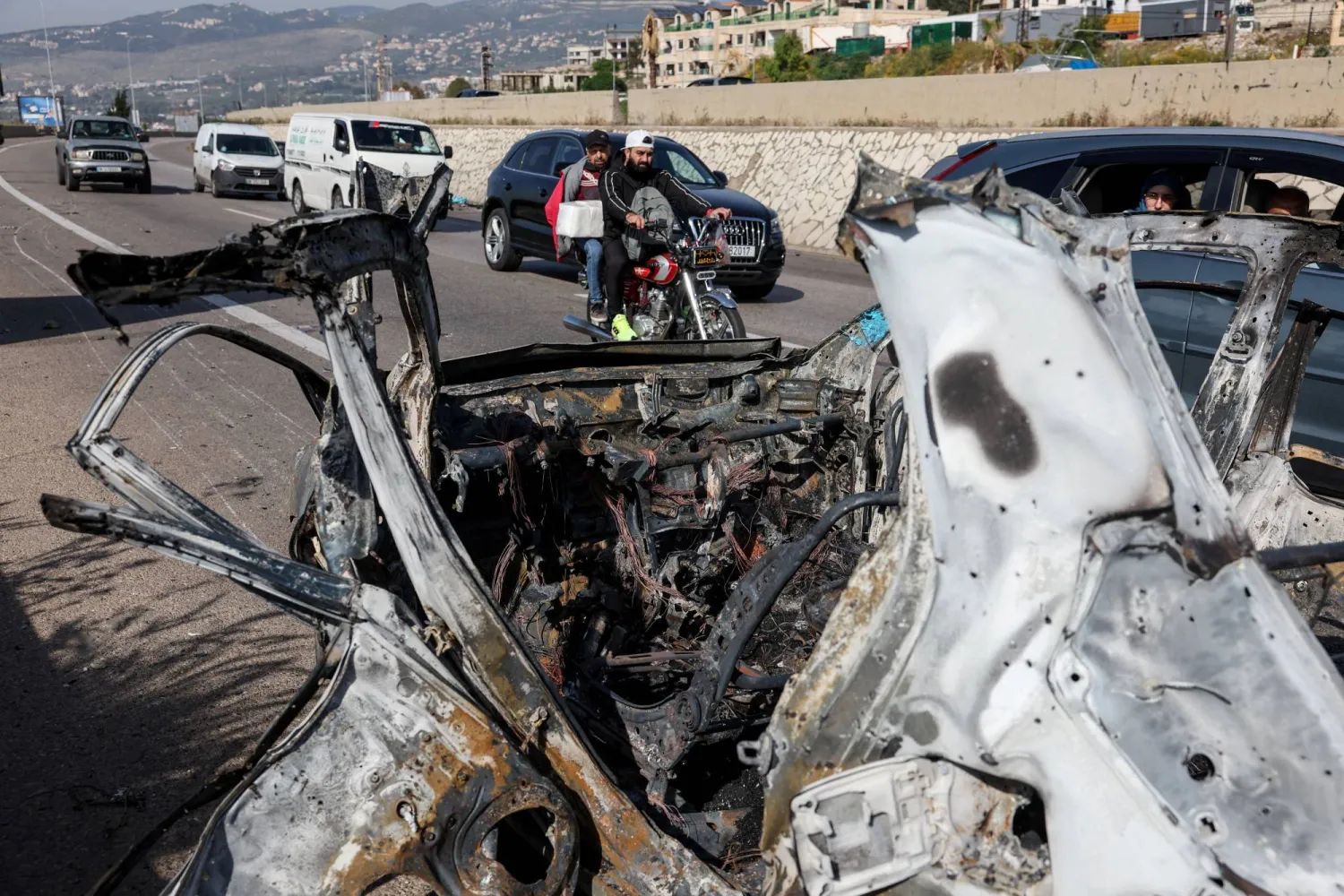
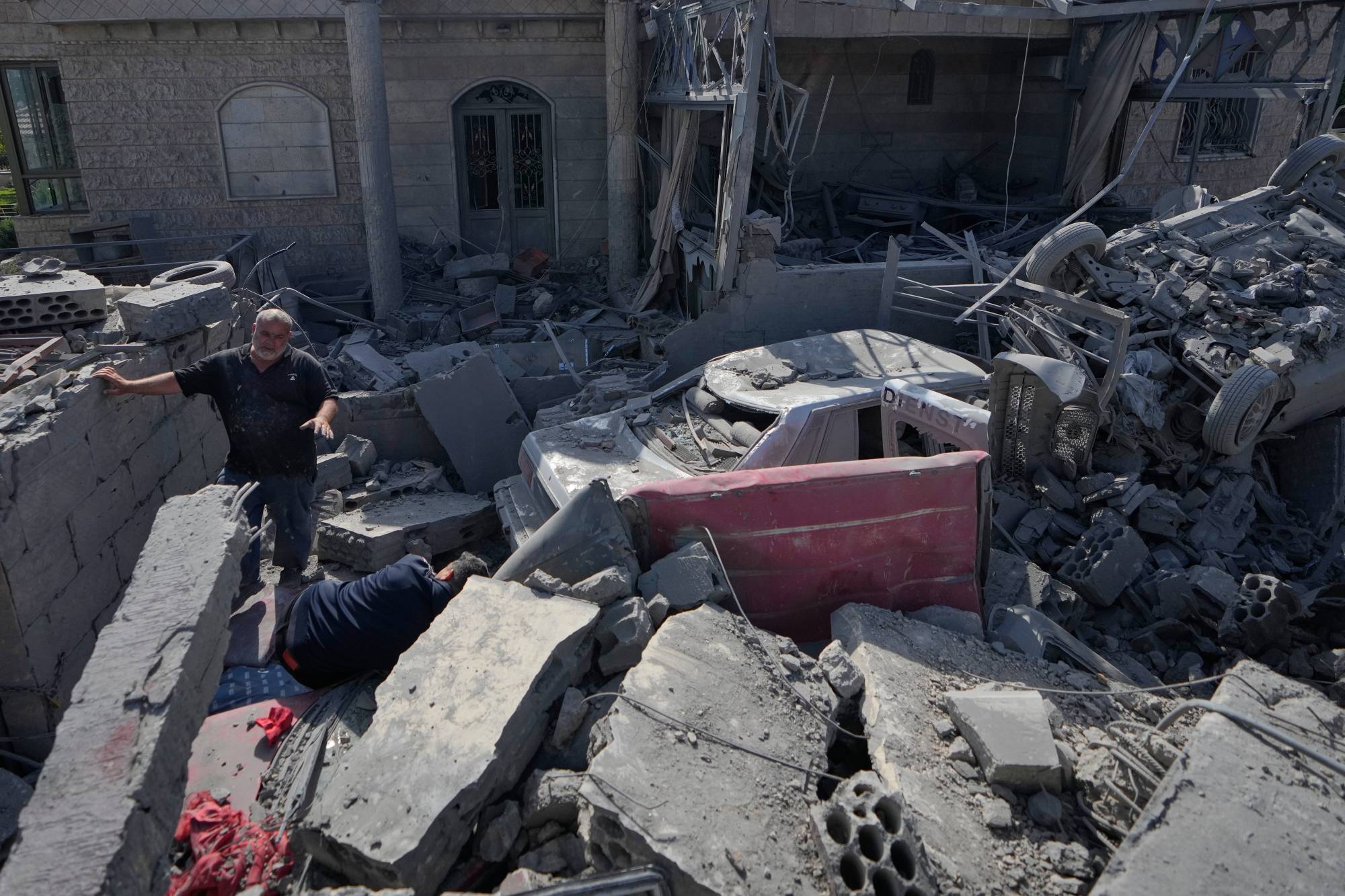
More than 300 people, mostly civilians according to a Lebanese military source, were killed in a wave of simultaneous Israeli strikes on Lebanon on Wednesday despite the announcement hours earlier of a truce between the United States and Iran, with Israel and the US saying it did not apply to Lebanon.

Iran has insisted on including Lebanon in its ceasefire negotiations with the US.

- Quiet in Beirut -

On Thursday afternoon, the Israeli military issued a warning of incoming strikes for large, densely populated areas of southern Beirut, but had not carried out the threat as of Friday, with a Western diplomat telling AFP Friday that European and Arab states are pressuring Israel to stop targeting Beirut.

The Western diplomat, who asked to remain anonymous in order to discuss sensitive matters, said on Friday that "there is ongoing diplomatic pressure from European states, Gulf states and Egypt on Israel to prevent renewed Israeli airstrikes on Beirut after 'Black Wednesday'".

Thursday's Israeli warning included areas home to major hospitals and the road to the country's only international airport.

Public Works and Transport Minister Fayez Rasamny said, in a statement carried by the state-run National News Agency (NNA) on Thursday, that he had "received assurances" from foreign diplomats that the airport and the road leading to it would be spared.

Meanwhile, Mohammad Zaatari, director of the country's largest public medical facility, Rafic Hariri Hospital, told AFP: "We have received assurances, including from the International Committee of the Red Cross that the hospital would not be targeted."

The World Health Organization on Thursday called on Israel to cancel its evacuation warning for the Jnah district of Beirut because around 450 patients were in the Rafic Hariri and Al-Zahraa hospitals in the district, including 40 in intensive care.

The Israeli military said on Friday it had "dismantled" more than 4,300 Hezbollah sites in Lebanon and killed "more than 1,400" Hezbollah fighters.

Hezbollah, for its part, claimed several rocket launches on northern Israel, as well as attacks on Israeli troops advancing in the border area.

Hezbollah also said it targeted a naval base in the southern Israeli city of Ashdod on Friday, far from the border, with missiles.


Israel’s Zamir: Lebanon is the Main Combat Arena

First responders gather at the site of an Israeli airstrike in the village of Habbouch, southern Lebanon on April 10, 2026. (Photo by Abbas FAKIH / AFP)
TT

Israel’s Zamir: Lebanon is the Main Combat Arena

First responders gather at the site of an Israeli airstrike in the village of Habbouch, southern Lebanon on April 10, 2026. (Photo by Abbas FAKIH / AFP)

The head of Israel’s military, Lt. Gen. Eyal Zamir, has said that the “main combat arena is in Lebanon.”

The mission is to keep weakening Hezbollah, Zamir said.

He was speaking on Thursday to Israeli troops inside Lebanon, on the outskirts of the town of Bint Jbeil.

“Our main combat arena is here in Lebanon,” he stated.

Zamir said the army’s mission is to “continue deepening the damage and to continue weakening Hezbollah.”

He added that the objective is to remove the direct threat to residents of northern Israel.

Israeli Prime Minister Benjamin Netanyahu has offered a potential boost to ceasefire efforts in the region when saying he had approved direct talks with Lebanon.

The announcement came after Israel’s pounding of Beirut Wednesday killed more than 300 people. The negotiations are expected next week in Washington.
