


Somalia Finance Minister to Asharq Al-Awsat: We Settled $4.5 Bln in Debt with Saudi Support

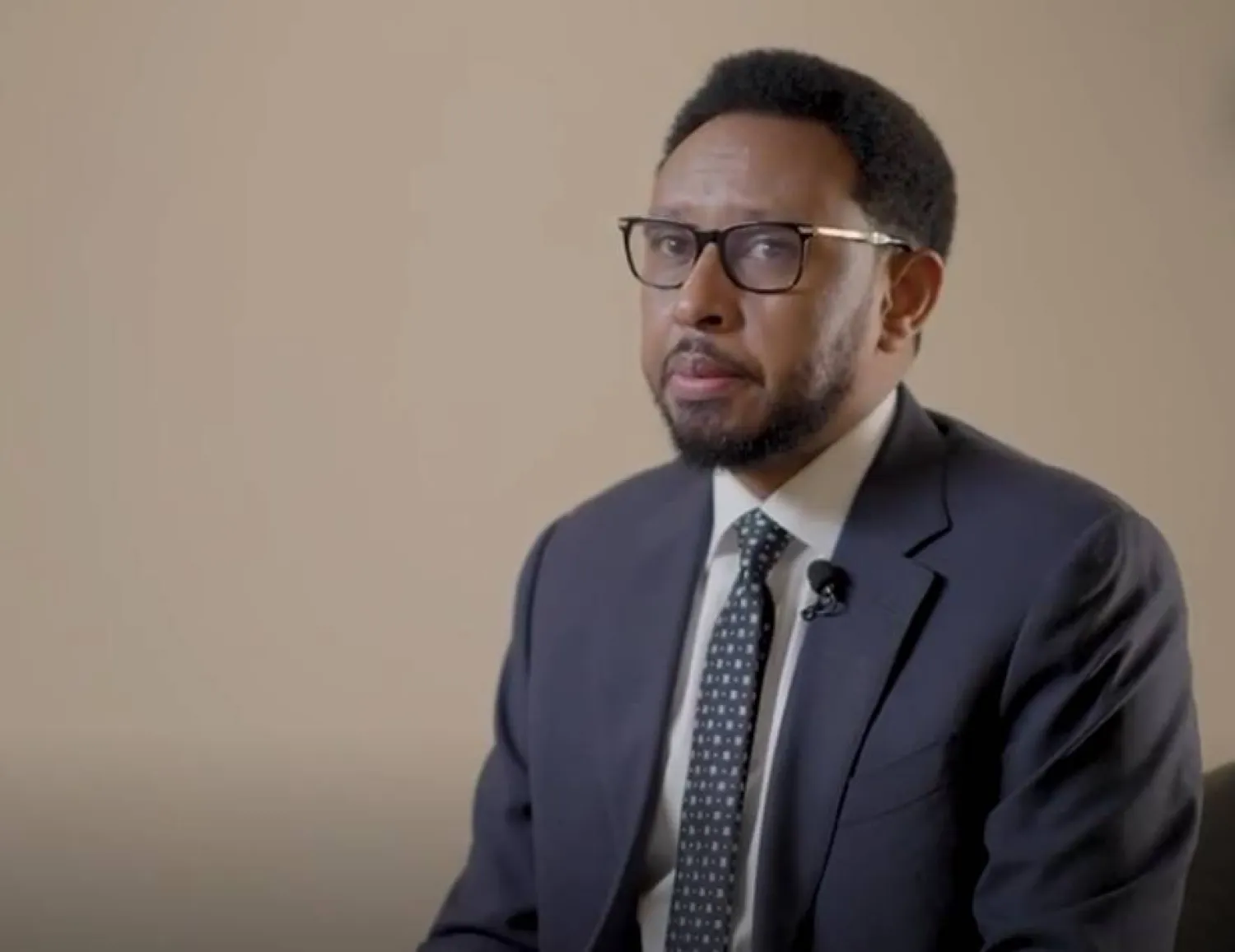
Somalia’s Minister of Finance Bihi Iman Egeh speaks to Asharq Al-Awsat.
TT

Somalia Finance Minister to Asharq Al-Awsat: We Settled $4.5 Bln in Debt with Saudi Support

Somalia’s Minister of Finance Bihi Iman Egeh speaks to Asharq Al-Awsat.

Somalia’s Minister of Finance Bihi Iman Egeh announced that the country has successfully settled around $4.5 billion in debt under the Heavily Indebted Poor Countries (HIPC) Initiative led by the International Monetary Fund (IMF). He attributed this milestone to major institutional and financial reforms, as well as increased domestic revenue mobilization.

In an interview with Asharq Al-Awsat, Egeh emphasized that Mogadishu views Riyadh as a key strategic partner in fostering economic growth and enhancing security and stability. He also praised Saudi Arabia’s pivotal role in facilitating Somalia’s debt relief efforts.

Egeh outlined Somalia’s priorities for the next phase, with a strong focus on attracting investments, particularly from Saudi Arabia, in key sectors such as livestock, renewable energy, the blue economy, and natural resources, including gold and minerals.

He said that in December 2023, Somalia reached the completion point of the HIPC Initiative—a process nearly a decade in the making. This achievement followed a series of reforms aimed at rebuilding state institutions, improving public financial management, and implementing broad economic policies. As a result, Somalia successfully restructured its debts, particularly those owed to members of the Paris Club and other international creditors.

Saudi Arabia’s role

Egeh confirmed that Arab financial institutions were part of the Paris Club negotiations and that Somalia had settled its obligations, including debts owed to the Saudi Fund for Development. He acknowledged Saudi Arabia’s critical role in facilitating and supporting the restructuring of Somalia’s debt.

The minister underscored the strong and ongoing coordination between Mogadishu and Riyadh, particularly in security matters. He revealed that a Somali delegation, including security officials, was currently in Saudi Arabia discussing strategies for combating terrorist groups.

Additionally, Somalia’s National Intelligence and Security Agency (NISA) has a mission in Jeddah to strengthen bilateral cooperation beyond financial matters, extending into military and intelligence coordination. Egeh stressed his country’s commitment to expanding this partnership to effectively respond to security threats, noting that terrorist groups operate across borders, posing a shared threat to regional and global stability.

Boosting investment and economic growth

Following its debt relief success, Somalia is now focused on economic development and attracting foreign investments. The government is preparing to sign a new program with the IMF to build on the progress made through debt relief and solidify economic reforms.

Egeh stated that Mogadishu has taken significant steps to improve the investment climate and regulatory framework, offering incentives to investors. He emphasized Saudi Arabia’s importance as a historical and geographical partner in the Red Sea region, positioning it as a priority market for Somali investments.

Key investment sectors

Somalia, home to Africa’s longest mainland coastline, offers vast opportunities in the blue economy, fisheries, and untapped natural resources. Egeh pointed to agriculture and livestock as particularly promising sectors for investment.

Saudi Arabia is Somalia’s largest trade partner, importing between three and five million livestock annually. The minister highlighted opportunities to modernize and expand this trade by upgrading the agricultural and livestock sectors.

He also pointed to significant potential in renewable energy, which could have a transformative impact on industries such as livestock farming and cold-chain logistics within the blue economy. Additionally, Somalia’s vast mineral wealth—including gold and other valuable minerals—positions the country as an attractive destination for investors.

General view of the Somali capital, Mogadishu. (Reuters)

Security concerns

Egeh noted Somalia’s history of security challenges, but stressed that over the past 15 to 20 years, the country has been on a steady path toward rebuilding its economy and strengthening security.

The Somali government has launched an aggressive military campaign against the extremist Al-Shabaab group, liberating more than 80 villages. Egeh stated that these security gains create a significant opportunity to attract investments and revitalize the economy.

According to the minister, Somalia has adopted a three-pronged strategy to combat Al-Shabaab and other extremist groups. The first involves countering their ideological influence by educating communities about the false narratives promoted by these organizations. The second targets their financial networks by cutting off funding sources. The third focuses on direct military engagement to dismantle their operational capabilities.

Egeh noted that his country has made significant progress in disrupting terrorist financing, shutting down thousands of suspicious accounts on electronic money platforms and in traditional banks. These measures have severely weakened Al-Shabaab’s ability to generate revenue through extortion and illegal taxation.

He pointed out that before the current Somali government took office, Al-Shabaab had access to substantial financial resources, posing a regional threat across Africa and the Middle East. However, recent countermeasures have significantly diminished the group’s ability to fund operations, both within Somalia and beyond.

Somalia is also engaged in a campaign against ISIS militants operating in the country, particularly in the northeastern regions. Egeh revealed that government forces have reclaimed significant territory and destroyed ISIS strongholds.

Potential Al-Shabaab links with Houthis

When asked about possible ties between Al-Shabaab and Yemen’s Iran-backed Houthi militias, Egeh said that while no direct connections have been confirmed, Somalia remains vigilant against any emerging alliances between terrorist groups.

He reiterated that his country’s primary goal is the complete eradication of both Al-Shabaab and ISIS to prevent them from destabilizing the broader region.



Türkiye Calls Israel’s Recognition of Somaliland ‘Illegitimate’

This handout photograph taken and released by the Turkish presidential press service on December 30, 2025, shows Türkiye’s President Recep Tayyip Erdogan (R) and Somalia's President Hassan Sheikh Mohamud (L) shaking hands before their meeting in Istanbul. (Photo by Handout / Turkish Presidential Press Service / AFP)
TT

Türkiye Calls Israel’s Recognition of Somaliland ‘Illegitimate’

This handout photograph taken and released by the Turkish presidential press service on December 30, 2025, shows Türkiye’s President Recep Tayyip Erdogan (R) and Somalia's President Hassan Sheikh Mohamud (L) shaking hands before their meeting in Istanbul. (Photo by Handout / Turkish Presidential Press Service / AFP)

Türkiye’s president on Tuesday called Israel's recognition of Somaliland "illegitimate and unacceptable" as he hosted a visit by his Somali counterpart.

"Preserving the unity and integrity of Somalia in all circumstances holds special importance in our view. Israel's decision to recognize Somaliland is illegitimate and unacceptable," Turkish leader Recep Tayyip Erdogan said in a press conference alongside Somali President Hassan Sheikh Mohamud.

Israel sparked criticism last Friday when it said it was officially recognizing Somaliland -- a breakaway territory in Somalia's north.

The declaration was a first for the territory, which in 1991 had unilaterally declared secession from Somalia.

Israel's move has drawn widespread criticism from the African Union, Egypt and the European Union, which insist on war-torn Somalia's sovereignty.

Türkiye has frequently clashed with Israel over a range of issues, especially over the conflict in Gaza and Israeli obstruction of aid to the Palestinian territory.

Mohamud said Israeli Prime Minister Benjamin Netanyahu's "aggressive position, which also includes Somalia, is unacceptable".

He called Netanyahu's Somaliland declaration "a violation of international law" and "the start of insecurity and instability, especially for Somalia and the African region".


10 Countries Warn of ‘Catastrophic’ Gaza Situation

 Palestinians stand next to a tent set up on the rubble of buildings destroyed during Israeli air and ground operations in the Sheikh Radwan neighborhood, in Gaza City, Tuesday, Dec. 30, 2025. (AP)
Palestinians stand next to a tent set up on the rubble of buildings destroyed during Israeli air and ground operations in the Sheikh Radwan neighborhood, in Gaza City, Tuesday, Dec. 30, 2025. (AP)
TT

10 Countries Warn of ‘Catastrophic’ Gaza Situation

 Palestinians stand next to a tent set up on the rubble of buildings destroyed during Israeli air and ground operations in the Sheikh Radwan neighborhood, in Gaza City, Tuesday, Dec. 30, 2025. (AP)
Palestinians stand next to a tent set up on the rubble of buildings destroyed during Israeli air and ground operations in the Sheikh Radwan neighborhood, in Gaza City, Tuesday, Dec. 30, 2025. (AP)

The foreign ministers of 10 nations on Tuesday expressed "serious concerns" about a "renewed deterioration of the humanitarian situation" in Gaza, saying the situation was "catastrophic". 

"As winter draws in, civilians in Gaza are facing appalling conditions with heavy rainfall and temperatures dropping," the ministers of Britain, Canada, Denmark, Finland, France, Iceland, Japan, Norway, Sweden and Switzerland said in a joint statement released by the UK's Foreign Office. 

"1.3 million people still require urgent shelter support. More than half of health facilities are only partially functional and face shortages of essential medical equipment and supplies. The total collapse of sanitation infrastructure has left 740,000 people vulnerable to toxic flooding," the statement added. 

The ministers said they welcomed the progress that had been made to end the bloodshed in Gaza and secure the release of Israeli hostages. 

"However, we will not lose focus on the plight of civilians in Gaza," they said, calling on the government of Israel to take a string of "urgent and essential" steps. 

These included ensuring that international NGOs could operate in Gaza in a "sustained and predictable" way. 

"As 31 December approaches, many established international NGO partners are at risk of being de-registered because of the government of Israel's restrictive new requirements," the statement said. 

It also called for the UN and its partners to be able to continue their work in Gaza and for the lifting of "unreasonable restricts on imports considered to have a dual use". 

This included medical and shelter equipment. 

The foreign ministers also called for the opening of crossings to boost the flows of humanitarian aid into Gaza. 

While welcoming the partial opening of the Allenby crossing, they said other corridors for moving goods remained closed or severely restricted for humanitarian aid, including Rafah. 

"Bureaucratic customs processes and extensive screenings are causing delays, while commercial cargo is being allowed in more freely," the statement said. 

"The target of 4,200 trucks per week, including an allocation of 250 UN trucks per day, should be a floor not a ceiling. These targets should be lifted so we can be sure the vital supplies are getting in at the vast scale needed," it added. 


UN Condemns Israel's Moves against Agency for Palestinian Refugees

UNRWA center targeted by Israeli shelling in northern Gaza (DPA)
TT

UN Condemns Israel's Moves against Agency for Palestinian Refugees

UNRWA center targeted by Israeli shelling in northern Gaza (DPA)

The United Nations warned Tuesday that recent actions by Israel against the UN agency for Palestinian refugees risked depriving millions of people of basic services such as education and healthcare.

Israel's parliament passed new legislation on Monday formally stripping the United Nations Relief and Works Agency (UNRWA) of diplomatic immunity, and barring Israeli companies from providing water or electricity to the agency's institutions, AFP reported.

According to UNRWA, the legislation also grants the Israeli government the authority to expropriate the agency's properties in East Jerusalem, including its headquarters and main vocational training center.

UNRWA chief Philippe Lazzarini condemned the legislation as "outrageous", decrying it on social media as "part of an ongoing, systematic campaign to discredit UNRWA and thereby obstruct the core role that the agency plays providing human-development assistance and services to Palestine refugees".

Filippo Grandi, the outgoing head of the UN refugee agency, UNHCR, and a former UNRWA chief, also criticised the move as "very unfortunate".

In an interview with AFP, he highlighted that UNRWA, unlike other UN agencies, provides basic public services such as education and healthcare to the millions of registered Palestinian refugees it serves across Gaza and the West Bank, as well as in Lebanon, Jordan and Syria.

"If you deprive those people of those services... then you had better find a substitute," he said, warning: "I think it would be very difficult."

"At the moment, there is a great risk that millions of people will be deprived of basic services if UNRWA is further deprived of space to work, and resources to work."

Israel has been ratcheting up pressure on UNRWA over the past two years.

It has accused the agency of providing cover for Hamas militants, claiming that some UNRWA employees took part in the militant group's October 7, 2023 assault on Israel, which sparked the war in Gaza.

A series of UN-linked internal and external investigations found some "neutrality-related issues" at UNRWA, but stressed Israel had not provided conclusive evidence for its headline allegation.

Grandi criticised the torrent of accusations that have swirled around the agency.

"UNRWA is a very indispensable organization in the Middle East," he said.

"Contrary to much of the frankly baseless rhetoric that we have heard in the past couple of years, UNRWA is a force for peace and stability," he added.

"In a region in which you need every bit of stability and efforts towards peace, it would be really irresponsible to let such an important organization decline further."