


Brazil’s Ex-President Bolsonaro Charged in Alleged Coup Plot 

Former Brazilian President Jair Bolsonaro arrives for a luncheon with senators from his support base, at the National Congress building in Brasilia, Brazil, Tuesday, Feb. 18, 2025. (AP)
TT

Brazil’s Ex-President Bolsonaro Charged in Alleged Coup Plot 

Former Brazilian President Jair Bolsonaro arrives for a luncheon with senators from his support base, at the National Congress building in Brasilia, Brazil, Tuesday, Feb. 18, 2025. (AP)

Former Brazil President Jair Bolsonaro was charged on Tuesday with overseeing a plot to overturn his 2022 election loss with a coup, further complicating the far-right firebrand's already narrow hopes of pulling off a political comeback.

Prosecutor General Paulo Gonet charged Bolsonaro and his running mate, General Walter Braga Netto, with leading a "criminal organization" that aimed to overthrow Brazil's 40-year-old democracy.

A total of 34 people were charged in the plot, including several military officials, such as Bolsonaro's former national security adviser, retired General Augusto Heleno, and former Navy Commander Almir Garnier Santos, according to the charge sheet.

"The responsibility for acts harmful to the democratic order falls upon a criminal organization led by Jair Messias Bolsonaro, based on an authoritarian project of power," it added.

Analysts consider it unlikely Bolsonaro will be arrested before his trial, unless Supreme Court Justice Alexandre de Moraes, who is overseeing the case, deems him a flight risk.

The case echoes the criminal charges faced by US President Donald Trump that accused him of seeking to overturn his own re-election loss in 2020. That case was repeatedly delayed and ultimately dropped after Trump was returned to power in last November's US election.

The charges against Bolsonaro come just months after Brazil's federal police concluded a two-year investigation into his role in the election-denying movement that culminated in the riots by his supporters that swept the capital, Brasilia, in early 2023, a week after President Luiz Inacio Lula da Silva took office.

At the time, many protesters admitted that they wanted to create chaos to justify a military coup that they considered imminent. Late last year, police arrested five alleged conspirators suspected of planning to assassinate the leftist Lula before he took office.

Prosecutors have said the Bolsonaro-led plot included plans to poison Lula, a one-time union leader who previously served two terms as president.

Lula narrowly defeated the right-wing standard-bearer in the late 2022 presidential election.

A PLOT TO TAKE CONTROL

"They sought total control over the three branches of government; they outlined a central office that would serve the purpose of organizing the new order they intended to establish," the charging document noted, referring to those who allegedly pushed the coup plot.

Bolsonaro, a former army captain, has repeatedly denied breaking any laws, and calls allegations against him a witch hunt by his political opponents.

Lawyers representing Bolsonaro said in a Tuesday statement that he never supported any movement aimed at dismantling Brazil's democratic rule of law or the institutions that uphold it.

Meanwhile, Senator Flavio Bolsonaro, a son of the former president, in a post on X on Tuesday night derided the charges as an "unconstitutional and immoral mission to attend to Alexandre de Moraes' whims and Lula's nefarious interest."

Tuesday's indictment marks the first time Bolsonaro has been charged with a crime, though he has faced several legal challenges to his conduct as president since he lost his reelection bid.

Two previous decisions by Brazil's Federal Electoral Court have already blocked him from running for president until 2030.

Bolsonaro's lawyers have two weeks to respond to the charges before the Supreme Court decides whether it will accept the charges and potentially hold a dramatic, televised trial.

If convicted, Bolsonaro faces at least a dozen years behind bars.

DIMMING COMEBACK HOPES

"There's a 99% chance that the Supreme Court will accept the charges," said Vera Chemim, a constitutional lawyer in Sao Paulo. "But to convict Bolsonaro, the Supreme Court will need robust evidence."

Bolsonaro's former running mate, General Braga Netto, was arrested two months ago after police accused him of interfering in the investigations. In a statement late Tuesday, his lawyers called the charges a "fantasy" that will not erase his "unblemished history" over four decades of service in the Brazilian Army.

A lawyer for former Navy chief Garnier Santos said he will comment once he had fully reviewed the charges, while a lawyer for General Heleno, Bolsonaro's national security adviser, did not immediately respond to a request for comment.

A Supreme Court conviction could mark an insurmountable obstacle to Bolsonaro's hopes to run in the 2026 presidential election, in a potential rematch against Lula.

A 2010 law that Bolsonaro himself voted to pass when he was a member of Congress bars anyone convicted by an appeals court from running for office.

Two sources close to Bolsonaro said the former president has little hope the courts will rule in his favor. Instead, his allies hope to mobilize political support to increase the pressure on courts and lawmakers to clear a path for a comeback.

On Tuesday, hours before prosecutors presented the charges against him, Bolsonaro met with opposition senators to discuss a bill that would lower the length of time politicians are barred from elections if they commit irregularities.

While its prospects for passage are unclear, some conservatives are emboldened by Lula's unpopularity, according to recent polls.

A February survey released by Datafolha showed that only 24% of Brazilians approve of Lula's government, his lowest-ever rating in any of his three terms as president.



Trump Pressures NATO, China over Iran's Closure of Key Waterway

FILE PHOTO: Tankers sail in the Gulf, near the Strait of Hormuz, as seen from northern Ras al-Khaimah, near the border with Oman’s Musandam governance, amid the US-Israeli conflict with Iran, in United Arab Emirates, March 11, 2026. REUTERS/Stringer//File Photo
TT

Trump Pressures NATO, China over Iran's Closure of Key Waterway

FILE PHOTO: Tankers sail in the Gulf, near the Strait of Hormuz, as seen from northern Ras al-Khaimah, near the border with Oman’s Musandam governance, amid the US-Israeli conflict with Iran, in United Arab Emirates, March 11, 2026. REUTERS/Stringer//File Photo

President Donald Trump urged NATO partners and China to help reopen the Strait of Hormuz, the critical conduit for crude that Iran has effectively closed, as major economic players began releasing oil reserves on Monday to ward off supply disruptions.

Global oil prices have surged by 40 to 50 percent after Iran choked off the waterway and attacked energy and shipping industry targets in the Gulf in retaliation for the US-Israeli war against the Iranian republic.

Crude prices were hovering around $100 on Monday as the Middle East war entered its third week, with Israel saying it still has "thousands of targets in Iran", where it was also "identifying new targets every day".

Trump said the United States was in discussions with Iran but that Tehran was not ready for a deal to end the war, although the Iranian republic's foreign minister had earlier denied any talks with Washington.

"I don't think they're ready. But they are getting pretty close," Trump said.

The US president had called on countries including China, France, Japan, South Korea and Britain at the weekend to send ships to escort tankers through the strait.

"It's only appropriate that people who are the beneficiaries of the strait will help to make sure that nothing bad happens there," Trump told the Financial Times on Sunday. Unlike the United States, Europe and China are heavily dependent on the Gulf for oil imports.

Trump threatened to delay a planned summit with Chinese leader Xi Jinping later this month if Beijing does not assist with reopening the strait.

He also warned that no response or a negative reply to his request would be "very bad for the future of NATO".

But Tokyo and Canberra both said they were not planning deployments.

- Iran warning -

Trump's comments came after Iran warned other countries against getting involved in the war, which has spread across the Middle East.

In a phone conversation with his French counterpart Jean-Noel Barrot, Tehran's top diplomat Abbas Araghchi called on other countries to "refrain from any action that could lead to escalation and expansion of the conflict".

Arguing that the US security umbrella in the region was "inviting rather than deterring trouble", Araghchi on X urged neighboring countries "to expel foreign aggressors".

Iran has launched waves of attacks on countries in the Middle East that host US forces, and Italy's military said a drone attack at Ali Al Salem airbase in Kuwait -- which hosts both US and Italian forces -- destroyed an unmanned aircraft belonging to Italy but caused no casualties.

Italy's foreign minister, Antonio Tajani, sought to play down the attack -- the second on an Italian base in the Middle East this week -- insisting: "We are not at war with anyone."

Iraqi authorities meanwhile said rockets wounded five people at Baghdad's airport, which houses a US diplomatic facility, while Iran's Revolutionary Guards said about 700 missiles and 3,600 drones had been fired at US and Israeli targets so far.

Saudi Arabia intercepted more than 60 drones since midnight, according to a tally of defense ministry figures released on Monday, while Dubai airport suspended flights briefly after a "drone-related incident" sparked a fire nearby.

And French President Emmanuel Macron told Iran's President Masoud Pezeshkian it was "unacceptable" to target French interests after an Iranian-designed drone killed a French soldier in Iraq's Kurdistan region.

The war has also spread to Lebanon, where Israel launched a new strike on Beirut's southern suburbs late on Sunday.

- Energy markets -

On the economic front, the International Energy Agency said members will begin releasing 400 million barrels of oil from their strategic reserves, with Asia Oceania nations to make stocks available immediately, and Europe and the Americas follow in the weeks to come.

Japan, which depends on the Middle East for 95 percent of its oil imports, said Monday in a notice in its official government gazette that the level of oil reserves in the country "is being lowered".

The issuance of the notice compels managers of oil reserves to release part of their stockpile to meet the new standard.

The blockade of Hormuz has been felt across the globe, with Australia officials urging the public against price-gouging and panic buying as prices soar, while India restaurants were forced to adapt their menus to save cooking gas.

On the outskirts of Sydney, landscaper Emma Futterleib, who drives up to 500 km a week, told AFP "there's definitely some penny pinching going on".

"It hurts the budget, that's for sure," she said, adding she was "trying to be a bit careful on how much we are spending on groceries."

In Tehran, some residents sought to restore some normalcy at the weekend compared to the start of the war on February 28.

Traffic was busier than last week and some cafes and restaurants had reopened, as had more than a third of stalls in the Tajrish bazaar, a popular shopping hub, with Nowruz, the Persian New Year, just days away.

Some shoppers queued at ATMs to withdraw cash. Online operations at Bank Melli, one of the country's largest, had been paralyzed in recent days.

It was a similar story outside the capital. In an interview from Tonekabon, a city in Mazandaran province on the Caspian Sea, 49-year-old Ali told AFP that shops were open and crowded despite steep price rises.

"Only the main square is closed every night, and government demonstrations take place," he said, adding that only Iran's domestic intranet was working, without outside connections.

More than 1,200 people have been killed by US and Israeli strikes, according to Iranian health ministry figures that could not be independently verified.

The UN refugee agency says up to 3.2 million people have been displaced in Iran.


War-Related Oil Squeeze a ‘Short-Term Pain,’ US Official Insists

 A customer fuels up with regular gasoline priced at $5.29 at a Chevron gas station in Bellevue, Wash., Friday, March 13, 2026. (AP)
A customer fuels up with regular gasoline priced at $5.29 at a Chevron gas station in Bellevue, Wash., Friday, March 13, 2026. (AP)
TT

War-Related Oil Squeeze a ‘Short-Term Pain,’ US Official Insists

 A customer fuels up with regular gasoline priced at $5.29 at a Chevron gas station in Bellevue, Wash., Friday, March 13, 2026. (AP)
A customer fuels up with regular gasoline priced at $5.29 at a Chevron gas station in Bellevue, Wash., Friday, March 13, 2026. (AP)

President Donald Trump's top energy official said Sunday that Americans will have to endure the "short-term pain" of higher prices at the pump as US forces conduct their war against Iran.

Now in the third week of a multi-dimensional Middle East conflict that has seen US and Israeli forces pound Iran's military targets, and Tehran responding with missile and drone attacks against several neighboring states, global energy prices have soared.

And concern has swelled that a lengthy blockage by Iran of the critical Strait of Hormuz could send crude prices through the roof.

"President Trump needed to act now... to stop the killing of American soldiers, to stop the destabilization of the region, and to end Iran's ability to threaten energy markets," US Energy Secretary Chris Wright told ABC News talk show "This Week."

He said economic conditions would grow dramatically worse without the ongoing military operation "to defang the Iranian regime" and ensure it can no longer threaten the world with nuclear weapons.

"This is short-term pain to get through to a much better place where the Middle East can no longer be held hostage by the one rogue nation in Iran," Wright added.

The energy secretary also said he predicted the war could end "in the next few weeks, and we'll see a rebound in (fuel) supplies and a pushing down of prices after that."

Since the war began, gas prices have soared in the United States, where Trump in 2024 campaigned relentlessly on a vow to lower fuel costs for Americans. The issue is a critical one for US voters, who head to the polls in November for the country's mid-term congressional elections.

Gas prices have jumped 25 percent in the past month, to $3.70 per gallon, according to the American Automobile Association.

The Trump administration has stressed other governments should help in a possible effort to unblock the Strait of Hormuz by escorting tankers through the narrow waterway along Iran's coast.

US Transportation Secretary Sean Duffy, speaking on Fox News "Sunday Morning Futures," said oil could soon flow through the strait if such escorts -- and shipping insurance -- are worked out.

"Could be a day, could be a week," Duffy said of possible escorts.


Israel Says ‘No Interceptor Shortage’ After Reports of Scarcity as Iranian Missiles Injure at Least 8

15 March 2027, Israel, Tel Aviv: People watch the site of a projectile impact following an Iranian strike on Tel Aviv. (dpa)
TT

Israel Says ‘No Interceptor Shortage’ After Reports of Scarcity as Iranian Missiles Injure at Least 8

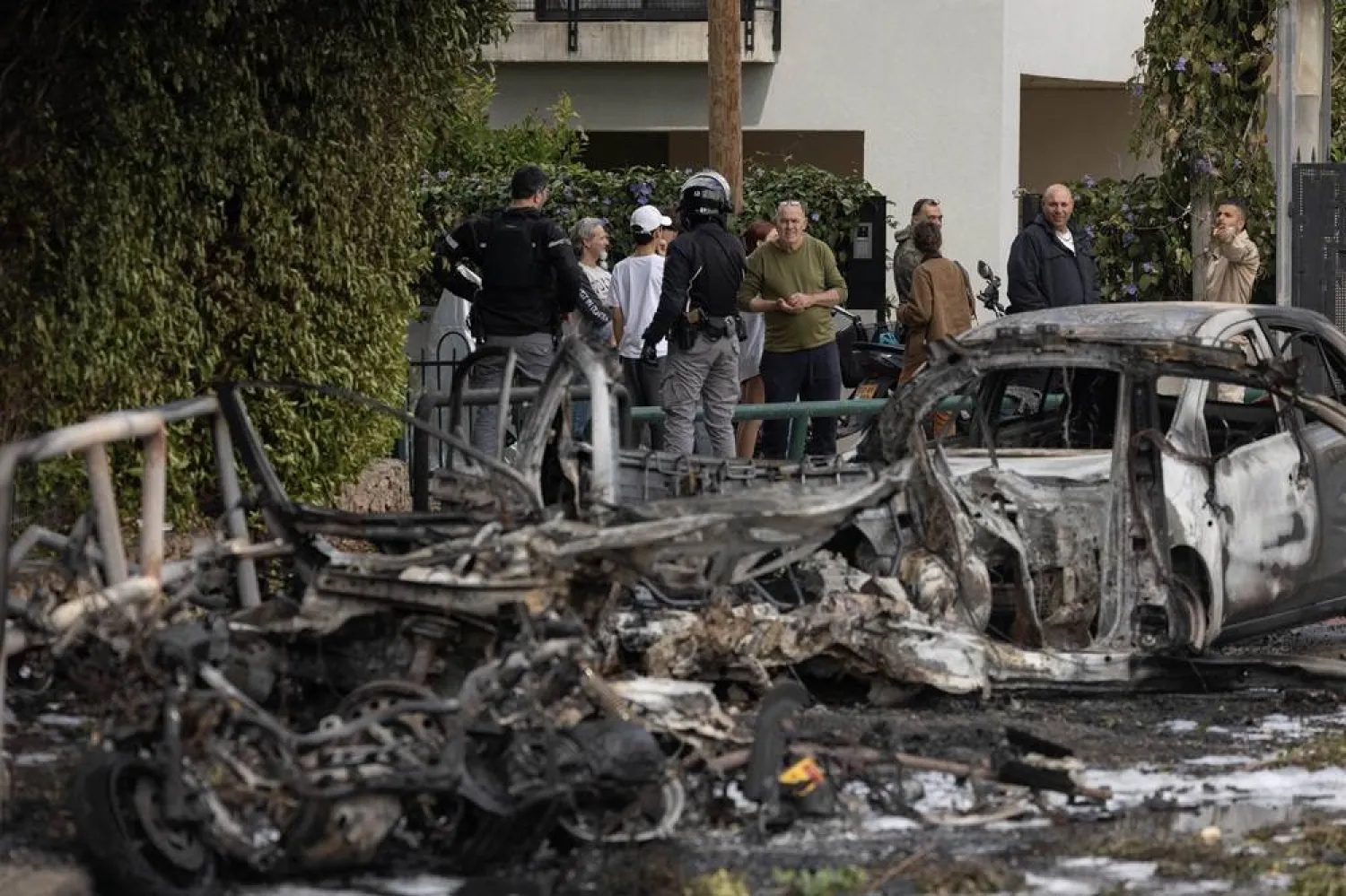
15 March 2027, Israel, Tel Aviv: People watch the site of a projectile impact following an Iranian strike on Tel Aviv. (dpa)

An Israeli military source on Sunday denied media reports that Israel was running low on missile interceptors crucial to its air defenses, adding that the army was "continuously monitoring the situation". 

Citing US officials, news outlet Semafor had reported that Israel had informed the United States that it was "running critically low on ballistic missile interceptors", as the US-Israeli war against Iran entered its third week. 

"As of now, there is no interceptor shortage. The Israeli army is prepared for prolonged combat. We are continuously monitoring the situation," the military source said, in response to media queries. 

Israeli Foreign Minister Gideon Saar also dismissed the reports when questioned by journalists earlier on Sunday. 

At least eight people were injured in Israel Sunday following repeated missile launches from Iran, at least two of which contained cluster munitions according to Israeli authorities. 

Israeli police released footage from a CCTV camera in the Tel Aviv area showing an impact on a road, saying that it was from "cluster munitions" that caused "damage at several locations". 

Bomblets and shrapnel from the missile wounded four people in various parts of the Tel Aviv metropolitan area, according to the Magen David Adom (MDA) rescue service. 

A man in his 60s was hospitalized with moderate injuries to his head from broken glass, while three were treated due to the shock waves from the blast. 

In another barrage shortly before noon, two men aged 62 and 44 reported minor injuries "from pieces of asphalt that struck them as a result of the blast", according to MDA. 

During a salvo toward the Tel Aviv area at around 3:00 am (0100 GMT), a man and a woman in their 80s suffered light injuries, from glass shards and smoke inhalation respectively. 

Another Iranian missile directed at Israel's southernmost city of Eilat was intercepted before reaching the target, without causing injuries. The municipality of Eilat quoted security sources saying it was a cluster missile. 

By late midday on Sunday, seven missile salvos were launched from Iran toward the State of Israel, some of which were intercepted. 

Saar on Sunday accused Iran of targeting civilian areas, during a visit to the northern Arab Israeli town of Zarzir, hit two days prior by shrapnel from an Iranian missile that lightly wounded almost 60 residents. 

"While we are targeting military objectives... the Iranian regime is targeting civilians," Saar said. 

"All the casualties we faced during these two weeks of confrontation... are civilians from Iranian missiles. This is of course a war crime," he added. 

His words were echoed by police superintendent Shlomi Schlezinger while speaking near the site of one of the impacts on Sunday. 

Iran is "always targeting crowded places, with people, the big major cities," he said in central Tel Aviv. 

He attributed the relatively low number of Israeli casualties to civilians' adherence to safety instructions. 

"We have a lot of collateral damage to cars and buildings, as you can see," he said. 

"We're used to, in the last 16 days, to be in shelters and in safe rooms when we have the alarm." 

According to Haaretz, citing security officials, 250 ballistic missiles had been fired by Iran at Israel as of March 13. 

Twelve people have been killed in Israel by missiles or falling debris since the start of the war, according to an AFP tally of figures given by Israeli authorities and first responders.