


Pope Francis is Conscious and Receiving Supplemental Oxygen Following a Respiratory crisis

Archbishop Rino Fisichella presides over Sunday's mass instead of Pope Francis. The Vatican, February 23, 2025. Vatican Media/­Simone Risoluti/Handout via REUTERS
TT

Pope Francis is Conscious and Receiving Supplemental Oxygen Following a Respiratory crisis

Archbishop Rino Fisichella presides over Sunday's mass instead of Pope Francis. The Vatican, February 23, 2025. Vatican Media/­Simone Risoluti/Handout via REUTERS

Pope Francis was conscious but still receiving high flows of supplemental oxygen Sunday following a respiratory crisis and blood transfusions, as he remains in critical condition with a complex lung infection, the Vatican said.

“The night passed quietly, the pope rested,” Vatican spokesman Matteo Bruni said in an early statement.

Further clinical tests were being performed on the 88-year-old pope, who had part of one lung removed as a young man, and a more detailed medical update was expected later Sunday.

On Saturday, Francis suffered a prolonged asthmatic respiratory crisis that required “high flows” of oxygen to help him breathe through a nasal tube. He also received blood transfusions after tests showed low counts of platelets, which are needed for clotting, the Vatican said, The AP reported.

Doctors said Saturday his prognosis was “reserved.”

Doctors have said Francis’ condition is touch-and-go, given his age, fragility and pre-existing lung disease. His condition has revived speculation about what might happen if he becomes unconscious or otherwise incapacitated, and whether he might resign.

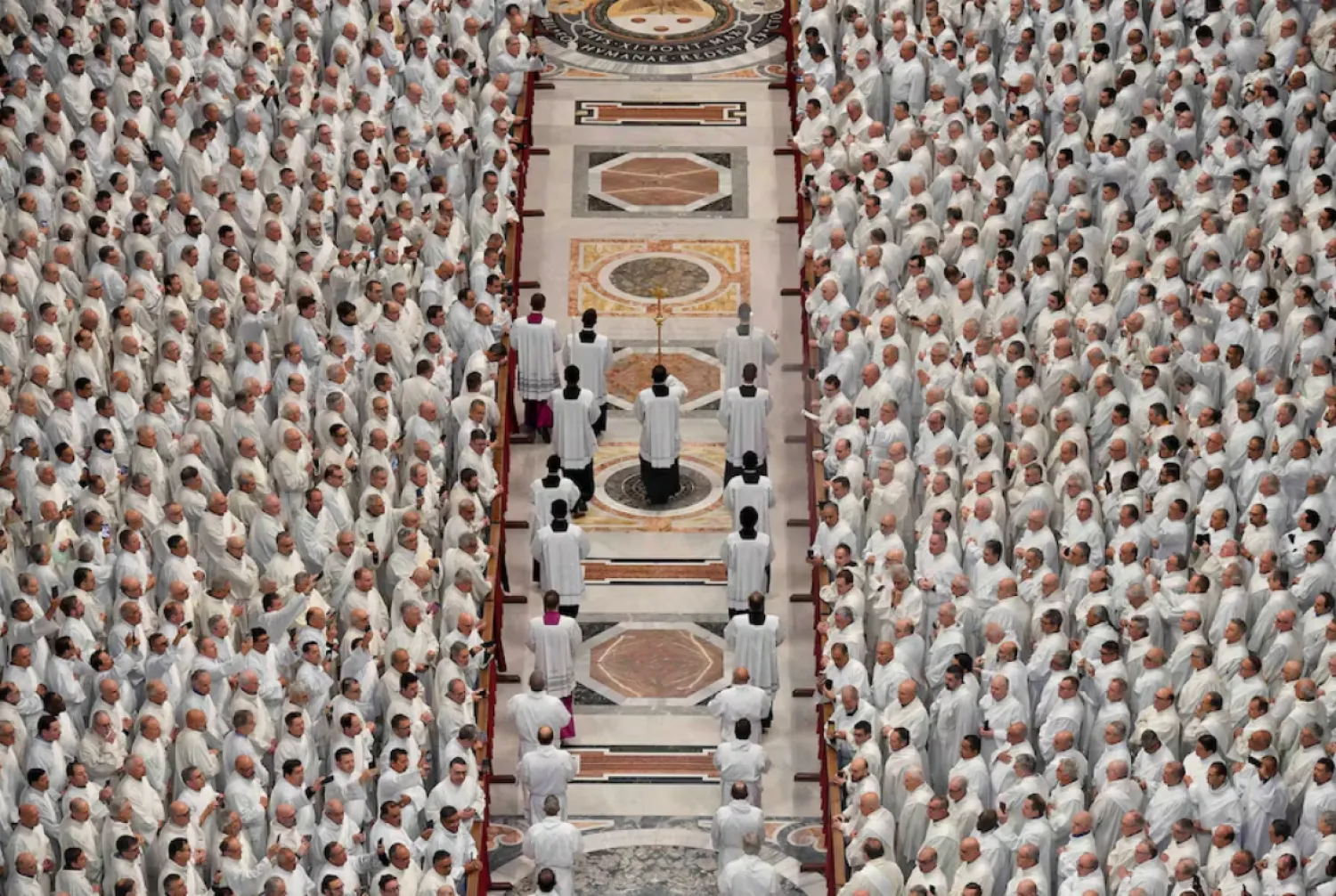
Prayers for pope at Vatican Francis was supposed to have celebrated Mass on Sunday morning in St. Peter's Basilica and ordained deacons as part of the Vatican's yearlong Holy Year commemoration.

The organizer of the Holy Year, Archbishop Rino Fisichella, celebrated the Mass in his place and offered a special prayer for Francis from the altar before delivering the homily the pope had prepared.

“Even though he is in a hospital bed, we feel Pope Francis close to us, we feel him present among us,” Fisichella told the hundreds of white-robed deacons.

A pre-written message that Francis had prepared for his Sunday noon prayer but did not deliver said he was “confidently continuing my hospitalization at the Gemelli Hospital, carrying on with the necessary treatment; and rest is also part of the therapy!” The message noted the upcoming anniversary of Russia's invasion of Ukraine, “a painful and shameful occasion for the whole of humanity.”

The main threat facing the pope is sepsis Doctors have warned that the main threat facing Francis would be the onset of sepsis, a serious infection of the blood that can occur as a complication of pneumonia. As of Friday, there was no evidence of any sepsis, and Francis was responding to the various drugs he is taking, the pope’s medical team said in their first in-depth update on the pope’s condition.

Saturday’s blood tests showed that he had developed a low platelet count, a condition called platelopenia or thrombocytopenia. Platelets are cell-like fragments that circulate in the blood that help form blood clots to stop bleeding or help wounds heal. Low platelet counts can be caused by a number of things, including side effects from medicines or infections, according to the U.S. National Institutes of Health.

Francis, who has chronic lung disease and is prone to bronchitis in winter, was admitted to Gemelli hospital on Feb. 14 after a weeklong bout of bronchitis worsened.

Doctors first diagnosed the complex viral, bacterial and fungal respiratory tract infection and then the onset of pneumonia in both lungs. They prescribed “absolute rest” and a combination of cortisone and antibiotics, along with supplemental oxygen when he needs it.

Francis’ recent reforms suggest he knew he was getting older and more fragile Francis has taken several recent decisions that suggest he was well aware that he was getting old and frail.

Last year, he revised the funeral rites that will be used after he dies, simplifying the rituals to emphasize his role as a mere bishop and allowing for burial outside the Vatican in keeping with his wishes. But the core elements of the rites remain, including the three key moments that must be observed between the death of a pope and his funeral: In his home, in St. Peter’s Basilica and in the place of burial.

In December, Francis created 21 new cardinals. All but one were under age 80 and thus eligible to vote in a conclave to elect his successor. Their additions brought the overall number of voting-age cardinals to 140, well over the 120 limit set by St. John Paul II. But several of the current electors are turning 80 this year, bringing the number down.

Earlier this month, once he was already sick, Francis decided to extend the five-year term of the current dean of the College of Cardinals, Cardinal Giovanni Battista Re, 91, rather than make way for someone new. As depicted in the film “Conclave,” the dean of the College of Cardinals plays an important role in the life of the Catholic hierarchy, and is a crucial figure during the transition between one papacy and the next.

Francis also decided to extend the term of the vice-dean, Argentine Cardinal Leonardo Sandri, 81.



FBI Foils 'Terror Plot' Targeting Los Angeles, US Attorney General Says

US Attorney General Pam Bondi speaks at a press conference following the arrest in the D.C. pipe bomber investigation, at the Justice Department in Washington, D.C., US, December 4, 2025. REUTERS/Jessica Koscielniak
TT

FBI Foils 'Terror Plot' Targeting Los Angeles, US Attorney General Says

US Attorney General Pam Bondi speaks at a press conference following the arrest in the D.C. pipe bomber investigation, at the Justice Department in Washington, D.C., US, December 4, 2025. REUTERS/Jessica Koscielniak

The FBI has foiled a bomb plot targeting multiple targets, including immigration agents and vehicles, in Los Angeles and Orange County, Attorney General Pam Bondi said on Monday, Reuters reported.

"The Turtle Island Liberation Front—a far-left, pro-Palestine, anti-government, and anti-capitalist group—was preparing to conduct a series of bombings against multiple targets in California beginning on New Year’s Eve. The group also planned to target ICE agents and vehicles," Bondi said in a statement.

Four people have been charged with conspiracy and possession of an unregistered destructive device, according to the complaint filed in the US District Court for the Central District of California.

The bombing plot called for planting explosive devices at five locations targeting two US companies at midnight on New Year's Eve in the Los Angeles area, it said.


Iran Hosts Regional Talks on Afghanistan, but Kabul Stays Away

The Iranian flag waves in front of the International Atomic Energy Agency (IAEA) headquarters, before the beginning of a board of governors meeting, amid the coronavirus disease (COVID-19) outbreak in Vienna, Austria, March 1, 2021. (Reuters)
TT

Iran Hosts Regional Talks on Afghanistan, but Kabul Stays Away

The Iranian flag waves in front of the International Atomic Energy Agency (IAEA) headquarters, before the beginning of a board of governors meeting, amid the coronavirus disease (COVID-19) outbreak in Vienna, Austria, March 1, 2021. (Reuters)

Afghanistan's neighbors met in Iran and agreed to deepen regional coordination to address political, economic and security challenges, as well as calling for sanctions on Afghanistan to be lifted. The only absent party? Afghanistan itself.

China, Pakistan, Pakistan, Tajikistan, Uzbekistan and Turkmenistan all joined the talks organized by Iran, as did Russia, according to a statement released after the meeting on Sunday, The AP news reported.

Afghanistan was invited but decided not to attend. Its Taliban-led government was tight-lipped on the reasons, with the foreign ministry saying only that it would not participate because Afghanistan “currently maintains active engagement with regional countries through existing regional organizations and formats, and has made good progress in this regard.”

The statement from the talks in Iran stressed the importance of maintaining economic and trade ties with Afghanistan to improve living conditions and called for the country’s integration into regional political and economic processes.

The Taliban were isolated after they retook power in Afghanistan in August 2021, but in the past year, they have developed diplomatic ties. They now raise several billion dollars every year in tax revenues to keep the lights on.

However, Afghanistan is still struggling economically. Millions rely on aid for survival, and the struggling economy has been further impacted by the international community not recognizing the Taliban government's seizure of power in the wake of the chaotic withdrawal of US-led troops in 2021. Natural disasters and the flow of Afghans fleeing Pakistan under pressure to return home have underlined Afghanistan’s reliance on foreign aid to meet essential needs.

The countries at the talks also voiced security concerns and pledged cooperation in combating terrorism, drug trafficking and human smuggling, while opposing any foreign military presence in Afghanistan. They underscored the responsibility of the international community to lift sanctions and release Afghanistan’s frozen assets, and urged international organizations to support the dignified return of Afghan refugees from neighboring countries.

The participants backed efforts to reduce tensions between Afghanistan and Pakistan, which have been particularly strained, with border clashes between the two sides killing dozens of civilians, soldiers and suspected militants and wounding hundreds more.

The violence followed explosions in Kabul on Oct. 9 that Afghan authorities blamed on Pakistan. A Qatar-mediated ceasefire has largely held since October, although there have been limited border clashes. The two sides failed to reach an overall agreement in November despite three rounds of peace talks.

Asif Durrani, Pakistan’s former special representative for Afghanistan, said the Taliban government’s decision to skip the meeting reflected a “lack of political maturity.” Writing on X, Durrani said the move reinforced concerns that the Taliban were unwilling to negotiate, instead adopting an “I don’t accept” stance that he said would do little to resolve serious regional problems.

Mohammad Sadiq, the current Pakistani special representative for Afghanistan who attended the talks, wrote on X that the Afghan people had already suffered enough and deserved better.

Only an Afghanistan that does not harbor militants would inspire confidence among neighboring and regional countries to engage meaningfully with Kabul and help unlock the country’s economic and connectivity potential, he wrote.

Participants agreed to hold the next meeting of foreign ministers of Afghanistan’s neighboring countries as soon as possible in Ashgabat, Turkmenistan, and welcomed Pakistan’s offer to host the next round of special envoys’ talks in Islamabad in March.

Iran’s foreign ministry spokesman, Esmail Baghaei, on Sunday said that the meeting had not been held for about two years and marked the first such gathering attended by special envoys on Afghanistan from neighboring countries as well as Russia. Russia and Uzbekistan sent the special envoys of their presidents, while Pakistan was represented by a delegate from the prime minister’s office.

Landlocked Afghanistan is sandwiched between the Middle East, Central Asia, and South Asia, making it strategically located for energy-rich and energy-hungry nations.


Russia Indicates It’s Open to Ukraine Joining EU as Part of Peace Deal to End War, US Officials Say

 In this photo provided by the Ukrainian Presidential Press Office, Ukrainian President Volodymyr Zelenskyy, left, shakes hands with US Secretary of the Army Dan Driscoll in Kyiv, Ukraine, Thursday, Nov. 20, 2025. (Ukrainian Presidential Press Office via AP)
In this photo provided by the Ukrainian Presidential Press Office, Ukrainian President Volodymyr Zelenskyy, left, shakes hands with US Secretary of the Army Dan Driscoll in Kyiv, Ukraine, Thursday, Nov. 20, 2025. (Ukrainian Presidential Press Office via AP)
TT

Russia Indicates It’s Open to Ukraine Joining EU as Part of Peace Deal to End War, US Officials Say

 In this photo provided by the Ukrainian Presidential Press Office, Ukrainian President Volodymyr Zelenskyy, left, shakes hands with US Secretary of the Army Dan Driscoll in Kyiv, Ukraine, Thursday, Nov. 20, 2025. (Ukrainian Presidential Press Office via AP)
In this photo provided by the Ukrainian Presidential Press Office, Ukrainian President Volodymyr Zelenskyy, left, shakes hands with US Secretary of the Army Dan Driscoll in Kyiv, Ukraine, Thursday, Nov. 20, 2025. (Ukrainian Presidential Press Office via AP)

Russia has indicated it’s open to Ukraine joining the European Union as part of a peace deal to end the war, US officials said as the latest round of talks between Ukrainian President Volodymyr Zelenskyy and US envoys ended Monday. as Kyiv faces Washington’s pressure to swiftly accept a US-brokered peace deal while confronting an increasingly assertive Moscow. 

Ukraine's lead negotiator, Rustem Umerov, said on social media that “real progress” had been achieved at the talks in Berlin with President Donald Trump’s special envoy Steve Witkoff and Trump’s son-in-law Jared Kushner as well as European officials. The talks lasted roughly 90 minutes, after a five-hour session Sunday. 

The US government said in a social media post on Witkoff’s account after Sunday's meeting that “a lot of progress was made.” 

The search for possible compromises has run into major obstacles, including control of Ukraine’s eastern Donetsk region, which is mostly occupied by Russian forces. 

Zelenskyy has expressed readiness to drop Ukraine’s bid to join the NATO military alliance if the US and other Western nations give Kyiv security guarantees similar to those offered to NATO members. But Ukraine’s preference remains NATO membership as the best security guarantee to prevent further Russian aggression however this option doesn’t currently have full backing from all allies. 

Still, Ukraine has continued to reject the US push for ceding territory to Russia. Russian President Vladimir Putin wants Ukraine to withdraw its forces from the part of Donetsk region still under its control as one of the key conditions for peace. 

Zelenskyy’s itinerary on Monday also included meetings with German and other European leaders. French President Emmanuel Macron’s office confirmed he would travel to Berlin later Monday. 

“The issue of security in particular will ultimately determine whether this war actually comes to a standstill and whether it flares up again,” a spokesperson for German Chancellor Friedrich Merz, Stefan Kornelius, told reporters. 

The Russian president has cast Ukraine’s bid to join NATO as a major threat to Moscow’s security and a reason for launching the full-scale invasion in February 2022. The Kremlin has demanded that Ukraine renounce the bid for alliance membership as part of any prospective peace settlement. 

Zelenskyy emphasized that any Western security assurances would need to be legally binding and supported by the US Congress. 

The Kremlin said Monday it expected to be updated on the Berlin talks by the US side. 

Asked whether the negotiations could be over by Christmas, Kremlin spokesperson Dmitry Peskov said trying to predict a potential time frame for a peace deal was a “thankless task.” 

“I can only speak for the Russian side, for President Putin,” Peskov said. “He is open to peace, to a serious peace and serious decisions. He is absolutely not open to any tricks aimed at stalling for time.” 

Putin has denied plans to attack any European allies. 

In London, meanwhile, the new head of the MI6 spy agency was set to warn on Monday how Putin’s determination to export chaos around the world is rewriting the rules of conflict and creating new security challenges. 

Blaise Metreweli was using her first public speech as chief of the United Kingdom’s foreign intelligence service to say that Britain faces increasingly unpredictable and interconnected threats, with emphasis on “aggressive, expansionist” Russia. 

Russia fired 153 drones of various types at Ukraine overnight Sunday into Monday, according to Ukraine’s Air Force, which said 133 drones were neutralized, while 17 more hit their targets. 

In Russia, the Defense Ministry on Monday said forces destroyed 130 Ukrainian drones overnight. An additional 16 drones were destroyed between 7 a.m. and 8 a.m. local time. 

Eighteen drones were shot down over Moscow itself, the defense ministry said. Flights were temporarily halted at the city’s Domodedovo and Zhukovsky airports as part of safety measures, officials said. 

Damage details and casualty figures were not immediately available.