


Putin Says Europe Is Needed in Ukraine Talks, but Suggests Deal Still Distant 

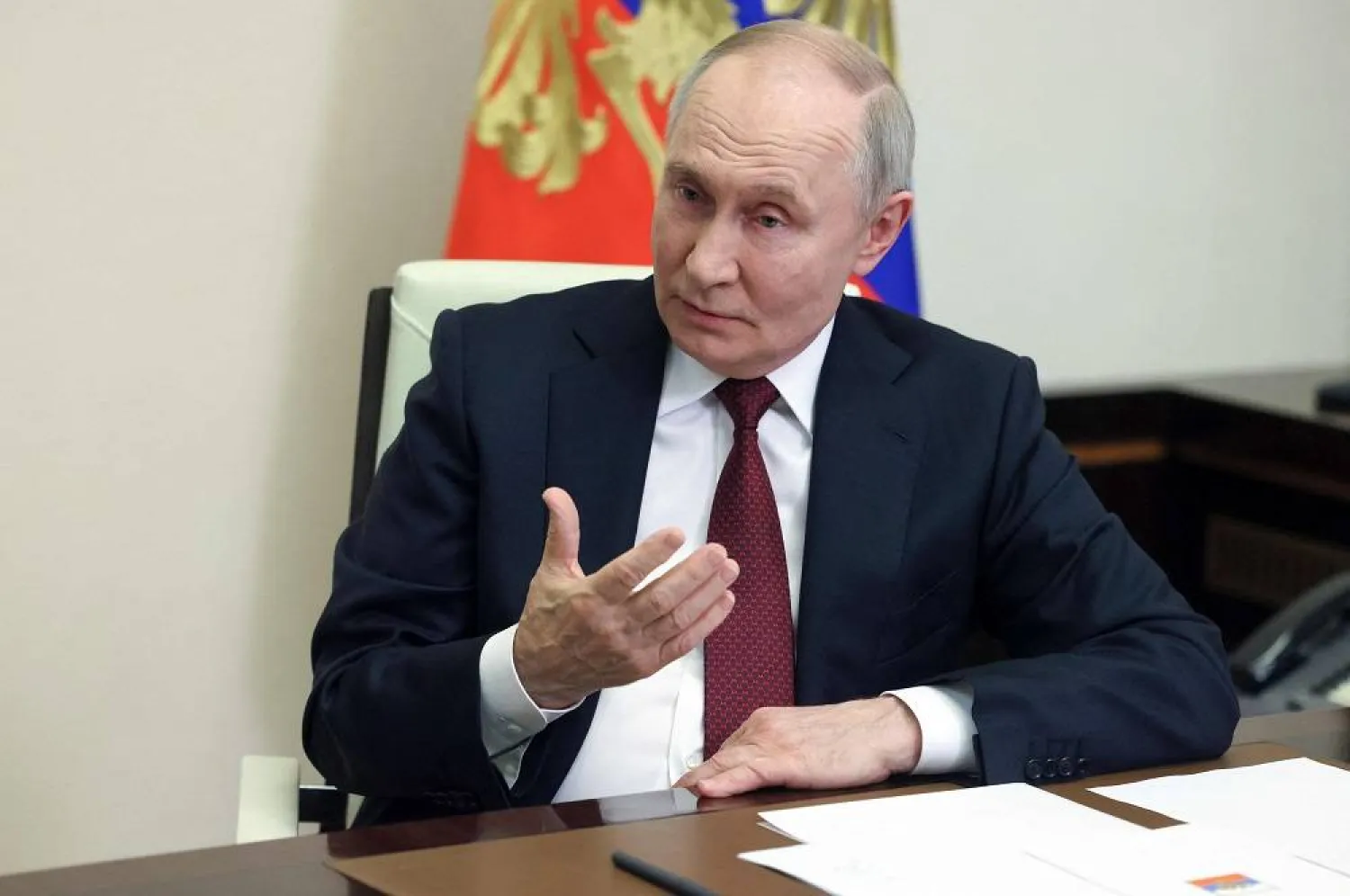
In this pool photograph distributed by the Russian state agency Sputnik, Russia's President Vladimir Putin speaks with Russian TV journalist Pavel Zarubin at the Novo-Ogaryovo state residence outside Moscow on February 24, 2025. (AFP)
TT

Putin Says Europe Is Needed in Ukraine Talks, but Suggests Deal Still Distant 

In this pool photograph distributed by the Russian state agency Sputnik, Russia's President Vladimir Putin speaks with Russian TV journalist Pavel Zarubin at the Novo-Ogaryovo state residence outside Moscow on February 24, 2025. (AFP)

Europe's participation in Ukraine peace talks will be needed eventually, but Moscow first wants to build trust with Washington, President Vladimir Putin said on Monday, while suggesting that a deal to end the conflict may still be far off.

As Ukraine marked the third anniversary on Monday of Russia's invasion that has killed thousands of civilians and displaced millions, US President Donald Trump suggested the war could end within weeks. But he did not elaborate.

Putin told Russian state television that Trump was approaching the Russia-Ukraine conflict rationally and not emotionally, but gave the impression it might not end as soon as Trump would like.

Both his telephone conversation with Trump and recent talks between the United States and Russia in Riyadh touched on the issue of resolution of the conflict in Ukraine, Putin added.

"But it was not discussed in detail," he said in an interview. "We only agreed that we would move toward this. And in this case, of course, we are not refusing the participation of European countries."

Ukraine and Kyiv's European allies both objected to not having been invited to the initial round of talks on Ukraine, held last week in Saudi Arabia by the United States and Russia.

Putin said Europe had "nothing with" the talks in Riyadh, as they were focused on establishing trust between Moscow and Washington, which he said was key.

"In order to resolve complex and rather acute issues, such as related to Ukraine, both Russia and the United States must take the first step," Putin said.

"What does it consist of? This first step should be devoted to increasing the level of trust between the two states," he added.

"But what do the Europeans have to do with it?"

The next few rounds of talks and high-level contacts will be devoted to building that trust, he said, but once the talks turn to reaching a settlement to the conflict, the presence of European partners will be logical.

"Their participation in the negotiating process is needed. We never rejected that, we held constant discussions with them."

Michael Froman, president of the US Council on Foreign Relations thinktank, said it would be a mistake for a ceasefire deal to come at the cost of the transatlantic alliance.

"To secure peace through strength, it would be in Trump's interest to work in tandem with our European partners, who will bear the burden of Ukraine's financial and economic survival," he wrote in a note last week.

HALVING DEFENSE BUDGETS

Putin also said he approved a suggestion that Russia and the United States could discuss deep cuts, of as much as half, in military spending.

"We could come to an agreement with the United States. We're not against that," Putin said.

"The idea seems like a good one to me. The United States reduces theirs by 50% and we reduce ours by 50%. And China could join us later if it wishes."

Putin dismissed any notion that Trump's sharp alteration of Washington's policy on Ukraine, including criticism of Ukrainian President Volodymyr Zelenskiy and suggestions that Kyiv might not recover all lost territory, was based on emotion.

Trump, he said, was acting logically and free of the constraints of promises to Ukraine made by European leaders.

"Unlike them, the new president of the United States has his hands free from shackles that don't allow you to move forward," he said.

"He is moving in a straightforward manner and without particular constraints. He is in a unique position: he doesn't just say what he thinks, he says what he wants. This is the privilege of the leader of one of the major powers."



NATO: Ukraine Still Receiving Arms Despite Mideast War

NATO Secretary General Mark Rutte via Reuters/File
TT

NATO: Ukraine Still Receiving Arms Despite Mideast War

NATO Secretary General Mark Rutte via Reuters/File

Ukraine is still getting essential defense equipment despite the war in the Middle East, which is depleting stockpiles in Europe and the United States, NATO Secretary General Mark Rutte said Thursday.

"The good news is that essential equipment into Ukraine continues to flow," he told reporters. That included American-made Patriot missile interceptors, which Ukraine desperately needs, he added, AFP reported.

The PURL program, launched last year, allows Ukraine to receive US equipment financed by European countries.

Some 75 percent of the missiles used by Patriot batteries in Ukraine have been supplied through the program, and 90 percent of the munitions used by other air-defense systems, Rutte added.

Rutte called on European countries to increase their own production capacity.

"They need to produce more extra production lines, extra shifts, opening new factories. The money is there," he said.


Germany FM Says 'Encouraging' if US Speaking Directly to Iran

German Foreign Minister Johann Wadephul. (Reuters: File Photo)
TT

Germany FM Says 'Encouraging' if US Speaking Directly to Iran

German Foreign Minister Johann Wadephul. (Reuters: File Photo)

Germany's foreign minister Thursday said it was encouraging if the United States was talking directly to Iran to end the war in the Middle East, but Washington should make its intentions clear.

"I hear that there are signs that the US is speaking directly to Iran. I think that this is encouraging and this is welcome," Johann Wadephul told reporters before heading into the meeting of G7 foreign ministers outside Paris, AFP reported.

With US Secretary of State Marco Rubio set to join the discussions from Friday, he added: "For the German government it is of great importance to know precisely what our American partners are intending."


US Envoy Witkoff Says Iran is Seeking an Off-ramp

US Special Envoy Steve Witkoff speaks during a cabinet meeting at the White House in Washington, DC, US, March 26, 2026. REUTERS/Evelyn Hockstein
TT

US Envoy Witkoff Says Iran is Seeking an Off-ramp

US Special Envoy Steve Witkoff speaks during a cabinet meeting at the White House in Washington, DC, US, March 26, 2026. REUTERS/Evelyn Hockstein

The United States has sent Iran a "15-point action list" as a basis for negotiations to end the current conflict, US Special Envoy Steve Witkoff said on Thursday, adding that there are signs that Tehran was interested in making a deal.


Witkoff, speaking during a cabinet meeting at the White House, said that the nascent talks could be successful if the Iranians realize there were no good alternatives - a realization Tehran might be coming to, he argued, Reuters reported.


"We will see where things lead, and if we can convince Iran that this is the inflection point with no good alternatives for them other than more death and destruction," Witkoff told reporters.


"We have strong signs that this is a possibility."


Witkoff said Pakistan had been acting as a mediator, confirming statements from Pakistani officials.