

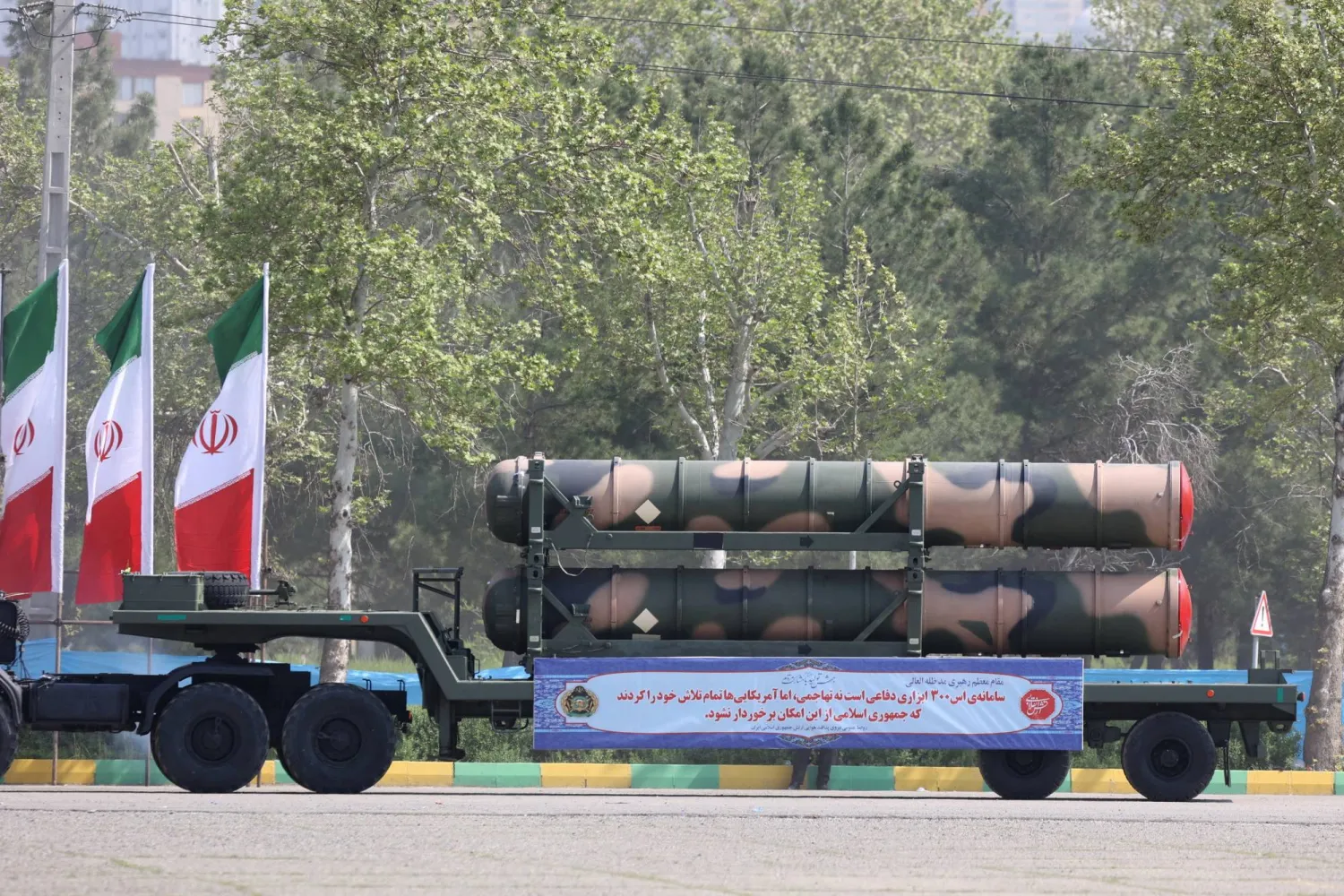

Tehran Objects to US Threats of Resorting to Military Option

FILE PHOTO: The S-300 missile system is seen during the National Army Day parade ceremony in Tehran, Iran, April 17, 2024. Majid Asgaripour/WANA (West Asia News Agency) via REUTERS
TT

Tehran Objects to US Threats of Resorting to Military Option

FILE PHOTO: The S-300 missile system is seen during the National Army Day parade ceremony in Tehran, Iran, April 17, 2024. Majid Asgaripour/WANA (West Asia News Agency) via REUTERS

Tehran has rejected US statements that warned Washington could resort to military option to curb Iran’s nuclear program.

In an interview with Fox Business Network, broadcast on Friday, Trump said he had sent a letter to Iran's Supreme Leader Ali Khamenei, urging Iran to reopen negotiations. “I said I hope you're going to negotiate, because it's going to be a lot better for Iran,” Trump said, before warning Tehran of potential military action.

In response, Iranian Foreign Ministry spokesperson, Esmaeil Baghaei, addressed the issue during his weekly press conference on Monday, stating that the US threats are considered violations of international law and acts of aggression. “The threat of force is prohibited under international regulations and constitutes a criminal act,” he stressed.

The spokesperson added: “Negotiation under pressure and threats is meaningless, and Iran will never accept such terms.”

Baghaei said that while such threats have persisted in various forms over the years, they have only been met with steadfast resistance from the Iranian people.

He accused US politicians of using a policy of bullying, adding that Iran “has never refused to negotiate ... will never accept negotiations under pressure.”

Asked on Monday if Russia had held consultations with Iran before or after Tehran responded to a letter from Trump urging the country to negotiate a nuclear deal, the Kremlin said Iran formulates its own policy positions.

Late on Sunday, Iranian Foreign Minister Abbas Araghchi said on social media platform X, that his country would not negotiate under “intimidation.”

“We will NOT negotiate under pressure and intimidation. We will NOT even consider it, no matter what the subject may be,” he wrote.

Araghchi’s comments contrasted with a statement delivered by the Iranian mission to the United Nations on Sunday and which suggested Tehran might be willing to discuss certain issues if the objective of negotiations is to address concerns vis-a-vis any potential militarization of Iran’s nuclear program.

Baghaei denied the presence of any disagreement between Iranian officials over negotiations with Washington. He told reporters that the position of Iran’s foreign ministry is clear. “The statements made by Iranian foreign ministry officials reflect our position very clearly,” he said.

Analysts assert that Iran is forced to negotiate with Trump, especially after the “Axis of Resistance” has suffered setbacks such as the collapse of Hamas, the weakening of Hezbollah, and the fall of the Assad regime.

Regarding the continuation of talks with the European Troika (France, Germany and the UK), Baghaei said: “Another round of our talks with Europe will be held in March before the end of this year, at the expert level.”
He said talks with three European countries, in addition to Russia and China, are ongoing, namely on the nuclear issue, “and we have no restrictions on our talks with the Europeans.”

Regarding Europe's possible move to activate the snapback mechanism, the spokesman said: “We do not see any justification for activating this mechanism, and it seems that other parties are now convinced that using this tool will not achieve any goals.”

Baghaei then criticized the International Atomic Energy Agency, accusing its director general, Rafael Grossi, of making statements that were “politically motivated and only fuel tensions.”

Grossi has said that time is running out for diplomacy to impose new restrictions on Iran's activities, as Tehran continues to accelerate its enrichment of uranium to near weapons-grade.

Meanwhile, the Iranian Foreign Ministry spokesperson condemned the US decision to revoke Iraq’s sanctions waiver for purchasing Iranian electricity, calling it illegal.

Baghaei said that the United States will bear responsibility for the consequences of this decision because failure to extend the exemption granted to Iraq represents a violation of law and are considered crimes against humanity.

“These unilateral sanctions have no legal or juridical justification. The US government must be held accountable for such actions,” he said.

Trump's administration on Saturday rescinded a sanctions waiver that since 2018 has allowed Iraq to pay Iran for electricity as it presses on with its “maximum pressure” campaign against Tehran, a State Department spokesperson said.



Top Trump Iran Negotiator Says Visits US Aircraft Carrier in Middle East

US Special Envoy Steve Witkoff delivers a press conference upon the signing of the declaration on deploying post-ceasefire force in Ukraine, during the so-called "Coalition of the Willing" summit, at the Elysee Palace in Paris, France, January 6, 2026. (Reuters)
TT

Top Trump Iran Negotiator Says Visits US Aircraft Carrier in Middle East

US Special Envoy Steve Witkoff delivers a press conference upon the signing of the declaration on deploying post-ceasefire force in Ukraine, during the so-called "Coalition of the Willing" summit, at the Elysee Palace in Paris, France, January 6, 2026. (Reuters)

US President Donald Trump's lead Iran negotiator Steve Witkoff on Saturday said he visited the USS Abraham Lincoln aircraft carrier currently in the Arabian Sea, with Washington and Tehran due to hold further talks soon.

"Today, Adm. Brad Cooper, Commander of US Naval Forces Central Command, Jared Kushner, and I met with the brave sailors and Marines aboard the USS Abraham Lincoln, her strike group, and Carrier Air Wing 9 who are keeping us safe and upholding President Trump's message of peace through strength," said Witkoff in a social media post.

Iranian Foreign Minister Abbas Araghchi said on Saturday he hoped talks with the United States would resume soon, while reiterating Tehran's red lines and warning against any American attack.


Israel’s Netanyahu Expected to Meet Trump in US on Wednesday and Discuss Iran

Israeli Prime Minister Benjamin Netanyahu delivers a speech during a special session to mark the 77th anniversary of the Knesset's establishment and the 60th anniversary of the dedication of the current building at the Knesset, the Israeli parliament, in Jerusalem, 02 February 2026. (EPA)
TT

Israel’s Netanyahu Expected to Meet Trump in US on Wednesday and Discuss Iran

Israeli Prime Minister Benjamin Netanyahu delivers a speech during a special session to mark the 77th anniversary of the Knesset's establishment and the 60th anniversary of the dedication of the current building at the Knesset, the Israeli parliament, in Jerusalem, 02 February 2026. (EPA)

Israeli Prime Minister Benjamin Netanyahu is expected to meet US President Donald Trump on Wednesday in Washington, where they will discuss negotiations with Iran, Netanyahu's office said on Saturday.

Iranian and US officials held indirect nuclear ‌talks in the ‌Omani capital ‌Muscat ⁠on Friday. ‌Both sides said more talks were expected to be held again soon.

A regional diplomat briefed by Tehran on the talks told Reuters Iran insisted ⁠on its "right to enrich uranium" ‌during the negotiations with ‍the US, ‍and that Tehran's missile capabilities ‍were not raised in the discussions.

Iranian officials have ruled out putting Iran's missiles - one of the largest such arsenals in the region - up ⁠for discussion, and have said Tehran wants recognition of its right to enrich uranium.

"The Prime Minister believes that any negotiations must include limiting ballistic missiles and halting support for the Iranian axis," Netanyahu's office said in a ‌statement.


Italy FM Rules Out Joining Trump’s ‘Board of Peace’

Italy's Minister for Foreign Affairs Antonio Tajani speaks to the press during the EPP Leaders’ meeting, in Zagreb, Croatia, 30 January 2026. (EPA)
TT

Italy FM Rules Out Joining Trump’s ‘Board of Peace’

Italy's Minister for Foreign Affairs Antonio Tajani speaks to the press during the EPP Leaders’ meeting, in Zagreb, Croatia, 30 January 2026. (EPA)

Italy will not take part in US President Donald Trump's "Board of Peace", Italian Foreign Minister Antonio Tajani said Saturday, citing "insurmountable" constitutional issues.

Trump launched his "Board of Peace" at the World Economic Forum in Davos in January and some 19 countries have signed its founding charter.

But Italy's constitution bars the country from joining an organization led by a single foreign leader.

Prime Minister Giorgia Meloni, a Trump ally, last month noted "constitutional problems" with joining, but suggested Trump could perhaps reopen the framework "to meet the needs not only of Italy, but also of other European countries".

Tajani appeared Saturday to rule that out.

"We cannot participate in the Board of Peace because there is a constitutional limit," he told the ANSA news agency.

"This is insurmountable from a legal standpoint," he said, the day after meeting US Secretary of State Marco Rubio and US Vice President JD Vance at the Olympics in Milan.

Although originally meant to oversee Gaza's rebuilding, the board's charter does not limit its role to the Palestinian territory and appears to want to rival the United Nations.