


Gaza's Christians 'Heartbroken' for Pope Who Phoned them Nightly

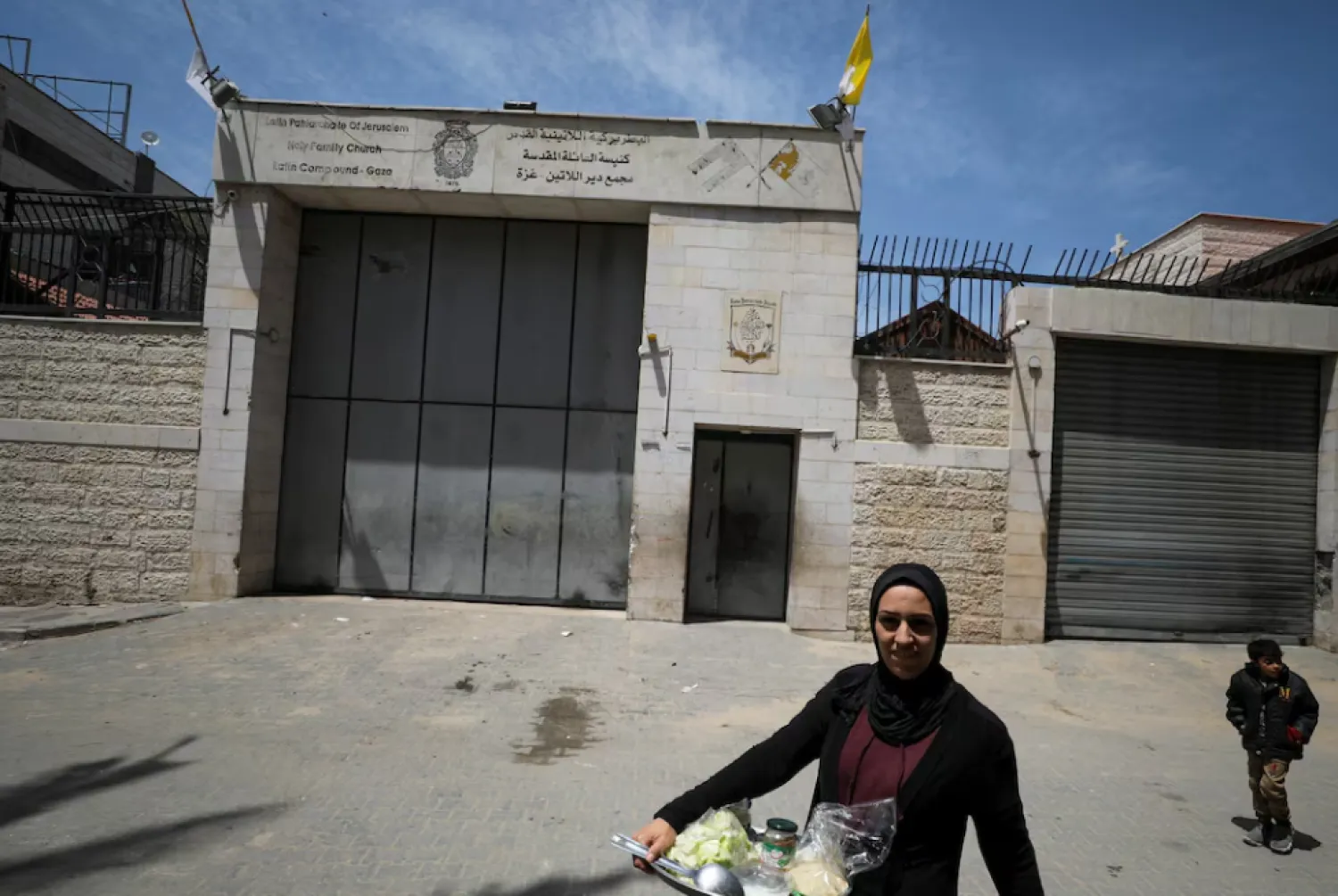
A Palestinian woman walks outside the Holy Family Church after the death of Pope Francis was announced by the Vatican, in Gaza City April 21, 2025. REUTERS/Dawoud Abu Alkas
TT

Gaza's Christians 'Heartbroken' for Pope Who Phoned them Nightly

A Palestinian woman walks outside the Holy Family Church after the death of Pope Francis was announced by the Vatican, in Gaza City April 21, 2025. REUTERS/Dawoud Abu Alkas

Members of Gaza's tiny Christian community said they were "heartbroken" on Monday at the death of Pope Francis, who campaigned for peace for the devastated enclave and spoke to them on the phone every evening throughout the war.

Across the wider Middle East, Palestinian, Lebanese and Syrian Christians, both Catholic and Orthodox, praised Francis' constant engagement with them as a source of solace at a time when their communities faced wars, disasters, hardship and persecution.

"We lost a saint who taught us every day how to be brave, how to keep patient and stay strong. We lost a man who fought every day in every direction to protect this small herd of his," George Antone, 44, head of the emergency committee at the Holy Family Church in Gaza, told Reuters.

Francis called the church hours after the war in Gaza began in October 2023, Antone said, the start of what the Vatican News Service would describe as a nightly routine throughout the war. He would make sure to speak not only to the priest but to everyone else in the room, Antone said.

"We are heartbroken because of the death of Pope Francis, but we know that he is leaving behind a church that cares for us and that knows us by name - every single one of us," Antone said, referring to the Christians of Gaza who number in the hundreds.

"He used to tell each one: I am with you, don't be afraid."

Francis phoned a final time on Saturday night, the pastor of the Holy Family parish, Rev. Gabriel Romanelli, told the Vatican News Service.

"He said he was praying for us, he blessed us, and he thanked us for our prayers," Romanelli said.

The next day, in his last public statement on Easter, Francis appealed for peace in Gaza, telling the warring parties to "call a ceasefire, release the hostages and come to the aid of a starving people that aspires to a future of peace".

'PEACE IN THIS LAND'

At the Church of the Holy Sepulchre in Jerusalem, on the site where many Christians believe Jesus was crucified, buried and resurrected, the superior of the Latin community, Father Stephane Milovitch, said Francis had stood for peace.

"We wish that peace will finally come very soon in this land and we wish the next pope will be able to help to have peace in Jerusalem and in all the world," he said.

In Lebanon, where a war between Israel and Hezbollah caused widespread casualties and extensive damage last year, sending millions from their homes, members of the Catholic Maronite community spoke of Francis' frequent mentions of their plight.

"He's a saint for us because he carried Lebanon and the Middle East in his heart, especially in the last period of war," said a priest in the southern Lebanese town of Rmeish, which was badly damaged during Israel's military campaign last year.

"We always felt he was very involved and he mobilized all the Catholic institutions and funds to help Lebanon throughout the crises that we went through," said Marie-Jo Dib, who works at a social foundation in Lebanon.

"He was a rebel and I really pray that the next pope will be like him," she added.

Francis made repeated trips to the Middle East, including to Iraq in 2021 where he learned that two suicide bombers had attempted to assassinate him in Mosul, a once cosmopolitan city where the ISIS terror group proclaimed a so-called caliphate from 2014-17.

He visited the ruins of four destroyed churches there and launched an appeal for peace.

In Syria, Archbishop Antiba Nicolas said he was holding mass at the historic Damascus Zaitoun church when he was handed a slip of paper with the news.

"He used to say 'dearest Syria' every time he spoke of Syria. He called on all international organisations to support Syria, the Christian presence and the church in Syria during the crisis in the past years," Nicolas said.



Nowruz to Be Celebrated in Damascus for First Time in Syria’s Modern History

People celebrate Nowruz in central Damascus in 2025. (Facebook)
TT

Nowruz to Be Celebrated in Damascus for First Time in Syria’s Modern History

People celebrate Nowruz in central Damascus in 2025. (Facebook)

Syria’s capital is witnessing an unprecedented cultural development as preparations got underway for official and popular celebrations of Nowruz, the Kurdish New Year, marking the arrival of spring on March 21.

For the first time in modern Syrian history, festivities will take place openly in Damascus, reflecting growing recognition of the Kurdish identity and culture.

The celebrations follow a decree issued two months ago by President Ahmed al-Sharaa, with expectations of broad participation from across society. Events are set to begin Friday night and continue through Saturday.

A Nowruz concert will be held in Umayyad Square - one of Damascus’s most prominent landmarks. The Ministry of Culture has invited audiences to a performance by the Kurdish heritage group Ashti at the Damascus Opera House, while a major celebration is planned at Al-Fayhaa Stadium in the Mazzeh area. Additional festivities are expected in Kurdish-populated neighborhoods such as Rukn al-Din and Wadi al-Mashari.

Nowruz symbolizes freedom, renewal and Kurdish national identity. Traditions include lighting bonfires, performing folk dances and wearing traditional dress.

Kurdish political analyst Zaid Safouk said the occasion would resonate both domestically and regionally. “For the first time in the history of the Syrian Republic, there is official recognition of a Kurdish holiday,” he told Asharq Al-Awsat, describing the celebration as “a message of hope that peace remains the only path for societies.”

For decades under Baath Party rule and later under Bashar al-Assad, Nowruz celebrations were banned, along with public expressions of Kurdish identity. Authorities often viewed such activities as separatist threats.

That has now changed. Following the fall of the Assad regime in December 2024, Damascus saw its first unrestricted Nowruz celebration in March 2025.

In January 2026, al-Sharaa issued Decree No. 13, granting broader rights to Kurdish citizens. The decree recognizes Nowruz as a national holiday, restores citizenship to previously stateless Kurds, and designates Kurdish as a national language.

Kurdish writer and political researcher Mohammed Wali described the decree as a break from decades of marginalization.

“Syrian Kurds view these steps with great positivity and have welcomed it,” he said, noting that official recognition of their language and culture represents a major milestone.

He added that acknowledging Kurdish rights within a national framework could help build “a future based on legal recognition and pluralism,” while strengthening trust among Syrians during a sensitive transitional period.

The presidency has also included Nowruz for the first time in the official holiday calendar, alongside Revolution Day, Eid al-Fitr and Mother’s Day, with public institutions closed from March 18 to 23.

Foreign Minister Asaad al-Shaibani said the move reflects “deep respect for all components of the Syrian population,” stressing that a free Syria must embrace its diverse cultures and heritage.

Damascus also hosted a rare public condolence ceremony for Kurdish politician Salih Muslim, a senior figure in the Democratic Union Party (PYD), who died on March 11. His funeral in Kobani drew Kurdish leaders and political representatives from across the region.


China Says to Provide Humanitarian Assistance to Iran, Mideast Nations

Smoke rises from the Lebanese village of Khiam after an Israeli strike as seen from the Upper Galilee in northern Israel on March 16, 2026.  (Photo by Odd ANDERSEN / AFP) /
Smoke rises from the Lebanese village of Khiam after an Israeli strike as seen from the Upper Galilee in northern Israel on March 16, 2026. (Photo by Odd ANDERSEN / AFP) /
TT

China Says to Provide Humanitarian Assistance to Iran, Mideast Nations

Smoke rises from the Lebanese village of Khiam after an Israeli strike as seen from the Upper Galilee in northern Israel on March 16, 2026.  (Photo by Odd ANDERSEN / AFP) /
Smoke rises from the Lebanese village of Khiam after an Israeli strike as seen from the Upper Galilee in northern Israel on March 16, 2026. (Photo by Odd ANDERSEN / AFP) /

China said on Tuesday it will provide humanitarian assistance to Middle Eastern countries, including Iran and Lebanon, targeted in US and Israeli strikes in the now three-week conflict.

"China has decided to provide emergency humanitarian assistance to Iran, Jordan, Lebanon and Iraq. It is hoped this will help alleviate the humanitarian plight faced by the local populations," foreign ministry spokesman Lin Jian told a press conference.


War Disrupts Education in Lebanon, Deepening Inequality Among Students

A child plays during a visit by Lebanon’s Health Minister Rakan Nassereddine to Maroun Abboud Secondary Public School, which is hosting displaced people, following an escalation between Hezbollah and Israel amid the US-Israeli conflict with Iran, in Aley district, Mount Lebanon Governorate, Lebanon, March 15, 2026. (Reuters)
TT

War Disrupts Education in Lebanon, Deepening Inequality Among Students

A child plays during a visit by Lebanon’s Health Minister Rakan Nassereddine to Maroun Abboud Secondary Public School, which is hosting displaced people, following an escalation between Hezbollah and Israel amid the US-Israeli conflict with Iran, in Aley district, Mount Lebanon Governorate, Lebanon, March 15, 2026. (Reuters)

Lebanon’s education system is struggling to survive an unprecedented crisis as war forces hundreds of thousands from their homes. Many schools have been converted into shelters for displaced families, with classrooms transformed into sleeping quarters, while others attempt to continue teaching amid security risks and uncertainty.

The Ministry of Education has placed 1,156 public schools and high schools, along with 75 vocational institutes, at the disposal of the national disaster authority. These include 334 public schools, 40 vocational institutes, and 17 centers affiliated with the Lebanese University.

A ministry source told Asharq Al-Awsat that not all facilities have yet been opened, but they will when the need arises.

An education crisis cell now meets daily to monitor developments and make urgent decisions. Early in the conflict, the ministry issued guidelines allowing schools — both public and private — to choose between in-person and remote learning.

The Secretariat General of Catholic Schools also urged each institution to form its own crisis committee to assess local security conditions and determine how to proceed.

Between classrooms and screens

In relatively safer areas, schools have resumed in-person teaching, while offering remote options for students unable to travel. In more dangerous regions, most schools rely exclusively on distance learning.

The Lebanese University has shifted entirely online, postponing student elections scheduled for later this month.

Yet these measures have exposed stark inequalities. Many students, particularly those living in shelters, lack the conditions or resources to follow lessons, even remotely.

Some parents argue that the ministry’s approach fails to ensure equal access to education. Others insist on continuing their children’s schooling wherever possible.

A mother of two in Bsalim, Mount Lebanon, said: “The Lebanese state did not decide this war, so why should we bear its consequences? We will resist in our own way, by educating our children to build a more aware generation that rejects war.”

She added that remote learning had already proven ineffective during the COVID-19 crisis, especially for younger children.

In contrast, a displaced mother living with her four children in a Beirut school described education as a distant concern.

“We cannot secure safety or food, how can we think about schooling?” she asked, warning that continuing classes while much of the country suffers only deepens injustice. “No place in Lebanon is truly safe,” she remarked.

Schools in limbo

School administrations face difficult choices. One major private school in Baabda, near Beirut’s southern suburbs, briefly reopened before closing again after ten days.

“The situation is extremely sensitive,” a staff member said. “We reassess daily to avoid putting students at risk.”

When classes do resume, faculty attempt to soften the impact of nearby airstrikes, sometimes playing low music to mask the sound of explosions.

Lama al-Tawil, head of the union of parents’ committees in private schools, described the situation as “unclear.” She called the ministry’s plan “flexible and positive,” but stressed that implementation remains the real challenge.

“In-person learning is best for those who can attend safely,” she said, “but remote education is not equally accessible and its effectiveness is limited.”

With roughly 40 school days remaining, authorities may extend the academic year if the conflict continues.

Meanwhile, teachers and families alike are navigating not only a security crisis, but a deepening economic one, hoping flexibility will help prevent a lost generation.