


Trump’s Saudi Visit to Cement Deeper Strategic Ties

US President Donald Trump during his visit to the Saudi capital Riyadh in May 2017 (SPA)
TT

Trump’s Saudi Visit to Cement Deeper Strategic Ties

US President Donald Trump during his visit to the Saudi capital Riyadh in May 2017 (SPA)

Analysts expect US President Donald Trump’s upcoming visit to Saudi Arabia in mid-May – his first foreign trip since taking office – to lay the groundwork for deeper strategic and security ties between Washington and Riyadh, while boosting economic and investment cooperation.

The White House has officially announced that Trump will visit Saudi Arabia from May 13 to 16, as part of a regional tour that also includes Qatar and the United Arab Emirates.

Analysts told Asharq Al-Awsat that Trump's agenda during his visit is expected to be dominated by the region’s most pressing and complex issues, including Iran’s nuclear program and broader tensions with Tehran, the ongoing war and humanitarian crisis in Gaza, as well as the current situation in Yemen.

In a previous interview with CBS News, Trump described his relationship with the Middle East as “good,” frequently praising Washington’s trade ties with Saudi Arabia and the kingdom’s regional role in promoting peace and stability.

Trump has also repeatedly lauded Saudi Arabia for hosting US diplomatic efforts and facilitating talks aimed at securing a ceasefire between Russia and Ukraine.

Dr. Abdulaziz Sager, chairman of the Gulf Research Center, said several key regional files require resolution or a clear US stance ahead of the president’s Gulf tour.

“Chief among them are Iran’s nuclear file and broader relations with Tehran, the current situation in Yemen, and the humanitarian crisis in Gaza,” he said.

Sager told Asharq Al-Awsat that alongside strategic and security matters, economic issues will also feature prominently during Trump’s visit.

These include Gulf investments in the US economy, the stability of the US dollar, and global oil prices, which he described as “core economic concerns.”

He noted, however, that US tariffs are unlikely to be a priority topic during the trip.

“Unlike with other countries, the trade balance with Gulf states favors the United States, so tariffs are not high on the regional agenda,” he said.

Saudi political analyst Dr. Khaled al-Habbas said the president’s visit is a clear signal of the strength of US-Saudi relations, which have spanned more than eight decades.

“These ties have been built on a solid foundation of mutual interests across political, economic, military, and social fields,” he told Asharq Al-Awsat.

He added that this long-standing partnership has proven vital to the interests of both countries, particularly during regional crises and on the international stage—from the Cold War era to more recent Saudi-led mediation between the US and Russia amid the Ukraine conflict.

Trump’s decision to make Riyadh the first stop on his foreign tour reflects the importance Washington places on its relationship with Saudi Arabia, given the kingdom’s growing influence both regionally and globally, the Saudi analyst said.

“The choice underscores how much weight the US administration gives to its ties with the Kingdom, due to Riyadh’s pivotal role on the regional and international stages, as well as its significant economic and political clout,” al-Habbas explained.

He said the talks between the two leaderships are expected to cover a wide range of shared concerns, including economic cooperation and current political developments across the region and beyond.

“This visit is likely to pave the way for deeper military and political coordination, as well as collaboration in the field of peaceful nuclear energy,” he added.

Saudi Arabia holds a key diplomatic position in the eyes of the White House.

Trump also chose the kingdom as the first destination of his inaugural foreign tour in 2017— a gesture seen by many as a strong signal of the administration’s appreciation and recognition of Riyadh’s regional and international role.

Saudi Arabia has hosted two rounds of talks between the United States and Russia, as well as between the US and Ukraine, as part of ongoing efforts to broker a ceasefire and end the war that has raged for more than three years.

Washington has also expressed appreciation for Riyadh’s role within OPEC, particularly its efforts to stabilize global oil prices.



GCC Secretary-General Condemns Iranian Officials' Statements on Member States' Sovereignty

Secretary General of the Gulf Cooperation Council Jasem Mohamed Albudaiwi. GCC
TT

GCC Secretary-General Condemns Iranian Officials' Statements on Member States' Sovereignty

Secretary General of the Gulf Cooperation Council Jasem Mohamed Albudaiwi. GCC

Secretary-General of the Gulf Cooperation Council (GCC) Jasem Albudaiwi expressed the GCC states’ denunciation of the media statements made by Iranian officials regarding the GCC states.

"These statements contained fallacies, false claims, and rejected allegations that contradict the principles of non-interference in internal affairs and good neighborliness—principles which Iran violated through its aggression against the sovereignty and independence of the State of Qatar," Albudaiwi stated.

Furthermore, he noted that these statements contradict the GCC states' continuous efforts to enhance relations with the Islamic Republic of Iran at all levels, SPA reported.

"The GCC states have consistently reaffirmed the importance of adhering to the foundations and principles enshrined in the United Nations Charter and international law, including the principles of good neighborliness, respect for state sovereignty, non-interference in internal affairs, the peaceful resolution of disputes, and refraining from the use or threat of force," Albudaiwi emphasized.

He added that the GCC states have consistently demonstrated goodwill towards Iran, stressing their keenness on Iran's security and stability to preserve the interests of the Iranian people and to spare the region the repercussions of tension and escalation.

"This commitment was underlined during the joint meetings between the GCC foreign ministers and Iranian Foreign Minister Dr. Seyyed Abbas Araghchi. The council member states have also underscored the significance of continuing bilateral communication between the GCC and Iran to enhance shared interests and maintain regional security and stability," he pointed out.

Moreover, Albudaiwi affirmed the GCC states' commitment to peace, coexistence, and pursuing dialogue and diplomatic solutions in international relations. He called on Iran to cease spreading false claims that undermine trust and hinder communication and understanding, at a time when the countries of the region need rapprochement and cooperation to safeguard their interests and achieve their peoples' aspirations for security, stability, growth, and prosperity.


Saudi Crown Prince Receives Emir of Qatar in Riyadh

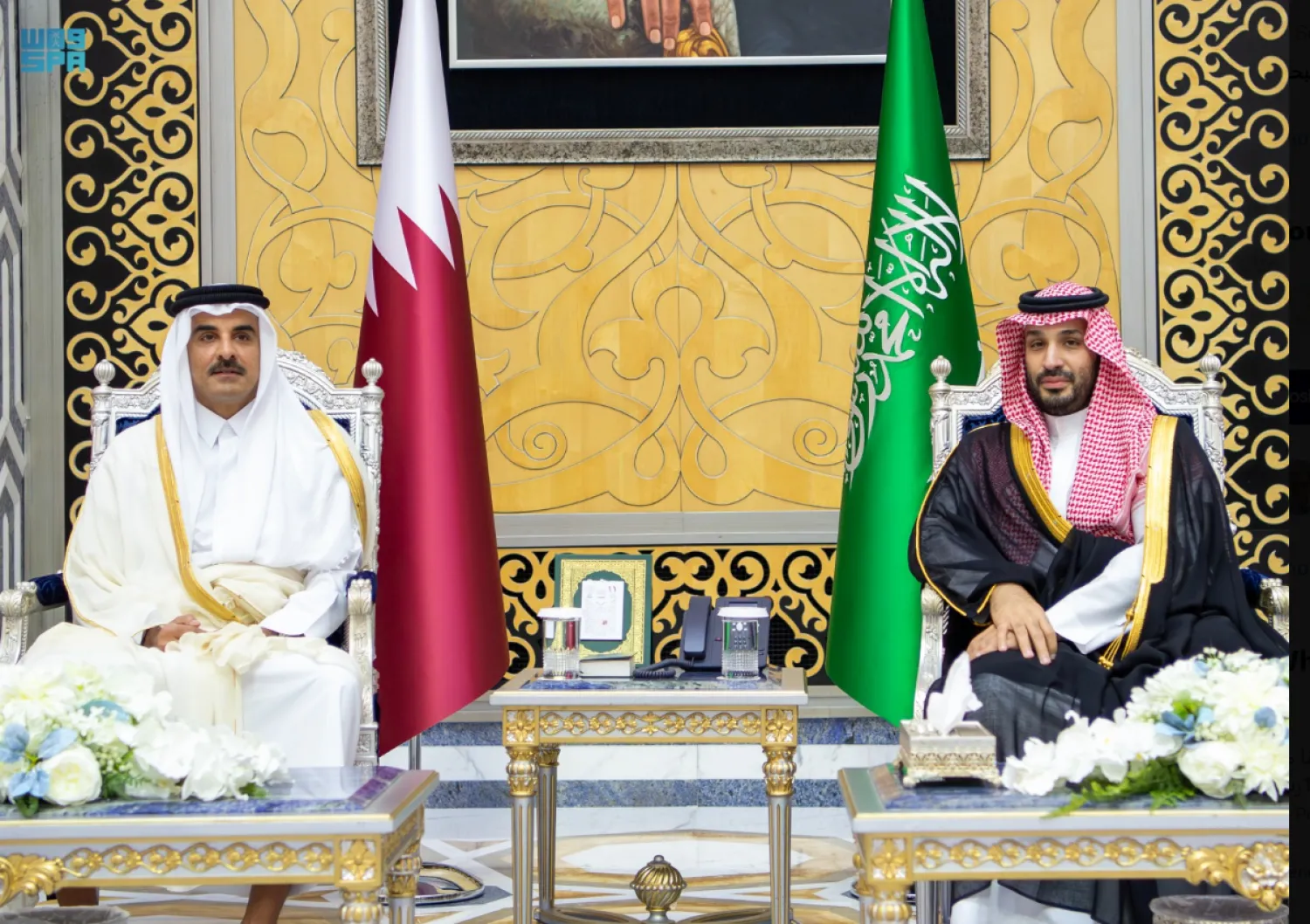
Prince Mohammed bin Salman bin Abdulaziz Al Saud, Saudi Crown Prince and Prime Minister, and Emir of Qatar Sheikh Tamim bin Hamad Al Thani meet in Riyadh on Monday. (SPA)
TT

Saudi Crown Prince Receives Emir of Qatar in Riyadh

Prince Mohammed bin Salman bin Abdulaziz Al Saud, Saudi Crown Prince and Prime Minister, and Emir of Qatar Sheikh Tamim bin Hamad Al Thani meet in Riyadh on Monday. (SPA)

Emir of Qatar Sheikh Tamim bin Hamad Al Thani arrived in Riyadh on Monday to chair the eighth meeting of the Saudi-Qatari coordination council.

He was welcomed upon his arrival in the Kingdom by Prince Mohammed bin Salman bin Abdulaziz Al Saud, Saudi Crown Prince and Prime Minister.

They will chair the meeting in Riyadh on Monday.

Saudi Arabia and Qatar have held a series of talks in preparation for the meeting.

In recent days, Saudi Foreign Minister Prince Faisal bin Farhan bin Abdullah held talks in Riyadh with his Qatari counterpart and Prime Minister Sheikh Mohammed bin Abdulrahman Al Thani.

The officials discussed bilateral relations and aspects of cooperation between their countries and means to develop them.

Sheikh Mohammed and other senior officials are accompanying Sheikh Tamim on his visit to Riyadh.


Saudi Crown Prince, French President Discuss Regional Developments 

Prince Mohammed bin Salman bin Abdulaziz Al Saud, Saudi Crown Prince and Prime Minister. (SPA)
TT

Saudi Crown Prince, French President Discuss Regional Developments 

Prince Mohammed bin Salman bin Abdulaziz Al Saud, Saudi Crown Prince and Prime Minister. (SPA)

Prince Mohammed bin Salman bin Abdulaziz Al Saud, Saudi Crown Prince and Prime Minister, received on Monday a telephone call from French President Emmanuel Macron.

They discussed regional and international developments and ongoing efforts to achieve security and stability.

They reviewed bilateral relations and the existing cooperation between their two countries in a number of fields, in addition to discussing several issues of common interest.