


Chinese Tea Hub Branches into Coffee as Tastes Change

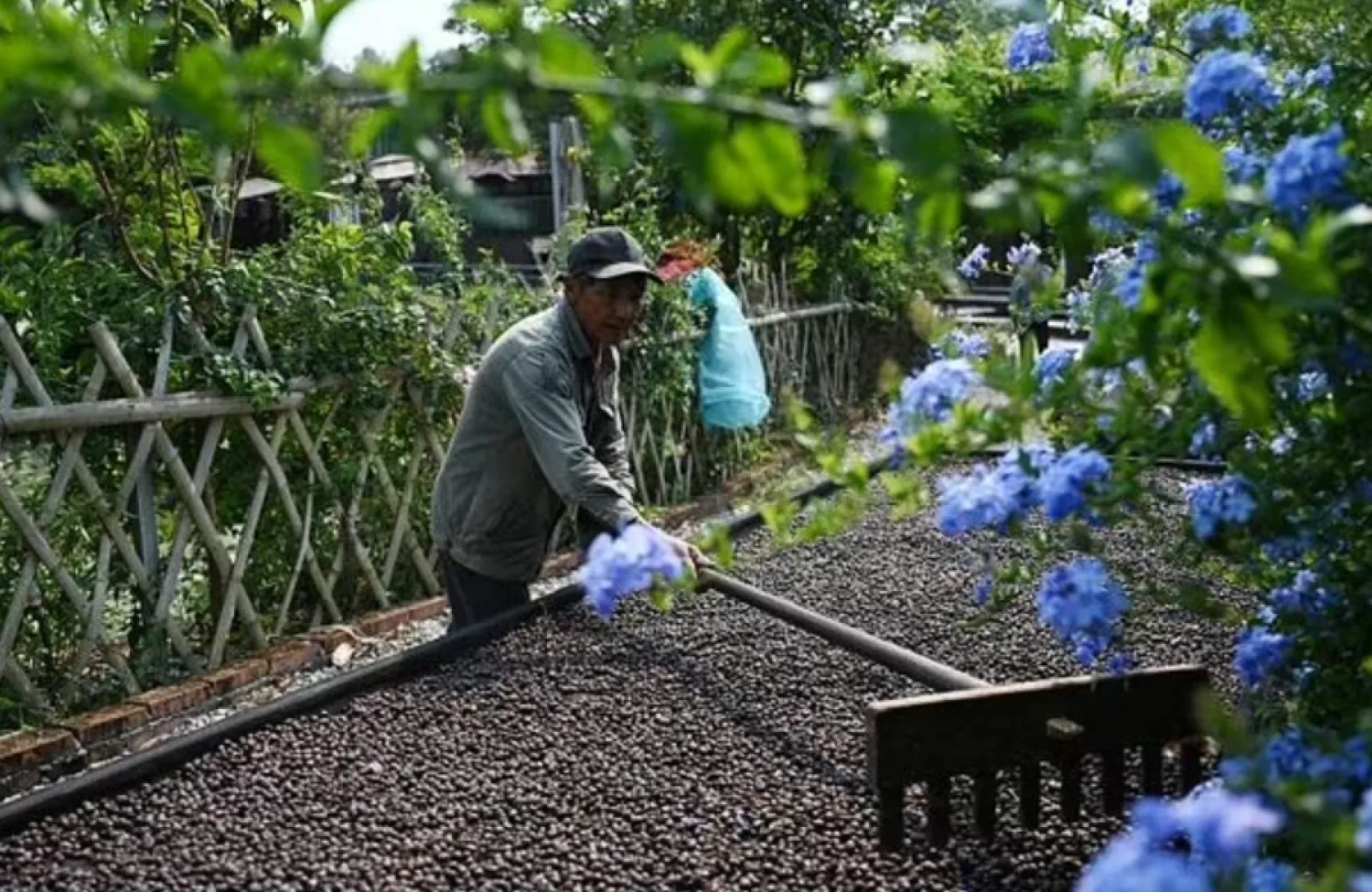
A worker raking coffee beans during the drying process at the Xiaowazi, or Little Hollow, coffee plantation in Pu'er - AFP
TT

Chinese Tea Hub Branches into Coffee as Tastes Change

A worker raking coffee beans during the drying process at the Xiaowazi, or Little Hollow, coffee plantation in Pu'er - AFP

At a mountainside cafe in southwestern China, Liao Shihao brews handfuls of locally grown beans into steaming cups of coffee, a modern twist on the region's traditional drink.

For centuries, Pu'er in Yunnan province has given its name to a type of richly fermented tea -- sometimes styled "pu-erh" -- famous across East Asia and beyond.

But as younger Chinese cultivate a taste for punchy espressos, frothy lattes and flat whites, growers are increasingly branching out into tea's historic rival.

"People are coming to try our hand-drip coffee... and more fully experience the flavours it brings," Liao, 25, told AFP.
"In the past, they mostly went for commercialised coffee, and wouldn't dabble in the artisanal varieties," he said.

Liao´s family has run the Xiaowazi, or Little Hollow, coffee plantation for three generations.

Nestled in a shady valley, spindly coffee trees line its steep hillsides, their cherry-like fruit drying on wooden pallets outside.

When AFP visited this month, clusters of tourists sipped boutique brews in the airy cafe overlooking its verdant slopes.

"It's very good," said Cai Shuwen, 21, as he perched on a bar stool lifting sample after sample to his lips.

"Even though some beans are more astringent than I imagined, others have exceeded my expectations."

- Brewing success -

Every year, Pu'er's plantations sell tens of thousands of tons of coffee to major Chinese cities, according to government data.

In metropolises such as Beijing and Shanghai, a thriving cafe scene has emerged in recent years, driven by people aged between 20 and 40.

To Liao, a trained roaster and barista, coffee from his home region possesses "a creamy flavour with a silky, viscous mouthfeel".

Modern commercial plantations only sprang up in Pu'er in the 1980s, and the area is still better known for its centuries-old tea trade.

Liao's grandfather, Liao Xiugui, said "nobody knew anything about coffee" when he arrived in Pu'er a few decades ago.

At the time, the older man was one of very few people in China who had studied coffee cultivation.

But the region's relatively high altitude and temperate climate were well-suited to the unfamiliar crop, the now 83-year-old told AFP.

"The quality of the coffee we plant here is strong but not too bitter, floral but not too heady, and slightly fruity," he added.

Free from artificial pesticides and interspersed with other species for biodiversity, Little Hollow yields about 500 tons of raw coffee fruit per year.

Liao Xiugui himself drinks two or three cups a day, and credits the caffeinated beverage for keeping him spry in his advanced years.

"Drinking coffee can make you younger and healthier... and prevent ageing," he smiled.

"Also, everyone is tired at work these days... and they want to give their brains a boost."

- Richer pickings -

China's coffee output has risen dramatically in recent years, though it still lags far behind traditional powerhouses such as Brazil, Vietnam and Colombia.

Yunnan, near three borders with Southeast Asian nations, accounts for virtually all of China's coffee production, much of it concentrated in Pu'er.

On a visit to Yunnan last month, President Xi Jinping said the province's coffee "represents China", according to state media.

Keen to further expand the sector, officials have rolled out policies to improve production, attract investment and boost exports, according to government statements.

They have also merged coffee production with tourism, dovetailing with a central government push to increase domestic consumption.

Longtime farmer Yu Dun, 51, said she had opened new income streams with plantation tours, homestays and a restaurant fusing coffee with the cuisine of her native Dai ethnicity.

Her prospects were bright, she said, adding that she also earned "10 times" more revenue from her beans since learning to process and roast them herself.

"We used to say only rich people could drink coffee, but that's all changed now," she said.


iRead Marathon Records over 6.5 Million Pages Read

Participants agreed that the number of pages read was not merely a numerical milestone - SPA
TT

iRead Marathon Records over 6.5 Million Pages Read

Participants agreed that the number of pages read was not merely a numerical milestone - SPA

The fifth edition of the iRead Marathon achieved a remarkable milestone, surpassing 6.5 million pages read over three consecutive days, in a cultural setting that reaffirmed reading as a collective practice with impact beyond the moment.

Hosted at the Library of the King Abdulaziz Center for World Culture (Ithra) and held in parallel with 52 libraries across 13 Arab countries, including digital libraries participating for the first time, the marathon reflected the transformation of libraries into open, inclusive spaces that transcend physical boundaries and accommodate diverse readers and formats.

Participants agreed that the number of pages read was not merely a numerical milestone, but a reflection of growing engagement and a deepening belief in reading as a daily, shared activity accessible to all, free from elitism or narrow specialization.

Pages were read in multiple languages and formats, united by a common conviction that reading remains a powerful way to build genuine connections and foster knowledge-based bonds across geographically distant yet intellectually aligned communities, SPA reported.

The marathon also underscored its humanitarian and environmental dimension, as every 100 pages read is linked to the planting of one tree, translating this edition’s outcome into a pledge of more than 65,000 trees. This simple equation connects knowledge with sustainability, turning reading into a tangible, real-world contribution.

The involvement of digital libraries marked a notable development, expanding access, strengthening engagement, and reinforcing the library’s ability to adapt to technological change without compromising its cultural role. Integrating print and digital reading added a contemporary dimension to the marathon while preserving its core spirit of gathering around the book.

With the conclusion of the iRead Marathon, the experience proved to be more than a temporary event, becoming a cultural moment that raised fundamental questions about reading’s role in shaping awareness and the capacity of cultural initiatives to create lasting impact. Three days confirmed that reading, when practiced collectively, can serve as a meeting point and the start of a longer cultural journey.


Imam Turki bin Abdullah Royal Reserve Launches Fifth Beekeeping Season

Jazan’s Annual Honey Festival - File Photo/SPA
TT

Imam Turki bin Abdullah Royal Reserve Launches Fifth Beekeeping Season

Jazan’s Annual Honey Festival - File Photo/SPA

The Imam Turki bin Abdullah Royal Nature Reserve Development Authority launched the fifth annual beekeeping season for 2026 as part of its programs to empower the local community and regulate beekeeping activities within the reserve.

The launch aligns with the authority's objectives of biodiversity conservation, the promotion of sustainable environmental practices, and the generation of economic returns for beekeepers, SPA reported.

The authority explained that this year’s beekeeping season comprises three main periods associated with spring flowers, acacia, and Sidr, with the start date of each period serving as the official deadline for submitting participation applications.

The authority encouraged all interested beekeepers to review the season details and attend the scheduled virtual meetings to ensure organized participation in accordance with the approved regulations and the specified dates for each season.


Hail Municipality Named Arab Green City For 2024-2025

The achievement establishes Hail as a leading Arab model for sustainable urban development - SPA
TT

Hail Municipality Named Arab Green City For 2024-2025

The achievement establishes Hail as a leading Arab model for sustainable urban development - SPA

The Hail Region Municipality has secured first place in the Arab Green City award for 2024-2025 at the 15th session of the Arab Towns Organization.

This recognition honors the municipality’s commitment to environmental sustainability, the expansion of green spaces, and the implementation of urban practices that elevate the quality of life, SPA reported.

The award follows a series of strategic environmental initiatives, including large-scale afforestation, the modernization of public parks, and the adoption of eco-friendly solutions to enhance the urban landscape and resource efficiency.

By aligning its projects with the sustainability goals of Saudi Vision 2030, the municipality continues to foster a healthy and safe environment for residents and visitors.

This achievement establishes Hail as a leading Arab model for sustainable urban development.
