


Baghdad Backs Down on Accusing Kurdistan of Unilateral US Ties

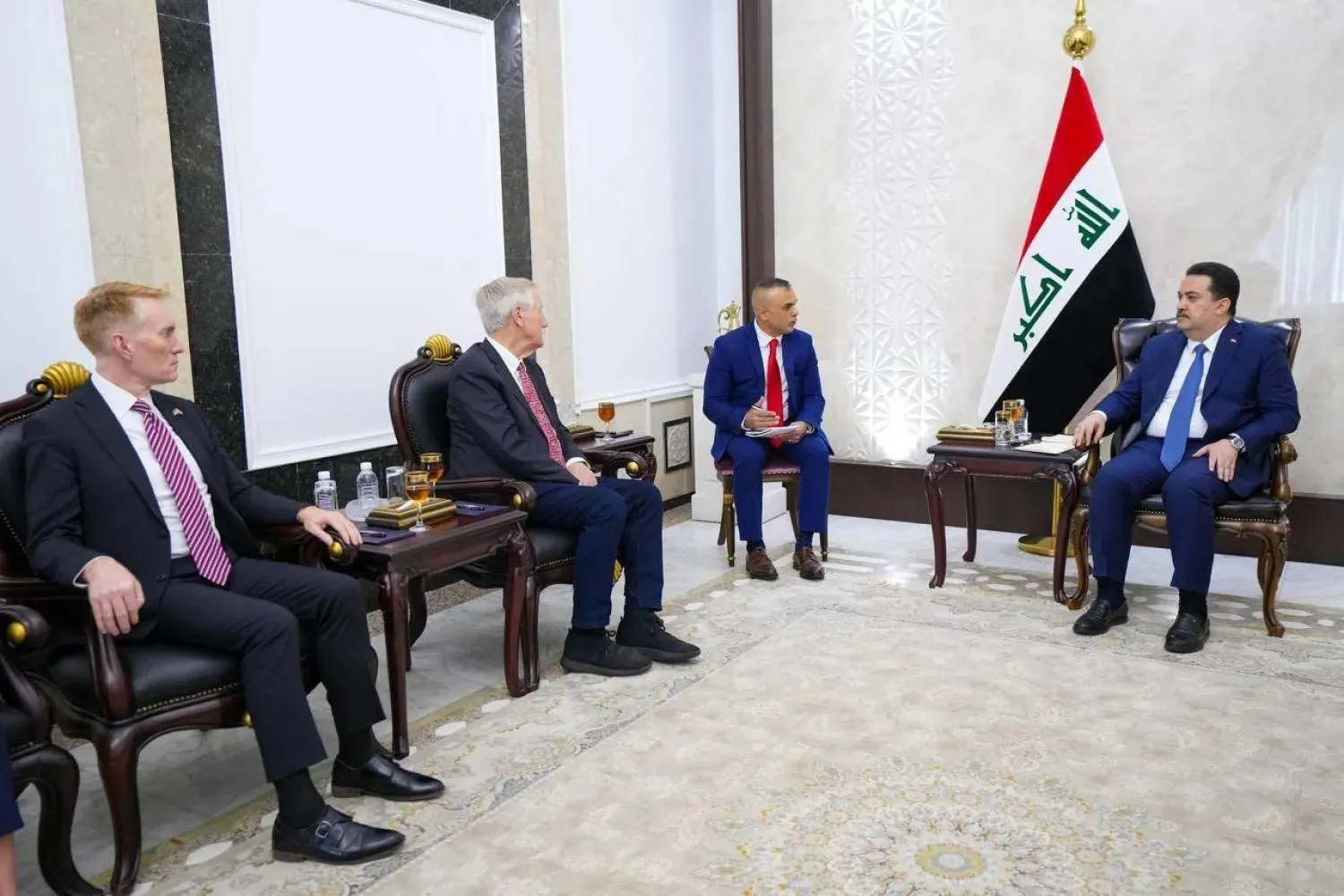
Meeting with US Senators Angus King and James Lankford, Iraqi Prime Minister Mohammed Shia al-Sudani underscored “Iraq’s political and economic stability.” (Premier’s Office)
TT

Baghdad Backs Down on Accusing Kurdistan of Unilateral US Ties

Meeting with US Senators Angus King and James Lankford, Iraqi Prime Minister Mohammed Shia al-Sudani underscored “Iraq’s political and economic stability.” (Premier’s Office)

Iraq’s federal government has softened its stance after initially rejecting recent multibillion-dollar oil contracts signed between the Kurdistan Regional Government (KRG) and two US energy firms, which were concluded without Baghdad’s consent.

The deals, worth an estimated $110 billion over their lifetime, were signed by KRG Prime Minister Masrour Barzani with HKN Energy and WesternZagros to develop gas fields in the Miran and Topkhana-Kor Mor areas of Sulaimaniyah province.

While Baghdad first dismissed the agreements as “invalid and unconstitutional,” citing a 2022 Supreme Court ruling, it later scaled back its rhetoric and simply called for adherence to the constitution — a vague position that underscores the enduring political impasse over a national oil and gas law.

The contracts have reignited long-standing tensions between Baghdad and Erbil, as the two sides remain at odds over the legal framework governing Iraq’s energy sector. Efforts to pass a national oil and gas law — first proposed in 2007 — have repeatedly stalled in parliament due to deep political divisions, particularly resistance from key Shi’ite factions.

A Legal Grey Zone

Legal experts argue that the issue goes beyond the contracts’ constitutional validity and touches on the very authority of the KRG to engage in such agreements.

“These contracts are unconstitutional,” legal expert Ali al-Tamimi told Asharq al-Awsat.

“The KRG is currently operating as a caretaker government, which limits its ability to sign international agreements.” He added that Article 110 of the Iraqi Constitution grants the federal government exclusive authority over foreign policy, international treaties, and energy policy.

“Oil is a federal matter,” Tamimi said. “International agreements should be made between sovereign states — not between a state and a regional government.”

Decades of Discord

The KRG has maintained strong ties with Washington since before the 2003 US-led invasion that toppled Saddam Hussein. However, some Shi’ite leaders believe they are losing influence in shaping US-Iraq relations, as Iran asserts greater sway amid shifting regional dynamics.

“The post-2003 political structure empowered Shi’ites and Kurds, but they failed to prepare for long-term governance,” a senior Iraqi political figure, speaking on condition of anonymity, told Asharq al-Awsat.

“Much of the current friction stems from the power-sharing deal struck after the US invasion and a constitution that now shows its flaws.”

The source added, “Every constitutional or sovereignty-related crisis reflects unresolved compromises between Kurds and Shiites — made while sidelining the Sunnis.”

KRG Sees Strategic Leap

Barzani defended the gas deals as transformative for the region’s energy infrastructure.

“These projects mark a major leap forward. They will create jobs and bolster energy security across Iraq,” he said following the signing.

Yet the absence of a unified oil and gas law leaves the KRG’s deals in a legal limbo — raising questions over Baghdad’s ability to enforce its authority and over foreign firms’ appetite for investment in Iraq’s energy sector.

Baghdad Eyes Deeper Ties with Washington

Despite the controversy, Iraqi Prime Minister Mohammed Shia al-Sudani reaffirmed Baghdad’s commitment to expanding ties with the United States, especially in energy, economy, and culture.

Meeting with US Senators Angus King and James Lankford, Sudani underscored “Iraq’s political and economic stability” and highlighted reforms in the oil and gas sector aimed at attracting foreign investment.

“The government has taken decisive steps in this area and achieved important milestones that will strengthen cooperation with American companies,” Sudani’s office said in a statement.

Strategic Outlook Amid Western Caution

Iraqi Foreign Minister Fuad Hussein echoed the prime minister’s sentiment, expressing hope for sustained engagement with Washington. However, he lamented the continued classification of Iraq as a “high-risk” country by several Western governments.

Hussein said Iraq was working toward energy self-sufficiency and independence. “The relationship with the US remains strategic, spanning counterterrorism, reconstruction, and regional stability,” he said.

He also urged greater US investment in Iraq’s promising energy sector, citing progress in capturing associated gas, expanding electricity ties with neighboring states, and exploring new gas fields.

“Iraq is on the path to becoming a major gas producer,” he said, inviting American firms to participate in what he called a strategic opportunity.


Desperate Gazans Pull Iron Bars from Rubble to Construct Tents and Scratch Out a Living

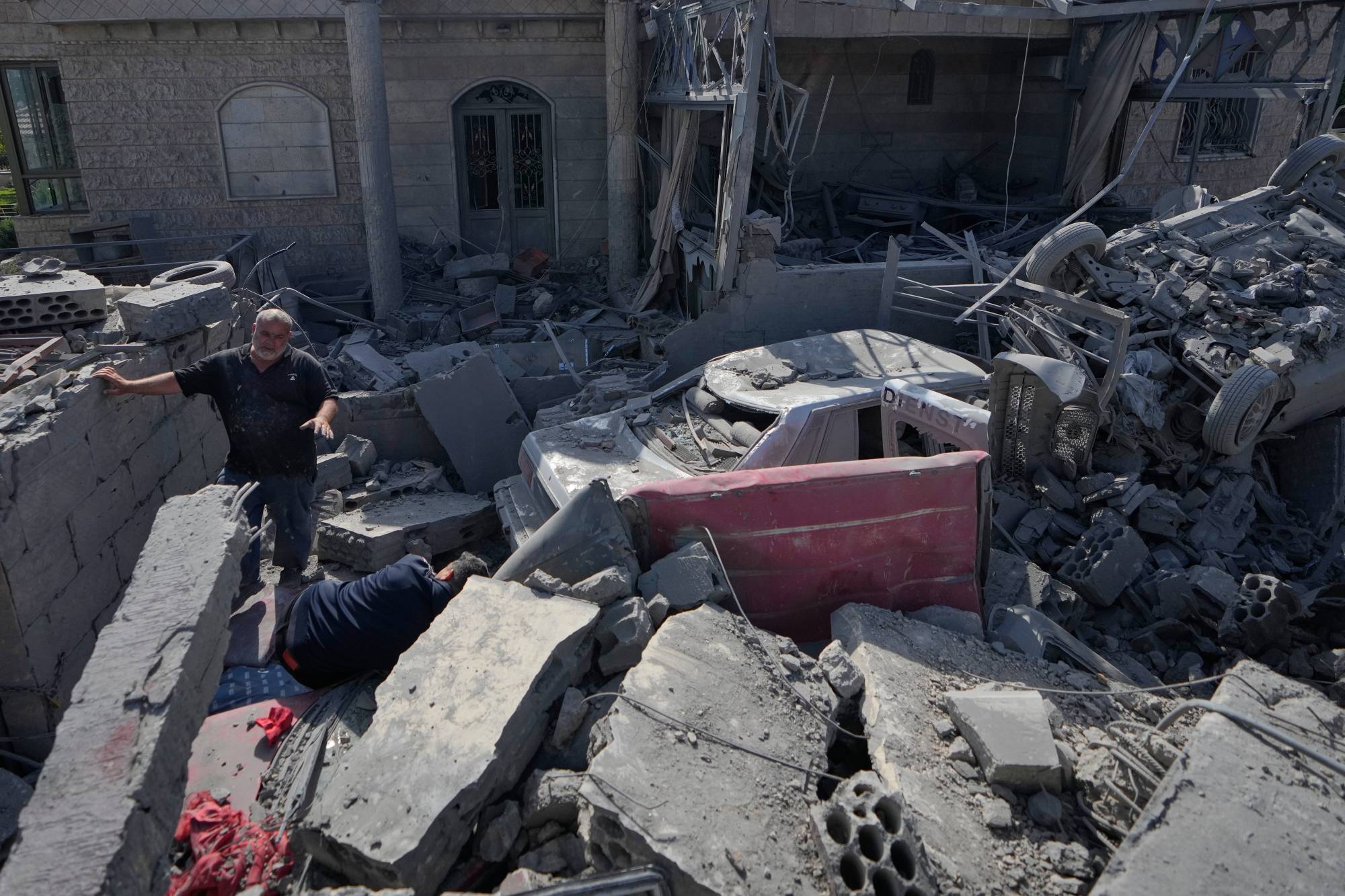
A Palestinian worker breaks concrete to extract steel bars from destroyed homes, using only simple hand tools amid a severe shortage of construction materials caused by long-standing restrictions on the entry of cement and iron, in Khan Younis, southern Gaza Strip, December 9, 2025. REUTERS/Haseeb Alwazeer
TT

Desperate Gazans Pull Iron Bars from Rubble to Construct Tents and Scratch Out a Living

A Palestinian worker breaks concrete to extract steel bars from destroyed homes, using only simple hand tools amid a severe shortage of construction materials caused by long-standing restrictions on the entry of cement and iron, in Khan Younis, southern Gaza Strip, December 9, 2025. REUTERS/Haseeb Alwazeer

As winter bites in Gaza, displaced Palestinians set out every day to homes destroyed by Israel. There they rip out iron rods from the walls and use them to prop up their flimsy tents or sell to scratch out a living in an enclave that will take years to recover from war.

The rods have become a hot item in Gaza, where they are twisted up in the wreckage left by an Israeli military campaign that spared few homes. Some residents spend days pounding away at thick cement to extract them, others do the back-breaking work for a week or more, Reuters.

With only rudimentary tools such as shovels, pickaxes and hammers, work proceeds at a snail's pace.

UN SAYS WAR GENERATED 61 MILLION TONS OF RUBBLE

Once the bars helped hold up cement walls in family homes, today they are destined for urgently-needed tents as temperatures at night fall. Heavy rainstorms have already submerged many Gazans' meagre belongings, adding to their misery.

Palestinian father-of-six Wael al-Jabra, 53, was putting together a makeshift tent, trying to hammer together two steel bars.

"I don’t have money to buy wood, of course. So, I had to extract this iron from the house. The house is made of five floors. We don’t have anything apart from God and this house that was sheltering us," he said.

In November, the UN Development Program said that the war in Gaza had generated 61 million tons of rubble, citing estimates based on satellite imagery.

Most of it can be cleared within seven years under the right conditions, it said.

A ROD CAN COST $15

A 10-meter metal rod costs displaced families $15 - a steep amount because many barely have cash.

The Palestinian group Hamas triggered the conflict after attacking Israel on Oct. 7, 2023, killing 1,200 people and taking 251 back to Gaza as hostages, according to Israeli calculations. Israel responded with a military campaign that killed over 70,000 people and laid waste to Gaza.

Carrying heavy buckets of rubble and pushing a wheelbarrow, Suleiman al-Arja, 19, described a typical day in the quest for iron rods.

"We pass by destroyed houses and agree with the house owner. He gives us a choice, whether to clean the house (clear the rubble) in exchange for iron or clean the house for money. We tell him that we want the iron and we start breaking the iron. As you can see, we spend a week, sometimes a week and a half," he said.

FOCUS IS ON DAILY STRUGGLE TO LIVE

US President Donald Trump promised to put together an international stabilization force and an economic development plan to rebuild and energize Gaza, which was impoverished even before the war. Palestinians in Gaza can't look so far ahead even though a ceasefire was reached in October. Every day is a struggle for Palestinians who have seen peace plans come and go over many decades.

Their minds are focused on finding ways to survive, every single day.

"We do this work to get our food and drink, to cover our living expenses and not need anyone, so we earn a living through halal (legitimate) means and effort. These are my hands," said Haitham Arbiea, 29.

Palestinians accuse Israel of depriving Gaza of the iron bars.

An Israeli official told Reuters that construction materials are considered dual use items - items for civilian but also potential military use - and will not be allowed into Gaza until the second phase of the US-led peace plan. The official cited concerns that the materials could be used for the building of tunnels, which have been used by Hamas.


Washington’s Opening Toward Damascus Clashes with Israel’s Ground Strategy

A meeting between Trump and Netanyahu at the White House, July 2025 (AFP). 
TT

Washington’s Opening Toward Damascus Clashes with Israel’s Ground Strategy

A meeting between Trump and Netanyahu at the White House, July 2025 (AFP). 

Washington’s recent openness toward Damascus is increasingly colliding with Israel’s assertive on-the-ground approach, highlighting a widening rift between the two traditional allies over the future of Syria following the fall of Bashar al-Assad’s regime.

The United States now appears to be pushing for expanded security cooperation with the new Syrian government led by President Ahmed al-Sharaa, aiming to confront shared security threats and stabilize the country.

At a conference convened to assess the new phase in Syria, Admiral Brad Cooper, commander of US Central Command (CENTCOM), placed future cooperation with Damascus at the center of discussions about US policy toward “post-Assad Syria.”

Cooper stressed that Washington is working “increasingly” with the Syrian army to counter common security threats, asserting that integrating the Syrian Democratic Forces (SDF) into the national army would enhance internal stability, improve border control, and strengthen Syria’s ability to pursue Daesh.

Cooper added that since last October, US forces have provided advice, assistance, and enablement to Syrian authorities in more than twenty operations against Daesh and in thwarting weapons shipments bound for Hezbollah, noting that such gains are only possible through close coordination with Syrian government forces.

This American trajectory, however, now overlaps with an expanding disagreement between Washington and Tel Aviv over the contours of a “new Syria,” according to the Wall Street Journal. The paper reported an unusually sharp divergence between the two allies over Syria’s future one year after Assad’s fall, as President Donald Trump pushes a more open approach toward Damascus with Saudi and Turkish backing.

Trump has lifted sanctions on al-Sharaa, praising him as a “young, attractive, tough guy" with a “real shot at doing a good job", which signaled Washington’s readiness for a major policy shift.

In contrast, Israel quickly moved after the regime’s collapse to establish a military presence in southern Syria, taking control of an estimated 250 square kilometers.

The area became a launchpad for an expanded Israeli security posture that has included arrests, weapons seizures, airstrikes deep inside Syrian territory, and even a strike on the military command headquarters in Damascus, actions justified as protection of the Druze community.

The WSJ attributes this assertive field strategy to a shift in Israel’s security mindset after the Oct. 7, 2023 attacks, noting that Israeli decision-makers now believe any security concession could open a dangerous breach.

Former Israeli national security adviser Yaakov Amidror remarked that making decisions from Washington is far easier than making them from the Golan Heights, reflecting Israel’s preference to secure its interests unilaterally.

While the US administration works to broker security negotiations between Damascus and Tel Aviv - parallel to de-escalation efforts in Gaza and Ukraine - Trump is urging Israel to engage in a “strong, honest dialogue” with Syria. Yet these efforts face obstacles, chief among them al-Sharaa’s rejection of Israel’s proposal for a demilitarized zone stretching from southern Damascus to the border, which he argues would create a dangerous security vacuum.

Within Israel, influential voices warn against overreliance on force, fearing conflict with Washington’s desire to rehabilitate the new Syrian state and potentially integrate it into the Abraham Accords framework.

Some Israeli experts propose allowing Syrian army deployment near the border while banning heavy weapons and Turkish forces, shifting from displaying military power to building diplomatic power. Diplomats predict any future agreement may resemble the 1974 disengagement framework, albeit updated for current realities.

The Wall Street Journal concluded that the US–Israeli dispute over Syria is no passing episode but a test of the resilience of their longstanding alliance amid a reshaped regional landscape.

“The new Syria” has become an open arena for redefining Middle Eastern power balances, as Washington attempts to merge counterterrorism efforts with rebuilding the Syrian state and crafting a new security formula between Damascus and Tel Aviv.


Lebanese Foreign Minister Declines Invitation to Tehran, Proposes Meeting in Neutral Country

Lebanese Foreign Minister Youssef Raji receives his Iranian counterpart Abbas Araghchi in Beirut in June 2025 (File – IRNA)
TT

Lebanese Foreign Minister Declines Invitation to Tehran, Proposes Meeting in Neutral Country

Lebanese Foreign Minister Youssef Raji receives his Iranian counterpart Abbas Araghchi in Beirut in June 2025 (File – IRNA)

Lebanese Foreign Minister Youssef Raji has declined an invitation from his Iranian counterpart Abbas Araghchi to visit Tehran, proposing instead that the two meet in a mutually agreed-upon neutral country.

In a post on X on Wednesday, Raji said he was “unable to accept” the invitation at this time, citing unspecified “current circumstances.”

He stressed that his reply “does not mean rejecting dialogue,” rather “the proper atmosphere is not appropriate.”

He added that any renewed engagement with Iran must rest on clear principles, including respect for Lebanon’s sovereignty, non-interference in its internal affairs, and adherence to international norms governing state-to-state relations.

Araghchi had recently invited Raji to Tehran for talks on bilateral relations.

Official Lebanese sources told Asharq Al-Awsat that the invitation was sent personally to the minister, not to the Lebanese state, and that Raji’s response “expresses his own position.”

Lebanon and Iran continue diplomatic engagement despite Beirut’s repeated warnings - conveyed directly to visiting Iranian officials - that Lebanon rejects any foreign meddling in its internal affairs.

Tensions between Raji and Tehran were visible during the August visit of Ali Larijani, secretary-general of Iran’s Supreme National Security Council.

Larijani said he lacked the time to meet Raji; the minister replied: “Even if I had the time, I would not have met him.”

Former Lebanese foreign minister Fares Boueiz said Raji’s latest stance is a clear diplomatic message that relations between Beirut and Tehran are “incomplete.”

When differences arise, Boueiz noted, first meetings are often held in a third country to establish a framework for resolving disputes.

Boueiz added that a foreign minister rarely deviates from the official position of the state. He argued that Raji’s move reflects the views of President Joseph Aoun and Prime Minister Nawaf Salam, and implicitly signal that Iran should halt its support for a particular Lebanese faction and stop its interference.

Lebanon has repeatedly accused Iran of meddling in its internal affairs. During his meeting with Larijani in August, Aoun reiterated that no group in Lebanon may carry weapons or rely on external backing.

While open to cooperation with Iran, Lebanon insists such engagement remains within the limits of sovereignty and mutual respect.

Boueiz recalled that Lebanese-Iranian diplomatic relations stabilized after 1990, when he restored protocol-based engagement in line with the Vienna Convention. During the civil war, Iranian delegations routinely entered Lebanon via Syria without coordinating with the Lebanese government and met directly with Hezbollah.

After Boueiz confronted Tehran’s ambassador in 1990, then-foreign minister Ali Akbar Velayati agreed to normalize diplomatic procedures, leading to formal exchanges and signed agreements.

Some Lebanese observers view Raji’s stance as evidence of diminishing Iranian influence in Lebanon, long bolstered by Tehran’s support for Hezbollah.

Boueiz, however, argues that Iran’s role is closely tied to its evolving relationship with Washington. US-Iran dynamics, including ongoing discussions over sanctions relief and frozen assets, inevitably ripple into Lebanon: “Whenever US-Iran negotiations worsen, tensions rise in Lebanon; when talks calm down, Lebanon feels the relief.”
