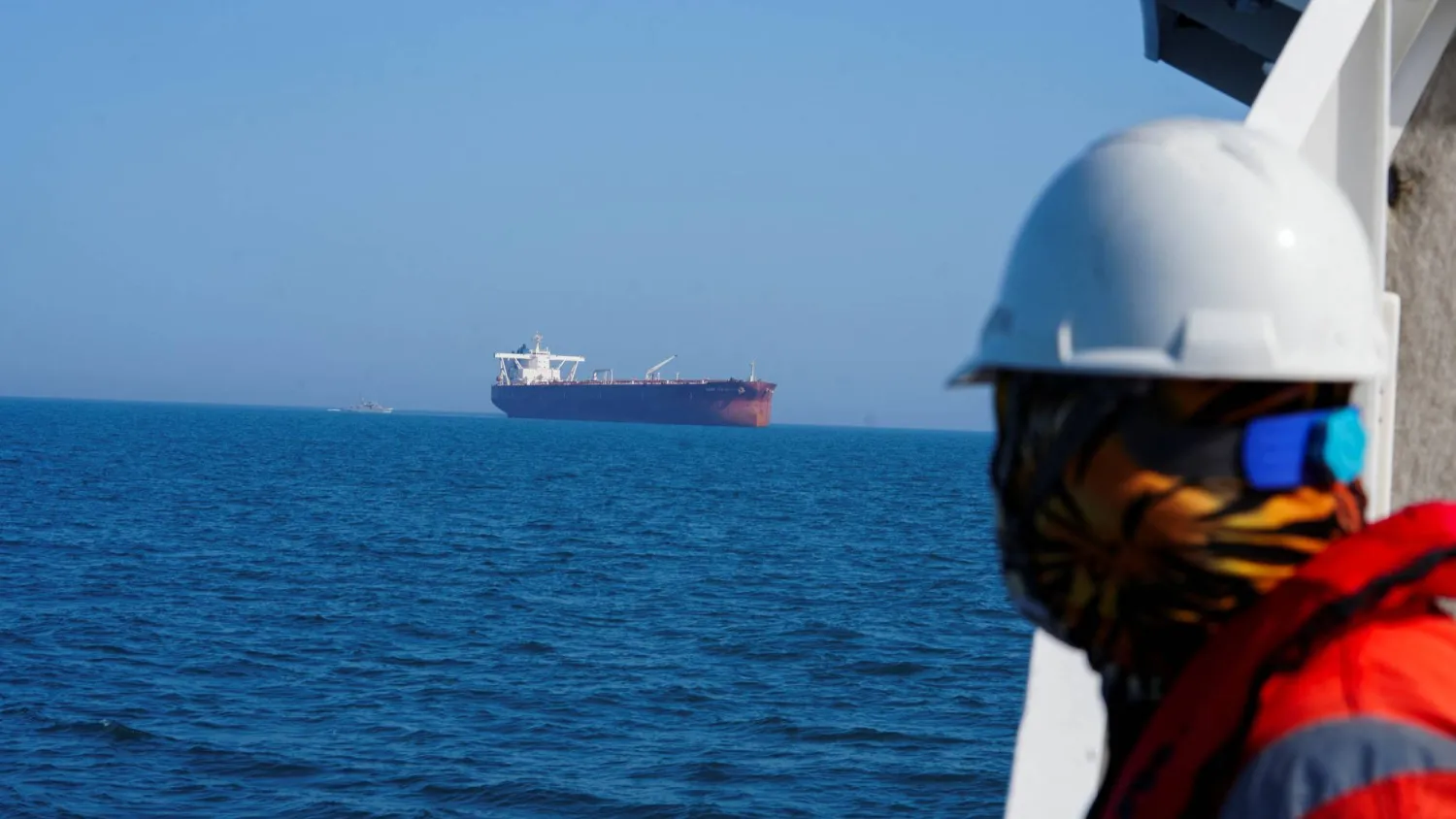
Iran said Friday it fully reopened the Strait of Hormuz to commercial vessels, but President Donald Trump said the American blockade on Iranian ships and ports “will remain in full force” until Tehran reaches a deal with the US, including on its nuclear program.
Iranian Foreign Minister Abbas Araghchi posted on X that the crucial waterway, through which about 20% of the world's oil is shipped, was now fully open to commercial vessels, as a 10-day truce between Israel and the Iran-backed Hezbollah group in Lebanon appeared to hold.
Trump initially celebrated the Iranian announcement, posting on social media that the strait was "fully open and ready for full passage.” But minutes later, he issued another post saying the US Navy's blockade would continue “UNTIL SUCH TIME AS OUR TRANSACTION WITH IRAN IS 100% COMPLETE.”
The president also said Iran, with help from the US, is working to remove all mines from the strait.
Trump imposed the blockade earlier this week after Iran restricted traffic through the strait due to fighting in Lebanon, which Iran claimed to be a breach of the Pakistan-brokered ceasefire reached between the US, Israel and Iran.
At the time, Trump said the blockade would enforce an “all or none” policy in hopes of pressuring Iran to reopen the strait.
The president's decision to continue the blockade despite Iran’s announcement appeared aimed at sustaining pressure on Tehran as the fate of the two-week ceasefire reached last week remains uncertain. Direct talks between the US and Iran last weekend were inconclusive, as the two nations differed over Iran’s nuclear program and other points.
Truce in Lebanon could help US-Iran peace efforts
Oil prices fell on hopes of a deal. The head of the International Energy Agency had warned that energy shocks could get worse if the strait did not reopen.
The truce in Lebanon could clear one major obstacle to a deal between Iran, the United States and Israel to end weeks of devastating war. But it was unclear to what extent Hezbollah would abide by a deal it did not play a role in negotiating and which will leave Israeli troops occupying a stretch of southern Lebanon.
Trump said in another post that Israel is “prohibited” by the US from further strikes on Lebanon and that “enough is enough” in the Israel-Hezbollah war. The White House did not immediately respond to a question about whether the prohibition spans both offensive and defensive strikes.
Shortly before Trump's social media post, Israeli Prime Minister Benjamin Netanyahu said Israel agreed to the ceasefire in Lebanon “at the request of my friend President Trump,” but that the campaign against Hezbollah is not complete.
He claimed Israel had destroyed about 90% of Hezbollah’s missile and rocket stockpiles and added that Israeli forces “have not finished yet” with the dismantling of the group.
Celebrations in Beirut
In Beirut, celebratory gunshots rang out across the Lebanese capital at the start of the truce. Displaced families began moving toward southern Lebanon and Beirut’s southern suburbs despite warnings by officials not to return to their homes until it became clear whether the ceasefire would hold.
A spokesperson for the UN peacekeepers in southern Lebanon said Friday they had not observed any airstrikes since midnight, but accused the Israeli military of violating airspace and of artillery shelling in southern Lebanon. The Israeli military did not immediately comment.
According to the agreement shared by the State Department, Israel can act in self-defense against imminent attacks but cannot carry out offensive operations against southern Lebanon.
Trump heralded the deal a “historic day for Lebanon” and expressed confidence the war with Iran would soon end.
“I will say the war in Iran is going along swimmingly,” Trump said in a Las Vegas speech. “It should be ending pretty soon.”
An end to Israel’s war with Hezbollah was a key demand of Iranian negotiators, who previously accused Israel of breaking the current ceasefire with strikes on Lebanon. Israel said that deal did not cover Lebanon.
Pakistan’s army chief met Thursday with Iran’s parliament speaker as part of international efforts to press for an extension of the ceasefire.
The fighting has killed at least 3,000 people in Iran, more than 2,290 in Lebanon, 23 in Israel and more than a dozen in Gulf Arab states. Thirteen US service members have also been killed.
Israel says it will keep troops in Lebanon
Israeli forces have engaged in fierce battles with Hezbollah in the border area as they pushed into southern Lebanon to create what officials have called a “security zone.”
Israel’s hardline Defense Minister Israel Katz said Israel would continue to hold all the places it is currently stationed, including a buffer zone extending 10 kilometers (6 miles) from the border into southern Lebanon. He said many homes in the area would be destroyed and Lebanese residents will not return.
Hezbollah has said Lebanese people have “the right to resist” Israeli occupation of their land and that their actions “will be determined based on how developments unfold.”
Israel and Hezbollah have fought several wars and have been fighting on and off since the day after the start of the Gaza war. Israel and Lebanon reached a deal to end that war in November 2024, but Israel has kept up near-daily strikes in what it says is an effort to prevent the party from regrouping. That escalated into another invasion after Hezbollah again began firing missiles at Israel in response to its war on Iran.
Pakistan army chief meets with Iranian parliament speaker
Pakistan’s army chief met Thursday with Iran’s parliament speaker as part of efforts to press for an extension to a ceasefire that has paused almost seven weeks of war between Israel, the US and Iran.
Regional officials reported progress, telling AP the United States and Iran had an “in-principle agreement” to extend it to allow for more diplomacy. They spoke on condition of anonymity to discuss sensitive negotiations.
Mediators are pushing for a compromise on three main sticking points: Iran’s nuclear program, the Strait of Hormuz and compensation for wartime damages, according to a regional official involved in the mediation efforts.
Trump on Friday suggested Iran has agreed to hand over its enriched uranium.
“The USA will get all Nuclear ‘Dust,’ created by our great B2 Bombers — No money will exchange hands in any way, shape, or form,” he said in a post. Nuclear dust is the shorthand Trump frequently uses to refer to the highly enriched uranium that is believed buried under nuclear sites the US bombed during last year’s 12-day war between Israel and Iran.
If true, it would be a major concession from Iran, and would lock in a key demand of the US to end the conflict. But neither Iran nor countries acting as intermediaries in the conflict have said Tehran has made such an agreement.
Trump also asserted Thursday that Iran had “agreed to give us back the nuclear dust.”