

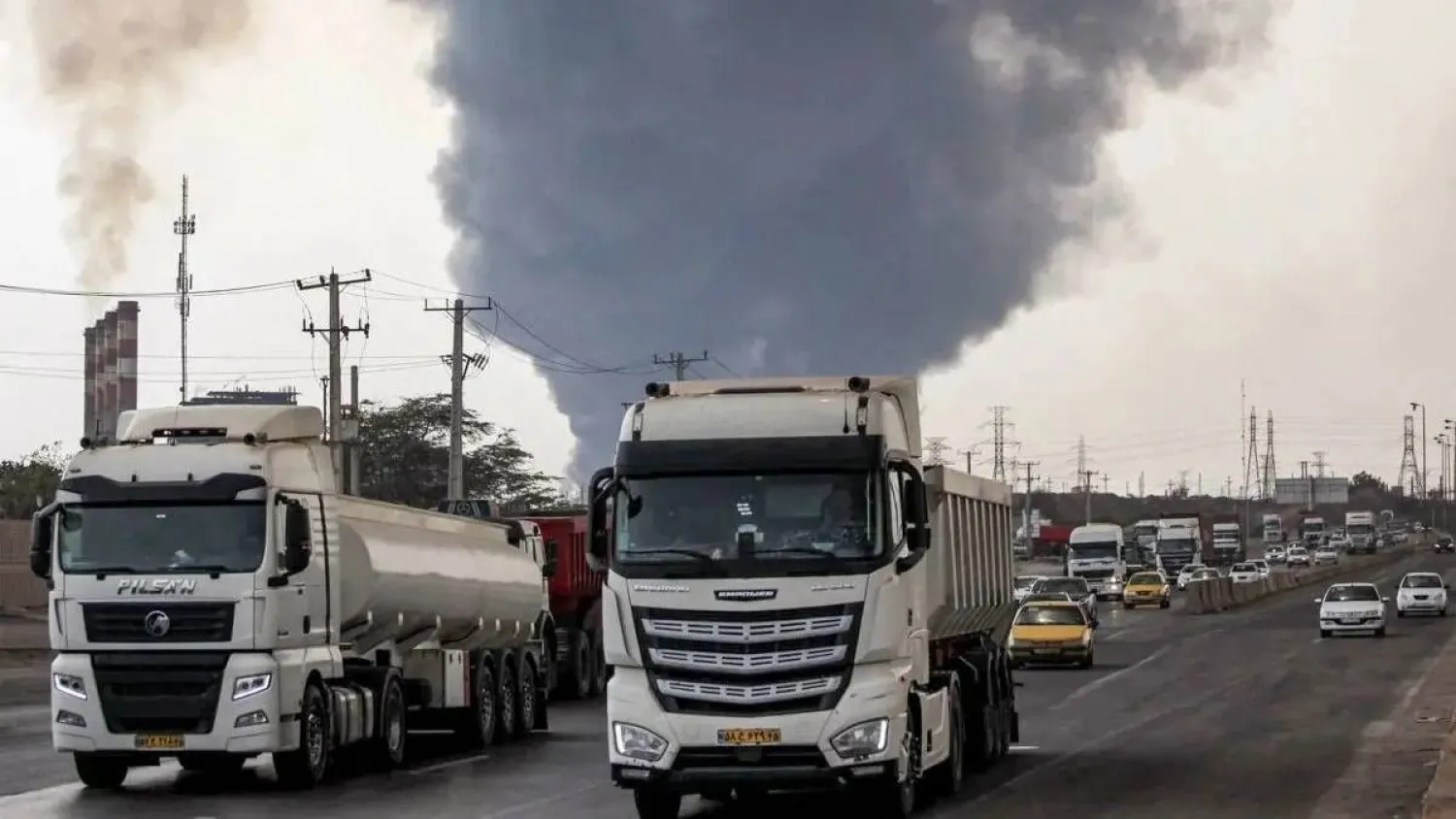

Truckers' Protests in Iran Grow and Win Support from Prominent Dissidents

Road transport is critical to food supply in Iran. (Via AFP)
TT

Truckers' Protests in Iran Grow and Win Support from Prominent Dissidents

Road transport is critical to food supply in Iran. (Via AFP)

Truck drivers in Iran blocked roads and ports Wednesday as part of their strike protesting low salaries, high insurance rates, and a possible hike in fuel prices.

The strikes, which began last Thursday in the southern port city of Bandar Abbas, one of the country’s main transportation and shipping hubs, have now spread across Iran. The protests are slowly gaining steam, supported by prominent dissident voices, and could morph into more serious protests against the government.

Last week, the Iranian government announced plans to increase the price of fuel for trucks from 4 cents per liter (15.14 cents per gallon) to nearly 50 cents per liter (about $1.90 per gallon) in late June. With massive resources of oil and gas, Iran has some of the lowest fuel prices in the world. The average price for a gallon of gas in the United States on Wednesday was $3.16, according to AAA, a drivers' assistance and advisory service.

Dissident Iranians expressed their support for the truckers. Film director Jafar Panahi, who last week won the Palme d’Or award at the Cannes Film Festival, encouraged the truck drivers to start a nationwide strike.

“The strike is a loud cry to the government: enough is enough! Stop the massive suppression and plundering before everything is lost and nothing remains for people,” he wrote on Instagram.

Nobel Peace Prize laureate Narges Mohammadi, who was imprisoned on charges of collusion against state security and propaganda against Iran’s government, also expressed her support for the strike on X.

Videos circulating on social media showed lines of trucks parked on the sides of major roads. Iran said the plan is intended to prevent fuel smuggling into neighboring countries. Fuel in neighboring Pakistan costs more than a dollar per liter ($4 per gallon).

Many of Iran's previous rounds of anti-government protests started out as economic protests over local issues, including demonstrations in 2017 and 2018. Those protests were met with a heavy reaction by the police and the Basij, the all-volunteer force of Iran’s paramilitary Revolutionary Guard.

In 2019, anger over the government eliminating the gasoline subsidy also sparked nation-wide protests. More than 1,000 people were arrested and the country temporarily shut down the internet. Protests also rocked the country in 2022 over the death of 22-year-old Mahsa Amini, who died in Iranian security custody after morality police detained her for improperly wearing her headscarf.

On Saturday, Jalal Mousavi, an official in the truckers’ union, said truckers are striking because they are struggling with the rising costs of fuel, spare parts and repairs.

The strike underscores the mounting economic pressures on Iran as it struggles to secure relief from crippling sanctions in the ongoing negotiations with the United States. Iran’s oil sector, the lifeblood of its economy, has been damaged by the impact of American sanctions over Tehran’s nuclear program, and it is one of the central issues under discussion in the Iran-US negotiations.



Putin Threatens Retaliatory Seizures of European Ships

Russian President Vladimir Putin holds a meeting aboard the Guards missile cruiser Varyag during the final stage of the Pacific Fleet's exercises off the coast of Sakhalin region, Russia, 12 August 2026. (EPA/Gavriil Grigorov Kremlin / Pool)
TT

Putin Threatens Retaliatory Seizures of European Ships

Russian President Vladimir Putin holds a meeting aboard the Guards missile cruiser Varyag during the final stage of the Pacific Fleet's exercises off the coast of Sakhalin region, Russia, 12 August 2026. (EPA/Gavriil Grigorov Kremlin / Pool)

Russian President Vladimir Putin on Wednesday threatened to seize ships belonging to European countries in retaliation for plans to sell off cargo seized from Russian "shadow fleet" vessels.

Several European companies have intercepted ships carrying Russian oil in contravention of European sanctions targeting the vital revenue source.

New sanctions passed last month permit EU members to sell the oil or any other cargo seized from the ships.

Moscow has bristled at the moves, with Putin calling it "piracy and banditry".

"We will be forced to respond in kind," the Kremlin chief said while overseeing naval drills in Russia's Far East.

Moscow would act "wherever we ourselves deem necessary and appropriate -- anywhere," he added.

Swedish court documents obtained by AFP earlier in August showed Stockholm will transfer to Kyiv a seized Russian ship suspected of transporting grain from occupied Ukraine.

Putin was speaking aboard the Russian cruiser Varyag off the island of Sakhalin, where Russia's navy was conducting drills.

The exercises come a week before joint US-South Korean war games, designed to simulate a possible invasion from North Korea.

Tensions are high in the region amid accusations from Kyiv and Seoul that Pyongyang and Moscow are further intensifying their military cooperation.


Pakistan Interior Minister in Iran to Discuss Regional Security

A handout photo made available by the Iranian Foreign Ministry Office shows Iranian Foreign Minister Abbas Araghchi (R) meeting with Pakistan's Minister of Interior Mohsin Naqvi in Tehran on August 11, 2026. (Iran Foreign Ministry / AFP)
TT

Pakistan Interior Minister in Iran to Discuss Regional Security

A handout photo made available by the Iranian Foreign Ministry Office shows Iranian Foreign Minister Abbas Araghchi (R) meeting with Pakistan's Minister of Interior Mohsin Naqvi in Tehran on August 11, 2026. (Iran Foreign Ministry / AFP)

Pakistan's interior minister is visiting Iran to discuss regional security, stability and other developments, the Pakistani foreign office said Wednesday, as Islamabad tries to mediate a resolution to the Middle East war.

Mohsin Naqvi, previously involved in mediation efforts between Iran and the US, is known to be close to the powerful head of the Pakistani army, Asim Munir.

Iranian state news agency IRNA reported late Tuesday that Naqvi met with Iranian President Masoud Pezeshkian, Foreign Minister Abbas Araghchi and Interior Minister Eskandar Momeni.

"He is discussing bilateral relations, security, regional security and stability, and constructive engagement amongst the parties in the region and regional developments," Pakistani foreign ministry spokesman Tahir Andrabi told reporters in Islamabad.

The Iranian government's website said Naqvi conveyed to Pezeshkian "a message from the Pakistani prime minister and the chief of the army", without specifying its content.

Tehran insists on retaining control of the Strait of Hormuz after the war and wants to charge fees for passage, repeatedly striking ships it accuses of attempting to circumvent its preferred route. The US has imposed a rival blockade on Iranian ports.

Attacks in the waterway, which was free to transit before the war, led to the collapse of an April ceasefire, and mediators have urged both sides to return to the terms of a subsequent June memorandum that set out a path for peace talks.

Last week Iran said it had agreed a route with neighboring Oman for ships transiting the strait and was finalizing arrangements for jointly managing the strategic waterway.

On Tuesday the US military announced that it had fired on a Panama-flagged cargo ship that attempted to break the American blockade of Iran's ports.


North Korea Fires Missile Ahead of Major US-South Korea Drills

People watch a news broadcast on a television screen showing a report on a missile launch, at a railway station in Seoul, South Korea, 12 August 2026. (EPA)
TT

North Korea Fires Missile Ahead of Major US-South Korea Drills

People watch a news broadcast on a television screen showing a report on a missile launch, at a railway station in Seoul, South Korea, 12 August 2026. (EPA)

North Korea fired a ballistic missile on Wednesday toward the sea off the Korean peninsula's east coast, South Korean and Japanese authorities said, days ahead of major joint military exercises by Seoul and Washington long denounced by Pyongyang.

The missile was launched from the North's Wonsan area at about 6 a.m. (2100 GMT Tuesday), South Korea's Joint Chiefs of Staff (JCS) said, six days after North Korea fired another ballistic missile from the same area.

The launch came ahead of South Korean and US military drills, dubbed Ulchi Freedom Shield, set to run from August 17 to August 27, aimed at countering Pyongyang's evolving nuclear and weapons capabilities.

Hong Min, a senior researcher at the Korea Institute for National Unification in Seoul, said the launch ‌was likely part of ‌North Korea's existing weapons development schedule, but the timing could also have been ‌selected ⁠to send a ⁠message ahead of the exercises.

"Even if it was a test of a weapon under development, choosing when to conduct it requires a political decision," Hong said.

There was no immediate statement from North Korea on the Wonsan launch, but Pyongyang on Wednesday afternoon criticized the nuclear ambitions of South Korea and Japan.

South Korea said North Korea also fired a ballistic missile from Wonsan on August 6, but Pyongyang did not report that launch in state media. Hong said that test may have failed to achieve its intended objective.

North Korea's series of tests this year has featured short-range ballistic missiles, artillery rockets and other tactical weapons.

Wednesday's ⁠launch was its 11th suspected ballistic missile test in 2026, according to South Korean ‌assessments.

South Korean and Japanese defense authorities said the missile flew about 700 ‌km (435 miles).

Seoul's Joint Chiefs of Staff did not identify it as a short-range ballistic missile, saying authorities would conduct a detailed ‌analysis.

The omission leaves open the question of what type of missile it was, analysts said. Ballistic missiles with ‌ranges of 300 km to 1,000 km (186 miles to 620 miles) are generally classified as short-range.

Hong said the range, trajectory and launch site suggested it may have been a type of hypersonic missile, though a submarine-launched missile was also possible.

CONDEMNATION AND HEIGHTENED TENSIONS

South Korea and Japan both condemned the launch.

"Japan lodged a strong protest with North Korea through diplomatic channels at the Japanese Embassy ‌in Beijing and strongly condemned the action," Japanese Defense Minister Shinjiro Koizumi told reporters.

South Korea's Office of National Security convened an emergency meeting and expressed concern over North Korea's continued ⁠ballistic-missile launches following the ⁠August 6 firing. It urged Pyongyang to halt provocations that violate UN Security Council resolutions.

South Korea's military said it was maintaining readiness to respond "overwhelmingly" to any provocation under its combined defense posture with the United States.

The US Indo-Pacific Command said it was consulting closely with allies and partners, adding that its initial assessment was that the launch posed no immediate threat to US personnel or territory, or to its allies.

On Tuesday, Ukrainian President Volodymyr Zelenskiy said Moscow used North Korean ballistic missiles during a Russian attack that killed seven workers at a steel plant in the southeastern city of Zaporizhzhia.

In a statement, a North Korean Foreign Ministry official responsible for South Korean affairs said Seoul's plans to develop nuclear-powered submarines would heighten instability in the region, for a "serious challenge" to the North's security.

Pyongyang needed the capability to counter its adversaries' military moves with retaliatory strikes that would make their "survival and recovery impossible", the statement added.

In a separate commentary state news agency KCNA accused Japan of seeking nuclear weapons under the guise of peaceful use of atomic energy, citing its nuclear power program and debate among Japanese politicians over nuclear armament.