The 911 Presidency: Trump Flexes Emergency Powers in His Second Term

FILE PHOTO: US President Donald Trump attends a meeting with German Chancellor Friedrich Merz (not pictured) at the White House in Washington, D.C., US, June 5, 2025. REUTERS/Kevin Lamarque/File Photo
TT

The 911 Presidency: Trump Flexes Emergency Powers in His Second Term

FILE PHOTO: US President Donald Trump attends a meeting with German Chancellor Friedrich Merz (not pictured) at the White House in Washington, D.C., US, June 5, 2025. REUTERS/Kevin Lamarque/File Photo

Call it the 911 presidency.
Despite insisting that the United States is rebounding from calamity under his watch, President Donald Trump is harnessing emergency powers unlike any of his predecessors.
Whether it’s leveling punishing tariffs, deploying troops to the border or sidelining environmental regulations, Trump has relied on rules and laws intended only for use in extraordinary circumstances like war and invasion.
An analysis by The Associated Press shows that 30 of Trump’s 150 executive orders have cited some kind of emergency power or authority, a rate that far outpaces his recent predecessors.
The result is a redefinition of how presidents can wield power. Instead of responding to an unforeseen crisis, Trump is using emergency powers to supplant Congress’ authority and advance his agenda.
“What’s notable about Trump is the enormous scale and extent, which is greater than under any modern president,” said Ilya Somin, who is representing five US businesses who sued the administration, claiming they were harmed by Trump’s so-called “Liberation Day” tariffs.
Because Congress has the power to set trade policy under the Constitution, the businesses convinced a federal trade court that Trump overstepped his authority by claiming an economic emergency to impose the tariffs. An appeals court has paused that ruling while the judges review it.
Growing concerns over actions
The legal battle is a reminder of the potential risks of Trump’s strategy. Judges traditionally have given presidents wide latitude to exercise emergency powers that were created by Congress. However, there’s growing concern that Trump is pressing the limits when the US is not facing the kinds of threats such actions are meant to address.
“The temptation is clear,” said Elizabeth Goitein, senior director of the Brennan Center’s Liberty and National Security Program and an expert in emergency powers. “What’s remarkable is how little abuse there was before, but we’re in a different era now.”
Rep. Don Bacon, R-Neb., who has drafted legislation that would allow Congress to reassert tariff authority, said he believed the courts would ultimately rule against Trump in his efforts to single-handedly shape trade policy.
“It’s the Constitution. James Madison wrote it that way, and it was very explicit,” Bacon said of Congress’ power over trade. “And I get the emergency powers, but I think it’s being abused. When you’re trying to do tariff policy for 80 countries, that’s policy, not emergency action.”
The White House pushed back on such concerns, saying Trump is justified in aggressively using his authority.
“President Trump is rightfully enlisting his emergency powers to quickly rectify four years of failure and fix the many catastrophes he inherited from Joe Biden — wide open borders, wars in Ukraine and Gaza, radical climate regulations, historic inflation, and economic and national security threats posed by trade deficits,” White House press secretary Karoline Leavitt said.
Trump frequently sites 1977 law to justify actions
Of all the emergency powers, Trump has most frequently cited the International Emergency Economic Powers Act, or IEEPA, to justify slapping tariffs on imports.
The law, enacted in 1977, was intended to limit some of the expansive authority that had been granted to the presidency decades earlier. It is only supposed to be used when the country faces “an unusual and extraordinary threat” from abroad “to the national security, foreign policy, or economy of the United States.”
In analyzing executive orders issued since 2001, the AP found that Trump has invoked the law 21 times in presidential orders and memoranda. President George W. Bush, grappling with the aftermath of the most devastating terror attack on US soil, invoked the law just 14 times in his first term. Likewise, Barack Obama invoked the act only 21 times during his first term, when the US economy faced the worst economic collapse since the Great Depression.
The Trump administration has also deployed an 18th century law, the Alien Enemies Act, to justify deporting Venezuelan migrants to other countries, including El Salvador. Trump's decision to invoke the law relies on allegations that the Venezuelan government coordinates with the Tren de Aragua gang, but intelligence officials did not reach that conclusion.
Congress has ceded its power to the presidency
Congress has granted emergency powers to the presidency over the years, acknowledging that the executive branch can act more swiftly than lawmakers if there is a crisis. There are 150 legal powers — including waiving a wide variety of actions that Congress has broadly prohibited — that can only be accessed after declaring an emergency. In an emergency, for example, an administration can suspend environmental regulations, approve new drugs or therapeutics, take over the transportation system, or even override bans on testing biological or chemical weapons on human subjects, according to a list compiled by the Brennan Center for Justice.
Democrats and Republicans have pushed the boundaries over the years. For example, in an attempt to cancel federal student loan debt, Joe Biden used a post-Sept. 11 law that empowered education secretaries to reduce or eliminate such obligations during a national emergency. The US Supreme Court eventually rejected his effort, forcing Biden to find different avenues to chip away at his goals.
Before that, Bush pursued warrantless domestic wiretapping and Franklin D. Roosevelt ordered the detention of Japanese-Americans on the West Coast in camps for the duration of World War II.
Trump, in his first term, sparked a major fight with Capitol Hill when he issued a national emergency to compel construction of a border wall. Though Congress voted to nullify his emergency declaration, lawmakers could not muster up enough Republican support to overcome Trump’s eventual veto.
“Presidents are using these emergency powers not to respond quickly to unanticipated challenges,” said John Yoo, who as a Justice Department official under George W. Bush helped expand the use of presidential authorities. “Presidents are using it to step into a political gap because Congress chooses not to act.”
Trump, Yoo said, “has just elevated it to another level.”
Trump's allies support his moves
Conservative legal allies of the president also said Trump’s actions are justified, and Vice President JD Vance predicted the administration would prevail in the court fight over tariff policy.
“We believe — and we’re right — that we are in an emergency,” Vance said last week in an interview with Newsmax.
“You have seen foreign governments, sometimes our adversaries, threaten the American people with the loss of critical supplies,” Vance said. “I’m not talking about toys, plastic toys. I’m talking about pharmaceutical ingredients. I’m talking about the critical pieces of the manufacturing supply chain.”
Vance continued, “These governments are threatening to cut us off from that stuff, that is by definition, a national emergency.”
Republican and Democratic lawmakers have tried to rein in a president’s emergency powers. Two years ago, a bipartisan group of lawmakers in the House and Senate introduced legislation that would have ended a presidentially-declared emergency after 30 days unless Congress votes to keep it in place. It failed to advance.
Similar legislation hasn’t been introduced since Trump’s return to office. Right now, it effectively works in the reverse, with Congress required to vote to end an emergency.
“He has proved to be so lawless and reckless in so many ways. Congress has a responsibility to make sure there’s oversight and safeguards,” said Sen. Richard Blumenthal, D-Conn., who cosponsored an emergency powers reform bill in the previous session of Congress. He argued that, historically, leaders relying on emergency declarations has been a “path toward autocracy and suppression.”



Global Nuclear Arms Control under Pressure in 2026 

Russian Yars ICBMs travel through central Moscow, Russia, May 3, 2025. (AFP)
TT

Global Nuclear Arms Control under Pressure in 2026 

Russian Yars ICBMs travel through central Moscow, Russia, May 3, 2025. (AFP)

The fragile global legal framework for nuclear weapons control faces further setbacks in 2026, eroding guardrails to avoid a nuclear crisis.

The first half of the year will see two key events: the US-Russia bilateral treaty, New START, expires on February 5, and in April, New York hosts the Review Conference (RevCon) of the Treaty on the Non-Proliferation of Nuclear Weapons (NPT) -- the cornerstone of global nuclear security frameworks.

The RevCon, held every four to five years, is meant to keep the NPT alive. But during the last two sessions, the 191 signatory states failed to agree on a final document, and experts expect the same outcome in April.

"I think this is going to be a difficult RevCon," said Alexandra Bell, head of US-based global security nonprofit the Bulletin of the Atomic Scientists, at a UN-hosted online conference in early December.

"In terms of the current state and near future prospects of nuclear arms control architecture, things are bleak," she added.

Anton Khlopkov, director of Russian think-tank the Center for Energy and Security Studies (CENESS), took an even starker point of view, saying at the same event that "we are at the point of almost complete dismantlement of arms control architecture".

"We should be realistic in the current circumstances. At best, I think we should try to preserve what we have," he said.

- 'Crumbling' safeguards -

From US strikes on Iranian nuclear sites to Russia's test of the new Burevestnik nuclear-powered cruise missile and US President Donald Trump's remarks about possibly resuming nuclear tests -- the international nuclear landscape darkened in 2025.

At the same time, "the arms control architecture is crumbling", Emmanuelle Maitre of France's Foundation for Strategic Research (FRS) told AFP.

A key challenge hinges on a shift in global relations.

Nuclear control had been built over decades around a Moscow-Washington axis, but China's growing power and rapid technological advances have shifted the international playing field, which is simultaneously increasingly strained.

"The growing interlinkage between nuclear and conventional forces and the emergence of disruptive technologies (such as the US Golden Dome defense system and new hypersonic weapons) have transformed traditional nuclear deterrence into a multi-domain concept, especially in a multipolar world," said Peking University's Hua Han.

"This trilateral configuration introduces complexities far beyond the Cold War-era bilateral model. Increasing China-Russia cooperation further complicates deterrence calculations, particularly in the two main theaters of concern: Europe and the Asia-Pacific," she added, according to the minutes of an April event held by Pakistan's Center for International Strategic Studies.

A likely result of the changing landscape is the lapse of New START, which sets weapon limits and includes inspection systems.

"The entire inspection component is no longer functioning, the notifications when a missile is moved, etc, all of that has vanished. What remains is only the voluntary commitment to stay within the limits," said Maitre.

- 'Collective solutions' -

But allowing New START to lapse is "in American interest", according to Robert Peters of the influential Heritage Foundation, reflecting the stance of much of the US strategic community to avoid tying Washington's hands to Moscow alone.

Beijing, which currently has fewer weapons, has so far refused to engage in trilateral disarmament talks.

"China is the fastest growing nuclear power on the planet. It's building 100 new warheads a year and now has more ICBM (intercontinental ballistic missile) silos than the US has active Minuteman III silos," Peters said at a recent online International Institute for Strategic Studies event.

"New START does nothing to address" that issue, he added.

However, Maitre said, a New START lapse doesn't mean the world should expect serious consequences as early as February 6.

In both Washington and Moscow, "there is a small margin to bring some weapons back into service, but the numbers cannot be very significant. There are bottlenecks" that will slow any buildup, she said.

Nor will the lack of a final document from the RevCon cause "immediate or damaging consequences" to the NPT, she said.

But, she warned, fewer safeguards risks leaving the world without diplomatic tools to resolve tensions.

"The less functional the NPT becomes, the harder it is to forge collective solutions in the event of a crisis."


Iraq's Political Future in Limbo as Factions Vie for Power

FILED - 02 November 2025, Iraq, Najaf: Iraqi Prime Minister Mohammed Shia' al-Sudani delivers a speech during a campaign rally of his Reconstruction and Development Coalition in Najaf, ahead of the Iraqi parliamentary elections, scheduled to be held on 11 November 2025. Photo: Ameer Al-Mohammedawi/dpa
TT

Iraq's Political Future in Limbo as Factions Vie for Power

FILED - 02 November 2025, Iraq, Najaf: Iraqi Prime Minister Mohammed Shia' al-Sudani delivers a speech during a campaign rally of his Reconstruction and Development Coalition in Najaf, ahead of the Iraqi parliamentary elections, scheduled to be held on 11 November 2025. Photo: Ameer Al-Mohammedawi/dpa

Political factions in Iraq have been maneuvering since the parliamentary election more than a month ago to form alliances that will shape the next government.

The November election didn't produce a bloc with a decisive majority, opening the door to a prolonged period of negotiations, said The Associated Press.

The government that eventually emerges will be inheriting a security situation that has stabilized in recent years, but it will also face a fragmented parliament, growing political influence by armed factions, a fragile economy, and often conflicting international and regional pressures, including the future of Iran-backed armed groups.

Uncertain prospects

Prime Minister Mohammed Shia al-Sudani's party took the largest number of seats in the election. Al-Sudani positioned himself in his first term as a pragmatist focused on improving public services and managed to keep Iraq on the sidelines of regional conflicts.

While his party is nominally part of the Coordination Framework, a coalition of Iran-backed Shiite parties that became the largest parliamentary bloc, observers say it’s unlikely that the Coordination Framework will support al-Sudani’s reelection bid.

“The choice for prime minister has to be someone the Framework believes they can control and doesn't have his own political ambitions,” said Sajad Jiyad, an Iraqi political analyst and fellow at The Century Foundation think tank.

Al-Sudani came to power in 2022 with the backing of the Framework, but Jiyad said that he believes now the coalition “will not give al-Sudani a second term as he has become a powerful competitor.”

The only Iraqi prime minister to serve a second term since 2003 was Nouri al-Maliki, first elected in 2006. His bid for a third term failed after being criticized for monopolizing power and alienating Sunnis and Kurds.

Jiyad said that the Coordination Framework drew a lesson from Maliki “that an ambitious prime minister will seek to consolidate power at the expense of others.”

He said that the figure selected as Iraq's prime minister must generally be seen as acceptable to Iran and the United States — two countries with huge influence over Iraq — and to Iraq’s top Shiite cleric, Grand Ali al-Sistani.

Al-Sudani in a bind

In the election, Shiite alliances and lists — dominated by the Coordination Framework parties — secured 187 seats, Sunni groups 77 seats, Kurdish groups 56 seats, in addition to nine seats reserved for members of minority groups.

The Reconstruction and Development Coalition, led by al-Sudani, dominated in Baghdad, and in several other provinces, winning 46 seats.

Al-Sudani's results, while strong, don't allow him to form a government without the support of a coalition, forcing him to align the Coordination Framework to preserve his political prospects.

Some saw this dynamic at play earlier this month when al-Sudani's government retracted a terror designation that Iraq had imposed on the Lebanese Hezbollah militant group and Yemen’s Houthis— Iran-aligned groups that are allied with Iraqi armed factions — just weeks after imposing the measure, saying it was a mistake.

The Coalition Framework saw its hand strengthened by the absence from the election of the powerful Sadrist movement led by Shiite cleric Muqtada Sadr, which has been boycotting the political system since being unable to form a government after winning the most seats in the 2021 election.

Hamed Al-Sayed, a political activist and official with the National Line Movement, an independent party that boycotted the election, said that Sadr’s absence had a “central impact.”

“It reduced participation in areas that were traditionally within his sphere of influence, such as Baghdad and the southern governorates, leaving an electoral vacuum that was exploited by rival militia groups,” he said, referring to several parties within the Coordination Framework that also have armed wings.

Groups with affiliated armed wings won more than 100 parliamentary seats, the largest showing since 2003.

Other political actors

Sunni forces, meanwhile, sought to reorganize under a new coalition called the National Political Council, aiming to regain influence lost since the 2018 and 2021 elections.

The Kurdish political scene remained dominated by the traditional split between the Kurdistan Democratic Party and Patriotic Union of Kurdistan parties, with ongoing negotiations between the two over the presidency.

By convention, Iraq’s president is always a Kurd, while the more powerful prime minister is Shiite and the parliamentary speaker Sunni.

Parliament is required to elect a speaker within 15 days of the Federal Supreme Court’s ratification of the election result, which occurred on Dec. 14.

The parliament should elect a president within 30 days of its first session, and the prime minister should be appointed within 15 days of the president’s election, with 30 days allotted to form the new government.

Washington steps in

The incoming government will face major economic and political challenges.

They include a high level of public debt — more than 90 trillion Iraqi dinars ($69 billion) — and a state budget that remains reliant on oil for about 90% of revenues, despite attempts to diversify, as well as entrenched corruption.

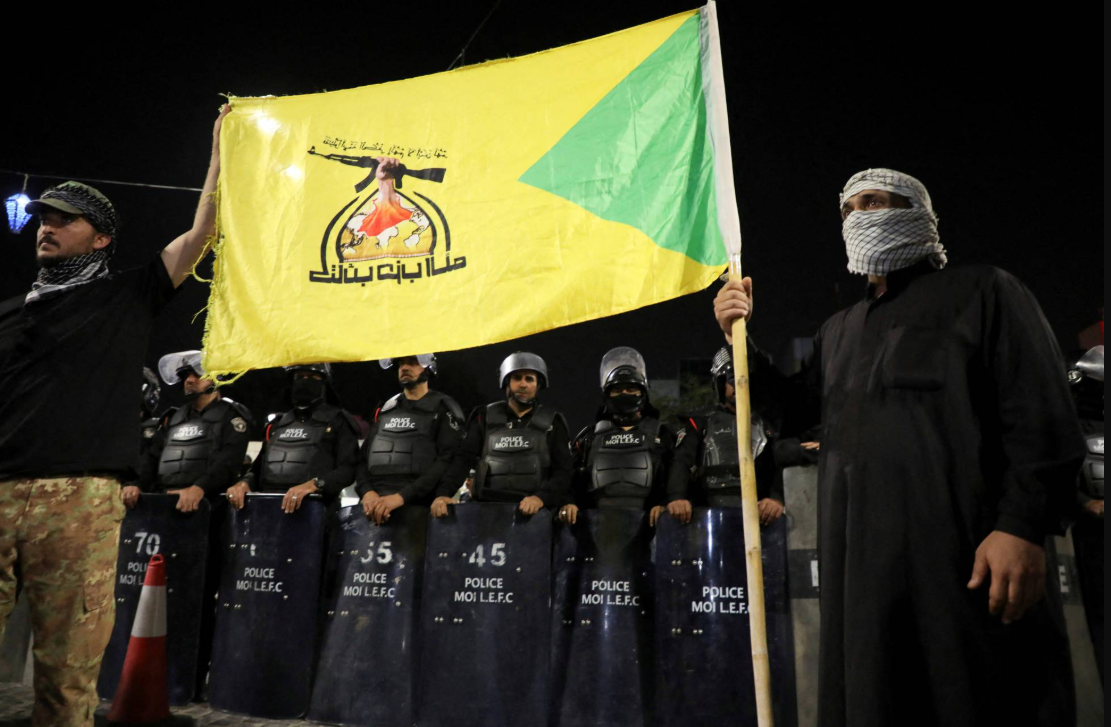
But perhaps the most delicate question will be the future of the Popular Mobilization Forces, a coalition of militias that formed to fight the ISIS group as it rampaged across Iraq more than a decade ago.

It was formally placed under the control of the Iraqi military in 2016 but in practice still operates with significant autonomy. After the Hamas-led attack in southern Israel on Oct. 7, 2023 sparked the devastating war in Gaza, some armed groups within the PMF launched attacks on US bases in the region in retaliation for Washington’s backing of Israel.

The US has been pushing for Iraq to disarm Iran-backed groups — a difficult proposition, given the political power that many of them hold and Iran’s likely opposition to such a step.

Two senior Iraqi political officials, who spoke on condition of anonymity because they weren't authorized to comment publicly, said that the United States had warned against selecting any candidate for prime minister who controls an armed faction and also cautioned against letting figures associated with militias control key ministries or hold significant security posts.

“The biggest issue will be how to deal with the pro-Iran parties with armed wings, particularly those... which have been designated by the United States as terrorist entities,” Jiyad said.


What Egypt’s Red Lines Mean for Sudan’s War

Egyptian President Abdel Fattah al-Sisi holds talks with Sudan’s army chief Abdel Fattah al-Burhan in Cairo on Thursday (Egyptian Presidency)
TT

What Egypt’s Red Lines Mean for Sudan’s War

Egyptian President Abdel Fattah al-Sisi holds talks with Sudan’s army chief Abdel Fattah al-Burhan in Cairo on Thursday (Egyptian Presidency)

In unusually blunt language, and following a visit by Sudan’s Sovereignty Council Chairman and army chief Abdel Fattah al-Burhan to Cairo, the Egyptian presidency issued a statement on the war in Sudan outlining three points it described as red lines.

It said Egypt would not allow any of them to be crossed or compromised, as they directly affect Egypt’s national security, which it said is inseparable from Sudan’s national security.

The reference to activating the joint defense agreement between the two countries was seen as a signal that Egypt could bring its military, political, and diplomatic weight to bear in support of the Sudanese army.

Joint defense agreement

In March 2021, Egypt signed a military cooperation agreement with Sudan that covers training, border security, and the confrontation of shared threats. That agreement followed a joint defense pact signed in 1976 during the presidencies of Sudan’s Gaafar Nimeiry and Egypt’s Anwar Sadat.

Articles One and Two of the pact stipulate that any attack on one party is considered an attack on the other, and require immediate consultation, including the use of armed force to repel aggression. The agreement also commits both sides to coordinating their defense and military policies on matters related to their national security.

After the fall of Nimeiry’s regime in the 1985 popular uprising, then Prime Minister Sadiq al-Mahdi informed the Egyptian leadership of his desire to cancel the joint defense agreement. Instead, the two sides signed what became known as the Brotherhood Charter in 1987. While it did not explicitly cancel the 1976 agreement, its mechanisms have not been discussed or activated since then.

Regional and international messages

Sudanese journalist Osman Mirghani, editor-in-chief of Al-Tayar newspaper, said the Egyptian statements amounted to regional and international messages linked to recent developments and what he described as serious security threats facing Sudan.

He pointed to the expansion of the Rapid Support Forces in the Darfur and Kordofan regions in a way that threatens shared Sudanese and Egyptian national security, warning of risks of geographic fragmentation that could endanger Sudan’s unity.

Speaking to Asharq Al-Awsat, Mirghani said Egypt was, for the first time, using direct and tough language and signaling the possibility of intervention under international law in Sudan’s conflict. He said this reflected the level of Egyptian concern over the situation in Sudan.

Mirghani added that the reference to red lines was a message directed at all parties, noting that there are many influential players in Sudan.

The red lines

The first red line cited by Cairo was the preservation of Sudan’s unity and territorial integrity, preventing any tampering with its resources or those of the Sudanese people, and rejecting the secession of any part of the country. Egypt reiterated its categorical refusal to the establishment or recognition of any parallel entities, saying such moves would undermine Sudan’s unity and territorial integrity.

The statement also stressed the need to preserve Sudanese state institutions and prevent any harm to them. Egypt affirmed its full right to take all necessary measures permitted under international law, including activating the joint defense agreement between the two brotherly countries, to ensure these red lines are not crossed.

Timing of the visit

Former Sudanese Foreign Minister Ali Youssef noted the timing of Burhan’s visit to Cairo, stating that it occurred after his trip to Saudi Arabia earlier this week and following a visit by Saudi Crown Prince Mohammed bin Salman to the United States.

Youssef said the trip was part of efforts to end the war in Sudan through the Quartet mechanism, which includes Saudi Arabia, the United Arab Emirates, Egypt, and the United States.

Speaking to Asharq Al-Awsat, Youssef said Burhan briefed Egyptian President Abdel Fattah al-Sisi on the outcomes of his Saudi visit and the latest developments in Sudan.

He stated that the visit did not follow the usual ceremonial protocol and was a result of developments in the war, noting that Egypt’s security is linked to Sudan’s security. He added that Egypt is part of the Quartet, which seeks to end a war that is approaching its third year.

Military implications

Sudanese military expert Al-Muatasim Abdel Qader said activating the joint agreement would imply Egyptian intervention in various forms, including supplying weapons and ammunition or direct military involvement.

He said the provisions of the agreement obligate each army to defend the other, adding that the red lines outlined by the Egyptian presidency represented a significant step and carried major implications for the Sudanese state.

In remarks to Asharq Al-Awsat, Abdel Qader described mutual protection between the two countries as a historically rooted matter, dating back to wars Egypt fought in the last century in which Sudanese armed forces took part.

Rapid Support Forces response

Basha Tabiq, an adviser to the commander of the Rapid Support Forces, said in posts on X that Egypt’s position amounted to blatant interference, bias toward one party, and a colonial mindset that views Sudan as a backyard.

Another source aligned with the RSF said accusations against Egypt of backing the Sudanese army have persisted since the early days of the war. The source pointed to the presence of Egyptian forces at Merowe air base in northern Sudan at the start of the conflict, when several Egyptian soldiers and officers were captured before later being handed over to Cairo.

The source also cited accusations by RSF leader Mohamed Hamdan Dagalo, known as Hemedti, who said in October 2024 that the Egyptian army had carried out air strikes against his forces and supplied the Sudanese army with drones and training.

He said Hemedti renewed those accusations last June, alleging that Cairo supported the Sudanese army with aircraft flown by Egyptian pilots that bombed areas under his forces’ control, and supplied weapons and aviation fuel. Hemedti described this as a blatant aggression against the Sudanese people.

The source, who requested anonymity, said Egypt has been intervening in the war from the outset and that activating the joint defense agreement would merely formalize an existing reality.

No time to spare

Sudanese ambassador Al-Sadiq al-Maqli said Egypt is working with Saudi Arabia and the international Quartet, in coordination with the United States, to give fresh momentum to efforts on Sudan.

He said Washington is currently using soft power rather than force, which he described as an option deferred until shuttle diplomacy by US President’s senior adviser Massad Boulos is exhausted.

Speaking to Asharq Al-Awsat, Maqli said the United States fully understands the influence of Saudi Arabia and Egypt and their ability to persuade and soften the stance of Sudan’s government, which has rejected the latest US initiative.

He said Burhan currently has no time to spare, as what is unfolding in Sudan represents the world’s worst humanitarian disaster, according to the international community.

Maqli noted that Egypt, represented by Foreign Minister Badr Abdelatty, has been almost fully dedicated to making the Quartet mechanism succeed, given that the continuation of the current situation in Sudan poses a threat to Egypt’s national security.

He described Burhan’s visits to Riyadh and Cairo as short but necessary steps toward accepting the Quartet initiative, saying the Saudi visit marked a qualitative shift in the Sudanese government’s official position.

He added that Sudan’s foreign ministry later expressed Port Sudan’s readiness to cooperate with President Donald Trump, his secretary of state, and Boulos in efforts to achieve peace in Sudan, predicting imminent developments that could lead to a major breakthrough in the crisis.