


Britain's MI6 Spy Agency Gets its First Female Chief

FILE - A general view of the headquarters of the Secret Intelligence Service, MI6, in London, Tuesday, March 18, 2025. (AP Photo/Kin Cheung, file)
TT

Britain's MI6 Spy Agency Gets its First Female Chief

FILE - A general view of the headquarters of the Secret Intelligence Service, MI6, in London, Tuesday, March 18, 2025. (AP Photo/Kin Cheung, file)

Britain’s real-life spies have finally caught up with James Bond. MI6 has appointed its first female chief.

Prime Minister Keir Starmer announced Sunday that Blaise Metreweli will be the next head of the UK’s foreign intelligence agency, and the first woman to hold the post since its founding in 1909. She is currently the MI6 director of technology and innovation — the real-world equivalent of Bond gadget-master Q, The Associated Press reported.

A career intelligence officer, Metreweli, 47, steps from the shadows into the light as the only MI6 employee whose name is made public. She said "I am proud and honored to be asked to lead my Service."

Starmer said the “historic appointment” comes at a time “when the work of our intelligence services has never been more vital.

“The United Kingdom is facing threats on an unprecedented scale – be it aggressors who send their spy ships to our waters or hackers whose sophisticated cyber plots seek to disrupt our public services,” he said.

Starmer made the announcement as he arrived in the Canadian province of Alberta for a Group of Seven leaders’ summit.

Metreweli takes over at MI6 as the agency faces growing challenges from states including China and Russia, whose use of cyber tools, espionage, and influence operations threatens global stability and British interests, even as it remains on alert against terrorist threats.

Metreweli is the first woman to get the top job, known as C – rather than M, the fictional MI6 chief of the 007 thrillers. M was played onscreen by Judi Dench in seven Bond movies starting in the 1990s.

She will take up her post in the fall, replacing Richard Moore, who has held the job for five years.

Britain’s two other main intelligence agencies have already shattered the spy world’s glass ceiling. MI5, the domestic security service, was led by Stella Rimington from 1992 to 1996 and Eliza Manningham-Buller between 2002 and 2007. Anne Keast-Butler became head of electronic and cyber-intelligence agency GCHQ in 2023.

Moore, an Oxford-educated former diplomat, fit the 007 mold like a Savile Row suit. But in recent years MI6 has worked to increase diversity, broadening its recruitment process from the traditional “tap on the shoulder” at an elite university. The agency’s website stresses its family-friendly flexible working policy and goal of recruiting “talented people from all backgrounds.”

Moore suggested he would like his successor to be a woman. He wrote on X in 2023 that he would “help forge women’s equality by working to ensure I’m the last C selected from an all-male shortlist.”

Like many things about MI6, also known as the Secret Intelligence Service, the process of choosing a new chief took place out of public view. It began with the country’s top civil servant writing to government departments in March asking them to put forward candidates. The job was open to applicants from other intelligence agencies, the civil service, the diplomatic service, the armed forces or the police.

In the end, MI6 opted for an internal candidate with a 25-year career in espionage, a degree in anthropology from Cambridge University — where she was on the women's rowing team — and expertise in cutting-edge technology.

“At a time of global instability and emerging security threats, where technology is power and our adversaries are working ever closer together, Blaise will ensure the UK can tackle these challenges head on to keep Britain safe and secure at home and abroad,” said Foreign Secretary David Lammy, who oversees MI6.



Man Who Crashed Pickup into Michigan Synagogue Was Inspired by Hezbollah, FBI Says

This sequence of images taken from security video at Temple Israel in West Bloomfield, Mich., and provided by the FBI, shows a pickup truck driven by Ayman Ghazali through a building door into the hallway of an early childhood education area, displayed during an FBI news conference, Thursday, March 12, 2026. (FBI via AP)
TT

Man Who Crashed Pickup into Michigan Synagogue Was Inspired by Hezbollah, FBI Says

This sequence of images taken from security video at Temple Israel in West Bloomfield, Mich., and provided by the FBI, shows a pickup truck driven by Ayman Ghazali through a building door into the hallway of an early childhood education area, displayed during an FBI news conference, Thursday, March 12, 2026. (FBI via AP)

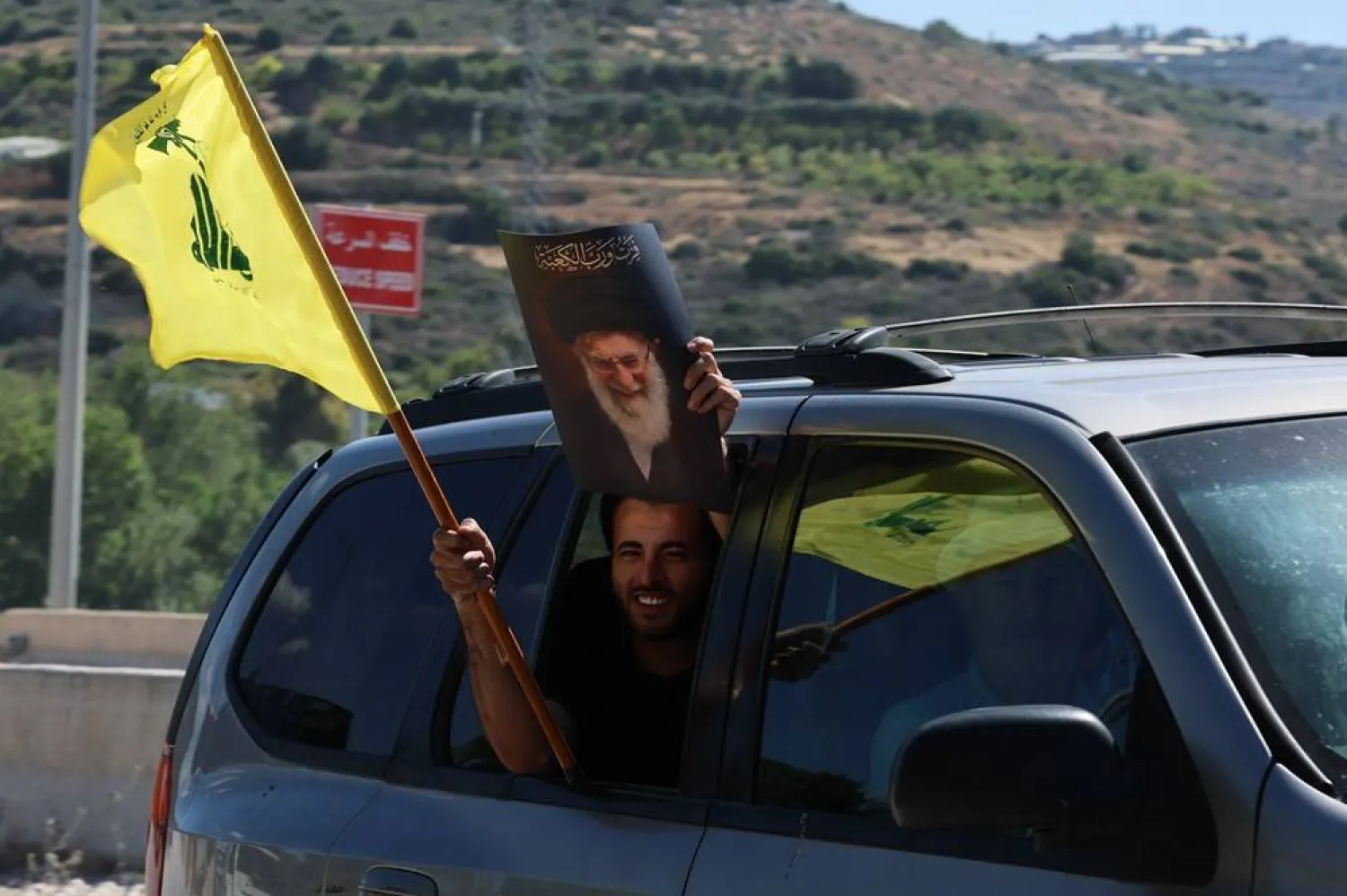
An armed man who crashed his pickup truck into a major Detroit-area synagogue earlier in March was inspired by the Iran-backed group Hezbollah and had sought to inflict as much damage as he could on Jewish people, the FBI said Monday.

Ayman Ghazali made a video just minutes before the attack at Temple Israel in West Bloomfield Township, saying he wanted to "kill as many of them as I possibly can" in the large Jewish congregation, said Jennifer Runyan, head of the FBI in Detroit, who announced the new information.

Ghazali, 41, sat in the parking lot for a few hours on March 12 before smashing his F150 through doors and into the hallway of an early childhood education area, striking a security guard. He then exchanged gunfire with another guard before fatally shooting himself. No one else among the 150 children and staff was injured.

It was a "Hezbollah-inspired act of terrorism purposely targeting the Jewish community and the largest Jewish temple in Michigan," Runyan said.

He sent two final videos to a sister overseas about 10 minutes before launching the assault, she said.

"This is the largest gathering place for Israelis in the State of Michigan in the United States," Runyan quoted him as saying in Arabic. "I have booby-trapped the car. I will forcefully enter and start shooting at them. God willing, I will kill as many of them as I possibly can."

Assault rifle and a lot of ammunition The FBI cited videos and other images discovered on Ghazali’s social media accounts in which he embraced vengeance and Hezbollah’s militant ideology. Runyan said he searched for Michigan synagogues and Jewish cultural sites a few days earlier before settling on Temple Israel, even looking up the time for lunch.

Runyan said there was no way to know whether Ghazali knew children would be present at the time.

Ghazali bought an AK-style rifle and 300 rounds of ammunition from a gun store on March 9 and practiced at a shooting range, she said.

His Ford F150 was stocked with commercial-grade fireworks and containers with more than 30 gallons (113 liters) of gasoline. The truck caught fire after barreling into the synagogue, Runyan said, though there was no explosion.

Detroit-area US Attorney Jerome Gorgon noted that Hezbollah in 1983 drove a massive truck bomb into US Marine barracks in Beirut, Lebanon.

"That is exactly what this terrorist did a few weeks ago in our backyard," Gorgon said, speaking along with Runyan.

The FBI did not release the entirety of Ghazali's videos and materials but showed screengrabs and quotes from several of the recordings.

Ghazali, who lived in Dearborn Heights, came to the US in 2011 on an immediate relative visa as the spouse of a US citizen and was granted US citizenship in 2016, according to the Department of Homeland Security.

His family ties to Hezbollah were publicly disclosed soon after the synagogue attack. Israel’s military said a brother, Ibrahim Ghazali, was a Hezbollah commander in Lebanon who was killed there on March 5. A Detroit-area mosque held a memorial service for the brother and other family members who also died.

Ghazali’s ex-wife had called police in Dearborn Heights around the time of the synagogue attack to warn that he seemed distraught and suicidal after losing family during the Israeli airstrike, according to 911 audio. The strike came days into the Iran war with Israel and the US that began Feb. 28.

Founded in 1982 during Lebanon’s civil war, Hezbollah initially was devoted to ending Israel’s occupation of southern Lebanon. Israel withdrew by 2000, but Hezbollah has continued its battle and seeks Israel’s destruction. The US has designated Hezbollah as a terrorist group since 1997. Hezbollah is also a political party with lawmakers in the Lebanese parliament and a presence in most Lebanese governments for decades.

Temple Israel, which has more than 12,000 members, is part of Reform Judaism, the largest branch of the religion in North America, which emphasizes progressive values such as social justice and gender equality. The congregation is the second-largest, according to the Union for Reform Judaism.

The attack was the latest in a spate of recent attacks targeting religious buildings — which has intensified fear among religious leaders and worshippers worldwide.


Allies Sent Ukraine ‘Signals’ on Reducing Strikes on Russian Oil, Zelenskiy Says

Ukraine's President Volodymyr Zelenskiy speaks during an interview with Reuters, amid Russia's attack on Ukraine, in Kyiv, Ukraine March 25, 2026. (Reuters)
TT

Allies Sent Ukraine ‘Signals’ on Reducing Strikes on Russian Oil, Zelenskiy Says

Ukraine's President Volodymyr Zelenskiy speaks during an interview with Reuters, amid Russia's attack on Ukraine, in Kyiv, Ukraine March 25, 2026. (Reuters)

Some of Ukraine's allies have sent Kyiv "signals" about the possibility of scaling back its long-range strikes on Russia's oil sector as global energy prices have surged, President Volodymyr Zelenskiy said on Monday. Speaking to reporters in a WhatsApp chat, Zelenskiy said that Ukraine is ready to reciprocate if Russia stops attacking the Ukrainian energy system, and that Kyiv is open to an Easter ceasefire.

"Recently, ‌following such ‌a severe global energy crisis, we have indeed ‌received ⁠signals from some of ⁠our partners about how to reduce our responses in the oil sector and the energy sector of the Russian Federation," Zelenskiy said in a WhatsApp briefing with journalists.

A source familiar with the situation said US officials had conveyed this message to their Ukrainian counterparts as part of their regular conversations, adding that the initial "signals" appeared to have come from ⁠Moscow.

The US State Department and the Russian embassy ‌in Washington didn't immediately respond to ‌requests for comment.

The US-Israeli war on Iran has squeezed international supplies of oil, ‌gas and refined products, sending prices soaring in the worst disruption ‌to energy supplies in history. Russian strikes on Ukraine's energy infrastructure have already left it scrambling for supplies.

Because of the Iran war, Ukraine's international partners were "primarily" sending their anti-ballistic missile systems to the Middle East at the moment, and Ukraine was sometimes being forgotten, he said.


Rubio Says US Hopeful in Private Talks After Iran ‘Fractures’

 US Secretary of State Marco Rubio looks on as he speaks to the press before his departure following a G7 Foreign Ministers' meeting with Partner Countries before his departure at the Bourget airport in Le Bourget, outside Paris, France, March 27, 2026. (Reuters)
US Secretary of State Marco Rubio looks on as he speaks to the press before his departure following a G7 Foreign Ministers' meeting with Partner Countries before his departure at the Bourget airport in Le Bourget, outside Paris, France, March 27, 2026. (Reuters)
TT

Rubio Says US Hopeful in Private Talks After Iran ‘Fractures’

 US Secretary of State Marco Rubio looks on as he speaks to the press before his departure following a G7 Foreign Ministers' meeting with Partner Countries before his departure at the Bourget airport in Le Bourget, outside Paris, France, March 27, 2026. (Reuters)
US Secretary of State Marco Rubio looks on as he speaks to the press before his departure following a G7 Foreign Ministers' meeting with Partner Countries before his departure at the Bourget airport in Le Bourget, outside Paris, France, March 27, 2026. (Reuters)

US Secretary of State Marco Rubio on Monday voiced hope for working with elements within Iran's government, saying the United States privately had received positive messages.

Rubio said there were internal "fractures" inside the country and that the United States hopes figures with "power to deliver" take charge.

"We are hopeful that that's the case," Rubio told the ABC News program "Good Morning America."

"There are clearly people there talking to us in ways that previous people in charge in Iran have not spoken to us in the past, some of the things they're willing to do," he said.

Rubio nonetheless also denounced Tehran in broad strokes, insisting that the war aimed to end its nuclear weapons building capacity, which President Donald Trump said he accomplished during an attack last year.

"These people are lunatics. They are insane. They are religious zealots who can never be allowed to possess a nuclear weapon because they have an apocalyptic vision of the future," Rubio said.

In a separate interview with Al Jazeera, Rubio said there were "messages and some direct talks going on between some inside of Iran and the United States."

The communication is "primarily through intermediaries, but there's been some conversation," he told the Qatar-based news channel.

"I think the president always prefers diplomacy."

Iran denies seeking a nuclear weapon and the UN nuclear watchdog has said no bomb was imminent.

Rubio's comments came a day after Trump said that Iran has already gone through "regime change," one month into the war launched by the United States and Israel.

Trump said that the United States was speaking to a "whole different group of people" and that they were "very reasonable."

On the first day of the war Israel assassinated Iran's longtime supreme leader, Ali Khamenei, and subsequent strikes have killed other top leaders.

Rubio said that there was a difference between private and public messages coming from Iran.

"Obviously they're not going to put it out in press releases, and what they say to you or put out there for the world doesn't necessarily reflect what they're saying in our conversations," Rubio said in the ABC interview.

Despite the Trump administration's public talk of diplomacy, the United States has been reinforcing its military presence in the region and Trump on Monday threatened to "blow up" Iran's oil-exporting island of Kharg if purported talks fail.

The comments from the administration signal a readiness to work with some form of the regime, after the United States and Israel at the start of the war spoke of toppling the government which weeks earlier killed thousands of people as it crushed mass protests.