Iraq’s Kurdistan Region formally announced Monday the unification of its Peshmerga forces, ending a division into two forces that had lasted more than three decades, in a step aimed at unifying Kurdish ranks that have long been divided politically and on security matters.
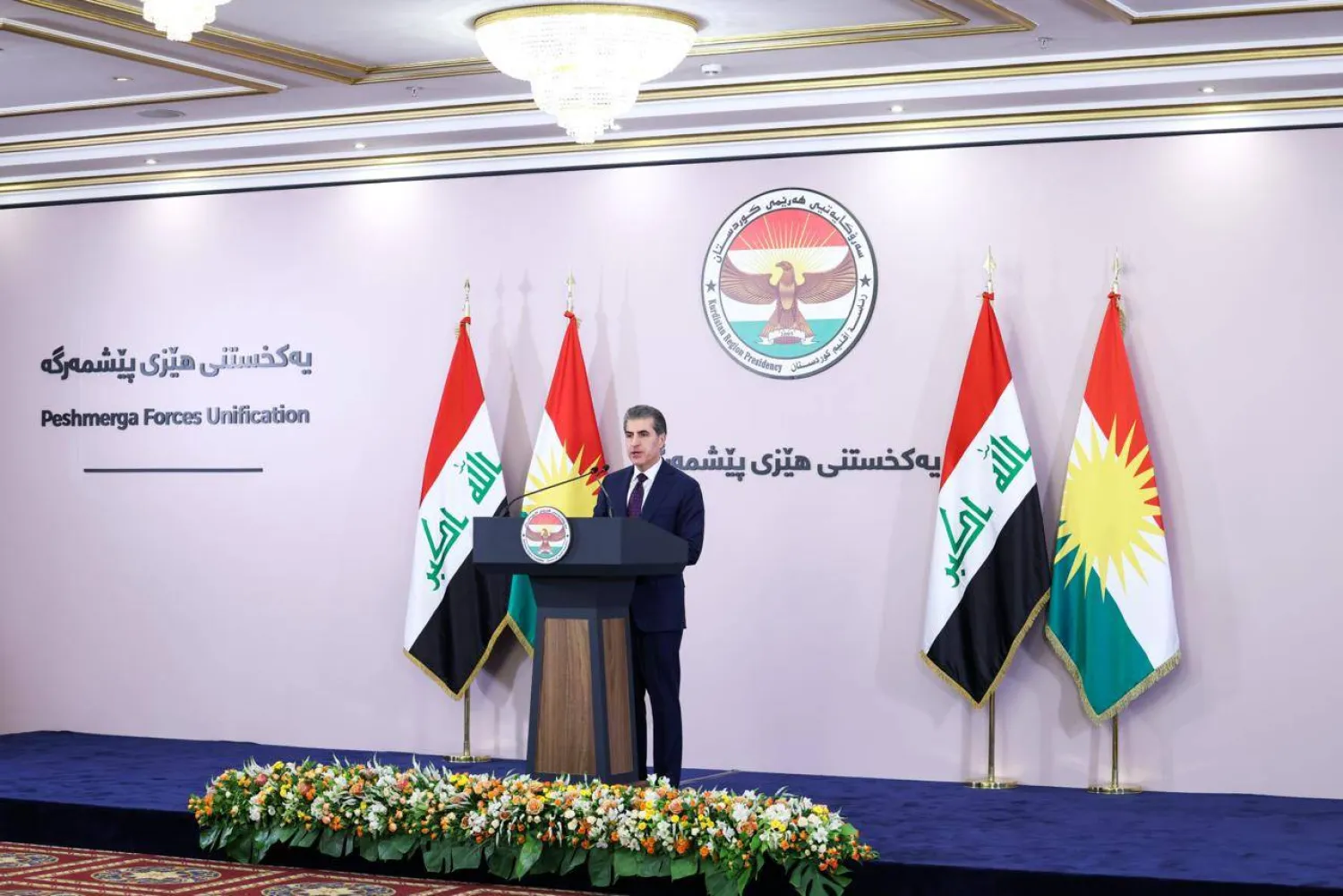
The ceremony at the Kurdistan Region Presidency in Erbil was overseen by President Nechirvan Barzani, commander-in-chief of the Peshmerga, and attended by Prime Minister Masrour Barzani, the deputy prime minister and minister of Peshmerga affairs, Kurdish officials, representatives of the international coalition and diplomatic missions.
Abdul-Amir al-Shammari, director of the Office of the Commander-in-Chief of the Iraqi Armed Forces, also attended.
The Peshmerga split in the mid-1990s during the Kurdish civil war between the Kurdistan Democratic Party, led by Masoud Barzani, and the Patriotic Union of Kurdistan, then led by the late Jalal Talabani.
The forces were divided between the KDP-affiliated Unit 80, based in the party’s areas of influence in Erbil and Duhok provinces, and the PUK-affiliated Unit 70, concentrated in Sulaymaniyah province and the Halabja area.
Kurdish sources said the ceremony culminated a lengthy reform process aimed at unifying and reorganizing the Peshmerga under an institutional military structure overseen by the Ministry of Peshmerga Affairs.
Under a new decree, no Peshmerga force will remain outside the ministry as of Sept. 21, according to the regional presidency.
The integration process began years ago with support and pressure from the international coalition, particularly the United States, Britain and Germany, as well as other European countries. Integration was among the conditions for continued military and logistical assistance.
Although the Peshmerga are not explicitly named in Iraq’s constitution, Article 121 allows regional authorities to establish and organize internal security forces, including police, security forces and regional guards. Kurdish authorities consider the Peshmerga part of the regional guard.
Nechirvan Barzani said no force remained outside the Peshmerga umbrella and that the force must rise above partisan interests.
“The Peshmerga are the force of the people of Kurdistan,” he stated, adding that their mission was to protect all the region’s communities, including Kurds, Turkmen, Christians, Yazidis and Arabs.
He described the Peshmerga as part of Iraq’s defense system, saying stronger capabilities and greater coordination with federal forces would strengthen Iraq as a whole.
Barzani noted that unification must extend to training, duties, rights, promotions and military doctrine, stressing that the military should not become an arena for settling political or partisan scores.
He thanked the United States, the international coalition and countries that supported Iraq and the Kurdistan Region in the war against ISIS, including Britain, Germany, the Netherlands, Italy and France, and praised their role in Peshmerga reform, training and restructuring.
Washington, with Baghdad’s approval, delivered 24 M119 105mm howitzers to the Peshmerga in early August to bolster their capabilities against ISIS remnants, a move that drew objections from some Sunni and Shiite factions and figures in Baghdad.
Despite the unification, serious doubts remain over Kurdish political unity after nearly two years of failure to complete the regional government lineup following parliamentary elections.
PUK official Soran Dawoodi told Asharq Al-Awsat that Peshmerga unification could pave the way for political rapprochement between the KDP and PUK, adding that it would strengthen Kurdish public confidence in the force and advance the institutional framework sought by Kurdish citizens.