


Salam: Disarming Militias is a Lebanese Need Not Just a Foreign Demand

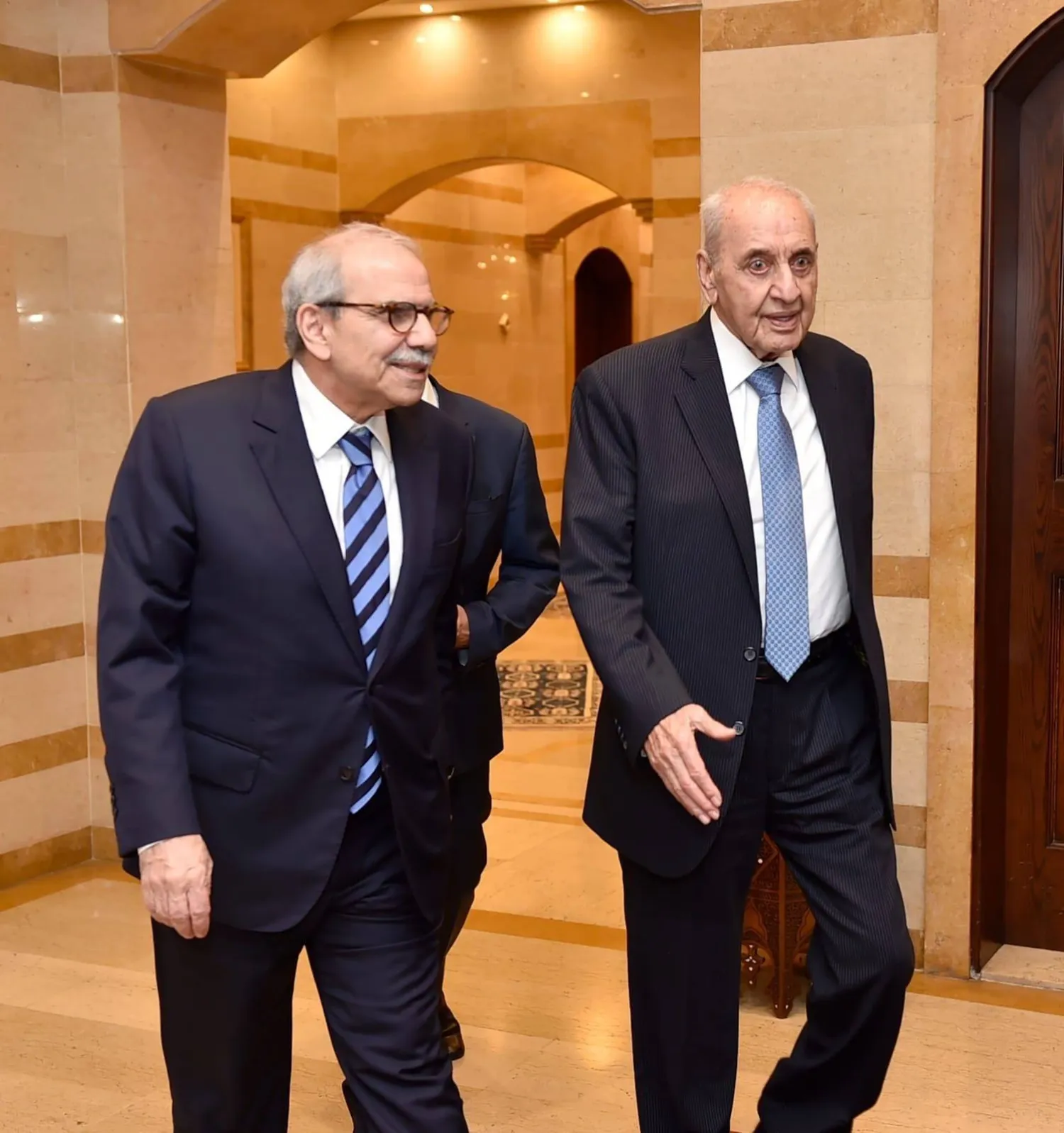
Lebanese Parliament Speaker Nabih Berri met with Prime Minister Nawaf Salam to discuss political and security developments, the parliament’s media office said on Sunday
TT

Salam: Disarming Militias is a Lebanese Need Not Just a Foreign Demand

Lebanese Parliament Speaker Nabih Berri met with Prime Minister Nawaf Salam to discuss political and security developments, the parliament’s media office said on Sunday

A much-anticipated meeting between Lebanon’s Parliament Speaker Nabih Berri and Prime Minister Nawaf Salam ended without a decisive outcome on a response to a set of US proposals, one of which reportedly includes a demand for Hezbollah to disarm.

However, Salam described the talks as “positive,” signaling continued dialogue with Berri once he receives the group’s official position.

Speaking to Asharq Al-Awsat by phone, Salam said the pair discussed the ideas put forward by US presidential envoy Tom Perriello.

Salam stressed the importance of implementing understandings brokered by the United States and France last November to halt hostilities along the southern border.

“This requires Israel to withdraw from Lebanese territory and to cease its aggression that threatens stability. In parallel, the Lebanese state must fulfill its duty and assert its sovereign authority across all its land. That includes the exclusive right to bear arms and to decide on matters of war and peace,” he said.

He argued that the measures should not be subject to debate over sequencing. “All of them should be implemented as swiftly as possible.”

Salam said Lebanon needs a “mechanism” to execute these commitments and that once it becomes clearer through ongoing contacts, it will be presented to the cabinet for approval. “Only the Council of Ministers can take such a decision,” he said.

He confirmed that he would meet Berri again soon and remains in constant communication with the president to reach the necessary consensus. Berri, he noted, is also awaiting Hezbollah’s feedback on key aspects of the US paper.

“We are engaging constructively with the American ideas,” Salam added. “They’re not scripture — we will debate them with the envoy in hopes of reaching the desired outcomes.”

He underscored that issues of sovereignty and the state’s monopoly over arms are “urgent Lebanese needs before being foreign demands. Lebanon deserves to be a normal state — one governed by peace, stability, and the rule of law, where the state alone defends its citizens and makes national decisions.”

Salam briefed Berri on his recent trip to Qatar and developments related to a US proposal aimed at de-escalating cross-border tensions, during talks that also addressed mounting Israeli violations in the south, including an airstrike on Nabatieh.

In a statement following the meeting, the Speaker’s office said the two leaders reviewed political and security developments in Lebanon and the wider region, particularly in light of Israel’s continued breaches of the ceasefire agreement.

Salam’s visit came amid growing momentum for a possible cabinet session to finalize a framework that would enshrine the state’s exclusive control over weapons. The meeting followed a working session held Friday at the presidential palace between President Joseph Aoun and Salam to advance discussions on the US-backed proposal.

If Berri, Aoun, and Salam reach consensus on the draft, the document is expected to be presented to the cabinet for approval.

It reportedly consists of three main pillars: the issue of Hezbollah’s arms and all non-state weapons, a package of structural reforms, and the future of Lebanese-Syrian relations. Once approved, the paper would be relayed to the US envoy to deliver to both Israel and Syria.

In what appeared to be a message of political de-escalation, Hezbollah sent conciliatory signals to the Lebanese state over the weekend.

Sheikh Mohammed Yazbek, head of the group’s religious authority, urged the government to fulfill its commitments to “liberate every inch of land, rebuild, and stand by its people.”

“Our hand is extended,” Yazbek said. “We want to live as one, and for Lebanon to serve as a model of coexistence among its diverse communities.”

He insisted Hezbollah acts “with awareness and wisdom” and does not rush into decisions. “Despite all the hostile media and distortion campaigns, our call remains one for national and human unity under God.”

Yazbek also warned that Israel “has no security and no peace,” adding, “We haven’t slept, and we will not sleep.”

Meanwhile, MP Hussein al-Hajj Hassan, head of the Baalbek-Hermel parliamentary bloc, called on the Lebanese state to intensify its stance against what he described as Israel’s blatant aggression.

“The government must push harder, and urge the international sponsors and the Quintet Committee to step up their roles. But we believe the American side is neither neutral nor impartial — it is complicit in the aggression,” he said.

Hajj Hassan described the Israeli airstrikes on Nabatieh and other areas as “an attack on all of Lebanon, not just a specific faction or region,” aimed at pressuring the country and its resistance forces.



Israel Calls Countries Condemning New West Bank Settlements ‘Morally Wrong’

Newly constructed buildings are pictured in the Israeli settlement of Givat Zeev near the Palestinian city of Ramallah in the occupied West Bank on October 24, 2025. (AFP)
TT

Israel Calls Countries Condemning New West Bank Settlements ‘Morally Wrong’

Newly constructed buildings are pictured in the Israeli settlement of Givat Zeev near the Palestinian city of Ramallah in the occupied West Bank on October 24, 2025. (AFP)

Israel reacted furiously on Thursday to a condemnation by 14 countries including France and Britain of its approval of new settlements in the occupied West Bank, calling the criticism discriminatory against Jews.

"Foreign governments will not restrict the right of Jews to live in the Land of Israel, and any such call is morally wrong and discriminatory against Jews," Foreign Minister Gideon Saar said.

"The cabinet decision to establish 11 new settlements and to formalize eight additional settlements is intended, among other things, to help address the security threats Israel is facing."

On Sunday, Israel's far-right Finance Minister Bezalel Smotrich announced that authorities had greenlit the settlements, saying the move was aimed at preventing the establishment of a Palestinian state.

Fourteen countries, including Britain, France, Germany, Spain and Canada, then issued a statement urging Israel to reverse its decision, "as well as the expansion of settlements".

Such unilateral actions, they said, "violate international law", and risk undermining a fragile ceasefire in Gaza in force since October 10.

They also reaffirmed their "unwavering commitment to a comprehensive, just and lasting peace based on the two-state solution... where two democratic states, Israel and Palestine, live side-by-side in peace and security".

Israel has occupied the West Bank following the 1967 Arab-Israeli war.

Excluding east Jerusalem, which was occupied and annexed by Israel in 1967, more than 500,000 Israelis live in the West Bank, along with about three million Palestinian residents.

Earlier this month, the United Nations said the expansion of Israeli settlements in the West Bank, all of which are illegal under international law, had reached its highest level since at least 2017.


Iraq Criminalizes Volunteering in Russia-Ukraine War

A photo circulated on social media shows a 24-year-old Iraqi who traveled to Russia to join its armed forces. (AFP)
TT

Iraq Criminalizes Volunteering in Russia-Ukraine War

A photo circulated on social media shows a 24-year-old Iraqi who traveled to Russia to join its armed forces. (AFP)

The Iraqi judiciary warned on Wednesday that people involved in the war between Russia and Ukraine will face jail as it attempts to crack down on the recruitment of Iraqis joining the conflict.

Faiq Zidan, the head of Iraq's Supreme Judicial Council, received on Wednesday National Security Advisor Qasim Al-Araji and members of a committee tasked with combating the recruitment of Iraqis.

Zaidan stressed that Iraq criminalizes any Iraqi who joins the armed forces of another nation without the approval of the government.

The judiciary does not have a fixed prison term for anyone accused of the crime, but a court in Najaf last week sentenced to life an Iraqi accused of human trafficking.

He was convicted of belonging to an international criminal gang that recruits Iraqis to fight for Russia in its war against Ukraine.

In November, Prime Minister Mohammed Shia al-Sudani ordered the formation of a committee, headed by Araji, to crack down on the recruitment of Iraqis to fight for the Russian and Ukrainian militaries.

Iraq does not have official figures detailing how many of its citizens have joined the war. Media reports said some 50,000 Iraqis have joined Russian ranks, while unofficial figures put the number at around 5,000, with 3,000 fighting for Russia and 2,000 for Ukraine.

The debate over the recruitment played out over the media between the Russian and Ukrainian ambassadors to Iraq.

Ukrainian Ambassador Ivan Dovhanych accused Russia of recruiting Iraqis. Last week, the Ukrainian government sent a letter to the Iraqi government about the recruitment.

It hailed Baghdad’s criminalization of such activity. The letter also revealed that Ukrainian authorities had arrested an Iraqi who was fighting for Russia.

Ukraine has denied that it has recruited Iraqis to join the conflict, but reports indicate otherwise.

Meanwhile, Russian Ambassador to Baghdad Elbrus Kutrashev acknowledged that Iraqi fighters had joined the Russian army.

Speaking to the media, he declined to give exact figures, but dismissed claims that they reached 50,000 or even 5,000, saying instead they number no more than a few hundred.

He confirmed that Iraqis had joined the Russian army and “that some four to five had lost their lives”.

He revealed that the Russian embassy in Baghdad had granted visas to Russia to the families of the deceased on humanitarian grounds.

Russian law allows any foreign national residing in Russia and who speaks Russian to join its army with a salary of around 2,500 to 3,000 dollars.

There have been mounting calls in Iraq for the authorities to crack down on human trafficking gangs.

Would-be recruits are often lured by the monthly salary and the possibility of gaining the Russian or Ukrainian nationality.

Critics of the authorities have said Iraqi youths are lured to join foreign wars given the lack of job opportunities in Iraq.


Somalia's Capital Votes in First Step toward Restoring Universal Suffrage

Members of the Justice and Solidarity Party (JSP) campaign in the streets as they share their political aims with voters in Mogadishu, Somalia, 22 December 2025. EPA/SAID YUSUF WARSAME
TT

Somalia's Capital Votes in First Step toward Restoring Universal Suffrage

Members of the Justice and Solidarity Party (JSP) campaign in the streets as they share their political aims with voters in Mogadishu, Somalia, 22 December 2025. EPA/SAID YUSUF WARSAME

Residents of Somalia's capital Mogadishu will vote on Thursday in municipal elections meant to pave the way for the East African country's first direct national polls in more than half a century.

With the exception of votes in the semi-autonomous region of Puntland and the breakaway region of Somaliland, Somalia last held direct elections in 1969, months before military general, Mohamed Siad Barre, took power in a coup, Reuters said.

After years of civil ‌war that ‌followed Barre's fall in 1991, indirect elections ‌were ⁠introduced in ‌2004. The idea was to promote consensus among rival clans in the face of an armed insurgency, although some Somalis say politicians prefer indirect elections because they create opportunities for corruption.

Under the system, clan representatives elect lawmakers, who then choose the president. The president, in turn, has been responsible for appointing Mogadishu's mayor.

The vote in Mogadishu, a ⁠city of some 3 million people where security conditions have improved in recent years ‌despite continuing attacks by al Qaeda-linked al ‍Shabaab militants, is seen as ‍a test run for direct elections at the national level.

Around ‍1,605 candidates are running on Thursday for 390 posts in Mogadishu's district councils, said Abdishakur Abib Hayir, a member of the National Electoral Commission. Council members will then choose a mayor.

"It shows Somalia is standing on its feet and moving forward," Hayir told Reuters. "After the local election, elections can and will take place in ⁠the entire country."

A 2024 law restored universal suffrage ahead of federal elections expected next year. However, President Hassan Sheikh Mohamud reached a deal in August with some opposition leaders stipulating that while lawmakers would be directly elected in 2026, the president would still be chosen by parliament.

Opposition parties have argued the rapid introduction of a new electoral system would benefit Mohamud's re-election prospects.

They also question whether the country is safe enough for mass voting given al Shabaab's control over vast areas of the countryside and regular strikes ‌on major population centers.