
Türkiye Reasserts its Red Lines in Syria

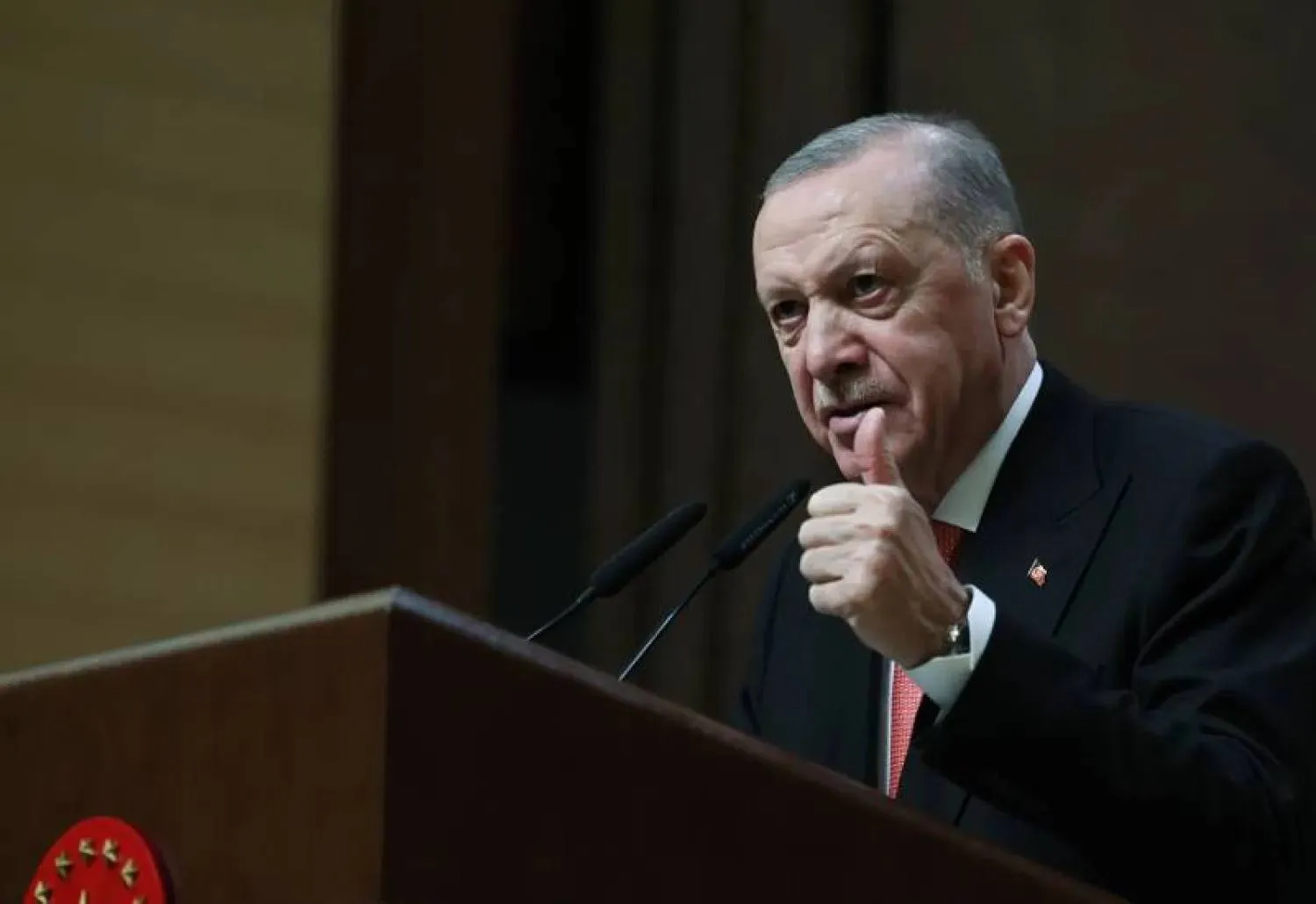
Turkish President Recep Tayyip Erdogan (Turkish Presidency)
TT

Türkiye Reasserts its Red Lines in Syria

Turkish President Recep Tayyip Erdogan (Turkish Presidency)

Türkiye has redrawn its red lines in Syria, firmly rejecting any move to legitimize organizations it labels as terrorist, while pledging support for efforts that could secure a stable and prosperous future for Syria, including Washington’s proposal for Damascus to join the Abraham Accords with Israel.

President Recep Tayyip Erdogan stressed that Türkiye would not tolerate plans to grant legitimacy to the Syrian Democratic Forces (SDF) or their affiliates. Speaking to Turkish journalists on his return flight from Azerbaijan, where he attended the 17th Economic Cooperation Organization Summit, Erdogan stressed that Syria’s territorial integrity remains a critical priority for Ankara.

Responding to questions about the proposed integration of SDF fighters into the Syrian Army, he said: “The unity of Syrian territory is of utmost importance to us. We have taken active measures on the ground, through the Euphrates Shield, Olive Branch, and Peace Spring operations, to secure our borders and end instability.”

He added that Ankara supports eliminating all armed groups in Syria so that the Syrian Army alone controls the country.

“Lasting peace and stability in Syria are in our interest too. Anyone who seeks to obstruct this will find Türkiye standing against them,” he said.

Erdogan has repeatedly accused the SDF of stalling implementation of the integration deal signed in March between Syria’s interim President Ahmad Al-Shara and SDF commander Mazloum Abdi.

While the US endorses the agreement between Damascus and the SDF, it continues to back the Kurdish People’s Protection Units (YPG), the backbone of the SDF. Türkiye considers the YPG an extension of the PKK, which it designates as a terrorist group, while Washington views it as a crucial partner against ISIS.

To persuade the US to end its support, Ankara has proposed aiding Damascus in combating ISIS and transferring control over prisons and camps holding ISIS fighters and families to the Syrian government. Türkiye also floated a regional cooperation plan, including Iraq, Jordan, Lebanon, and Syria, to coordinate counterterrorism operations from a center in Damascus. However, progress has been slow.

Erdogan also welcomed US and European decisions to lift sanctions on Syria and to initiate preliminary security talks between Syria and Israel. He noted that normalization between Ankara and Damascus is advancing rapidly, with plans for joint economic initiatives such as free trade zones and cross-border markets.

Finally, he revealed that Azerbaijan has agreed to supply natural gas to Syria, viewing it as an important step for regional stability.


Egyptian President Says Palestinian Cause Remains Top Priority

Egypt's President Abdel Fattah al-Sisi delivers a speech during the World Economic Forum (WEF) annual meeting in Davos on January 21, 2026.  (AFP)
Egypt's President Abdel Fattah al-Sisi delivers a speech during the World Economic Forum (WEF) annual meeting in Davos on January 21, 2026. (AFP)
TT

Egyptian President Says Palestinian Cause Remains Top Priority

Egypt's President Abdel Fattah al-Sisi delivers a speech during the World Economic Forum (WEF) annual meeting in Davos on January 21, 2026.  (AFP)
Egypt's President Abdel Fattah al-Sisi delivers a speech during the World Economic Forum (WEF) annual meeting in Davos on January 21, 2026. (AFP)

Egyptian President Abdel Fattah al-Sisi on Wednesday said the Palestinian cause is still “at the forefront of priorities” in the Middle East.

He told a panel at Davos that resolving Palestinian cause “is the core of regional stability, and a cornerstone to achieve a just and comprehensive peace.”

The Egyptian leader lauded US President Donald Trump’s efforts to help reach a ceasefire that stropped the Israel-Hamas war in Gaza in October.

The two leaders are expected to meet at Davos, said the Egyptian Presidency on Tuesday.

This ‌will be ‌the first ‌meeting ⁠between ​the ‌two leaders since the US announced it was launching the second phase of its plan to end the war in Gaza.

Sisi and ⁠Trump met in the ‌Red Sea resort ‍of Sharm ‍el-Sheikh in October during a ‍summit convened by Egypt to sign a ceasefire deal aimed at ending the ​war.


Israel’s Netanyahu Agrees to Join Trump’s Board of Peace

12 July 2025, Jerusalem: Benjamin Netanyahu, Prime Minister of Israel, speaks at the press conference after talks at the seat of government. (dpa)
TT

Israel’s Netanyahu Agrees to Join Trump’s Board of Peace

12 July 2025, Jerusalem: Benjamin Netanyahu, Prime Minister of Israel, speaks at the press conference after talks at the seat of government. (dpa)

Prime Minister Benjamin Netanyahu of Israel said Wednesday he had agreed to join US President Donald Trump’s Board of Peace, after his office earlier criticized makeup of the board’s executive committee.

The board, chaired by Trump, was originally envisioned as a small group of world leaders overseeing the Gaza ceasefire plan. The Trump administration’s ambitions have appeared to balloon into a more sprawling concept, with Trump extending invitations to dozens of nations and hinting it will soon broker global conflicts.

Netanyahu’s office had previously said the executive committee, which includes Türkiye, a key regional rival, wasn’t coordinated with the Israeli government and “is contrary to its policy,” without clarifying its objections.

Israel’s far-right finance minister, Bezalel Smotrich, has criticized the board and called for Israel to take unilateral responsibility for Gaza’s future.

Others who have joined the board are the UAE, Morocco, Vietnam, Belarus, Hungary, Kazakhstan and Argentina. Others, including the UK, Russia and the executive arm of the European Union, say they have received invitations but have not yet responded.

It came as Trump traveled to the World Economic Forum meeting in Davos, Switzerland, where he is expected to provide more details about the board. There are many unanswered questions. It was not immediately clear how many or which other leaders would receive invitations.

When asked by a reporter Tuesday if the board should replace the UN, Trump said, “It might.”

He asserted that the world body “hasn’t been very helpful” and “has never lived up to its potential” but also said the UN should continue ”because the potential is so great.”

That has created controversy, with some saying Trump is trying to replace the UN. French Foreign Minister Jean-Noel Barrot said Tuesday, “Yes to implementing the peace plan presented by the president of the United States, which we wholeheartedly support, but no to creating an organization as it has been presented, which would replace the United Nations.”

Told late Monday that French President Emmanuel Macron was unlikely to join, Trump said, “Well, nobody wants him because he’s going to be out of office very soon.” A day later, Trump called Macron “a friend of mine”, but reiterated that the French leader is “not going to be there very much longer.”

The executive board’s members include US Secretary of State Marco Rubio, Trump envoy Steve Witkoff, Trump’s son-in-law Jared Kushner, former British Prime Minister Tony Blair, Apollo Global Management CEO Marc Rowan, World Bank President Ajay Banga, and Trump’s deputy national security adviser Robert Gabriel.

The White House also announced the members of another board, the Gaza Executive Board, which, according to the ceasefire, will be in charge of implementing the tough second phase of the agreement. That includes deploying an international security force, disarming Hamas and rebuilding the war-devastated territory.

Nickolay Mladenov, a former Bulgarian politician and UN Mideast envoy, is to serve as the Gaza executive board’s representative overseeing day-to-day matters. Additional members include: Witkoff, Kushner, Blair, Rowan, Turkish Foreign Minister Hakan Fidan; Qatari diplomat Ali Al-Thawadi; Hassan Rashad, director of Egypt’s General Intelligence Agency; Emirati minister Reem Al-Hashimy; Israeli businessman Yakir Gabay; and Sigrid Kaag, the Netherlands’ former deputy prime minister and a Mideast expert.

The board also will supervise a newly appointed committee of Palestinian technocrats who will be running Gaza’s day-to-day affairs.


UAE Forces Accused of Committing Violations against Detainees Held in Secret Prisons in Yemen

A view from inside the Dabba facility. (Asharq Al-Awsat)
TT

UAE Forces Accused of Committing Violations against Detainees Held in Secret Prisons in Yemen

A view from inside the Dabba facility. (Asharq Al-Awsat)

United Arab Emirates forces are accused of running a secret prison in Yemen's Dabba area in the eastern city of Mukalla.

Asharq Al-Awsat toured the facility, bearing witness to the dire conditions in which the detainees were held as they waited in despair for their fate.

The walls themselves tell a story of despair with prisoners having etched pleas for mercy and prayers to God, with one prisoner writing a single word - "mother" - summing up his suffering.

Asharq Al-Awsat entered the facility as part of a tour for the media and rights groups. The UAE is accused of running several illegal prisons in Yemen, setting them up without coordination with the legitimate authorities.

Etchings on the wall by some of the detainees in the Dabba facility. (Asharq Al-Awsat)

Minister of Media, Tourism and Culture Moammar Al-Eryani said these detention centers are not affiliated with the state.

Dabba, he added, embodies the illegal practices that used to happen outside the state's control.

The state did not task any local or foreign party to set up the detention centers where prisoners have been tortured, he said.

These practices are a flagrant violation of the Yemeni constitution, international law and humanitarian law, he stressed.

Minister of Media, Tourism and Culture Moammar Al-Eryani at the Dabba center. (Asharq Al-Awsat

"Cells" at Dabba were nothing more than steel containers of varying sizes, some as small as 1 mete by 50 centimeters.

Along with the writings on the wall, Asharq Al-Awsat noted the blood stains in the cells, reflecting the horrors the detainees had to endure.

Al-Eryani said the state was restoring the rule of law, not seeking to settle scores. "Opening these facilities to the media is a message that the state was not afraid of the truth. Rather it wants to document it and tackle the issue through legal means," he added.

"We are not asking for political cover, but support for the state of law," he urged.

A Yemeni military source told Asharq Al-Awsat that the Dabba facility used to be a military air defense base.

Speaking on condition of anonymity, he revealed that people were held in the prison without charge, while those freed usually ended up suffering from severe trauma.