


Hamas Sources: Gaza Ceasefire Talks Ongoing Despite Israeli Obstacles

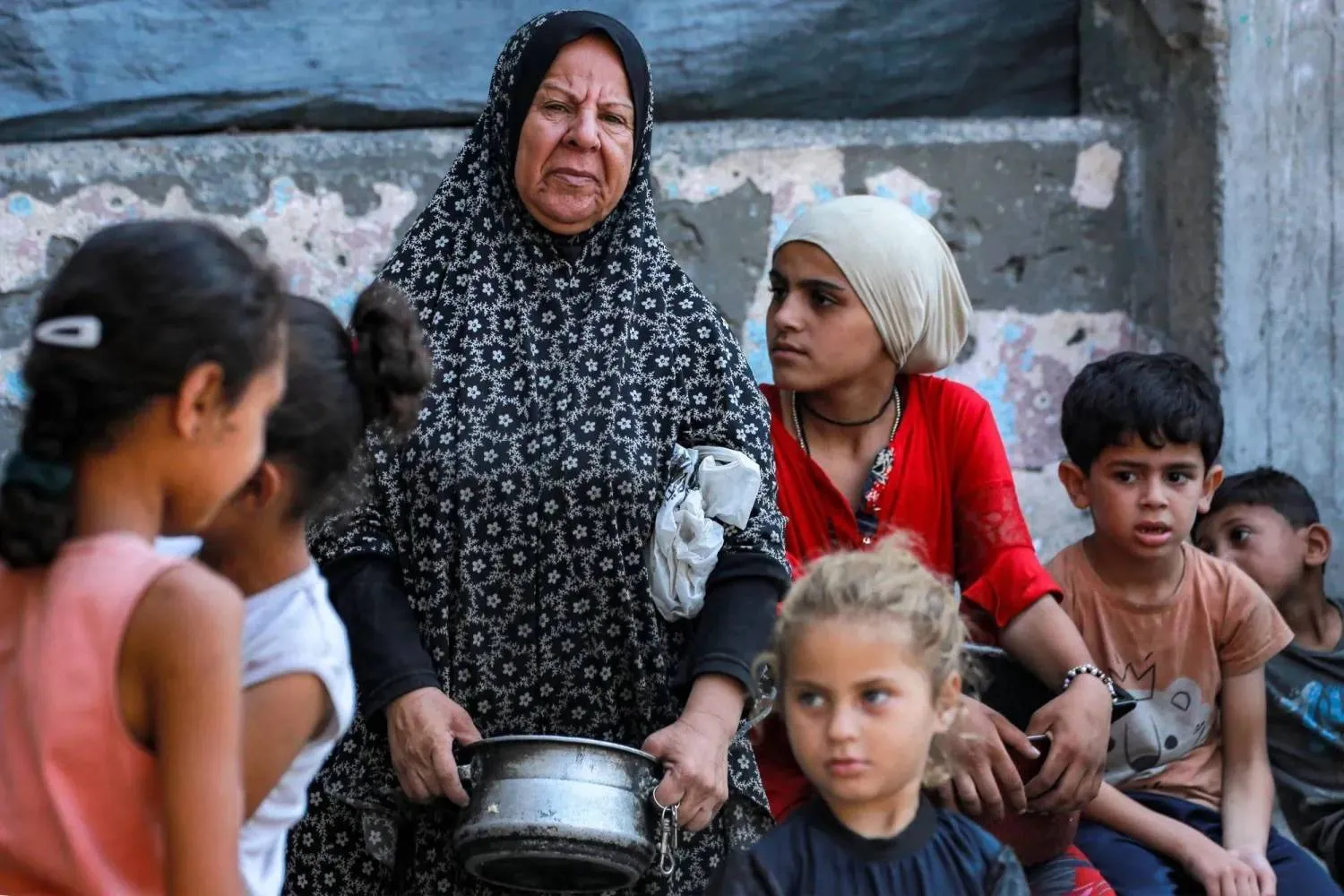
Palestinians in Gaza City wait to receive food aid on Monday (AFP)
TT

Hamas Sources: Gaza Ceasefire Talks Ongoing Despite Israeli Obstacles

Palestinians in Gaza City wait to receive food aid on Monday (AFP)

Despite accusations from Hamas that Israel is deliberately placing hurdles in the way of indirect negotiations in Doha aimed at securing a two-month ceasefire, sources within the movement confirmed to Asharq Al-Awsat that there are ongoing consultations.

Hamas sources said Israel continues to obstruct progress in the Qatar-hosted negotiations, which have been underway for over a week with only limited breakthroughs.

“Each time there is partial progress on some provisions, the Israeli delegation delays discussions on other points and refuses to engage until it receives fresh instructions from officials in Tel Aviv,” the sources explained.

Palestinian negotiators believe this approach is designed to buy time and apply pressure on the Palestinian factions’ team, while ultimately blaming them for any failure of the talks, which are dragging on due to Israel’s contradictory positions.

Humanitarian Aid a Major Sticking Point

The most significant obstacle, according to Hamas, remains Israel’s refusal to commit to a comprehensive withdrawal plan, as well as its insistence on maintaining the current aid delivery mechanism, which Hamas describes as a “death trap” for civilians in Gaza.

The sources said Israel has agreed in principle to allow aid into areas it withdraws from through international organizations. However, the Palestinian delegation is demanding that assistance be delivered under the humanitarian protocol negotiated in January.

This protocol is broader than Israel’s proposals and includes not only food and medical supplies, but also construction materials, equipment to repair hospitals and schools, and goods for the private sector to sell in local markets.

Israel has informed mediators that it reached an understanding with the European Union to allow 500 trucks per day into Gaza, which the Palestinian negotiators welcomed. Still, they insisted on clear guarantees that the deliveries would follow the January protocol without manipulation.

Maps and Withdrawal Timelines

Maps of military positions remain another major sticking point. The Hamas delegation is demanding that any Israeli withdrawal be based on the maps set out in the previous ceasefire agreement and implemented gradually according to a clear timetable.

That January agreement had allowed Israeli forces to remain temporarily in buffer zones around Gaza, ranging from 500 to 1,000 meters wide. The Palestinian side is adamant that troops must not remain inside Gaza itself and that the withdrawal must lead to a complete pullout in a second phase of the agreement.

According to the sources, the negotiators want precise language in each clause to prevent Israel from delaying or avoiding implementation, as has occurred in past agreements.

Waiting for US Pressure

Negotiations have not broken down, and the Hamas delegation believes American pressure will be critical to moving Israel off its current positions.

On Sunday evening, US President Donald Trump expressed hope that the ceasefire discussions would yield concrete results within days.

Later that night, a senior Hamas delegation met with Islamic Jihad leaders to coordinate positions and underscore that any deal must fulfill Palestinian aspirations, above all, ending the war, securing a full Israeli withdrawal, reopening crossings, and launching reconstruction.

Flexibility on the Morag Corridor

Meanwhile, Israel’s Security Cabinet convened Sunday evening to review the possibility of a prisoner swap. According to Channel 12, Prime Minister Benjamin Netanyahu told ministers he was interested in reaching an agreement on the hostages, even as Hamas continues to reject Israel’s terms. He warned that fighting could resume after any temporary ceasefire if Hamas does not accept Israel’s conditions for ending the war.

Yedioth Ahronoth reported that Netanyahu, once firmly opposed to any pullback from the Morag Corridor. a strategic strip that bisects Rafah and separates it from Khan Younis - is now willing to show some flexibility.

Israeli control of the 12-kilometer corridor would allow it to further fragment Gaza and expand its security buffer zones.



Israel Army Issues Evacuation Warning for Lebanon Village ahead of Strikes

 Smoke rises after Israeli strikes following Israeli military's evacuation orders, in Chehour, southern Lebanon November 19, 2025. REUTERS/Ali Hankir
Smoke rises after Israeli strikes following Israeli military's evacuation orders, in Chehour, southern Lebanon November 19, 2025. REUTERS/Ali Hankir
TT

Israel Army Issues Evacuation Warning for Lebanon Village ahead of Strikes

 Smoke rises after Israeli strikes following Israeli military's evacuation orders, in Chehour, southern Lebanon November 19, 2025. REUTERS/Ali Hankir
Smoke rises after Israeli strikes following Israeli military's evacuation orders, in Chehour, southern Lebanon November 19, 2025. REUTERS/Ali Hankir

The Israeli army issued an evacuation warning on Sunday for the village of Kafr Hatta in southern Lebanon ahead of air strikes on Hezbollah targets in the area, AFP reported.

"The Israeli (army) will soon, and once again, strike terrorist Hezbollah military infrastructure in the village, in order to address the prohibited attempts it is making to rebuild its activities there," Arabic-language spokesman Colonel Avichay Adraee wrote on X, posting a map of the expected target.

The Lebanese army said Thursday that it had completed disarming Hezbollah south of the Litani river, the first phase of a nationwide plan. Kafr Hatta is located north of the river.


Sudan PM Announces Govt Return to Khartoum from Wartime Capital

File Photo: Some shops reopen despite extensive damage (Asharq Al-Awsat)
TT

Sudan PM Announces Govt Return to Khartoum from Wartime Capital

File Photo: Some shops reopen despite extensive damage (Asharq Al-Awsat)

Sudan's Prime Minister Kamil Idris announced on Sunday the government's return to Khartoum, after nearly three years of operating from wartime capital of Port Sudan, AFP reported.

"Today, we return, and the Government of Hope returns to the national capital," Idris told reporters in Khartoum, ravaged by the war between the army and the Rapid Support Forces.

"We promise you better services, better healthcare and the reconstruction of hospitals, the development of educational services... and to improve electricity, water and sanitation services," he said.


Iran Protest Death Toll Rises as Alarm Grows over Crackdown 'Massacre'

Smoke rises as protesters gather amid evolving anti-government unrest at Vakilabad highway in Mashhad, Razavi Khorasan province, Iran, released on January 10, 2026, in this screen grab obtained from a social media video. SOCIAL MEDIA/via REUTERS
TT

Iran Protest Death Toll Rises as Alarm Grows over Crackdown 'Massacre'

Smoke rises as protesters gather amid evolving anti-government unrest at Vakilabad highway in Mashhad, Razavi Khorasan province, Iran, released on January 10, 2026, in this screen grab obtained from a social media video. SOCIAL MEDIA/via REUTERS

At least 192 protesters have been killed in Iran's biggest movement against the Islamic republic in more than three years, a rights group said Sunday, as warnings grew that authorities were committing a "massacre" to quell the demonstrations.

The protests, initially sparked by anger over the rising cost of living, have now become a movement against the theocratic system in place in Iran since the 1979 revolution and have already lasted two weeks.

The mass rallies are one of the biggest challenges to the rule of supreme leader Ali Khamenei, 86, coming in the wake of Israel's 12-day war against the Islamic republic in June, which was backed by the United States.

Protests have swelled in recent days despite an internet blackout that has lasted more than 60 hours, according to monitor Netblocks, with activists warning the shutdown was limiting the flow of information and the actual toll risks being far higher.

"Since the start of the protests, Iran Human Rights has confirmed the killing of at least 192 protesters," the Norway-based non-governmental organization said, warning that the deaths "may be even more extensive than we currently imagine".

Videos of large demonstrations in the capital Tehran and other cities over the past three nights have filtered out despite the internet cut that has rendered impossible normal communication with the outside world via messaging apps or even phone lines.

Video verified by AFP showed large crowds taking to the streets in new protests on Saturday night in several Iranian cities including Tehran and Mashhad in the east, where images showed vehicles set on fire.

Several circulating videos, which have not been verified by AFP, allegedly showed relatives in a Tehran morgue identifying bodies of protesters killed in the crackdown.

The US-based Center for Human Rights in Iran (CHRI) said it had received "eyewitness accounts and credible reports indicating that hundreds of protesters have been killed across Iran during the current internet shutdown".

"A massacre is unfolding in Iran. The world must act now to prevent further loss of life," it said.

It said hospitals were "overwhelmed", blood supplies were running low and that many protesters had been shot in the eyes in a deliberate tactic.


- 'Significant arrests' -


The US-based Human Rights Activists News Agency said it had confirmed the deaths of 116 people in connection with the protests, including 37 members of the security forces or other officials.

State TV on Sunday broadcast images of funeral processions for security forces killed in recent days, as authorities condemned "riots" and "vandalism".

National police chief Ahmad-Reza Radan said authorities made "significant" arrests of protest figures on Saturday night, without giving details on the number or identities of those arrested, according to state TV.

Iran's security chief Ali Larijani drew a line between protests over economic hardship, which he called "completely understandable", and "riots", accusing them of actions "very similar to the methods of terrorist groups", Tasnim news agency reported.

Iran's President Masoud Pezeshkian said "rioters" must not distrupt Iranian society.

"The people (of Iran) should not allow rioters to disrupt society. The people should believe that we (the government) want to establish justice," he told state broadcaster IRIB.

In Tehran, an AFP journalist described a city in a state of near paralysis.

The price of meat has nearly doubled since the start of the protests, and while some shops are open, many others are not.

Those that do open must close at around 4:00 or 5:00 pm, when security forces deploy in force.


- 'Legitimate targets' -


Reza Pahlavi, the exiled son of the ousted shah, who has played a prominent role in calling for the protests, called for new actions later Sunday.

"Do not abandon the streets. My heart is with you. I know that I will soon be by your side," he said.

US President Donald Trump has spoken out in support of the protests and threatened military action against Iranian authorities "if they start killing people".

Israel's Foreign Minister Gideon Saar urged the European Union on Sunday to designate Iran's Revolutionary Guards Corps as a "terrorist organization" over the suspected violence against protesters.

He also said Israel supports the Iranian people's "struggle for freedom".

Iran's parliament speaker Mohammad Bagher Ghalibaf said Iran would hit back if the US launched military action.

"In the event of a military attack by the United States, both the occupied territory and centers of the US military and shipping will be our legitimate targets," he said in comments broadcast by state TV.

He was apparently also referring to Israel, which the Islamic republic does not recognize and considers occupied Palestinian territory.