
Sudan PM Vows to Rebuild Khartoum on First Visit to War-torn Capital

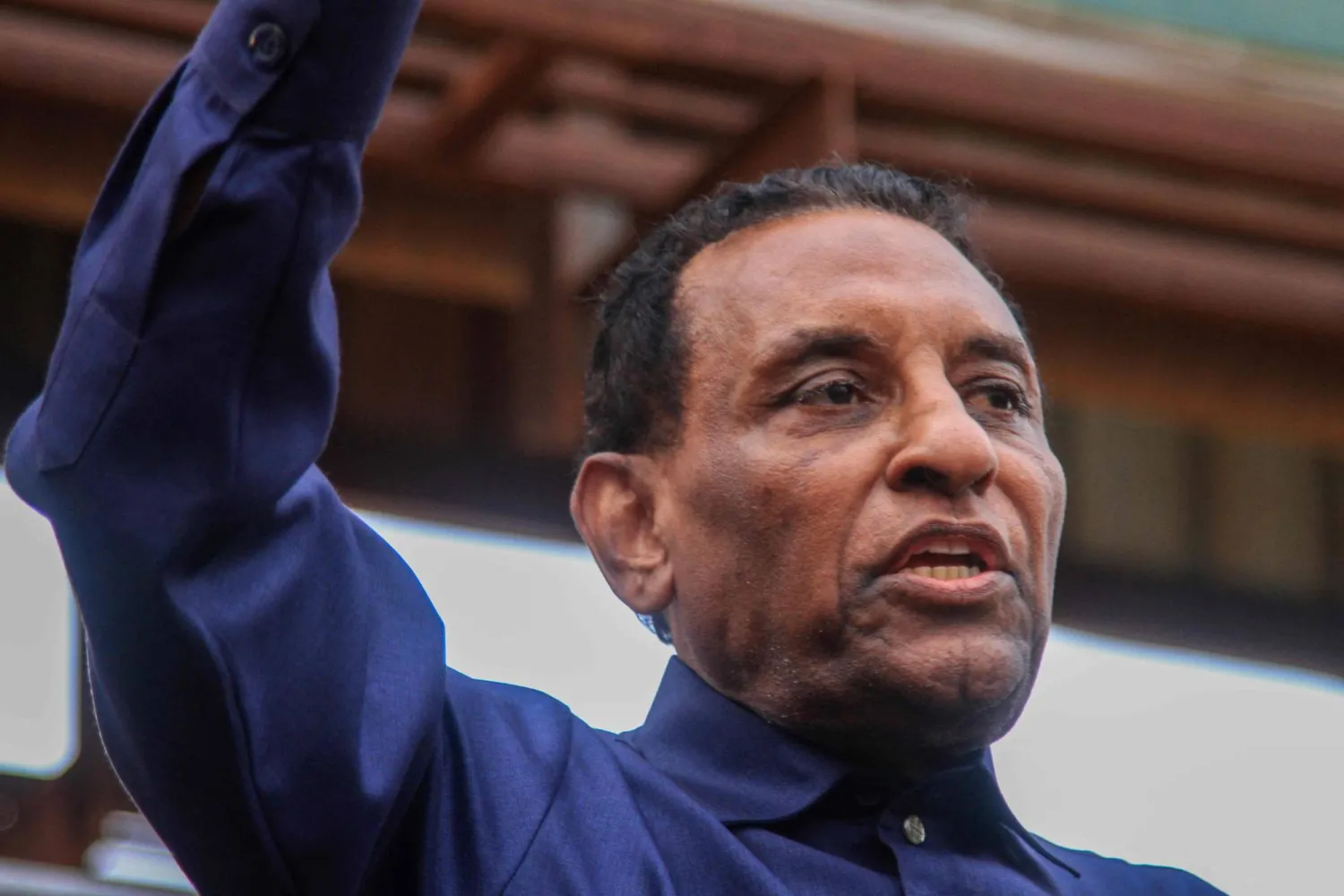
Kamil Idris, a former UN official who was appointed in May as prime minister by Sudan's leader Abdel Fattah al-Burhan, addresses people and local fighters supporting the Sudanese army who came to cheer him on, during a visit in Omdurman on July 19, 2025. (Photo by Ebrahim Hamid / AFP)
TT

Sudan PM Vows to Rebuild Khartoum on First Visit to War-torn Capital

Kamil Idris, a former UN official who was appointed in May as prime minister by Sudan's leader Abdel Fattah al-Burhan, addresses people and local fighters supporting the Sudanese army who came to cheer him on, during a visit in Omdurman on July 19, 2025. (Photo by Ebrahim Hamid / AFP)

Sudan's Prime Minister Kamil Idris on Saturday pledged to rebuild Khartoum, ravaged by more than two years of war, as he made his first visit to the capital since assuming office in May.

Touring Khartoum's destroyed infrastructure earlier, the new premier outlined mass repair projects in anticipation of the return of at least some of the over 3.5 million people who fled the violence, AFP reported.

"Khartoum will return as a proud national capital," Idris said, according to Sudan's state news agency.

Sudan's army chief and de facto leader Abdel Fattah al-Burhan, who appointed Idris, landed Saturday at Khartoum's airport, recaptured by the army in March after nearly two years of occupation by their rival paramilitary Rapid Support Forces.

The war between the Sudanese army and the RSF began in the heart of the capital in April 2023, quickly tearing the city apart.

Tens of thousands are estimated to have been killed in the once-bustling capital, and reconstruction is expected to be a herculean feat, with the government putting the cost at $700 billion nationwide, with Khartoum alone accounting for around half of that.

The army-aligned government, which moved to Port Sudan on the Red Sea early in the war and still operates from there, has begun to plan the return of ministries to Khartoum even as fighting rages on in other parts of the country.

Authorities have begun operations to properly bury the bodies still missing around the city, clear thousands of unexploded ordinance and resume bureaucratic services.

On a visit to Sudan's largest oil refinery, the Al-Jaili plant just north of Khartoum, Idris promised that "national institutions will come back even better than they were before".

The refinery -- now a blackened husk -- was recaptured in January, but the facility which once processed 100,000 barrels a day will take years and at least $1.3 billion to rebuild, officials told AFP.

Cabinet stumbles

The UN expects some two million people will return to Khartoum this year, but those coming back have found an unrecognizable city.

The scale of looting is unprecedented, aid workers say, with evidence of paramilitary fighters ripping copper wire out of power lines before they left.

Vast areas of the city remain without power, and the damage to water infrastructure has caused a devastating cholera outbreak. Health authorities recorded up to 1,500 cases a day last month, according to the UN.

"Water is the primary concern and obstacle delaying the return of citizens to their homes," Idris said on Saturday.

A career diplomat and former UN official, Idris is building a government that critics warn could put up a veneer of civilian rule, in addition to facing challenges within its own camp.

In 2020, during a short-lived transition to civilian rule, the government in Khartoum signed a peace agreement with Sudanese armed groups, allocating a share of cabinet posts to signatories.

All but three cabinet posts are now filled, and armed groups currently fighting alongside the army have retained their representation in Idris's government.

But reports that Idris had sought to appoint technocrats in their place have created tensions.

Some of the armed groups, known together as the Joint Forces, have been integral in defending North Darfur state capital El-Fasher, which has been besieged by the paramilitaries since May of last year.

If the RSF succeeds in taking El-Fasher, it will control all of the vast western region of Darfur, cementing the fragmentation of the country.

Despite the army securing the capital, as well as the country's north and east, war still rages in Sudan's west and south, where the RSF is accused of killing hundreds of civilians in recent days.

Sudan is suffering the world's largest hunger and displacement crises, with nearly 25 million people in dire food insecurity and over 10 million internally displaced across the country.

A further four million people have fled across borders.


Iran’s Araqchi to Visit Beirut After Lebanese FM Declines Trip to Tehran

Iranian Foreign Minister Abbas Araqhchi looks on during a press conference in Istanbul, Türkiye, June 22, 2025. REUTERS/Umit Bektas/File Photo
TT

Iran’s Araqchi to Visit Beirut After Lebanese FM Declines Trip to Tehran

Iranian Foreign Minister Abbas Araqhchi looks on during a press conference in Istanbul, Türkiye, June 22, 2025. REUTERS/Umit Bektas/File Photo

Iran's foreign minister, Abbas Araqchi, said on Thursday he would travel to Beirut for talks after receiving a formal invitation from his Lebanese counterpart, who a day earlier had declined to visit Tehran for direct talks.

On Wednesday, Lebanese Foreign Minister Youssef Raji said "current conditions" prevented him from travelling to Tehran, but stressed that the move did not mean rejection of dialogue with Iran.

Raji told Reuters late on Wednesday that he had invited Araqchi "in a formal diplomatic letter to come to Beirut to hold talks."

Araqchi said on X that he would "gladly accept the invitation to come to Beirut," although he said he found Raji's position "bemusing." He said foreign ministers of countries with "full diplomatic relations" did not need a neutral venue to meet.

"Subjected to Israeli occupation and blatant 'ceasefire' violations, I fully understand why my esteemed Lebanese counterpart is not prepared to visit Tehran," Araqchi added.

Raji said on Wednesday that Lebanon was ready to open a new phase of relations with Iran based on mutual respect, sovereignty and non-interference.

He added that no strong state could be built unless the government held the exclusive right to bear arms, in an apparent reference to calls to disarm Hezbollah, the Iran-aligned Lebanese armed group.


Berri Rejects Threats to the Lebanese

Lebanon Speaker Berri Receives United States Ambassador Michel Issa (Parliament)
TT

Berri Rejects Threats to the Lebanese

Lebanon Speaker Berri Receives United States Ambassador Michel Issa (Parliament)

Lebanon’s Parliament Speaker Nabih Berri dismissed what he called efforts to intimidate the Lebanese and underscored the "fundamental principles” that he says anchor negotiations with Israel via the Mechanism Committee.

He insisted that the May parliamentary elections will go ahead as scheduled and described his personal relationship with Saudi Arabia as “very good”, adding that ties between Lebanon and the kingdom were “good”.

Berri made the remarks during a meeting with senior Lebanese journalists from the Press Syndicate headed by Aouni Al-Kaaki.

His comments coincided with his second meeting in 24 hours with the United States ambassador to Beirut, Michel Issa.

According to a statement from the Speaker’s office, the talks reviewed “developments in the general situation and the latest events, as well as bilateral relations”.

Barrack’s “mistake”

Responding to a question from the syndicate on “threats voiced by some diplomats, especially repeated remarks by United States envoy Tom Barrack about joining Lebanon to Syria”, Berri said: “No one threatens the Lebanese."

"It is inconceivable to address the Lebanese in such language, especially from diplomats, let alone from someone like Ambassador Tom Barrack. What he said about annexing Lebanon to Syria is a big mistake that is completely unacceptable,” he added.

Berri said the Lebanese have “no alternative and no escape” from facing risks, repercussions and threats from any side except through unity, adding, “With unity we can liberate the land.”

Turning to the ceasefire agreement and negotiations, Berri asked, “Is the Mechanism Committee not a negotiating framework?”

“There are principles we negotiate through this committee, namely Israeli withdrawal, deployment of the Lebanese Army, and limiting weapons in the area south of the Litani to the hands of the Lebanese Army,” he explained, adding that the committee operates under American, French and United Nations sponsorship.

He added, “I have said more than once that there is no objection to bringing in any civilian or technical figure if needed, provided the agreement is implemented.”

Berri said Lebanon has fulfilled all required steps since November 2024. He said the Lebanese Army has deployed more than 9,300 officers and soldiers with the support of UNIFIL, which confirmed in its latest reports Lebanon’s compliance with all its obligations.

He added that Israel has violated the agreement with about 11,000 breaches.

Berri said the Lebanese Army has implemented 90 percent of the ceasefire provisions south of the Litani and will fully complete the remaining steps by the end of the year.

He said this was confirmed by UNIFIL, the Mechanism Committee and Army Commander General Rodolf Haykal.

“It is unfortunate that no one is asking whether Israel has complied with even a single clause of the ceasefire agreement. Instead, it has expanded its occupation of Lebanese territory,” he said.

No cancellation of parliamentary elections

On calls by some parliamentary blocs to amend the electoral law regarding expatriate voting, Berri said the existing law is in force and the elections will be held according to it.

“There will be no cancellation and no postponement. Everyone wants elections,” he said.

He added that he remains open to any formula leading to consensus on outstanding issues that divide political forces, especially the question of expatriates.

“No one wants to exclude expatriates. Even so, I have said and will repeat that we should implement the Taif Agreement in its provisions related to the electoral law and the establishment of a Senate. But are they willing?” he asked.

Berri reiterated that Lebanese bank deposits are “sacred rights” and warned that these rights must not be compromised, surrendered or accepted as lost.


Talks Fail on Transfer Mechanism for Syrian Prisoners in Lebanon

Prisoners stroll through a yard inside Roumieh prison, northeast of Beirut, on April 7, 2006. AFP
TT

Talks Fail on Transfer Mechanism for Syrian Prisoners in Lebanon

Prisoners stroll through a yard inside Roumieh prison, northeast of Beirut, on April 7, 2006. AFP

A Lebanese judicial delegation has returned from Damascus empty-handed, failing to secure the breakthrough it sought on a new treaty governing the transfer of Syrian prisoners held in Lebanon.

The talks instead laid bare deep rifts between the two sides, with Syria rejecting most of the proposed text and arguing that it fell short of even the minimum required to ensure the return of its nationals.

No agreement on all points

Even so, the Lebanese delegation sought to play down the gaps. A source close to the team said the atmosphere was positive but that there was no agreement on all points.

The source told Asharq Al-Awsat that Lebanon was cooperating with Damascus on the Syrian detainee file and appreciated Syria’s desire to complete the trials of those held in Lebanon or allow convicts to serve their sentences on Syrian territory.

The source acknowledged that the draft treaty applied only to convicts and did not include those still on trial, since handing over detainees requires a law issued by the Lebanese parliament, which is not currently possible.

Lebanon’s efforts to show flexibility did not receive a similar response in Damascus. Sources familiar with the meeting held in the Syrian capital described the draft agreement as loaded with problematic provisions and said it was unacceptable.

They said the two sides remained locked in disputes over two articles that Damascus viewed as attempts by Lebanon to sidestep understandings reached during talks in Damascus last month.

One article states that the transferring state, Lebanon, may refuse to hand over any convict or detainee without providing justification, based on considerations specific to it.

The sources said this effectively gave Lebanon the right to refuse the transfer of any Syrian prisoner without being required to present legal grounds.

The second, more sensitive, provision for the Syrians concerned what they saw as interference in the powers of Syrian authorities.

The sources said Article 10 of the treaty, which Lebanon intended to model after its agreement with Pakistan, stipulated that Syria, as the receiving state, may not grant amnesty to any convict or detainee handed over by Lebanon.

The agreement with Pakistan does not prohibit Islamabad from granting amnesty to its nationals returned from Lebanon.

The sources said Syria had already discussed all aspects of the agreement during its delegation’s visit to Beirut and had expressed a desire for Lebanon to facilitate the transfer of convicts and detainees under a clear mechanism that respects Lebanese sovereignty and applicable laws.

This mechanism would ban any Syrian who had been detained or convicted in Lebanon from reentering the country, and would allow Lebanese authorities to arrest and prosecute anyone who violates the ban.

Syrian dissatisfaction

Sources who followed Wednesday’s meeting in Damascus said the Syrian side was deeply dissatisfied with what it saw as Lebanese intransigence and a lack of flexibility, particularly since some of the convicts covered by the treaty have spent more than 11 years in Lebanese prisons.

Others remained in pretrial detention for years before their sentences were issued.

Damascus also informed the Lebanese delegation that it would not request the return of anyone proven to have killed Lebanese soldiers or carried out bombings that caused civilian casualties.

Tensions around the file heightened after the Lebanese delegation left Damascus without setting a date for another round of negotiations.

The sources expressed concern that Syria’s rejection of the draft could halt the dialogue altogether and strain bilateral relations.

Damascus has repeatedly said that establishing stable and strong ties requires a final resolution to the Syrian prisoners’ file in Lebanon, especially since most Syrians detained or convicted on terrorism charges had been part of the Syrian uprising, and their arrest and prosecution in Lebanon stemmed from their political choices.