


Türkiye Submits Draft Proposal to Iraq to Renew, Expand Energy Agreement

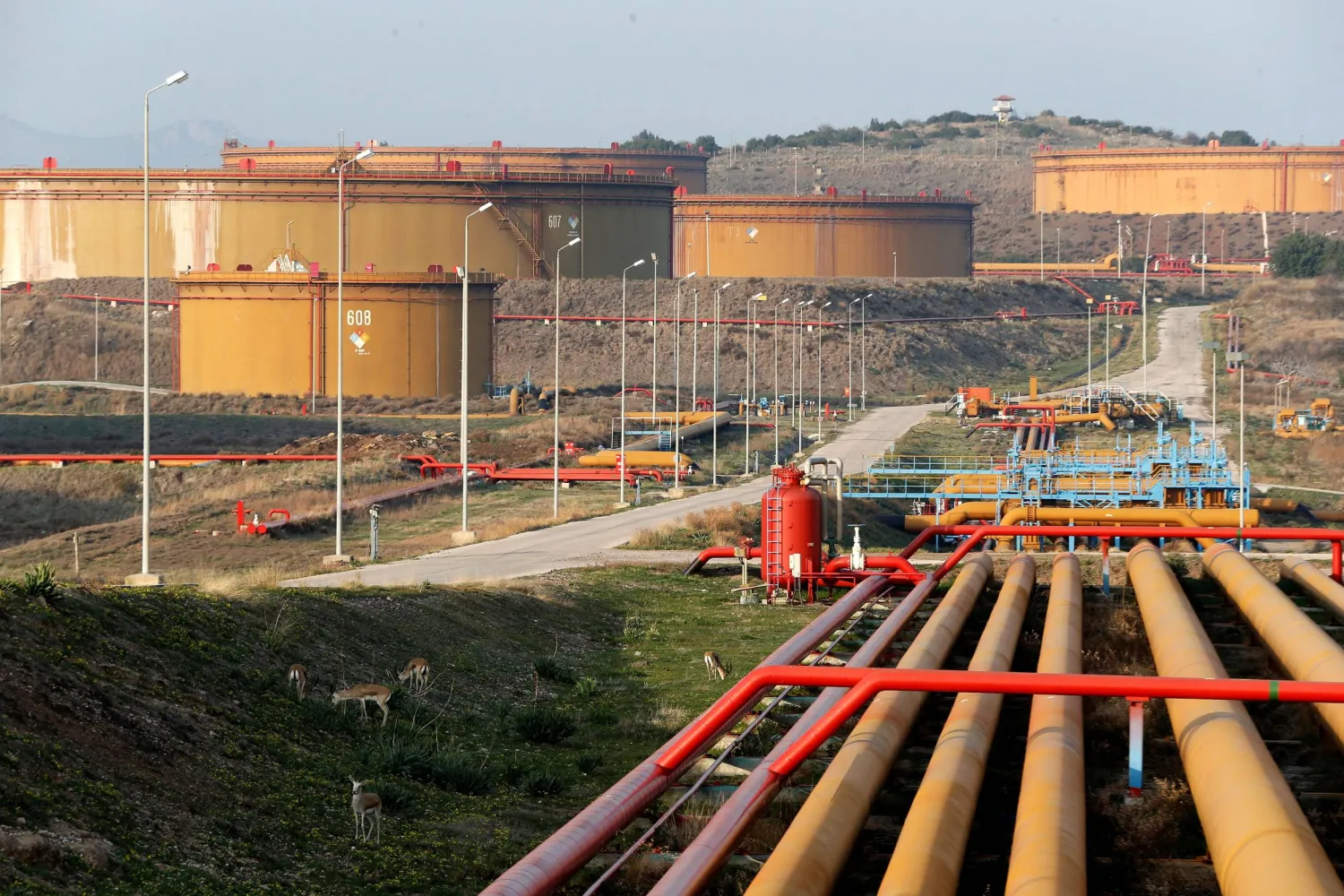
FILE PHOTO: A general view of oil tanks at Türkiye's Mediterranean port of Ceyhan, some 70 km (43.5 miles) from Adana February 19, 2014./File Photo
TT

Türkiye Submits Draft Proposal to Iraq to Renew, Expand Energy Agreement

FILE PHOTO: A general view of oil tanks at Türkiye's Mediterranean port of Ceyhan, some 70 km (43.5 miles) from Adana February 19, 2014./File Photo

Türkiye has submitted a draft proposal to Iraq to renew and expand an energy agreement between the two countries to include cooperation in oil, gas, petrochemicals and electricity, an Iraqi oil ministry official told the state news agency late on Monday.

The statement came after Ankara announced the end of a decades-old agreement covering the Kirkuk-Ceyhan oil pipeline.

"The Ministry of Oil is in the process of reviewing the draft agreement sent by the Turkish side and negotiating with them regarding it to reach a formula that serves the interests of Iraq and Türkiye", the Iraqi oil ministry official added.

The 1.6 million barrel-per-day Kirkuk-Ceyhan pipeline has been offline since 2023 after an arbitration court ruled Ankara should pay $1.5 billion in damages for unauthorized Iraqi exports between 2014 and 2018. Türkiye is appealing the ruling.

Türkiye still wants to revive the oil pipeline with Iraq, a senior Turkish official told Reuters earlier on Monday.

In a decision published in its Official Gazette on Monday, Türkiye said the existing deal dating back to the 1970s - the Türkiye -Iraq Crude Oil Pipeline Agreement - and all subsequent protocols or memorandums would be halted from July 27, 2026.

Iraq and Türkiye have been working to resume oil flows from the pipeline. Ankara said in late 2023 that the pipeline was ready to receive Iraq's oil but talks between Baghdad, Iraq's Kurdistan Regional Government and independent oil producers were not able to reach an agreement on terms.

The Turkish official said the pipeline had the potential to become a "highly active and strategic pipeline for the region".

The person added that Türkiye had invested heavily in its maintenance, and noted its importance for regional projects like the Development Road - a planned trade route involving Türkiye and Iraq.

"A new and vibrant phase for the Iraq- Türkiye pipeline will benefit both countries and the region as a whole," the Turkish official said, without giving details of what Ankara wanted the new agreement to include.

Türkiye sees the Development Road initiative - a high-speed road and rail link, running from Iraq's port city of Basrah on the Gulf to the Turkish border and later to Europe - as an opportunity to extend the pipeline further south. Baghdad allocated initial funding for the project in 2023.


Saudi Arabia Ranks 2nd Globally in World Bank’s GovTech Maturity Index 2025

The Saudi flag. Asharq Al-Awsat
TT

Saudi Arabia Ranks 2nd Globally in World Bank’s GovTech Maturity Index 2025

The Saudi flag. Asharq Al-Awsat

Saudi Arabia has achieved an unprecedented milestone, ranking second worldwide in the 2025 GovTech Maturity Index (GTMI) released by the World Bank, covering 197 economies.

The results were announced at a press conference in Washington on Thursday.

According to the GTMI findings, Saudi Arabia excelled across all the report’s indices, placing it in the “very advanced” category with an overall score of 99.64%.

The assessment examined digital infrastructure, core government systems, online service delivery, and citizen engagement, with the Kingdom achieving some of the highest scores recorded worldwide.

Governor of the Digital Government Authority (DGA) Eng. Ahmed Mohammed Alsuwaiyan said the achievement reflects the unlimited support provided by the Kingdom’s leadership, the integration of government efforts, and strong partnerships with the private sector.

He noted that national teams over recent years have redesigned government services and developed advanced digital infrastructure, enabling the Kingdom to achieve this global standing.

Alsuwaiyan stressed that the DGA will continue to promote innovation and enhance the quality of digital services to support the national economy and advance the objectives of Saudi Vision 2030.

The 2025 GTMI results show Saudi Arabia achieving 99.92% in the Core Government Systems Index (CGSI), 99.90% in the Public Service Digitalization Index (PSDI), 99.30% in the Digital Citizen Engagement Index (DCEI), and 99.50% in the GovTech Enablers Index (GTEI), securing an “A” rating among “very advanced countries” and reflecting an extensively mature digital government ecosystem.

This achievement caps a rising trajectory for Saudi Arabia’s digital government since the launch of Vision 2030, which prioritizes the citizen in the digital transformation process by improving government service delivery, enhancing user experience, and boosting operational efficiency.

These commitments have been supported by broad governmental integration, comprehensive development of digital systems, and the adoption of artificial intelligence and emerging technologies.

Saudi Arabia has made significant leaps in GovTech maturity, rising from 49th globally in the first GTMI in 2020 to third in 2022 and second in 2025, cementing its status as a global leader in digital transformation and innovation.


European Central Bank Leaves Rates Unchanged with Economy Showing Signs of Modest Growth

The Euro currency symbol is seen prior to a press conference after an ECB's governing council meeting in Frankfurt, Germany, Thursday, Dec. 18, 2025. (AP Photo/Michael Probst)
TT

European Central Bank Leaves Rates Unchanged with Economy Showing Signs of Modest Growth

The Euro currency symbol is seen prior to a press conference after an ECB's governing council meeting in Frankfurt, Germany, Thursday, Dec. 18, 2025. (AP Photo/Michael Probst)

The European Central Bank left interest rates unchanged Thursday for the fourth meeting in a row as the economy in the 20 countries that use the euro increasingly looks strong enough to get by without the stimulus of lower borrowing costs for businesses and consumers.

Bank President Christine Lagarde said that while the economy had remained “resilient,” there was too much uncertainty over trade and international conflicts to give any hints about future moves.

“We reconfirmed that we are in a good place” with interest rates, she said. “Which does not mean that we are static.”

Instead, the bank's rate setting council would take things meeting by meeting, starting with the next gathering in February. There is “no set date for any move,” she said. “There are lots of factors that that are in play and that will evolve over the course of '26.”

The council left the benchmark deposit rate unchanged at 2%, where it has been since a rate cut in June. Economists now think the rate could stay there for months - and possibly into 2027.

That’s because the ECB remains poised between inflation that’s just a bit too persistent and growth that’s underwhelming but steady after a trade deal with the US remove some of the uncertainty that had held back business planning. Higher rates fight inflation while cuts support growth.

The bank said in its decision statement that economic growth “is expected to be stronger” than in the bank's last projections in September, while inflation in services businesses was declining more slowly, even as overall inflation was expected to stabilize at the bank's 2% target.

Surveys of purchasing managers by S&P Global slipped slightly for December but still showed business activity expanding as the year comes to an end, reinforcing expectations that the 20 countries using the euro currency will continue to see growth of around 0.3% per quarter over the previous quarter.

That outcome is better than feared during turbulent trade negotiations with the United States over the summer, which finally settled with a 15% tariff, or import tax, imposed on European goods by US President Donald Trump.

Trump had threatened higher rates and the deal struck with the European Union's executive commission appears to have removed uncertainty and made it easier for businesses to make decisions. So the economy can get by without the added boost from a cut, analysts say.

“The haze of economic uncertainty has somewhat lifted, especially regarding trade,” The Associated Press quoted economist Lorenzo Codogno as saying.

On top of that, inflationary pressures remain too high for the ECB to contemplate a cut. The headline rate of 2.1% for annual inflation in November is roughly in line with the bank's goal of 2%, thanks in part to a drop in volatile energy prices. But inflation was higher at 3.5% in the services sector, which encompasses much of the economy from hairdressers and hotels to concert tickets and medical services.

While the ECB stood pat, the Bank of England on Thursday cut its key interest rate for the first time in four months as stubbornly high inflation starts to ease.

Policymakers voted 5-4 to reduce the base rate by a quarter of a percentage point to 3.75% on Thursday. Consumer price inflation slowed to 3.2% in the 12 months through November, from 3.6% a month earlier.

Central bank rate cuts can support growth because they strongly influence borrowing rates throughout the economy, lowering credit costs and promoting credit sensitive purchases such as new homes by consumers or new production facilities by businesses. Higher rates have the opposite effect and are used to contain inflation by dampening demand for goods.


Saudi Arabia Achieves 2nd Position Globally in ITU’s Digital Regulatory Maturity Index 2025

Saudi Arabia Achieves 2nd Position Globally in ITU’s Digital Regulatory Maturity Index 2025
TT

Saudi Arabia Achieves 2nd Position Globally in ITU’s Digital Regulatory Maturity Index 2025

Saudi Arabia Achieves 2nd Position Globally in ITU’s Digital Regulatory Maturity Index 2025

The International Telecommunication Union (ITU) announced that Saudi Arabia has ranked second globally in the Digital Regulatory Maturity Index 2025, placing just behind Germany among 193 countries, and maintaining its position in the highest “Leading” category of the global classification, according to a statement issued by the Communications, Space and Technology Commission (CST).

CST Acting Governor Eng. Haitham bin Abdulrahman Alohali stated that this achievement is the result of the support and enablement of the wise leadership, alignment of national digital economy directions with international multi-stakeholder initiatives, and strong collaboration between public and private sector entities through cooperative and participatory regulation, SPA reported.

He added that the Kingdom’s progress was further driven by adopting regulatory policies based on measuring social and economic impact, launching digital inclusion programs to empower all segments of society, implementing policies that promote development and innovation across sectors such as science, agriculture, and finance, and joining the Tampere Convention to facilitate the provision of telecommunications resources for disaster mitigation.

Alohali highlighted that attaining the highest “Leading” maturity level has contributed to accelerating the growth of Saudi Arabia’s digital economy, expanding the telecom and technology market, stimulating competition, attracting investment, and strengthening the Kingdom’s leading and active role within the ITU.

The statement added that this achievement reflects the efforts led by CST in collaboration with the National Regulatory Committee, Ministry of Communications and Information Technology, Ministry of Health, Ministry of Education, Ministry of Economy and Planning, Ministry of Environment, Water and Agriculture, Digital Government Authority, Saudi Central Bank, Saudi Data and Artificial Intelligence Authority, Transport General Authority, General Authority of Media Regulation, National Cybersecurity Authority, Saudi Water Authority, Saudi Electricity Regulatory Authority, General Authority for Competition, and Consumer Protection Association.
