


EU’s Von Der Leyen Says China Ties Are at ‘Inflection Point’ at Tense Summit 

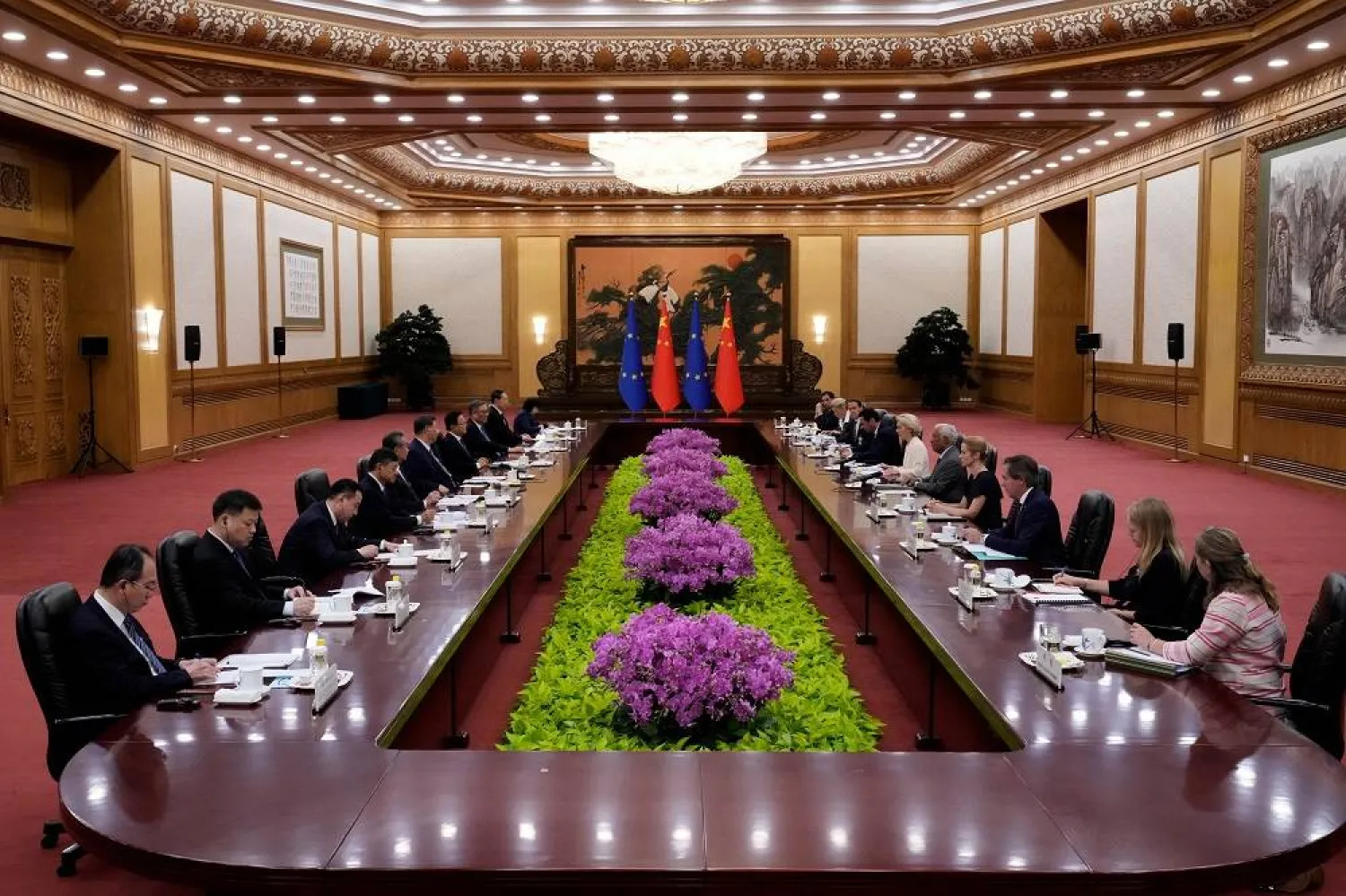
Chinese President Xi Jinping, European Council President Antonio Costa and European Commission President Ursula von der Leyen along with delegates attend the opening remarks of the EU-China summit at the Great Hall of the People in Beijing, China, July 24, 2025. (Reuters)
TT

EU’s Von Der Leyen Says China Ties Are at ‘Inflection Point’ at Tense Summit 

Chinese President Xi Jinping, European Council President Antonio Costa and European Commission President Ursula von der Leyen along with delegates attend the opening remarks of the EU-China summit at the Great Hall of the People in Beijing, China, July 24, 2025. (Reuters)

European Commission President Ursula von der Leyen called for an "essential" rebalancing of trade ties with China during a tense summit on Thursday with President Xi Jinping, saying ties stood at an "inflection point", according to a pool report.

Expectations were low for the summit marking 50 years of diplomatic ties after weeks of escalating tension and wrangling over its format, with the duration abruptly halved to a single day at Beijing's request.

Von der Leyen and European Council President Antonio Costa met Xi at the start of an event set to be dominated by thorny issues ranging from trade frictions to the Ukraine war.

"As our cooperation has deepened, so have imbalances. We have reached an inflection point," von der Leyen told Xi during the meeting in the Great Hall of the People.

She was referring to the EU's trade deficit with China, which ballooned to a historic 305.8 billion euros ($360 billion) last year.

"Rebalancing of our bilateral relation is essential ... It is vital for China and Europe to acknowledge our respective concerns and come forward with real solutions."

However, Xi urged the EU to "make correct strategic choices" during the meeting, state broadcaster CCTV said, in a veiled criticism of Brussels' hawkish stance on China.

"The more severe and complex the international situation, the more China and the EU must strengthen communication, enhance mutual trust and deepen cooperation," Xi told von der Leyen and Costa, it said.

"Chinese and European leaders should ... make correct strategic choices that meet the expectations of the people."

The weeks before the summit were dominated by tit-for-tat trade disputes and hawkish European rhetoric, such as a July 8 accusation by von der Leyen that China was flooding global markets as a result of its overcapacity and "enabling Russia's war economy".

Shortly before the summit, however, von der Leyen struck a more conciliatory tone, describing it as an opportunity to "both advance and rebalance our relationship" in a post on X on Thursday.

"I'm convinced there can be a mutually beneficial cooperation," von der Leyen added.

The two EU officials are set to meet Chinese Premier Li Qiang later. Both sides are hoping to reach a modest joint statement on climate, currently one of the only bright spots in EU-China cooperation.

State news agency Xinhua also appeared to downplay Beijing's rivalry with the 27-member bloc, saying China was a "critical partner" for Europe, with a range of shared interests.

"China is a critical partner to Europe, not a systemic rival," it said in a commentary.

The two shared interests in trade, climate, and global governance, it said, adding, "These areas of common ground should not be eclipsed by isolated points of friction."

The EU defines China as a "partner, competitor and systemic rival", which frames its strategic approach to China policy.

At the summit, European leaders are also expected to raise topics such as electric vehicles and Chinese industrial overcapacity.

China launched rare earth export controls in April that disrupted supply chains worldwide, leading to temporary stoppages in European automotive production lines the following month.

But its exports of rare earth magnets to the EU surged in June by 245% from May, to stand at 1,364 metric tons, though that was still 35% lower than the year-earlier figure, customs data showed.

The EU is likely to seal a trade deal with the United States for a broad tariff of 15% on its exports after intense negotiations, avoiding a harsher 30% figure threatened by President Donald Trump.



Indonesia Flood Death Toll Passes 1,000

The deadly torrential rains are one of the worst recent disasters to strike Sumatra. (AFP)
TT

Indonesia Flood Death Toll Passes 1,000

The deadly torrential rains are one of the worst recent disasters to strike Sumatra. (AFP)

Devastating floods and landslides have killed 1,003 people in Indonesia, rescuers said Saturday as the Southeast Asian nation grapples with relief efforts.

The disaster, which has hit the northwestern island of Sumatra over the past fortnight, has also injured more than 5,400, the National Disaster Mitigation Agency said in its latest toll.

The deadly torrential rains are one of the worst recent disasters to strike Sumatra, where a tsunami wreaked havoc in 2004 in Aceh province, which lies at the northern tip of the island.

The final toll is expected to rise, with the disaster agency reporting 218 people are still missing.

With vast tracts of territory hit, 1.2 million residents have been forced to take refuge in temporary shelters.

Frustration has grown among flood victims, who have complained about the pace of relief efforts.

President Prabowo Subianto said Saturday the situation has improved, with several areas which had been cut off now accessible.

"Here and there, due to natural and physical conditions, there have been slight delays, but I checked all the evacuation sites: their conditions are good, services for them are adequate, and food supplies are sufficient," Prabowo said after visiting Langkat in North Sumatra province.

Costs to rebuild after the disaster could reach 51.82 trillion rupiah ($3.1 billion) and the Indonesian government has so far shrugged off suggestions that it call for international assistance.


Moscow, Tehran ‘Working Closely’ on Nuclear Program

Russian President Vladimir Putin and Iranian President Masoud Pezeshkian on the sidelines of the Peace Summit in Ashgabat, Turkmenistan, on Friday (Tasnim). 
TT

Moscow, Tehran ‘Working Closely’ on Nuclear Program

Russian President Vladimir Putin and Iranian President Masoud Pezeshkian on the sidelines of the Peace Summit in Ashgabat, Turkmenistan, on Friday (Tasnim). 

Russian President Vladimir Putin said on Friday that relations between Moscow and Tehran are “developing very positively,” stressing that the two countries are working in close coordination at the United Nations on Iran’s nuclear program.

He made the remarks during talks with Iranian President Masoud Pezeshkian on the sidelines of the International Peace and Trust Summit in Ashgabat.

According to Russian media, Putin said Russia is cooperating with Iran at the Bushehr nuclear power plant and on major infrastructure projects, including the North–South Transport Corridor.

He added that the two sides are also exploring cooperation in the gas and electricity sectors.

Pezeshkian, quoted by Iranian and Russian media, reaffirmed Tehran’s commitment to implementing the comprehensive strategic partnership agreement with Moscow.

He said Iran is “determined to activate the agreement” and expects Russia to accelerate implementation of joint understandings, particularly in energy, transport and strategic transit corridors.

The Iranian president said Iran would complete its share of the groundwork for the North–South Corridor by the end of the year, noting growing economic and trade cooperation between the two countries.

He also called for strengthening multilateral partnerships within frameworks such as the Shanghai Cooperation Organization and BRICS to counter what he described as “unilateralism.”

Russia and Iran aim to expand economic ties through projects such as the International North–South Transport Corridor, a multimodal route linking northern and southern Asia via sea, rail and road networks.

The corridor is intended to speed up cargo transport between Russia and India through Iran and other countries while reducing costs compared with traditional routes. The project is seen as part of Moscow’s efforts to deepen trade links with Central Asia and Europe and to lessen reliance on longer maritime routes.

Putin said bilateral trade between Russia and Iran increased by 13 percent last year and by 8 percent in the first nine months of the current year, underscoring continued cooperation in energy and infrastructure. He added that coordination between Moscow and Tehran on international issues remains “close and ongoing.”

On the sidelines of the summit, Pezeshkian also met Pakistani Prime Minister Shehbaz Sharif, with both sides agreeing on the need to accelerate implementation of bilateral agreements and enhance cooperation in transport, transit, energy and border infrastructure, according to Iran’s Mehr News Agency.


US Says Mexico Agrees to Water Treaty Obligations

FILE PHOTO: The sun sets over the Rio Grande River in Salineno, Texas, US, February 18, 2025. REUTERS/Cheney Orr/File Photo
TT

US Says Mexico Agrees to Water Treaty Obligations

FILE PHOTO: The sun sets over the Rio Grande River in Salineno, Texas, US, February 18, 2025. REUTERS/Cheney Orr/File Photo

The United States and Mexico reached an agreement on water-sharing on Friday, after President Donald Trump threatened new sanctions.

Trump said Mexico owed 800,000 acre-feet of water to the US and demanded it release a quarter of this amount by December 31 or be hit with a new five percent tariff, AFP said.

The Republican leader accused Mexico of violating a 1944 treaty under which the US shares water from the Colorado River in exchange for flows from the Rio Grande, which forms part of the border between the two countries.

"The United States and Mexico reached an understanding to meet the current water obligations of American farmers and ranchers," the US Department of Agriculture agency said in a statement.

It said the agreement includes both the current water cycle and the deficit from the previous cycle.

The two countries are expected to finalize the plan at the end of January.

The agreement as it stands would have Mexico releasing 202,000 acre-feet of water starting next week.

US Agriculture Secretary Brooke Rollins said in a statement on Friday that Mexico "has delivered more water in the last year than in the previous four years combined," but fallen short of their obligations.

"Farmers across South Texas have been reeling from the uncertainty caused by the lack of water. Now they can expect the resources promised to them," Rollins added.

Rollins echoed Trump's threat saying that if "Mexico continues to violate its commitments, the United States reserves the right and will impose five percent tariffs on Mexican products."

Mexican President Claudia Sheinbaum has not commented on the agreement, but on Tuesday expressed confidence in reaching a solution.

At the time, she also cautioned it would be physically impossible to meet the December 31 deadline because of limitations on the pumping equipment, but said: "We have the best will to deliver the amount of water that is owed."

Mexico acknowledged that it has been behind in its water deliveries to the US over the past five years, citing drought in 2022 and 2023.

Trump had previously threatened Mexico in April with economic repercussions over the water dispute, prompting Mexico at the time to immediately send water.

Mexican goods currently face a 25 percent tariff unless they fall under the United States-Mexico-Canada Agreement (USMCA), a free trade deal struck during Trump's first term and which Washington is aiming to renegotiate in 2026.