


Thai, Cambodian Forces Clash as Escalating Border Dispute Leaves at Least 11 Dead

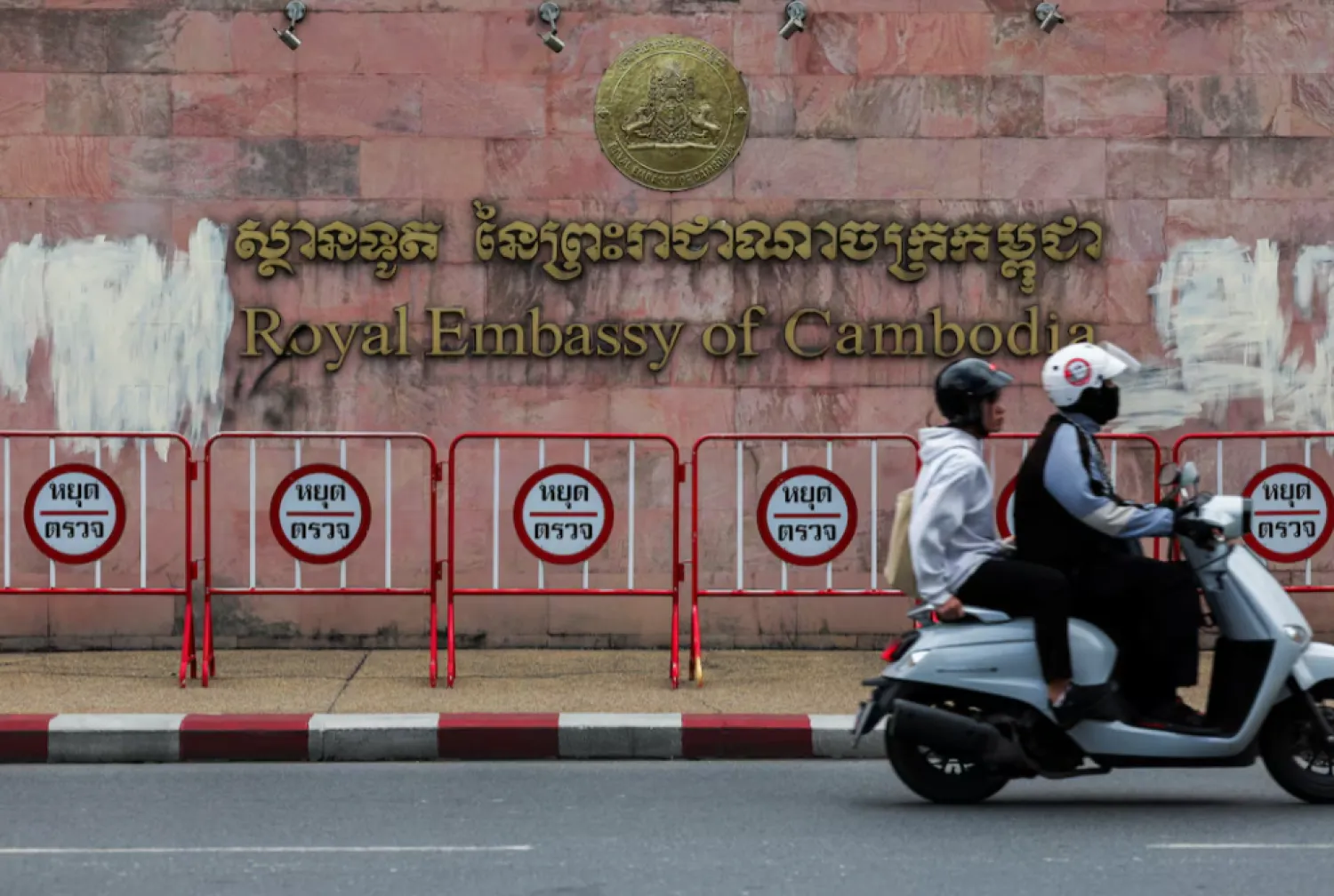
People ride a two-wheeler past the Royal Embassy of Cambodia, after Thailand recalled its ambassador to Cambodia and said it would expel Cambodia's ambassador, following a landmine incident that injured Thai soldiers - Reuters
TT

Thai, Cambodian Forces Clash as Escalating Border Dispute Leaves at Least 11 Dead

People ride a two-wheeler past the Royal Embassy of Cambodia, after Thailand recalled its ambassador to Cambodia and said it would expel Cambodia's ambassador, following a landmine incident that injured Thai soldiers - Reuters

Thai and Cambodian soldiers clashed in several areas along their border Thursday in a major escalation of their conflict that left at least 11 people dead, mostly civilians. The two sides fired small arms, artillery and rockets, and Thailand also called in airstrikes.

Thai villagers could be seen on video fleeing their homes to seek shelter as the clashes began in the morning.

Fighting was ongoing in at least six areas along the border, Thai Defense Ministry spokesperson Surasant Kongsiri said. The trigger for the clashes was a mine explosion along the border on Wednesday that wounded five Thai soldiers and led Bangkok to withdraw its ambassador to Cambodia and expelled Cambodia’s, The AP news reported.

Thailand has also sealed all land border crossings while urging its citizens to leave Cambodia.

The Southeast Asian neighbors have longstanding border disputes that periodically flare along their 800-kilometer (500-mile) frontier and usually result in brief confrontations that sometimes involves exchanges of gunfire.

But relations have deteriorated sharply since a confrontation in May that killed a Cambodian soldier, and Thursday's clashes were far bigger in scale and intensity than usual.

Each side accuses the other of starting the clashes The first clash Thursday morning happened in an area near the ancient Ta Muen Thom temple along the border of Thailand’s Surin province and Cambodia’s Oddar Meanchey province.

A video from the Thai side showed people running from their homes and hiding in a concrete bunker as explosions sounded.

The Thai army said its forces heard a drone before seeing six armed Cambodian soldiers moving closer to Thai military positions at the border. It said Thai soldiers tried to shout at them to defuse the situation, but the Cambodian side started to open fire.

Cambodia’s Defense Ministry, however, said Thailand deployed a drone first before opening fire, and that Cambodia “acted strictly within the bounds of self-defense, responding to an unprovoked incursion by Thai troops that violated our territorial integrity.”

Cambodian Prime Minister Hun Manet wrote to the current president of the UN Security Council asking for an urgent meeting “to stop Thailand’s aggression.”

The Thai army said it later launched airstrikes on military targets in Cambodia, while the Cambodian Defense Ministry said the Thai jets dropped bombs on a road near the ancient Preah Vihear temple, which has been the site of some of the most prominent and violent past conflicts between the countries.

Thailand’s Foreign Ministry accused Cambodia of attacking both military and non-military sites in Thailand, including a hospital.

“The Royal Thai Government is prepared to intensify our self-defense measures if Cambodia persists in its armed attack and violations upon Thailand’s sovereignty in accordance with international law and principles,” said Nikorndej Balankura, the ministry’s spokesperson.

Acting Prime Minister Phumtham Wechayachai said 11 people have died, including 10 civilians and one soldier. Meanwhile 28 have been injured, four of whom were soldiers and the rest civilians.

Cambodia released no details on deaths or injuries on its side.

Relations deteriorated even before the clashes On Wednesday, Thailand withdrew its ambassador to Cambodia and expelled the Cambodian ambassador to protest the mine blast that wounded its soldiers.

Thai authorities alleged the mines were newly laid along paths that both sides had agreed were supposed to be safe. They said the mines were Russian-made and not of a type employed by Thailand’s military.

Cambodia rejected Thailand’s account as “baseless accusations,” pointing out that many unexploded mines and other ordnance are a legacy of 20th century wars and unrest.

Cambodia also downgraded diplomatic relations, recalling all Cambodian staff on Thursday from its embassy in Bangkok.

The border dispute in May that resulted in the death of a Cambodian soldier has had political fallout in Thailand. Prime Minister Paetongtarn Shinawatra came under fire for for being too fawning in a phone call with her Cambodian counterpart when she tried to defuse the situation. She has since been suspended from office pending an investigation into possible ethics violations over the matter.



UK PM's Communications Director Quits

British Prime Minister Keir Starmer delivers a speech at Horntye Park Sports Complex in St Leonards, Britain, February 05, 2026. Peter Nicholls/Pool via REUTERS
TT

UK PM's Communications Director Quits

British Prime Minister Keir Starmer delivers a speech at Horntye Park Sports Complex in St Leonards, Britain, February 05, 2026. Peter Nicholls/Pool via REUTERS

British Prime Minister Keir Starmer's director of communications Tim Allan resigned on Monday, a day after Starmer's top aide Morgan McSweeney quit over his role in backing Peter Mandelson over his known links to Jeffrey Epstein.

The loss of two senior aides ⁠in quick succession comes as Starmer tries to draw a line under the crisis in his government resulting from his appointment of Mandelson as ambassador to the ⁠US.

"I have decided to stand down to allow a new No10 team to be built. I wish the PM and his team every success," Allan said in a statement on Monday.

Allan served as an adviser to Tony Blair from ⁠1992 to 1998 and went on to found and lead one of the country’s foremost public affairs consultancies in 2001. In September 2025, he was appointed executive director of communications at Downing Street.


Road Accident in Nigeria Kills at Least 30 People

FILE PHOTO: A police vehicle of Operation Fushin Kada (Anger of Crocodile) is parked on Yakowa Road, as schools across northern Nigeria reopen nearly two months after closing due to security concerns, following the mass abductions of school children, in Kaduna, Nigeria, January 12, 2026. REUTERS/Nuhu Gwamna/File Photo
TT

Road Accident in Nigeria Kills at Least 30 People

FILE PHOTO: A police vehicle of Operation Fushin Kada (Anger of Crocodile) is parked on Yakowa Road, as schools across northern Nigeria reopen nearly two months after closing due to security concerns, following the mass abductions of school children, in Kaduna, Nigeria, January 12, 2026. REUTERS/Nuhu Gwamna/File Photo

At least 30 people have been killed and an unspecified number of people injured in a road accident in northwest Nigeria, authorities said.

The accident occurred Sunday in Kwanar Barde in the Gezawa area of Kano state and was caused by “reckless driving” by the driver of a truck-trailer, Gov. Abba Yusuf said in a statement. He did not specify what other vehicles were involved.

Yusuf described the accident as “heartbreaking and a great loss” to the affected families and the state. He did not provide more details of the accident, said The Associated Press.

Africa’s most populous country recorded 5,421 deaths in 9,570 road accidents in 2024, according to data by the country’s Federal Road Safety Corps.

Experts say a combination of factors including a network of bad roads, lax enforcement of traffic laws and indiscipline by some drivers produce the grim statistics.

In December, boxing heavyweight champion Anthony Joshua was in a deadly car crash that injured him and killed Sina Ghami and Latif “Latz” Ayodele, two of his friends, in southwest Nigeria.

Adeniyi Mobolaji Kayode, Joshua’s driver, was charged with dangerous and reckless driving and his trial is scheduled to begin later this month.

Africa has the highest road fatality rate in the world despite having only about 3% of the world’s vehicles, mainly due to weak enforcement of road laws, poor infrastructure and widespread use of unsafe transport. 


US Vice President Vance Heads to Armenia, Azerbaijan to Push Peace, Trade

US Vice President JD Vance speaks during the Critical Minerals Ministerial at the State Department in Washington, DC, US, February 4, 2026. (Reuters)
TT

US Vice President Vance Heads to Armenia, Azerbaijan to Push Peace, Trade

US Vice President JD Vance speaks during the Critical Minerals Ministerial at the State Department in Washington, DC, US, February 4, 2026. (Reuters)

US Vice President JD Vance will visit Armenia and Azerbaijan this week to push a Washington-brokered peace agreement that could transform energy and trade routes in the strategic South Caucasus region.

His two-day trip to Armenia, which begins later on Monday, comes just six months after the Armenian and Azerbaijani leaders signed an agreement at the White House seen as the first step towards peace after nearly 40 years of war.

Vance, the first US vice president to visit Armenia, is seeking to advance the Trump Route for International Peace and Prosperity (TRIPP), a proposed 43-kilometre (27-mile) corridor that would run across southern Armenia and give Azerbaijan a direct route to its exclave ‌of Nakhchivan ‌and in turn to Türkiye, Baku's close ally.

"Vance's visit should ‌serve ⁠to reaffirm the ‌US's commitment to seeing the Trump Route through," said Joshua Kucera, a senior South Caucasus analyst at Crisis Group.

"In a region like the Caucasus, even a small amount of attention from the US can make a significant impact."

The Armenian government said on Monday that Vance would hold talks with Prime Minister Nikol Pashinyan and that both men would then make statements, without elaborating.

Vance will then visit Azerbaijan on Wednesday and Thursday, the White House has said.

Under the agreement signed last year, ⁠a private US firm, the TRIPP Development Company, has been granted exclusive rights to develop the proposed corridor, with Yerevan ‌retaining full sovereignty over its borders, customs, taxation and security.

The ‍route would better connect Asia to Europe ‍while - crucially for Washington - bypassing Russia and Iran at a time when Western countries are ‍keen on diversifying energy and trade routes away from Russia due to its war in Ukraine.

Russia has traditionally viewed the South Caucasus as part of its sphere of influence but has seen its clout there diminish as it is distracted by the war in Ukraine.

Securing US access to supplies of critical minerals is also likely to be a key focus of Vance's visit.

TRIPP could prove a key transit corridor for the vast mineral wealth of ⁠Central Asia - including uranium, copper, gold and rare earths - to Western markets.

CLOSED BORDERS, BITTER RIVALS

In Soviet times the South Caucasus was criss-crossed by railways and oil pipelines until a series of wars beginning in the 1980s disrupted energy routes and shuttered the border between Armenia and Türkiye, Azerbaijan's key regional ally.

Armenia and Azerbaijan were locked in bitter conflict for nearly four decades, primarily over the mountainous region of Nagorno-Karabakh, an internationally recognized part of Azerbaijan that broke away from Baku's control as the Soviet Union fell apart in 1991.

Azerbaijan and Armenia fought two wars over Karabakh before Baku finally took it back in 2023. Karabakh's entire ethnic Armenian population of around 100,000 people fled to Armenia. The two neighbors have made progress in recent months on normalizing relations, including restarting ‌some energy shipments.

But major hurdles remain to full and lasting peace, including a demand by Azerbaijan that Armenia change its constitution to remove what Baku says contains implicit claims on Azerbaijani territory.