
Hulk Hogan, Who Helped Turn Pro Wrestling into Billion-Dollar Spectacle, Dies at 71 

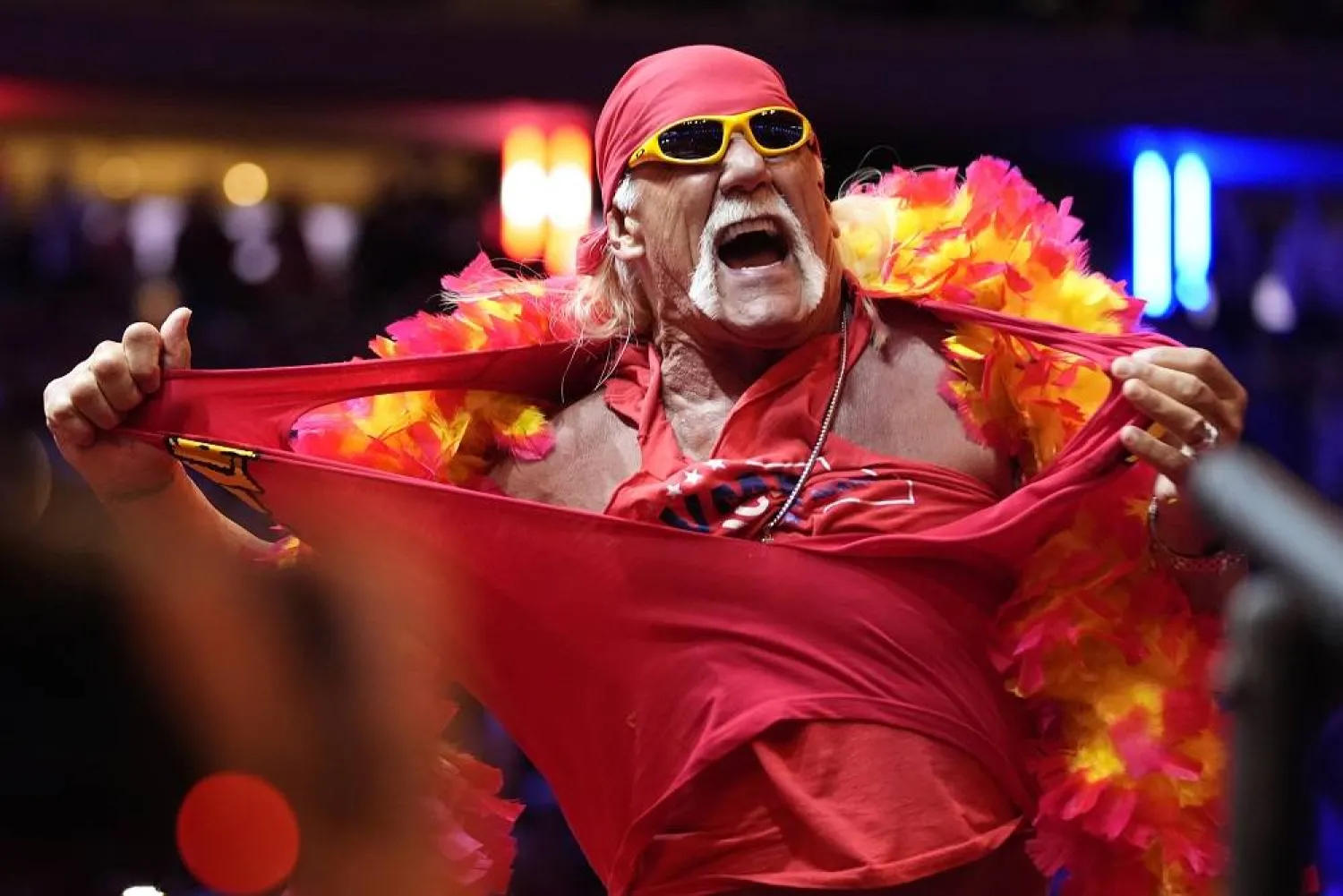
Hulk Hogan rips his shirt before Republican presidential nominee former President Donald Trump speaks at a campaign rally at Madison Square Garden, Oct. 27, 2024, in New York. (AP)
TT

Hulk Hogan, Who Helped Turn Pro Wrestling into Billion-Dollar Spectacle, Dies at 71 

Hulk Hogan rips his shirt before Republican presidential nominee former President Donald Trump speaks at a campaign rally at Madison Square Garden, Oct. 27, 2024, in New York. (AP)

Hulk Hogan, the American sports and entertainment star who made professional wrestling a global phenomenon and loudly supported Donald Trump for president, has died at the age of 71, World Wrestling Entertainment said on Thursday.

"WWE is saddened to learn WWE Hall of Famer Hulk Hogan has passed away. One of pop culture's most recognizable figures, Hogan helped WWE achieve global recognition in the 1980s," WWE said in a statement.

Police in Clearwater, Florida, said authorities had responded to a medical call for a cardiac arrest at Hogan's residence on Thursday morning. Hogan was taken to a hospital, where he was pronounced dead, they said.

The bleach-blond, mahogany-tanned behemoth became the face of professional wrestling in the 1980s, helping transform the mock combat from a seedy spectacle into family-friendly entertainment worth billions of dollars.

A key moment in that evolution came at the WrestleMania III extravaganza in 1987, when Hogan, billed at 6'8", hoisted fellow wrestler André the Giant before a sold-out Pontiac Silverdome in Michigan for a thunderous body slam of the 7'4" Frenchman.

Hogan parlayed his wrestling fame into a less successful career in Hollywood, starring in films like "Rocky III" and "Santa With Muscles," but kept returning to the ring as long as his body would allow.

In 2024, he appeared at the Republican National Convention to endorse the presidential bid of Trump, who in the 1980s had played host to Hulk-headlined WrestleManias. Hogan said he made the decision to support the Republican candidate after seeing his combative, fist-pumping reaction to an attempted assassination on the campaign trail.

"Let Trumpamania run wild, brother!" Hogan bellowed to a cheering crowd, ripping off his shirt to reveal a Trump tank top. "Let Trumpamania rule again!"

BECOMING 'HULK'

Born Terry Gene Bollea in Augusta, Georgia, on August 11, 1953, the future Hulk and his family soon moved to the Tampa, Florida area. After high school, he played bass guitar for area rock bands, but felt a pull to the red-hot wrestling scene in Florida in the 1970s.

Many of the details of his career were showbusiness exaggerations, representative of the blurred lines between fact and fiction in wrestling.

His first trainer reportedly broke Hogan's leg to dissuade him from entering the business, but he kept at wrestling, weight training, and - he later admitted - anabolic steroids. He gained in notoriety as his biceps turned into what he dubbed the "24-inch pythons."

The "Hulk" moniker came from comparisons to the comic-book hero portrayed on TV at the time. He would end up paying royalties to Marvel Comics for years. "Hogan" was the invention of promoter Vincent J. McMahon, the owner of the World Wrestling Federation (WWF), who wanted Irish representation among his stable of stars.

His appearance as wrestler Thunderlips in "Rocky III," where he dwarfed leading man Sylvester Stallone, rocketed Hogan to the mainstream. Upon a return to the WWF, now controlled by McMahon's son Vincent K., he defeated the Iron Sheik in 1984 to claim the world championship, a belt he would hold for four years.

Hogan became a household name, appearing on the cover of magazine Sports Illustrated and performing alongside pop culture stars like Mr. T. The WWF came to dominate wrestling, anchored by its annual WrestleMania pay-per-view events.

"He drew more people to professional wrestling over the course of a career than anyone," said Dave Meltzer, a wrestling journalist and historian. "He paid the price in health for all of that stuff, being so big."

FACING 'THE ROCK'

Later, he joined competitor World Championship Wrestling, swapping his trademark yellow tights for black and taking on a persona as the villainous "Hollywood" Hogan, the head of a gang of rulebreakers known as the New World Order. The gimmick reinvigorated his career.

Hogan eventually returned to the WWF, now known as WWE, and faced Dwayne "The Rock" Johnson at WrestleMania in 2002.

"I'm in better shape than him," Hogan told Reuters at the time, five months shy of his 50th birthday. "I'll stand next to The Rock and pose down with him if he wants to." The Rock ultimately won the match.

Hogan was inducted twice into the WWE Hall of Fame, and referred to himself as the "Babe Ruth" of wrestling - after the New York Yankees' famed baseball player.

But Hogan's support of Trump in 2024 did not go down well with all wrestling fans, and he also faced other controversies. Gossip website Gawker was shuttered after it posted parts of a sex tape between him and a friend's wife and Hogan sued on privacy grounds, winning a $140 million judgment.

In 2015, he was suspended by the WWE after another surreptitious recording revealed that Hogan had used a racial slur. He was reinstated in 2018.

He was married three times and had two children, who starred alongside him and first wife Linda in a 2005-2007 reality TV show, "Hogan Knows Best."

Condolences for the Hulkster poured in across social media, including from Vince K. McMahon, his partner in the 1980s wrestling boom and the former executive chairman of TKO Group that absorbed WWE in 2023.

"He was a trailblazer," McMahon wrote in a post on X. "He leaves us with one of his favorite expressions, 'Train, take your vitamins and say your prayers.'"

"Today, we pray for him."


AI Revolution Looms Over Berlin Film Fest

Director and screenwriter Yoshitoshi Shinomiya attends a press conference for “A New Dawn” during the 76th Berlin International Film Festival, in Berlin, Germany, 18 February 2026. (EPA)
TT

AI Revolution Looms Over Berlin Film Fest

Director and screenwriter Yoshitoshi Shinomiya attends a press conference for “A New Dawn” during the 76th Berlin International Film Festival, in Berlin, Germany, 18 February 2026. (EPA)

The artificial intelligence revolution sweeping through the entertainment sector was at first glance not evident at this year's Berlin Film Festival, but the potential for widespread changes was still on people's minds.

The festival has had the air of an arthouse bubble when it comes to the topic of AI and the event's leadership is keeping above the fray.

"At present, we do not intend to issue any statements regarding the use of AI in the film industry," the festival said in a statement sent to AFP, adding: "We are monitoring developments with great interest."

Nevertheless, some of the filmmakers present addressed the question of how the technology is changing the industry.

Yoshitoshi Shinomiya, director of the only animated feature in competition, "A New Dawn," told reporters he had briefly considered using AI in his film.

"During production, we weren't entirely sure we would be able to complete the film. At one point we wondered whether we should use AI for the backgrounds," he said.

But Shinomiya concluded that AI is not yet "well-developed enough" to do that sort of work.

Juliette Prissard from Eurocinema, an organization representing French film and TV producers, said it's only a matter of time until the tools improve.

"It's reasonable to think that in one, two or three years... you won't be able to tell the difference anymore," she told AFP.

AI can already "write scripts" and replace extras in crowd scenes or even generate "digital replicas" of someone.

- 'No choice' -

In France, where foreign-language films are frequently shown with dubbing, voice actors have already been raising the alarm about AI's impact on their profession.

But Prissard warns other film industry jobs could be replaced in the "near" future, such as "technicians, the set designers" and even "the producers themselves".

Sevara Irgacheva, secretary general of the European Film Agency Directors' association (EFAD), said that already "junior jobs are disappearing: all the assistant editors, assistant screenwriters".

Despite this, the industry "is leaning toward accepting" AI "because, in any case, we have no choice".

The tools have the potential to help the sector become more efficient and "save time at every stage of production", particularly in the more "bureaucratic" aspects of the process.

A survey carried out in early 2025 by France's National Center for Cinema (CNC) found that 90 percent of film and audiovisual professionals surveyed were already using AI tools in their work.

In Berlin, Austrian director Georg Tiller presented a short film mixing filmed footage and AI-generated images, saying it was an attempt to encourage his fellow filmmakers to fight for a place in the new "digital cinema".

"If we don't then I fear that that we will die a slow death, because it will just steamroll over us," Tiller told AFP.

- The 'temptation' of deregulation -

The issue garnered some relief with a December agreement between OpenAI and Disney, which allowed the use of the entertainment giant's characters on Sora, the AI-generated video platform.

In return, Disney now has "privileged access" to OpenAI's "highly sophisticated" tools, giving it a "technological advantage over the rest of the sector," said Prissard.

But the use of AI in cinema has prompted thorny legal questions over intellectual property and the very notion of authorship, at a time when legislation is only just beginning to grapple with the subject.

Under EU rules, streaming platforms such as Netflix and Amazon Prime must carry at least 30 percent of European content in their catalogues.

Prissard questioned how those enforcing the rules "will be able to tell the difference" between original creations and "synthetic" ones.

Given "the fear of falling behind" the United States and China in developing AI technologies, Prissard said that Europe may succumb to the "temptation to allow more leeway to innovate without obstacles".


Bad Bunny Positioned to Consolidate His Popularity in Brazil with First-Ever Performances

 Puerto Rican singer Bad Bunny performs during his "Debí Tirar Más Fotos" world tour at the Allianz Parque stadium in Sao Paulo, Brazil, on February 20, 2026. (AFP)
Puerto Rican singer Bad Bunny performs during his "Debí Tirar Más Fotos" world tour at the Allianz Parque stadium in Sao Paulo, Brazil, on February 20, 2026. (AFP)
TT

Bad Bunny Positioned to Consolidate His Popularity in Brazil with First-Ever Performances

 Puerto Rican singer Bad Bunny performs during his "Debí Tirar Más Fotos" world tour at the Allianz Parque stadium in Sao Paulo, Brazil, on February 20, 2026. (AFP)
Puerto Rican singer Bad Bunny performs during his "Debí Tirar Más Fotos" world tour at the Allianz Parque stadium in Sao Paulo, Brazil, on February 20, 2026. (AFP)

While Bad Bunny has dominated global charts, the superstar has not had quite the same success in Brazil, a country notoriously hard for foreign stars to win over due to a devotion to national artists.

But a shift that began with his Grammy-winning album "Debí Tirar Más Fotos" may accelerate further after his first-ever gigs in Brazil on Friday and Saturday in Sao Paulo.

Bad Bunny has come to Brazil at the peak of his career so far, following the phenomenal hype around his performance at the Super Bowl halftime show.

"It’s the best time to try and unlock a country like Brazil, at a time when he’s managed to dominate practically the entire world," said Felipe Maia, an ethnomusicologist who is pursuing a doctoral degree on popular music and digital technologies at Paris Nanterre University.

For years, the Puerto Rican artist born Benito Antonio Martínez Ocasio has been one of the most-streamed artists on the planet.

But neither the singer, nor his album, nor his songs were among the most played last year in Brazil, according to Spotify. The most streamed artists in the country on the platform in 2025 were all Brazilian.

In the land of samba, funk, bossa nova, choro, sertanejo, forro and pagode, among other Brazilian music genres, 75% of streaming consumption in Brazil focuses on national artists, according to the 2025 midyear music report of Luminate, a company specializing in entertainment industry data. Brazil is the country that most listens to its own music, it said.

Still, particularly since "Debí Tirar Más Fotos," the fever around Bad Bunny has made headway in Brazil. Only one performance was initially scheduled at the Allianz Parque arena, but it sold out so quickly the artist added an extra date, which also sold out.

By mid-afternoon on Friday, long queues had formed. Brazilian fans mixed with people from El Salvador, Colombia and Venezuela. Many came wearing straw hats — used by Bad Bunny and traditionally worn by jíbaros, rural Puerto Rican farmers.

Tickets on Ticketmaster, the official vendor, ranged from $50 to $210, but resellers on Friday were selling tickets for that same night for more than $830 — more than 2.5 times the minimum monthly wage in Brazil.

Flávia Durante, a Sao Paulo -based DJ who specializes in Latin American music, said that some Brazilians have a tendency to see Spanish-language music as corny due to the association with Mexican telenovelas, but that Bad Bunny pierced a bubble with his latest album.

"Nowadays everyone knows all the songs, they sing along and really get into it. I normally play him at the peak of the night. People request him, even at rock or 80s pop themed parties," Durante said.

Since the half-time Super Bowl show, that popularity has grown. Bad Bunny’s average streams grew by 426% on Spotify in Brazil in the following week compared with the previous one. Many songs experienced massive streaming surges, with "Yo Perreo Sola" leading the growth with a 2,536% increase.

‘Latino resistance’

During Brazil’s Carnival celebrations, Bad Bunny themed costumes were a fixture in Rio’s raucous, dazzling street parties.

Nicole Froio, a Colombian Brazilian writer specializing in Latin American cultural issues, went kitted out in a straw hat and plastic, tropical plants that echo the background of his latest album. It was the third Carnival in which Froio — who has two Bad Bunny tattoos and a third one planned — wore attire that evoked the Puerto Rican artist.

For a long time, Froio was the sole person among her Brazilian friendship group who liked Bad Bunny. She believes that Brazilians in general have trouble identifying themselves as Latino.

"There’s a lot of prejudice around Hispanic music and there were preconceptions against him because of his Puerto Rican accent, because people don’t understand him," she said.

Brazil’s Latino identity exists but it is diffuse and difficult to seize due to the variety within the continent-sized country, said Maia. But Bad Bunny succeeds in giving it emphasis, particularly in cosmopolitan cities such as Sao Paulo and Rio de Janeiro, he said.

Brazil, like other countries in the Americas, was listed by Bad Bunny in the Super Bowl halftime show, when he reminded the world that while "America" is used as a synonym for the US in the US, it is the name used across two continents.

Bad Bunny’s global success, including in Brazil, "reinforces that we’re part of this — that we belong," said 22-year-old Diogo da Luz, a longtime fan of the Puerto Rican ahead of Friday's concert. "He reinforces that we are one people and that we’re very united."

For Froio, who has been waiting to see him live for six years and will see him on Saturday, Bad Bunny "represents a Latino resistance."

She pointed to the fact that other Latin American superstars, including Anitta, Shakira, and Ricky Martin, have recorded full songs in other languages, while Bad Bunny has kept his music almost entirely in Spanish.

"For me, there’s a great authenticity in his sound that inspires me to be who I am and let everyone else deal with it," Froio said.


Political Drama Overshadows Berlin Film Festival Finale

Jury president Wim Wenders at the opening of the Berlin Film Festival which has been rocked by political controversy. Ronny HARTMANN / AFP
TT

Political Drama Overshadows Berlin Film Festival Finale

Jury president Wim Wenders at the opening of the Berlin Film Festival which has been rocked by political controversy. Ronny HARTMANN / AFP

The 76th Berlin Film Festival draws to a close on Saturday after 10 days in which the 22 films in competition were often overshadowed by a row over the role politics should play in filmmaking.

The controversy erupted at the beginning of the festival when jury president Wim Wenders answered a question about the German government's support for Israel by saying: "We cannot really enter the field of politics."

At the same press conference, he had earlier said that films had the power to "change the world" but in a different way from party politics.

"No movie has ever changed the ideas of a politician, but we can change the idea that people have of how they should live," Wenders, 80, said.

But his comments in response to the question on Israel prompted a storm of outrage.

Award-winning Indian novelist Arundhati Roy, who had been due to present a restored version of a 1989 film she wrote, pulled out of the event, branding Wender's words "unconscionable" and "jaw-dropping".

On Tuesday, a letter signed by dozens of film industry figures, including Javier Bardem, Tilda Swinton and Adam McKay, condemned the Berlin festival's "silence on the genocide of Palestinians".

- Films overshadowed -

The letter, drafted by the Film Workers for Palestine collective, accused the Berlinale of being involved in "censoring artists who oppose Israel's ongoing genocide against Palestinians in Gaza and the German state's key role in enabling it".

Director Tricia Tuttle, in her second year at the helm of the Berlinale, has firmly rejected the accusations, describing some of the claims in the letter as "misinformation" and "inaccurate".

She called for "cool heads in hot times" and expressed fears that the controversy was crowding out conversation about the films.

Among the standout entries in the official competition was "We Are All Strangers" by Anthony Chen.

Set in Chen's native Singapore, the film is a moving family drama which playfully satirizes the yawning social disparities to be found in the city-state's glittering skyscrapers.

German actress Sandra Hueller, who gained international acclaim for her roles in "The Zone of Interest" and "Anatomy of a Fall", received audience plaudits for her turn as the title character in "Rose" by Austrian director Markus Schleinzer.

The black-and-white drama tells the story of a woman passing herself off as a man in rural 17th-century Germany to escape the constraints of patriarchy.

- Repression in Iran -

Juliette Binoche, playing a woman caring for her mother with dementia, also moved cinemagoers in "Queen at Sea" by American director Lance Hammer, who had not made a feature film since 2008.

Sensitively, the film portrays the devastation Alzheimer's disease inflicts on a patient's loved ones.

"My husband's got dementia, so I have had a lot of background," a visibly moved actress Anna Calder-Marshall, who plays the ailing mother in the film, told a press conference.

The first major event of the film calendar also provided a platform for Iranian filmmakers to address the deadly crackdown on anti-government protests in their home country.

Director Mahnaz Mohammadi, who has spent time in Tehran's notorious Evin prison, presented "Roya", a searing portrayal of conditions in the jail and the traces they leave on prisoners' psyches.

Dissident director Jafar Panahi, who won the Cannes Palme d'Or for "It Was Just An Accident", also spoke from the Berlinale to denounce the Iranian government's repression of protestors, which international organizations say has left thousands dead.

"An unbelievable crime has happened. Mass murder has happened. People are not even allowed to mourn their loved ones," Panahi told a talk organized as part of the festival.

"People do not want violence. They avoid violence. It is the regime that forces violence upon them," Panahi said.

In December he was sentenced to one year in prison and a travel ban in Iran but has expressed his intention to return nevertheless.