


Lebanon: George Abdallah Released after 40 Years in French Jail

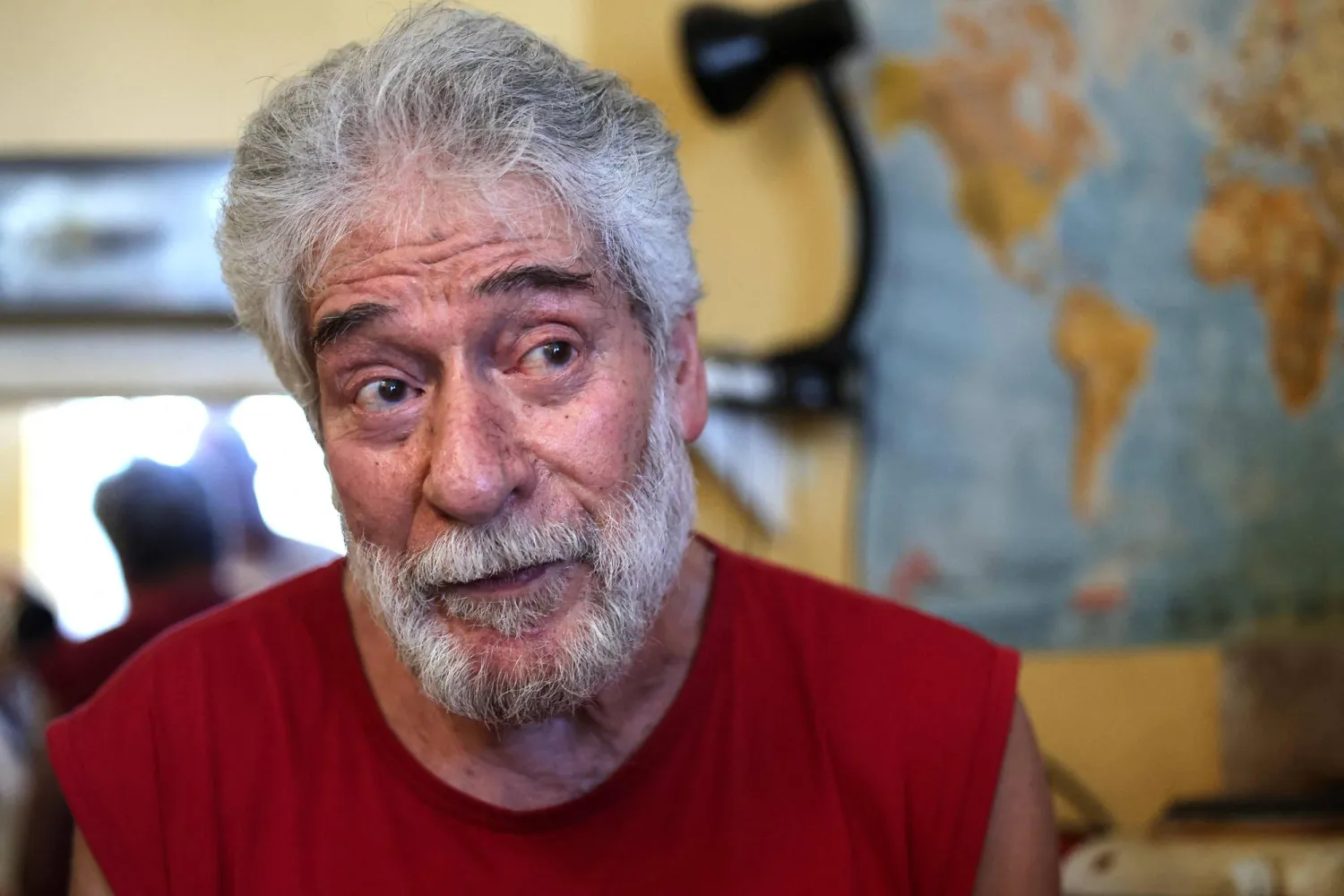
TOPSHOT - This photograph taken during a visit of French leftist party La France Insoumise (LFI)'s MP Andree Taurinya shows pro-Palestinian Lebanese activist Georges Ibrahim Abdallah looking on in his prison cell in Lannemezan, southwestern France, on July 17, 2025, after an appeals court ordered his release.(Photo by Valentine CHAPUIS / AFP)
TT

Lebanon: George Abdallah Released after 40 Years in French Jail

TOPSHOT - This photograph taken during a visit of French leftist party La France Insoumise (LFI)'s MP Andree Taurinya shows pro-Palestinian Lebanese activist Georges Ibrahim Abdallah looking on in his prison cell in Lannemezan, southwestern France, on July 17, 2025, after an appeals court ordered his release.(Photo by Valentine CHAPUIS / AFP)

One of France's longest-held inmates, the pro-Palestinian Lebanese activist Georges Ibrahim Abdallah, will be released and deported on Friday, after more than 40 years behind bars for the killings of two diplomats.

At around 3:40 am (01:30 GMT), a convoy of six vehicles left the Lannemezan penitentiary with lights flashing, AFP journalists saw, though they were unable to catch a glimpse of the 74-year-old grey-bearded prisoner.

Abdallah was detained in 1984 and sentenced to life in prison in 1987 for his involvement in the murders of US military attache Charles Robert Ray and Israeli diplomat Yacov Barsimantov in Paris.

The Paris Court of Appeal had ordered his release "effective July 25" on the condition that he leave French territory and never return.

He had been eligible for release since 1999, but his previous requests were denied as the United States -- a civil party to the case -- consistently opposed him leaving prison.

Inmates serving life sentences in France are typically freed after fewer than 30 years.

Once out of prison, Abdallah is set to be transported to the Tarbes airport where a police plane will take him to Roissy for a flight to Beirut, according to a source close to the case.

Abdallah's lawyer, Jean-Louis Chalanset, visited for a final time on Thursday. "He seemed very happy about his upcoming release, even though he knows he is returning to the Middle East in an extremely tough context for Lebanese and Palestinian populations," Chalanset told AFP.

AFP visited Abdallah last week after the court's release decision, accompanying a lawmaker to the detention center.

The founder of the Lebanese Revolutionary Armed Factions (FARL) -- a long-disbanded Marxist anti-Israel group -- said for more than four decades he had continued to be a "militant with a struggle".

The appeals court in February noted that Abdallah "had not committed a violent action since 1984" and that Abdallah "today represented a past symbol of the Palestinian struggle".

The appeals judges also found the length of his detention "disproportionate" to the crimes and given his age.

Abdallah's family said they plan to meet him at Beirut airport's "honor lounge" before heading to their hometown of Kobayat in northern Lebanon where a reception is planned.



Fighter from Iraq's PMF Killed in Strike near Syria Border

Archive: Popular Mobilization Forces (PMF) fighters ride in a tank near the Iraqi-Syrian border in al-Qaim, Iraq. Iraq November 26, 2018. REUTERS/Alaa al-Marjani
TT

Fighter from Iraq's PMF Killed in Strike near Syria Border

Archive: Popular Mobilization Forces (PMF) fighters ride in a tank near the Iraqi-Syrian border in al-Qaim, Iraq. Iraq November 26, 2018. REUTERS/Alaa al-Marjani

A strike killed a fighter from the former paramilitary coalition Hashed al-Shaabi, or Popular Mobilization Forces, in Iraq near the border with Syria on Tuesday, the alliance said, blaming the United States and Israel.

"At 4 am (0100 GMT) this morning the 45th Brigade... was subjected to a treacherous Zionist-American aggression in the Qaim district of Anbar province," the alliance said.

The strike resulted in "the martyrdom of one of the fighters of the 45th Brigade", which belongs to the US-blacklisted, pro-Iran group Kataeb Hezbollah.


WHO Suspends Gaza Operations After Contract Worker Killed

 Palestinians inspect the damage after a person was hit by an Israeli strike while riding a bicycle, according to medics, in Gaza City, April 6, 2026. (Reuters)
Palestinians inspect the damage after a person was hit by an Israeli strike while riding a bicycle, according to medics, in Gaza City, April 6, 2026. (Reuters)
TT

WHO Suspends Gaza Operations After Contract Worker Killed

 Palestinians inspect the damage after a person was hit by an Israeli strike while riding a bicycle, according to medics, in Gaza City, April 6, 2026. (Reuters)
Palestinians inspect the damage after a person was hit by an Israeli strike while riding a bicycle, according to medics, in Gaza City, April 6, 2026. (Reuters)

The World Health Organization announced it was suspending evacuations from Gaza after a worker contracted to help them was killed on Monday.

"@WHO is devastated to confirm that a person contracted to provide services to the Organization in Gaza was killed today during a security incident," the agency's chief Tedros Adhanom Ghebreyesus posted on X.

Two staff members were present at the incident but were not injured, he added.

"Following the incident, WHO suspended today's medical evacuation of patients from Gaza via Rafah to Egypt. Medical evacuations will remain suspended until further notice."

The United Nations health agency did not give details of what had happened, but Tedros said "the relevant authorities" were investigating.

"We call for the protection of civilians and humanitarian workers," he added in his post.

Israel and Hamas have accused each other of violating the ceasefire that came into force on October 10 in the Gaza Strip, after two years of devastating war.


US Stops Israel’s Plan to Drag Syria to War on Hezbollah

Lebanese General Security members stand guard at the Masnaa border crossing with Syria in the Bekaa Valley, eastern Lebanon, 05 April 2026, following an Israeli warning to target the M30 highway between Lebanon and Syria. (EPA)
TT

US Stops Israel’s Plan to Drag Syria to War on Hezbollah

Lebanese General Security members stand guard at the Masnaa border crossing with Syria in the Bekaa Valley, eastern Lebanon, 05 April 2026, following an Israeli warning to target the M30 highway between Lebanon and Syria. (EPA)

Political sources in Tel Aviv revealed that Washington stopped Israel from striking the Masnaa border crossing between Lebanon and Syria, as well as a plan to drag Damascus into the war against Hezbollah.

Israel radio said that the American administration stopped Israel from bombing the crossing shortly after Tel Aviv had threatened to attack it over the weekend.

Israel had bombed an area close to the crossing, claiming Hezbollah was using it for “military” purposes.

Israel radio reported that the US had asked Tel Aviv to refrain from attacking the crossing for “political reasons” and to leave the issue to Syrian security officials who are working on behalf of Syrian President Ahmed al-Sharaa.

It quoted an informed source as saying that the Damascus government had told the Americans that it was working against Hezbollah and that it had thwarted in recent days attempts to smuggle weapons from Syria to Lebanon.

Other sources revealed that Israel wants Syria to become involved in the war against Hezbollah, despite the previous past experience when Israel allowed the Syrian army to enter Lebanon 1976 under the pretext of restoring peace when the country was in civil war. The military intervention led to years of Syrian hegemony over Lebanon, straining relations between Beirut and Damascus.

The sources told Israel’s Maariv that Israel is convinced that Lebanon has failed in confronting Hezbollah and American and western powers have lost faith in the Lebanese state. So, Israel has turned to the new Syrian authorities to “handle security responsibilities in Lebanon,” they said.

The US believes that the Lebanese government has not met the least of its commitments in disarming Hezbollah, while the army is incapable - or unwilling - to really confront the Iran-backed party, the sources continued.

Washington believes that it has no real partner in Lebanon and that no state and military authority has the power to disarm Hezbollah, they added.

Observers believe that the only two parties capable of and willing to fight Hezbollah are Israel and the new Syrian authorities led by Sharaa.

Israeli sources said Tel Aviv and Damascus have this common goal even if they are not allied with each other. The Syrian authorities view Hezbollah as an enemy, making it a convenient partner in achieving interests in Lebanon.

Tel Aviv believes that it can eventually reach understandings with Damascus whereby the Israeli military can control southern Lebanon and Syrian army controls the north and they can both work against Hezbollah.

“This appears to be the least of evils amid the current impasse,” said the observers.

Tel Aviv is trying to convince Washington of its position, explaining that it would not be waging war against the Lebanese state or imposing hegemony over it. Rather, it would be acting to remove the Hezbollah threat and impose a new reality in Lebanon.

Israel wants the US to relay these messages to Syria.

Former US Secretary of State Henry Kissinger had in the 1970s held indirect talks between late Syrian President Hafez al-Assad's regime and Israel on Damascus sending troops to Lebanon with the aim to break the alliance between Lebanese leftists and the PLO.

The regime sent its forces in 1976, but over the years it became obvious that Assad sought to impose Syrian hegemony over Lebanon. In the ensuing years, he acted against Israeli invasions of Lebanon in 1978 and 1982.

The current Israeli government is hoping to avoid similar failures in Lebanon by reaching understandings with the current Syrian authorities.