


Voice Actors Push Back as AI Threatens Dubbing Industry 

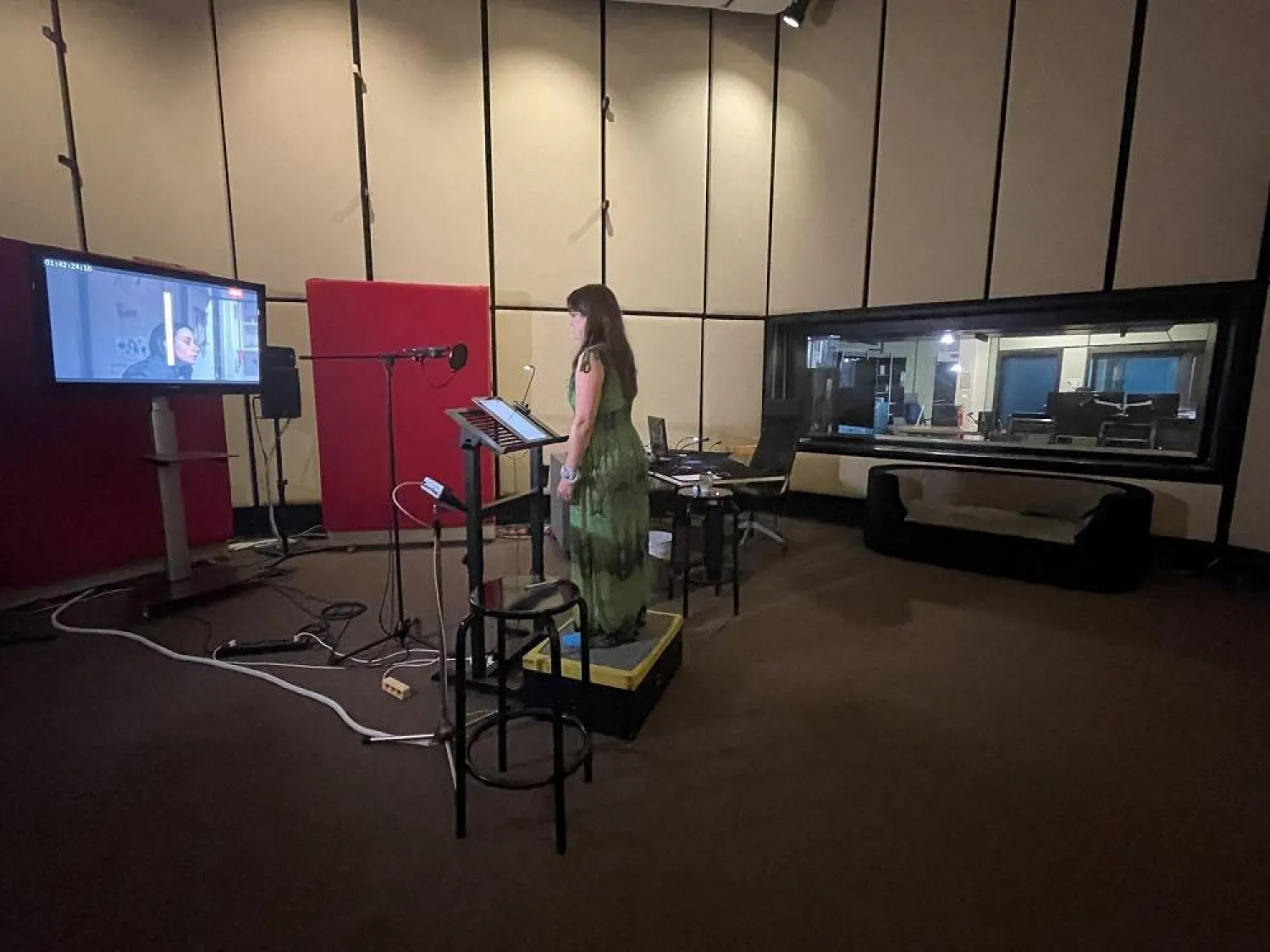
Synchronous speaker Bettina Zech stands in a dubbing studio in Munich, July 2, 2025. (Reuters) 
TT

Voice Actors Push Back as AI Threatens Dubbing Industry 

Synchronous speaker Bettina Zech stands in a dubbing studio in Munich, July 2, 2025. (Reuters) 

Boris Rehlinger may not turn heads on the streets of Paris, but his voice is instantly recognizable to millions of French filmgoers.

As the French voice of Ben Affleck, Joaquin Phoenix, and even Puss in Boots, Rehlinger is a star behind the scenes — and now he is fighting to keep his craft alive in the age of AI.

"I feel threatened even though my voice hasn't been replaced by AI yet," the actor, who is part of a French initiative, TouchePasMaVF, to protect human-created dubbing from artificial intelligence, told Reuters.

He said there was a team of professionals, including actors, translators, production directors, dialogue adapters and sound engineers, to ensure audiences barely notice that the actor on screen is speaking a different language than they hear.

The rise of global streaming platforms such as Netflix, which relies heavily on dubbing to make global hits such as "Squid Game" and "Lupin", has amplified demand.

Consumer research firm GWI says 43% of viewers in Germany, France, Italy and Britain prefer dubbed content over subtitles.

The market is expected to grow to $4.3 billion in 2025, reaching $7.6 billion by 2033, according to Business Research Insights.

That growth could also amplify demand for the so-far nascent technology-based solutions, with platforms competing for subscribers and revenue, and seeking to win over advertisers from their rivals by emphasizing their increasing reach.

But as AI-generated voices become more sophisticated and cost-effective, voice actor industry associations across Europe are calling on the EU to tighten regulations to protect quality, jobs and artists' back catalogues from being used to create future dubbed work.

"We need legislation: Just as after the car, which replaced the horse-drawn carriage, we need a highway code," Rehlinger said.

Worries over technology in the movie industry and whether it will replace the work of humans are not new. AI has been a flashpoint in Hollywood since the labor unrest of 2023, which resulted in new guidelines for the use of the technology.

Netflix co-CEO Ted Sarandos said this month that the company used generative AI to produce visual effects for the first time on screen in the original series "El Eternauta (The Eternaut)".

It has also tested GenAI to synchronize actors' lip movements with dubbed dialogue to improve the viewing experience, according to three sources familiar with the work.

These experiments rely on local voice actors to deliver the lines, rather than use AI to synthetically translate the on-screen performer's voice into another language.

Such a use of AI for dubbing is permitted under the new SAG-AFTRA actors' union contract, which covers voice-over dubbing from foreign languages into English. It also requires that the actor rendering the dubbing service be paid.

Netflix declined to comment on its use of AI in dubbing when asked by Reuters.

INTELLECTUAL PROPERTY

Such test-runs by an industry giant will do little to allay the fears of dubbing actors.

In Germany, 12 well-known dubbing actors went viral on TikTok in March, garnering 8.7 million views, for their campaign saying: "Let's protect artistic, not artificial, intelligence".

A petition from the VDS voice actors' association calling on German and EU lawmakers to push AI companies to obtain explicit consent when training the technology on artists' voices and fairly compensate them, as well as transparently label AI-generated content, gained more than 75,500 signatures.

When intellectual property is no longer protected, no one will produce anything anymore "because they think 'tomorrow it will be stolen from me anyway'," said Cedric Cavatore, a VDS member who has dubbed films and video games including the PlayStation game "Final Fantasy VII Remake".

VDS collaborates with United Voice Artists, a global network of over 20,000 voice actors advocating for ethical AI use and fair contracts.

In the United States, Hollywood video game voice and motion capture actors this month signed a new contract with video game studios focused on AI that SAG-AFTRA said represented important progress on protections against the tech.

STUDIOS EXPERIMENT

Some studios are already cautiously exploring AI.

Eberhard Weckerle, managing director of the Neue Tonfilm Muenchen studio, hopes AI and human dubbing can one day coexist.

"The fear is that AI will be used to make something as cheap as possible and then people will say, 'Okay, I'll accept that I'll have poorer quality'. And that would actually be the worst thing that could happen to us," said the sound engineer whose studio worked on the German version of "Conclave" and is currently dubbing Guy Ritchie's new film.

Earlier this year, the German-dubbed version of streaming service Viaplay's Polish crime series "Murderesses" was removed after criticism from viewers about the monotony of its AI-generated dialogue.

The streamer had decided to look into alternative dubbing options due to how prohibitively expensive going through the traditional channels can be in Germany.

The hybrid dubbing, created with Israeli startup DeepDub, used a mix of human and AI voices. DeepDub did not respond to an emailed request for comment.

"We'll continue offering subtitles and reserve dubbing for select content," said Vanda Rapti, the executive vice president of ViaPlay Group, ViaPlay Select & Content distribution.

Despite the disquiet over that series, other potential viewers seem more sanguine. According to GWI, nearly half of viewers said their opinion would not change if they learned that the content they liked was generated by AI.

Some 25% said they would like it slightly less, and only 3% said they would like it much more.

'INTEREST IS HUGE'

Stefan Sporn, CEO of Audio Innovation Lab, which used AI to dub the Cannes Film Festival entry "Black Dog" from Chinese to German, believes AI will reshape, but not replace, voice work.

Humans will always be needed for emotion, scripting, and language nuance, he said, "just not to the same extent".

Audio Innovation Lab's technology alters the original actor's voice to match the target language, aiming for authenticity and efficiency.

"Interest is huge," said Sporn, adding that producers, studios and advertisers all want to know how well it works.

Another startup, Flawless AI, bills itself as an ethical AI company that works with local voice actors and uses its technology to match the on-screen actor's lip movements to the different languages.

"When AI technologies are used in the right way, they are a silver bullet to change how we can film-make in a new way," co-CEO Scott Mann said.



Hollywood Stars Gather for an All-Winners Celebration at the American Film Institute Awards

Leonardo DiCaprio takes the stage to accept the award for Outstanding Performance by a Male Actor in a Leading Role for his role in "The Revenant" at the 22nd Screen Actors Guild Awards in Los Angeles, California January 30, 2016.(Reuters)
TT

Hollywood Stars Gather for an All-Winners Celebration at the American Film Institute Awards

Leonardo DiCaprio takes the stage to accept the award for Outstanding Performance by a Male Actor in a Leading Role for his role in "The Revenant" at the 22nd Screen Actors Guild Awards in Los Angeles, California January 30, 2016.(Reuters)

If the American Film Institute Awards stands for anything, it's that everyone in the room - from Leonardo DiCaprio and Ryan Coogler to Timothée Chalamet and Ariana Grande - leaves feeling like a winner.

That spirit was on full display Friday as the AFI Awards gathered its 2026 honorees for an invitation-only luncheon in Beverly Hills, where the institute once again celebrated the collaborative nature of film and television by honoring creative teams - in front of and behind the camera.

Inside the ballroom, there were no acceptance speeches in the traditional sense and no suspense over envelopes. Instead, AFI's ceremony unfolded as a series of thoughtfully written tributes: eloquent rationales for each honored film and television program, followed by brief clips designed to place the year's work within a broader cultural and artistic context.

AFI President Bob Gazzale spoke in front of star-filled room, ensuring there were no losers with only shared recognition.

The room reflected that mood. Filmmaker Steven Spielberg was spotted chatting with Coogler, whose wife and "Sinners" producer, Zinzi Coogler, stood beside him. Meanwhile, Michael B. Jordan worked the room, trading hugs and handshakes with fellow honorees and guests including "Bugonia" star Jesse Plemons and "Task" actor Mark Ruffalo. Filmmakers James Cameron and Guillermo del Toro greeted each other.

Nearby, DiCaprio stood side by side with Netflix co-CEO Ted Sarandos and actors Benicio del Toro and Edward James Olmos. Chase Infiniti looked on from her table, gazing toward her "One Battle After Another" co-stars before the program kicked off.

On the red carpet, with "Death by Lightning" actor Nick Offerman beside him, George Clooney shared laughs with a photographer, adding to the easygoing tone that carried throughout the afternoon. After the event, Infiniti and Jordan reunited for a hug and a brief catch-up, a quiet moment that underscored the camaraderie in the room.

Films honored include "Avatar: Fire and Ash,Bugonia,Frankenstein,Hamnet,Jay Kelly,Marty Supreme,One Battle After Another,Sinners,Train Dreams" and "Wicked: For Good."

Television shows recognized were "Adolescence,Andor,Death by Lightning,The Diplomat,The Lowdown,The Pitt,Severance,The Studio" and "Task."

Closing the ceremony was Carol Burnett, who delivered AFI's annual benediction, celebrating the honorees' achievements while reflecting on her own lifelong love of cinema and television.

"I've never lost the deep respect and love that I have for all the stories we tell through cinema and television and by all of those behind and in front of the camera," Burnett said. "Creative collaboration has always remained at the heart of our work, and AFI brings us all together. The world is a better place for having heard your voices."

The luncheon also featured AFI's signature March of Time video montage, a sweeping look at cinematic and television milestones from decades past, situating this year's honorees within the evolving history of the medium.


K-Pop Might Win at the Grammys for the First Time

Grammy Awards are displayed at the Grammy Museum Experience at Prudential Center in Newark, N.J. on Oct. 10, 2017. (AP)
TT

K-Pop Might Win at the Grammys for the First Time

Grammy Awards are displayed at the Grammy Museum Experience at Prudential Center in Newark, N.J. on Oct. 10, 2017. (AP)

Two things can be true at once. K-pop is an inextricable force in global pop culture, and it has long been undercelebrated at institutions like the Grammys — where K-pop artists have performed but have never taken home a trophy.

That could change at next month's 2026 Grammy Awards ceremony. Songs released by K-pop artists — or K-pop-adjacent artists, more on that later — have received nominations in the big four categories for the first time. Rosé, perhaps best known as one-fourth of the juggernaut girl group Blackpink, is the first K-pop artist to ever receive a nomination in the record of the year field for “APT.,” her megahit with Grammys' favorite Bruno Mars.

The song of the year category also features K-pop nominees for the first time. “APT.” will go head-to-head with the fictional girl group HUNTR/X's “Golden,” performed by Ejae, Audrey Nuna and Rei Ami from the “KPop Demon Hunters” soundtrack.

And the girl group Katseye, the brain child of HYBE — the entertainment company behind K-pop sensation BTS and countless other international acts — fashioned in the image of the K-pop idol system, has been nominated for best new artist.

Is this a historic moment for K-pop? It depends on who you ask.

Areum Jeong, assistant professor of Korean Studies at Arizona State University and author of “K-pop Fandom: Performing Deokhu from the 1990s to Today” says the majority of these nominations strike her more as “a de-territorialized, hybrid idea of K-pop,” instead of a recognition of K-pop.

While Rosé “was recruited and trained under the K-pop system, and while ‘APT.’ does contain some motifs from the Korean drinking game,” Jeong says, “the song does not feel like a localized K-pop production. ... Same with Katseye, who was trained and produced under HYBE but marketed more toward Western fans and listeners.”

Jeong says that both “APT.” and Katseye's “Gabriela” — both of which will go head-to-head with “Golden” in the pop duo/group performance category — “seem less K-pop than other K-pop songs that could have been nominated over the years.”

She argues the same is true for the music of “Kpop Demon Hunters.” “It is very similar to ‘APT.’ in that it takes inspiration and motif from Korean culture,” where “K-pop serves as an idea, a jumping-off point, or a motif, creating alternatives or new possibilities.”

Mathieu Berbiguier, a visiting assistant professor in Korean Studies at Carnegie Mellon University, points out that these nominations differ from past K-pop Grammy nominations because “Golden,” “APT.” and Katseye all feature “a mainstream popular music factor.”

That's the connection of a massive popular Netflix film (“Kpop Demon Hunters”), a collaboration with Bruno Mars (“APT.”), and Katseye's international membership and Netflix series (“Pop Star Academy: Katseye”), respectively.

“It tells you that K-pop is not considered as something niche anymore,” he says. “Now, when we think about pop music in general, we also think of K-pop as part of it.”

Bernie Cho, industry expert and president of the South Korean agency, the DFSB Kollective, agrees that there is an international, mainstream appeal to the nominees.

“All the nominees represent a sort of post-idol K-pop, in the sense that Rosé, the three ladies of HUNTR/X and Katseye represent the globalized version of K-pop, where the ‘K’ is very much there, but some people might argue it’s silent. The songs are not necessarily for Korea, by Korea, from Korea, just kind of beyond Korea,” he says. “It’s a celebration and testament to how diverse and dynamic K-pop has become.”

Why are these acts being recognized now? “For years, the Recording Academy has snubbed K-pop acts that have set record-breaking standards, such as BTS, Seventeen and Stray Kids,” argues Jeong. “I think one of the main reasons is that the Western world is still so resistant to non-English lyrics.”

“It does not surprise me that ‘APT.’ and Katseye’s music, which mainly contain English lyrics and seem less K-pop, were nominated,” she continues.

Berbiguier adds that “is a reflection of K-pop nowadays, like, trends: the fact that there’s less and less Korean and more and more English.”

There may be an additional factor at play. Tamar Herman, a music journalist and author of the “Notes on K-pop” newsletter, says many critics and industry voices found 2025 to be a lackluster year for new pop music in the US — a fact that was all but confirmed in Luminate's 2025 Mid-Year Report, which found that streams of new music had slowed compared to the year prior, potentially due to a dearth of megahits dominating the charts.

“Yes, it's a big moment for K-pop, but it is so overdue, these recognitions are more of a sign of how poorly the music industry in the US did this year that we're looking externally,” she says.

She argues that acknowledgment of Korean entertainment from US entertainment industries is more symbolic of US cultural dominance slipping than “K-pop being really good, because K-pop has been really good for a really long time,” she says. “This is all recognition of just global storytelling improvement, global taste-making improvement.”

“I don't want to diminish it,” she adds. “These are all universally friendly, accessible, good pop songs.”

And if they weren't, they wouldn't connect.

“It's very obvious that they’re not just performers. They're artists. They're singers. They're songwriters,” says Cho.

Will a K-pop artist win a Grammy for the first time this year? The jury is still out.

“I think it’s not even a matter of if or when. It’s going to be who and how many,” says Cho.

Others are less committal. “It's hard to predict,” says Berbiguier. “For me, it's more possible that ‘Golden’ gets one.”

“Yes and no,” offers Herman. For her, it depends on an evolving and fluid definition of K-pop. After all, HUNTR/X is a fictional girl group from an animated film that did not debut through the K-pop music industry system. Would a victory for their song “Golden” mean a victory of K-pop? That's a matter of opinion.


Warner Bros Rejects Revised Paramount Bid as Risky Leveraged Buyout

A drone view shows the Warner Bros. studio lot in Burbank, California, US, December 8, 2025. (Reuters)
TT

Warner Bros Rejects Revised Paramount Bid as Risky Leveraged Buyout

A drone view shows the Warner Bros. studio lot in Burbank, California, US, December 8, 2025. (Reuters)

Warner Bros Discovery's board has unanimously turned down Paramount Skydance's latest attempt to acquire the studio, saying its revised $108.4 billion hostile bid amounted to a risky leveraged buyout that investors should reject.

In a letter to shareholders on Wednesday, Warner ​Bros' board said Paramount's offer hinges on "an extraordinary amount of debt financing" that heightens the risk of closing. It reaffirmed its commitment to streaming giant Netflix's $82.7 billion deal for the film and television studio and other assets.

Paramount and Netflix have been vying to win control of Warner Bros, and with it, its prized film and television studios and its extensive content library. Its lucrative entertainment franchises include "Harry Potter", "Game of Thrones", "Friends" and the DC Comics universe, as well as coveted classic films such as "Casablanca" and "Citizen Kane."

Paramount's financing plan would saddle the smaller Hollywood studio with $87 billion in debt once the acquisition closed, making it the largest leveraged buyout in history, the Warner Bros board told shareholders after voting against the $30-per-share cash offer on Tuesday.

The letter accompanied a 67-page amended merger filing where it laid out its case for rejecting Paramount's offer.

The ‌revised Paramount offer "remains inadequate particularly ‌given the insufficient value it would provide, the lack of certainty in PSKY’s ability ‌to ⁠complete ​the offer, ‌and the risks and costs borne by WBD shareholders should PSKY fail to complete the offer," the Warner Bros board wrote.

Paramount, which has a market value of about around $14 billion, proposed to use $40 billion in equity personally guaranteed by Oracle's billionaire co-founder Larry Ellison and $54 billion in debt to finance the deal.

Its financing plan would further weaken its credit rating, which S&P Global already rates at junk levels, and strain its cash flow – heightening the risk that the deal will not close, the Warner Bros board said.

Netflix, which has offered $27.75 a share in cash and stock, has a $400 billion market value and investment-grade credit rating.

The decision keeps Warner Bros on track to pursue the deal with Netflix, even after Paramount amended its bid on ⁠December 22 to address the earlier concerns about the lack of a personal guarantee from Ellison, who is Paramount's controlling shareholder and the father of its CEO David Ellison.

Warner Bros shares ‌closed at $28.47 on Tuesday.

HIGH BREAK-UP FEES

Wednesday's filing said Warner Bros' board met on ‍December 23 to review Paramount's amended offer and noted some improvements, including ‍Ellison's personal guarantee and a higher reverse termination fee of $5.8 billion, but found "significant costs" associated with Paramount's bid compared with a Netflix ‍deal.

Warner Bros would be obligated to pay the streaming service a $2.8 billion termination fee for abandoning its merger agreement with Netflix, $1.5 billion in fees to its lenders and about $350 million in additional financing costs.

Altogether, Warner Bros said it would incur about $4.7 billion in additional costs to terminate its deal with Netflix, or $1.79 per share.

The board repeated some concerns it had laid out on December 17, such as that Paramount would impose operating restrictions on the studio ​that would harm its business and competitive position, including barring the planned spin-out of the company's cable television networks into a separate public company, Discovery Global.

Paramount offered "insufficient compensation" for the damage done to the studio's business, if the Paramount ⁠deal failed to close, Warner Bros said.

Paramount "repeatedly failed to submit the best proposal" to Warner Bros shareholders, the board wrote, "despite clear direction" on the deficiencies in its bid and potential solutions.

TILTING THE POWER BALANCE IN HOLLYWOOD

The jockeying for Warner Bros has become Hollywood's most closely watched takeover battle, as studios race to scale up amid intensifying competition from streaming platforms and volatile theatrical revenues.

While Netflix's offer has a lower headline value, analysts have said it presents a clearer financing structure and fewer execution risks than Paramount's bid for the entire company, including its cable TV business.

Harris Oakmark, Warner Bros' fifth-largest investor, previously told Reuters that Paramount's revised offer was not "sufficient," noting it was not enough to cover the breakup fee.

Paramount has argued its bid would face fewer regulatory obstacles, but a combined Paramount-Warner Bros entity would create a formidable competitor to industry leader Disney and merge two major television operators and two streaming services.

The valuation of Warner Bros' planned Discovery Global spin-off, which includes cable television networks CNN, TNT Sports and the Discovery+ streaming service, is seen as a major sticking point.

Analysts peg the cable channels' value at up to $4 per share, while Paramount has suggested just $1.

Lawmakers ‌from both parties have raised concerns about further consolidation in the media industry, and US President Donald Trump has said he plans to weigh in on the landmark acquisition.