


Internal Divisions Prevent EU From Imposing Collective Sanctions on Israel

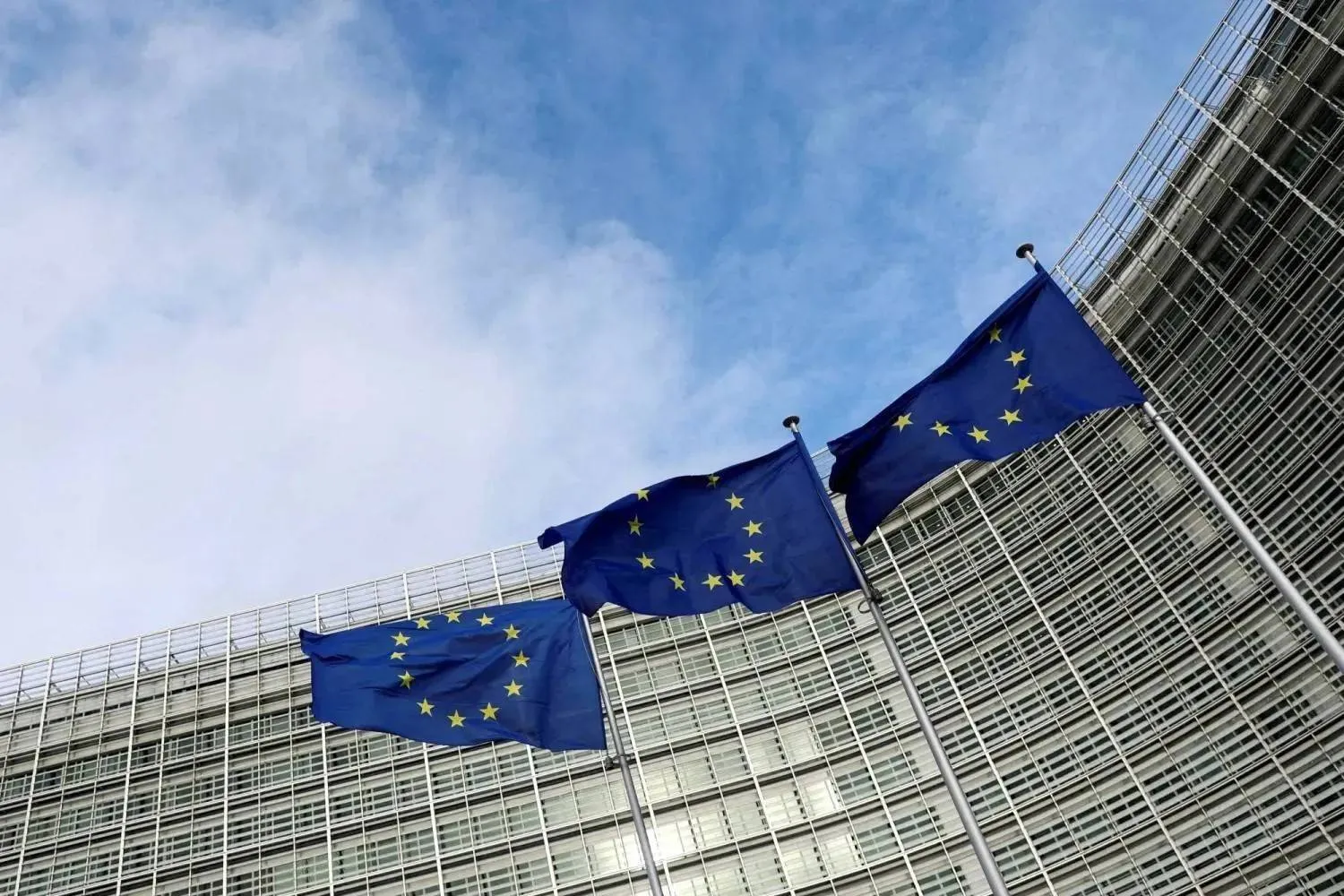
European Union flags fly outside the European Commission in Brussels, Belgium (Reuters) 
TT

Internal Divisions Prevent EU From Imposing Collective Sanctions on Israel

European Union flags fly outside the European Commission in Brussels, Belgium (Reuters) 

Last Monday, after much hesitation, the European Commission recommended curbing Israeli access to its flagship research funding after calls from EU countries to increase pressure on Israel to alleviate the humanitarian crisis in Gaza.

Since the beginning of June, the Netherlands requested the Commission to investigate Israel's compliance with Article 2 of the EU-Israel Association Agreement, which requires respect for human rights and democratic principles. Sweden also voiced support for this review.

On June 23, EU High Representative for Foreign Affairs and Security Policy, Kaja Kallas recognized in her report human rights violations by Israel in Gaza.

Horizon Europe

Horizon Europe is the EU's key funding program for research and innovation. Until last Monday, the European Commission had not taken any action or decision against Israel although over 60,000 Palestinians have been killed in the 21-month Israel-Hamas war.

Therefore, the Commission's latest proposal is the first collective practical step by the European Union to counter Israel’s actions in the Strip.

But the proposal needs approval from a qualified majority of EU countries to take effect - at least 15 of the EU's 27 members, representing at least 65% of its population.

Reports indicate that the Commission’s proposal was already blocked by four countries, primarily Germany, Italy, Hungary, and the Czech Republic.

It is worth noting that the EU has not collectively or officially condemned Israel's actions in Gaza and that its only unanimous measure and “symbolic” sanctions on settlers in the West Bank, has not stopped the settlement movement or violence.

This week, the Commission said the proposal would impact the participation of Israeli entities in the bloc's European Innovation Council Accelerator “which targets start-ups and small businesses with disruptive innovations and emerging technologies that have potential dual-use applications, such as in cybersecurity, drones, and artificial intelligence.”

A European Commission official said “Israel relies heavily, in its war on Gaza, on artificial intelligence and the increased use of drones.”

Israel has sensed the mounting pressure. The country’s President Isaac Herzog wrote on X that “it will be a huge mistake if EU takes such steps, especially in light of Israel’s ongoing and upgraded humanitarian efforts.”

It is not clear what “effort” Herzog was talking about. He fears that such a measure “would hurt Israel's image and open the door to other punitive measures.”

Also, Israel's foreign ministry said in a post on social media platform X on Monday that the Commission's move was “mistaken, regrettable, and unjustified” and that it hoped EU member countries would not adopt the proposal.

Europe’s Achilles Heel

It is no secret that splits among European countries is preventing the Union from playing an active role in the Gaza war and, more generally, in the Middle East crisis.

Some European countries want to resort to tough measures against Israel. Sweden, which recognizes the Palestinian state since 2015, called on the European Union to suspend the trade component of the bloc’s Association Agreement with Israel.

“The situation in Gaza is utterly deplorable, and Israel is not fulfilling its most basic obligations and agreed-upon commitments regarding humanitarian aid,” Swedish Prime Minister Ulf Kristersson said on X.

“Sweden therefore demands that the EU, as soon as possible, freezes the trade component of the association agreement,” Kristersson added. “Economic pressure on Israel must increase. The Israeli government must allow unrestricted humanitarian aid in Gaza.”

His Dutch counterpart, Dick Schoof, said Monday that the Netherlands is prepared to support suspending Israel’s participation in the European Union’s Horizon research program if Brussels determines that Israel is obstructing humanitarian aid access to Gaza.

Meanwhile, Slovenia announced last Thursday that it will ban all weapons trade with Israel over the war in Gaza, in what it said is a first by a European Union nation.

As of now, 12 EU member states recognize an independent state of Palestine. Others like France, Portugal, Malta, Luxembourg and Finland could join next month.

But this support does not mean that the EU member states would reach a qualified majority to suspend Israel’s participation in the Horizon program. Major countries, such as Germany, Italy and Austria block such plans.

CSU Secretary-General Martin Huber has categorically ruled out sanctions against Israel by the German government.

In an interview with Redaktionsnetzwerk Deutschland, Huber said that criticizing the Israeli government is legitimate, “but sanctions between friends are out of the question.”


Russia Hits Energy System in Several Regions of Ukraine, Kyiv Says

Local residents gather around a bonfire during an outdoor party to keep warm as many apartments remain without heating in Kyiv on January 18, 2026, amid the Russian invasion of Ukraine. (AFP)
TT

Russia Hits Energy System in Several Regions of Ukraine, Kyiv Says

Local residents gather around a bonfire during an outdoor party to keep warm as many apartments remain without heating in Kyiv on January 18, 2026, amid the Russian invasion of Ukraine. (AFP)

Russia launched a barrage of drone strikes on Ukraine's energy infrastructure overnight on Monday, cutting off power in five regions ​across the country amid freezing temperatures and high demand, Ukrainian officials said.

The Ukrainian air force said that Russian troops had launched 145 drones. Air defense units shot down 126 of them, it said.

"As of this morning, consumers in Sumy, Odesa, Dnipropetrovsk, Kharkiv, and Chernihiv regions are without power," the energy ministry said in a statement. "Emergency repair ‌work is ‌underway if the security situation ‌allows."

In ⁠the ​southern ‌Odesa region, energy and gas infrastructure was damaged, the regional governor said, adding that one person was hurt in the attack.

DTEK, Ukraine's largest private energy company, said its energy facility in Odesa was "substantially" damaged, knocking out power for 30,800 households.

A local power grid company in northern Chernihiv region said that ⁠five important energy facilities were damaged, leaving tens of thousands of consumers ‌without power.

Russia also hit Ukraine's second-largest ‍city of Kharkiv with missiles ‍on Monday morning, significantly damaging a critical infrastructure facility, ‍Mayor Ihor Terekhov said.

Moscow has stepped up a winter campaign of strikes on the Ukrainian energy system, including generation, electricity transmission and gas production facilities, amid freezing temperatures that complicate repair works.

The ​attacks have caused long blackouts.

"Being without electricity for more than 16 hours is awful," Serhii Kovalenko, ⁠CEO of energy distribution company Yasno, said on Facebook late on Sunday. "And it's not because of the energy companies, but because of cynical attacks by the enemy, who is trying to create a humanitarian disaster."

Ukraine declared an energy emergency last week as its grid crumbled due to accumulated wartime damage and a new targeted wave of Russian bombardments.

Energy Minister Denys Shmyhal said on Monday the government would implement projects to improve electricity transmission from the western part ‌of the country to its power-hungry east.


‘Not Right’ for Iran to Attend Davos Summit After Deadly Protests, Say Organizers

Iranian Foreign Minister Abbas Araghchi speaks in a joint press briefing with his Iraqi counterpart Fuad Hussein in Tehran, Iran, Sunday, Jan. 18, 2026. (AP)
TT

‘Not Right’ for Iran to Attend Davos Summit After Deadly Protests, Say Organizers

Iranian Foreign Minister Abbas Araghchi speaks in a joint press briefing with his Iraqi counterpart Fuad Hussein in Tehran, Iran, Sunday, Jan. 18, 2026. (AP)

Iran's foreign minister will not be attending the Davos summit in Switzerland this week, the organizers said Monday, stressing it would not be "right" after the recent deadly crackdown on protesters in Iran.

Abbas Araghchi had been scheduled to speak on Tuesday during the annual gathering of the global elite at the upscale Swiss ski resort town.

But activists have been calling on the World Economic Forum organizers to disinvite him amid what rights groups have called a "massacre" in his country.

"The Iranian Foreign Minister will not be attending Davos," the World Economic Forum said on X.

"Although he was invited last fall, the tragic loss of lives of civilians in Iran over the past few weeks means that it is not right for the Iranian government to be represented at Davos this year," it added.

Demonstrations sparked by anger over economic hardship exploded into protests late December in what has been widely seen as the biggest challenge to the Iranian leadership in recent years.

The rallies subsided after a government crackdown under the cover of a communications blackout that started on January 8.

Norway-based Iran Human Rights says it has verified the deaths of 3,428 protesters killed by security forces, confirming cases through sources within the country's health and medical system, witnesses and independent sources.

The NGO warned that the true toll is likely to be far higher. Media cannot independently confirm the figure and Iranian officials have not given an exact death toll.


Iran to Consider Lifting Internet Ban; State TV Hacked

People walk past a burnt-out building destroyed during public protests in the Iranian capital Tehran on January 19, 26. (AFP)
TT

Iran to Consider Lifting Internet Ban; State TV Hacked

People walk past a burnt-out building destroyed during public protests in the Iranian capital Tehran on January 19, 26. (AFP)

Iran may lift its internet blackout in a few days, a senior parliament member said on Monday, after authorities shut communications while they used massive force to crush protests in the worst domestic unrest since ​the 1979 revolution.

In the latest sign of weakness in the authorities' control, state television appeared to be hacked late on Sunday, briefly showing speeches by US President Donald Trump and the exiled son of Iran's last shah calling on the public to revolt.

Iran's streets have largely been quiet for a week since anti-government protests that began in late December were put down in three days of mass violence.

An ‌Iranian official ‌told Reuters on condition of anonymity that the ‌confirmed ⁠death ​toll ‌was more than 5,000, including 500 members of the security forces, with some of the worst unrest taking place in ethnic Kurdish areas in the northwest. Western-based Iranian rights groups also say thousands were killed.

Opponents accuse the authorities of opening fire on peaceful demonstrators to crush dissent. Iran's clerical rulers say armed crowds egged on by foreign enemies attacked hospitals and mosques.

The death tolls dwarf ⁠those of previous bouts of anti-government unrest put down by the authorities in 2022 and 2009. ‌The violence drew repeated threats from Trump ‍to intervene militarily, although he has backed ‍off since the large-scale killing stopped.

INTERNET TO RETURN WHEN 'CONDITIONS ARE APPROPRIATE'

Ebrahim ‍Azizi, the head of parliament's National Security and Foreign Policy Committee, said top security bodies would decide on restoring internet in the coming days, with service resuming "as soon as security conditions are appropriate".

Another parliament member, hardliner Hamid Rasaei, said authorities should ​have listened to earlier complaints by Supreme Leader Ali Khamenei about "lax cyberspace".

Iranian communications including internet and international phone lines were ⁠largely stopped in the days leading up to the worst unrest. The blackout has since partially eased, allowing accounts of widespread attacks on protesters to emerge.

During Sunday's apparent hack into state television, screens broadcast a segment lasting several minutes with the on-screen headline "the real news of the Iranian national revolution".

It included messages from Reza Pahlavi, the US-based son of Iran's last shah, calling for a revolt to overthrow rule by the clerics who have run the country since the 1979 revolution that toppled his father.

Pahlavi has emerged as a prominent opposition voice and has said he plans ‌to return to Iran, although it is difficult to assess independently how strong support for him is inside Iran.
