


Israeli Forces Kills over 20 People Seeking Food in Gaza, Witnesses and Health Officials Say

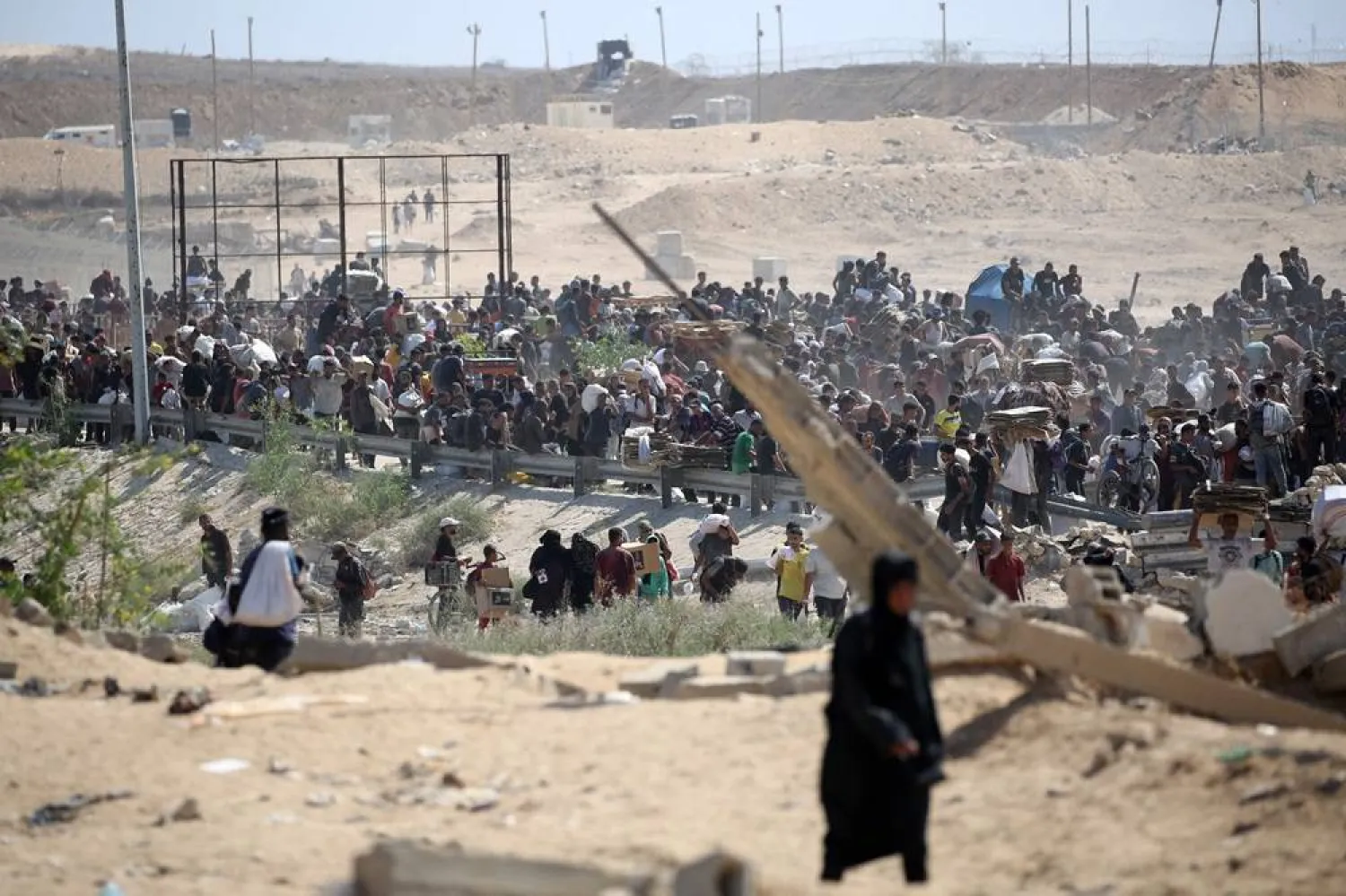
Palestinians return with bags, boxes and wooden pallets from a food distribution point run by the US and Israeli-backed Gaza Humanitarian Foundation (GHF) group, near the Netsarim corridor in the central Gaza Strip on August 3, 2025. (AFP)
TT

Israeli Forces Kills over 20 People Seeking Food in Gaza, Witnesses and Health Officials Say

Palestinians return with bags, boxes and wooden pallets from a food distribution point run by the US and Israeli-backed Gaza Humanitarian Foundation (GHF) group, near the Netsarim corridor in the central Gaza Strip on August 3, 2025. (AFP)

Israeli forces killed at least 23 Palestinians seeking food on Sunday in the Gaza Strip, according to hospital officials and witnesses, who described facing gunfire as hungry crowds surged around aid sites as the malnutrition-related death toll surged.

Desperation has gripped the Palestinian territory of more than 2 million, which experts have warned is at risk of famine because of Israel’s blockade and nearly two-year offensive.

Yousef Abed, among the crowds en route to a distribution point, described coming under what he called indiscriminate fire, looking around and seeing at least three people bleeding on the ground.

“I couldn’t stop and help them because of the bullets,” he said.

Southern Gaza’s Nasser Hospital said they had received bodies from near multiple distribution sites, including eight from Teina, about three kilometers (1.8 miles) away from a distribution site in Khan Younis, which is operated by the Gaza Humanitarian Foundation, a private US and Israeli-backed contractor that took over aid distribution more than two months ago.

The hospital also received one body from Shakoush, an area hundreds of meters (yards) north of a different GHF site in Rafah. Another nine were also killed by troops near the Morag corridor, who were awaiting trucks entering Gaza through an Israeli border crossing, it said.

Three Palestinian eyewitnesses, seeking food in Teina and Morag, told The Associated Press the shootings occurred on the route to the distribution points, which are in military zones secured by Israeli forces. They said they saw soldiers open fire on hungry crowds advancing toward the troops.

Further north in central Gaza, hospital officials described a similar episode, with Israeli troops opening fire Sunday morning toward crowds of Palestinians trying to GHF’s fourth and northernmost distribution point.

“Troops were trying to prevent people from advancing. They opened fire and we fled. Some people were shot,” said Hamza Matter, one of the aid seekers.

At least five people were killed and 27 wounded at GHF’s site near Netzarim corridor, Awda Hospital said.

Eyewitnesses seeking food in the strip have reported similar gunfire attacks in recent days near aid distribution sites, leaving dozens of Palestinians dead.

The United Nations reported 859 people have been killed near GHF sites from May 27 to July 31 and that hundreds more have been slain along the routes of UN-led food convoys.

The GHF launched in May as Israel sought an alternative to the UN-run system, which had safely delivered aid for much of the war but was accused by Israel of allowing Hamas, which guarded convoys early in the war, to siphon supplies.

Israel has not offered evidence of widespread theft. The UN has denied it.

GHF says its armed contractors have only used pepper spray or fired warning shots to prevent deadly crowding. Israel’s military has said it only fires warning shots as well. Both claimed the death tolls have been exaggerated

Neither Israel’s military nor GHF immediately responded to questions about Sunday's reported fatalities.

Meanwhile, the Gaza health ministry also said six more Palestinian adults died of malnutrition-related causes in the Gaza Strip in the past 24 hours. This brings the death toll among Palestinian adults to 82 in the past five weeks since the ministry started counting deaths among adults in late June, it said.

Ninety-three children have also died of causes related to malnutrition since the war in Gaza started in 2023, the ministry said.

The war began when Hamas attacked southern Israel on Oct. 7, 2023, killing about 1,200 people, and abducted another 251. They are still holding 50 captives, around 20 believed to be alive, after most of the rest were released in ceasefires or other deals. Israel’s retaliatory military offensive has killed more than 60,400 Palestinians, according to Gaza’s Health Ministry.

The ministry, which doesn’t distinguish between civilians and combatants in its count, is staffed by medical professionals. The United Nations and other independent experts view its figures as the most reliable count of casualties. Israel has disputed its figures, but hasn’t provided its own account of casualties.



Israel Meets Lebanon’s Diplomatic Overture with Strikes on the South

Smoke rises following Israeli airstrikes that targeted the Nabatieh area in May 2025 (Archive – EPA). 
TT

Israel Meets Lebanon’s Diplomatic Overture with Strikes on the South

Smoke rises following Israeli airstrikes that targeted the Nabatieh area in May 2025 (Archive – EPA). 

Israel on Thursday ended days of ambiguity over whether the recent “positive atmosphere” created by civilian negotiations with Lebanon might ease tensions. Instead, it launched four airstrikes targeting homes in South Lebanon, including one north of the Litani River.

The attacks came less than 24 hours after the latest meeting of the joint “mechanism” committee.

The escalation appeared to answer leaked Lebanese reports that Ambassador Simon Karam, head of Lebanon’s negotiating delegation, had been tasked with discussing a cessation of hostilities, a prisoner exchange, Israeli withdrawal from occupied Lebanese areas, and technical adjustments along the Blue Line.

Al-Jadeed channel quoted President Joseph Aoun as saying Lebanon “has not entered normalization nor signed a peace agreement.”

At Thursday’s cabinet session, Aoun presented his decision to appoint Karam after consultations with Speaker Nabih Berri and Prime Minister Nawaf Salam, stressing the need for talks in Naqoura and for a civilian figure in the delegation.

The initial meeting, he said, “was not expected to be highly productive,” but it paved the way for subsequent sessions beginning on the 19th. “The language of negotiation must replace the language of war,” he added.

Army Commander Gen. Rodolphe Haykal also submitted his monthly report on enforcing the state’s monopoly over arms, outlining operations south of the Litani River. Lebanese media reported a significant step in this direction: the army, accompanied by UNIFIL, reportedly seized Hezbollah rockets in the area.

As Lebanon tries to widen the diplomatic window to contain tensions and avert a large-scale Israeli attack, two contrasting messages have emerged from Israel. One camp welcomed the appointment of Karam, while another insists on separating diplomacy from military operations and preventing negotiations from influencing conditions on the ground.

This harder line became clear when Israeli army spokesperson Avichay Adraee warned residents of Mahrouna, Bar’ashit, al-Majadal (south of the Litani), and Jbaa (north of it) to evacuate at least 300 meters away because the army would soon strike Hezbollah infrastructure across the south.

Hours later, Israel carried out the strikes, saying it targeted depots embedded in residential areas - an example, it claimed, of Hezbollah’s use of civilian buildings for military purposes.

MP Ashraf Rifi told Asharq Al-Awsat that the political and security climate “remains dangerous despite the sense of relief surrounding the negotiations.” Messages from Israeli officials, he said, show that talks “do not automatically halt targeting of Hezbollah or its weapons,” adding that escalation “remains highly possible.”

Rifi said Israel has “a clear strategic project aimed at ending Iranian influence across the Arab region,” and if it concludes that Lebanon cannot disarm Hezbollah, it “may resort to military action.”

He cited the return of Israeli drones over Beirut as proof that Lebanon “remains squarely within the circle of threat.”

MP Akram Chehayeb of the Democratic Gathering said the essential question is whether Israel genuinely seeks peace, given ongoing actions against Palestinians. He argued that a return to the 1949 Armistice framework would be a major gain for Lebanon, recalling earlier negotiation rounds, including those leading to the 2022 maritime agreement.


'Land Without laws': Israeli Settlers Force Bedouins from West Bank Community

AFP visited Ahmed Kaabneh weeks before he was forced to flee his home in the al-Hathrura area. Menahem Kahana / AFP
TT

'Land Without laws': Israeli Settlers Force Bedouins from West Bank Community

AFP visited Ahmed Kaabneh weeks before he was forced to flee his home in the al-Hathrura area. Menahem Kahana / AFP

As relentless harassment from Israeli settlers drove his brothers from their Bedouin community in the central occupied West Bank, Ahmed Kaabneh remained determined to stay on the land his family had lived on for generations.

But when a handful of young settlers constructed a shack around 100 meters above his home and started intimidating his children, 45-year-old Kaabneh said he had no choice but to flee too.

As with scores of Bedouin communities across the West Bank, the small cluster of wood and metal houses where Kaabneh's father and grandfather had lived now lies empty.

"It is very difficult... because you leave an area where you lived for 45 years. Not a day or two or three, but nearly a lifetime," Kaabneh told AFP at his family's new makeshift house in the rocky hills north of Jericho.

"But what can you do? They are the strong ones and we are the weak, and we have no power."

Israel has occupied the West Bank since 1967, and violence there has soared since the Gaza war erupted in October 2023 following Hamas's attack on Israel.

Some 3,200 Palestinians from dozens of Bedouin and herding communities have been forced from their homes by settler violence and movement restrictions since October 2023, the UN's humanitarian agency OCHA reported in October.

The United Nations said this October was the worst month for settler violence since it began recording incidents in 2006.

Almost none of the perpetrators have been held to account by the Israeli authorities.

'Terrifying'

Kaabneh, four of his brothers and their families, now live together some 13 kilometers (eight miles) northeast of their original homes, which sat in the al-Hathrura area.

Outside his freshly constructed metal house, boys kicked a football while washing hung from the line. But Kaabneh said the area didn't feel like home.

"We are in a place we have never lived in before, and life here is hard," he said.

Alongside surging violence, the number of settler outposts has exploded in the West Bank.

While all Israeli settlements are illegal under international law, outposts are also prohibited under Israeli law. But many end up being legalized by the Israeli authorities.

AFP had visited Kaabneh in the al-Hathrura area weeks before he was forced to flee.

On the dirt road to his family's compound, caravans and an Israeli flag atop a hill marked an outpost established earlier this year -- one of several to have sprung up in the area.

On the other side of the track, in the valley, lay the wreckage of another Bedouin compound whose residents had recently fled.

While in Kaabneh's cluster of homes, AFP witnessed two settlers driving to the top of a hill to surveil the Bedouins below.

"The situation is terrifying," Kaabneh said at the time, with life becoming almost untenable because of daily harassment and shrinking grazing land.

Less than three weeks later, the homes were deserted.

Kaabneh said the settlers "would shout all night, throw stones, and walk through the middle of the houses."

"They didn't allow us to sleep at night, nor move freely during the day."

'Thrive on chaos'

These days, only activists and the odd cat wander the remnants of Kaabneh's former life -- where upturned children's bikes and discarded shoes reveal the chaotic departure.

"We are here to keep an eye on the property... because a lot of places that are abandoned are usually looted by the settlements," said Sahar Kan-Tor, 29, an Israeli activist with the Israeli-Palestinian grassroots group Standing Together.

Meanwhile, settlers with a quadbike and digger were busy dismantling their hilltop shack and replacing it with a sofa and table.

"They thrive on chaos," Kan-Tor explained.

"It is, in a way, a land without laws. There (are) authorities roaming around, but nothing is enforced, or very rarely enforced."

A report by Israeli settlement watchdogs last December said settlers had used shepherding outposts to seize 14 percent of the West Bank in recent years.

NGOs Peace Now and Kerem Navot said settlers were acting "with the backing of the Israeli government and military".

Some members of Israel's right-wing government are settlers themselves, and far-right ministers have called for the West Bank's annexation.

Kan-Tor said he believed settlers were targeting this stretch of the West Bank because of its significance for a contiguous Palestinian state.

But Kaabneh said the threat of attacks loomed even in his new location in the east of the territory.

He said settlers had already driven along the track leading to his family's homes and watched them from the hill above.

"Even this area, which should be considered safe, is not truly safe," Kaabneh lamented.

"They pursue us everywhere."


Security Council Delegation in First Visit to Damascus Since 1945

President of Syria's interim government Ahmed Al-Sharaa (C) attends a reception with the UN Security Council delegation at the presidential palace in Damascus, Syria, 04 December 2025. EPA/MOHAMMED AL RIFAI
TT

Security Council Delegation in First Visit to Damascus Since 1945

President of Syria's interim government Ahmed Al-Sharaa (C) attends a reception with the UN Security Council delegation at the presidential palace in Damascus, Syria, 04 December 2025. EPA/MOHAMMED AL RIFAI

Syrian President Ahmad al-Sharaa received on Monday a UN Security Council delegation and several UN officials at the People’s Palace in Damascus.

“Al-Sharaa and the UN delegation discussed the Israeli aggressions on the country’s territory,” said Syria's permanent representative to the United Nations, Ibrahim Olabi.

Olabi described the delegation’s visit as a historic moment, marking the Council’s first unified stance in support of Syria.

He told the state-run news channel, Al-Ikhbariy, that the timing of the visit reflects the Security Council’s recognition of the significant achievements made during the first year of liberation that marked the fall of former Syrian president Bashar Assad.

“The Israeli aggression on Syrian territory was one of the main points discussed by the Syrian President with the UN delegation,” he said.

Olabi stressed that the shift from international division to consensus about Syria represents a major turning point that will move the country from being a source of crisis to a stable nation capable of restoring its role in supporting global peace and security.

The visit of the delegation of representatives from the 15 member states of the Security Council is the first since the council’s founding in 1945.

Syria’s state-run SANA news agency said the delegation visited the heavily war-damaged Damascus suburb of Jobar and historic sites in old Damascus, accompanied by Olabi and Deputy UN Special Envoy for Syria, Najat Rochdi.

The diplomats are to visit neighboring Lebanon on Friday and Saturday.

The visit comes as the UN is working to reestablish itself in Syria and after the Security Council has recently lifted sanctions against al-Sharaa, whose forces led the offensive that toppled Assad in December last year.

In brief remarks to journalists in Damascus, Samuel Zbogar, permanent representative of Slovenia to the UN and president of the Security Council, said the delegation came to Syria to build trust, to support Syria’s efforts toward a better future, and to strengthen the trust of the Syrian people in the work of the Security Council and the United Nations.”

“The international community stands ready to support you whatever you believe that we can be helpful,” Zbogar said, adding: “We want to help build a bridge to this better future for all Syrians.”

He also stressed that the presence of a UN team inside Syria helps provide the country with the necessary tools and expertise to advance toward a more stable and prosperous future.

ON Monday, Zbogar said that “the visit to Syria and Lebanon is the first official visit of the Security Council to the Middle East in six years, the first visit to Syria ever.”

The trip comes “at a crucial time for the region” and for both countries, Zbogar said, noting the new authorities' efforts towards Syria's transition as well as a year-old ceasefire in Lebanon between Israel and Hezbollah “which we see daily that is being challenged.”

He noted that “there's still a bit of lack of trust in the UN-Syria relationship, which we try to breach with this visit.”

UN Secretary-General Antonio Guterres's spokesman Stephane Dujarric said on Tuesday that “we very much hope that the visit will increase the dialogue between the United Nations and Syria.”