


IMF Applauds Saudi Arabia’s Fiscal Policies, Economic Diversification Success

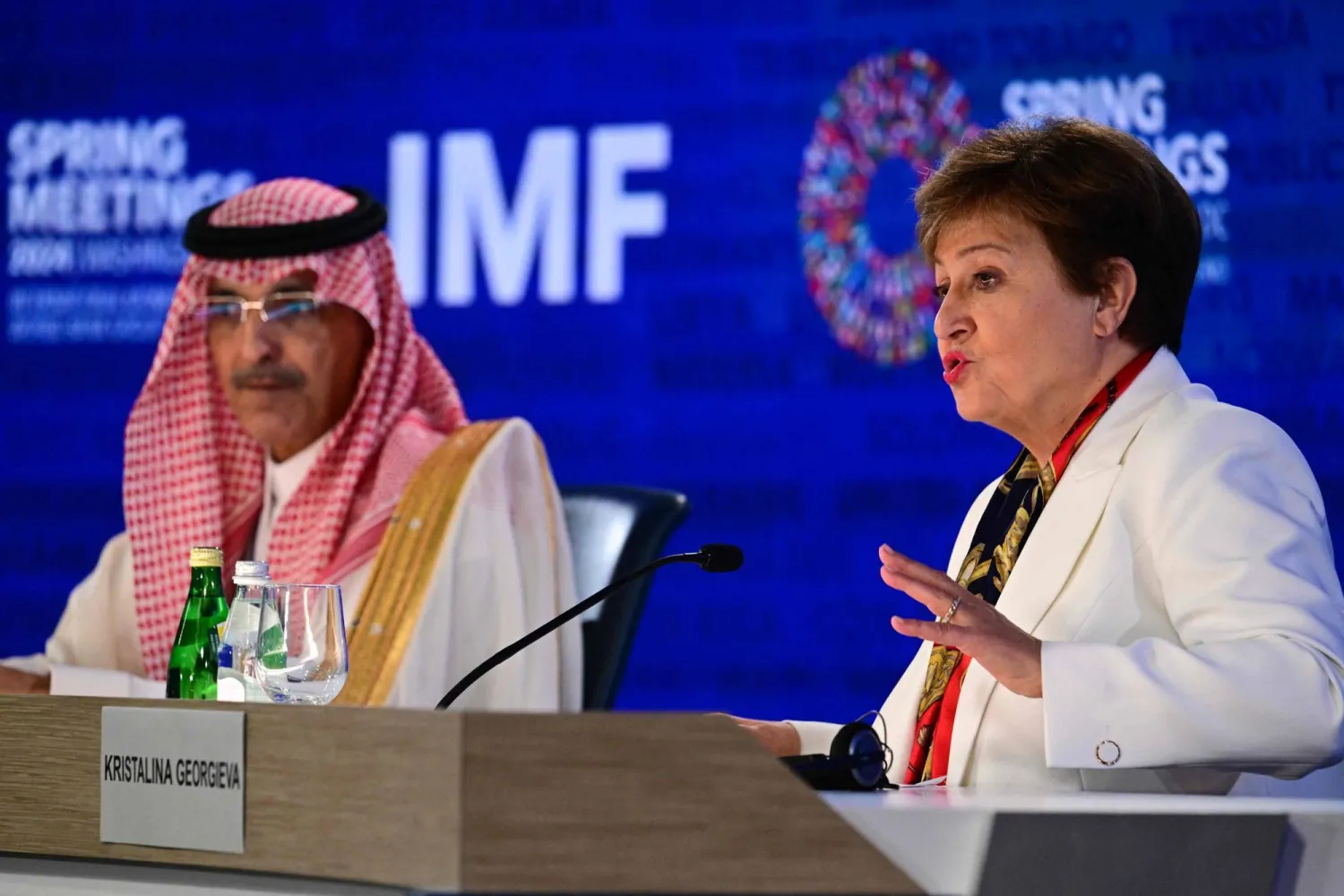
IMF Managing Director Kristalina Georgieva and Saudi Finance Minister Mohammed Al-Jadaan during a meeting of the IMF’s International Monetary and Financial Committee (AFP)
TT

IMF Applauds Saudi Arabia’s Fiscal Policies, Economic Diversification Success

IMF Managing Director Kristalina Georgieva and Saudi Finance Minister Mohammed Al-Jadaan during a meeting of the IMF’s International Monetary and Financial Committee (AFP)

The Executive Board of the International Monetary Fund (IMF) has commended the strong performance of the Saudi economy and its resilience in the face of external shocks, highlighting the Kingdom’s prudent fiscal policies and the success of its economic diversification strategies.

Despite rising global uncertainty and declining commodity prices, the IMF affirmed that Saudi Arabia’s economic outlook remains robust.

The Fund emphasized the importance of continuing structural reforms to sustain non-oil sector growth and to drive comprehensive economic diversification, regardless of fluctuations in oil prices. This international recognition underscores the effectiveness of the Kingdom’s economic strategy in maintaining momentum toward the goals of Vision 2030, while balancing fiscal stability and structural transformation.

Saudi Finance Minister Mohammed Al-Jadaan welcomed the IMF report, noting via his official account on X that the praise reflects the strength and resilience of Saudi Arabia’s diversified economy, which continues to move steadily toward achieving Vision 2030 objectives.

According to a statement issued following the conclusion of Article IV consultations with Saudi Arabia on Monday, the Kingdom’s economy continues to show remarkable resilience, supported by strong non-oil activity, contained inflation, and a significant decline in unemployment.

The jobless rate dropped to a record low of 7% in the fourth quarter of 2024, surpassing Vision 2030 targets ahead of schedule, which had been revised to 5% by 2030.

The IMF mission, led by Amine Mati, conducted its visit to the Kingdom between May 12 and 26, 2025, as part of the annual Article IV review. The final statement was issued on June 26, with the Executive Board subsequently approving the final report.

The IMF raised its economic growth forecast for Saudi Arabia to 3.6% in 2025, up from a previous estimate of 3% in April. The growth projection for 2026 was also adjusted upward to 3.9%.

No Further Spending Cuts Needed

During a press conference presenting the key findings of the IMF’s review, Mati stated that Saudi Arabia had already made sufficient spending adjustments this year and likely would not need to implement further fiscal tightening, even if oil prices weakened.

In response to a question on the Fund’s recommendation for a counter-cyclical fiscal policy, he said: “We do not believe there is a need for additional measures to cut spending or further fiscal adjustments in 2025.”

At the end of 2024, Saudi Arabia announced a planned expenditure of SAR1.285 trillion ($342 billion) for 2025 - lower than previous targets - as part of efforts to accelerate progress on economic diversification.

The IMF expects the Kingdom’s budget deficit to widen to 4% this year, a level Mati described as “entirely appropriate” given Saudi Arabia’s substantial foreign reserves. Meanwhile, the government projects a smaller deficit of 2.3%.

Strong Non-Oil Growth and Key Fiscal Insights

The IMF report confirmed that real non-oil GDP grew by 4.5% in 2024, driven by key sectors such as retail, hospitality, and construction.

On the other hand, oil GDP declined by 4.4%, due to production cuts under the OPEC+ agreement, which pulled overall growth down to 2%. Nonetheless, inflation remained under control, aided by slowing increases in housing rents.

The trade balance shifted from a 2.9% surplus of GDP to a slight 0.5% deficit, financed through external borrowing and a slowdown in the accumulation of foreign assets. Despite this shift, the Saudi Central Bank (SAMA) maintained strong reserves, with net foreign assets at $415 billion, covering 187% of the IMF’s adequacy threshold.

Forward-Looking Projections

The IMF expects domestic demand to remain strong, helping to sustain non-oil growth above 3.5% over the medium term, supported by continued Vision 2030 projects and major international events hosted by the Kingdom.

It forecasts overall GDP growth to reach 3.9% by 2026, as oil production cuts are gradually lifted under OPEC+ agreements. Inflation is expected to remain contained, while the current account is projected to stay in deficit due to higher investment-related imports and outflows from expatriate remittances.

These deficits are expected to be covered by drawing down deposits, slowing foreign asset accumulation, and increasing external borrowing.

Debt, Borrowing, and Market Access

The IMF projects the Kingdom’s public debt-to-GDP ratio to reach 29.8% in 2025, rising to 32.6% in 2026, while emphasizing that Saudi Arabia still has ample access to international capital markets. The share of foreign currency debt is expected to increase slightly over time.

Saudi Arabia’s public debt stood at 26.2% of GDP in 2024, one of the lowest ratios among G20 nations. The IMF expects public debt to rise moderately but remain within normal levels, supported by sound fiscal management and borrowing strategies.

However, the report also warned of near-term risks such as weak global oil demand due to trade tensions, reduced public spending, and regional security concerns. Conversely, a rise in oil production or expanded Vision 2030 investments could significantly boost growth.

Banking and Structural Reforms

IMF directors praised the health of the Saudi banking sector, noting strong capital buffers, profitability, and adequate liquidity. They encouraged swift finalization of the new banking law and the implementation of a comprehensive crisis management framework.

They also welcomed SAMA’s proactive stance in monitoring risks and employing counter-cyclical capital buffers. Non-performing loans fell to 1.2% by the end of 2024, signaling sector resilience.

The Fund applauded progress in deepening the domestic capital market, an essential step toward diversifying funding sources. It also recognized increased fiscal transparency and improved risk analysis, including contingency liabilities. Narrow sovereign bond spreads were cited as a sign of growing investor confidence.

2034 FIFA World Cup and Investment Law

The report noted that Saudi Arabia is preparing to spend approximately $26 billion on infrastructure for the 2034 FIFA World Cup, aligned with Vision 2030 goals. The event is expected to add between $9 and $14 billion to the Kingdom’s GDP.

The updated investment law was also praised, particularly for ensuring equal treatment of domestic and foreign investors in terms of rights and obligations.

Sustaining Reform Momentum

The IMF concluded its statement by praising Saudi Arabia’s “impressive” structural reforms since 2016, especially improvements in the regulatory and business environments, female workforce participation, and human capital development.

It emphasized the importance of maintaining reform momentum regardless of oil price fluctuations and continuing efforts to attract private sector investment to advance economic diversification.



Saudi Arabia, Syria Sign Joint Airline and Telecoms Deals

Officials pose after signing a framework agreement for developmental cooperation and the launch of 45 development initiatives between the Syrian Development Fund and Saudi Arabia's Development Committee at the People's Palace in Damascus, Syria, Saturday, Feb. 7, 2026. (AP)
TT

Saudi Arabia, Syria Sign Joint Airline and Telecoms Deals

Officials pose after signing a framework agreement for developmental cooperation and the launch of 45 development initiatives between the Syrian Development Fund and Saudi Arabia's Development Committee at the People's Palace in Damascus, Syria, Saturday, Feb. 7, 2026. (AP)

Syria and Saudi Arabia signed deals Saturday that include a joint airline and a $1-billion project to develop telecommunications, officials said, as Syria seeks to rebuild after years of war.

The new authorities in Damascus have worked to attract investment and have signed major agreements with several companies and governments.

Syrian Investment Authority chief Talal al-Hilali announced a series of deals including "a low-cost Syrian-Saudi airline aimed at strengthening regional and international air links".

The agreement also includes the development of a new international airport in the northern city of Aleppo, and redeveloping the existing facility.

Hilali also announced an agreement for a project called SilkLink to develop Syria's "telecommunications infrastructure and digital connectivity".

Syrian Telecommunications Minister Abdulsalam Haykal told the signing ceremony that the project would be implemented "with an investment of around $1 billion".

For decades, Syria was unable to secure significant investments because of Assad-era sanctions.

But the United States fully removed its remaining sanctions on Damascus late last year, paving the way for the full return of investments.

Syria and Saudi Arabia also inked an agreement on water desalination and development cooperation on Saturday.

At the ceremony, Saudi Investment Minister Khalid Al-Falih announced the launch of an investment fund for "major projects in Syria with the participation of the (Saudi) private sector".

The deals are part of "building a strategic partnership" between the two countries, he said.

Syria's Hilali said the agreements targeted "vital sectors that impact people's lives and form essential pillars for rebuilding the Syrian economy".

Syria has begun the mammoth task of trying to rebuild its shattered infrastructure and economy.

In July last year, Riyadh signed investment and partnership deals with Damascus valued at $6.4 billion to help rebuild the country's infrastructure, telecommunications and other major sectors.

A month later, Syria signed agreements worth more than $14 billion, including investments in Damascus airport and other transport and real estate projects.

This week, Syria signed a preliminary deal with US energy giant Chevron and Qatari firm Power International to explore for oil and gas offshore.


India’s Modi Lauds Interim Trade Pact After US Tariff Rollback

Indian Prime Minister Narendra Modi addresses the media before the budget session of Parliament at Parliament House in New Delhi, India, 29 January 2026. (EPA)
TT

India’s Modi Lauds Interim Trade Pact After US Tariff Rollback

Indian Prime Minister Narendra Modi addresses the media before the budget session of Parliament at Parliament House in New Delhi, India, 29 January 2026. (EPA)

Indian Prime Minister Narendra Modi on Saturday hailed an interim trade agreement with the United States, saying it would bolster global growth and deepen economic ties between the two countries.

The pact cuts US "reciprocal" duties on Indian products to 18 percent from 25 percent, and commits India to large purchases of US energy and industrial goods.

US President Donald Trump, while announcing the deal Tuesday, had said Modi promised to stop buying Russian oil over the war in Ukraine.

The deal eases months of tensions over India's oil purchases -- which Washington says fund a conflict it is trying to end -- and restores the close ties between Trump and the man he describes as "one of my greatest friends."

"Great news for India and USA!" Modi said on X on Saturday, praising US President Donald Trump's "personal commitment" to strengthening bilateral ties.

The agreement, he said, reflected "the growing depth, trust and dynamism" of their partnership.

Modi's remarks came hours after Trump issued an executive order scrapping an additional 25 percent levy imposed over New Delhi's purchases of Russian oil, in a step to implement the trade deal announced this week.

Modi, who has faced criticism at home about opening access of Indian agricultural markets to the United States and terms on oil imports, did not mention Russian oil in his statement.

"This framework will also strengthen resilient and trusted supply chains and contribute to global growth," he said.

It would also create fresh opportunities for Indian farmers, entrepreneurs and fishermen under the "Make in India" initiative.

In a separate statement, Commerce Minister Piyush Goyal said the pact would "open a $30 trillion market for Indian exporters".

Goyal also said the deal protects India's sensitive agricultural and dairy products, including maize, wheat, rice, soya, poultry and milk.

Other terms of the agreement include the removal of tariffs on certain aircraft and parts, according to a separate joint statement released Friday by the White House.

The statement added that India intends to purchase $500 billion of US energy products, aircraft and parts, precious metals, tech products and coking coal over the next five years.

The shift marks a significant reduction in US tariffs on Indian products, down from a rate of 50 percent late last year.

Washington and New Delhi are expected to sign a formal trade deal in March.


Gold Bounces Back on Softer Dollar, US-Iran Concerns; Silver Rebounds

Gold and silver bars are stacked in the safe deposit boxes room of the Pro Aurum gold house in Munich, Germany, January 10, 2025. REUTERS/Angelika Warmuth
TT

Gold Bounces Back on Softer Dollar, US-Iran Concerns; Silver Rebounds

Gold and silver bars are stacked in the safe deposit boxes room of the Pro Aurum gold house in Munich, Germany, January 10, 2025. REUTERS/Angelika Warmuth

Gold rebounded on Friday and was set for a weekly gain, helped by bargain hunting, a slightly weaker dollar and lingering concerns over US-Iran talks in Oman, while silver recovered from a 1-1/2-month low.

Spot gold rose 3.1% to $4,916.98 per ounce by 09:31 a.m. ET (1431 GMT), recouping losses posted during a volatile Asia session that followed a fall of 3.9% on Thursday. Bullion was headed for a weekly gain of about 1.3%.

US gold futures for April delivery gained 1% to $4,939.70 per ounce.

The US dollar index fell 0.3%, making greenback-priced bullion cheaper for the overseas buyers.

"The gold market is seeing perceived bargain hunting from bullish traders," said Jim Wyckoff, senior analyst at Kitco Metals.

Iran and the US started high-stakes negotiations via Omani mediation on Friday to try to overcome sharp differences over Tehran's nuclear program.

Wyckoff said gold's rebound lacks momentum and the metal is unlikely to break records without a major geopolitical trigger.

Gold, a traditional safe haven, does well in times of geopolitical and economic uncertainty.

Spot silver rose 5.3% to $74.98 an ounce after dipping below $65 earlier, but was still headed for its biggest weekly drop since 2011, down over 10.6%, following steep losses last week as well.

"What we're seeing in silver is huge speculation on the long side," said Wyckoff, adding that after years in a boom cycle, gold and silver now appear to be entering a typical commodity bust phase.

CME Group raised margin requirements for gold and silver futures for a third time in two weeks on Thursday to curb risks from heightened market volatility.

Spot platinum added 3.2% to $2,052 per ounce, while palladium gained 4.9% to $1,695.18. Both were down for the week.