Syria Will Not Take Part in Meetings with Kurdish-led SDF in Paris, State TV Sayshttps://english.aawsat.com/arab-world/5173455-syria-will-not-take-part-meetings-kurdish-led-sdf-paris-state-tv-says
Syria Will Not Take Part in Meetings with Kurdish-led SDF in Paris, State TV Says
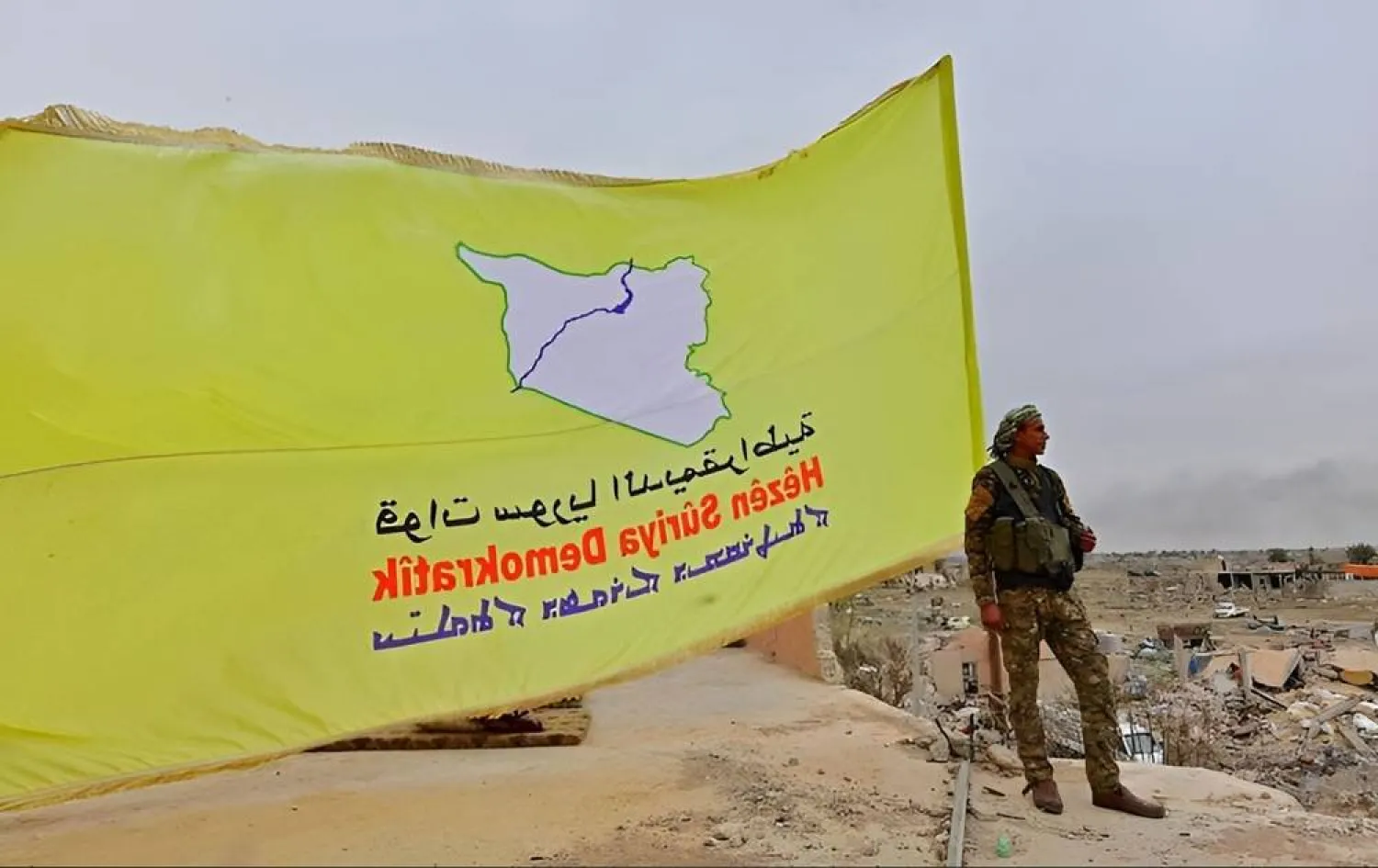
A member of the SDF in Deir Ezzor, Syria. (AFP file)
Syria will not take part in planned meetings with Kurdish-led Syrian Democratic Forces (SDF) in Paris, Syria's state news agency quoted a government source as saying on Saturday, casting doubt over an integration deal signed by the two sides in March.
The SDF was the main fighting force allied to the United States in Syria during fighting that defeated the ISIS group in 2019 after the group declared a caliphate across swathes of Syria and Iraq.
In March, the SDF signed a deal with the new government in Damascus to join Syria's state institutions.
The deal aims to stitch back together a country fractured by 14 years of war, paving the way for Kurdish-led forces that hold a quarter of Syria to merge with Damascus, along with regional Kurdish governing bodies.
It did not specify how the SDF will be merged with Syria's armed forces, however. The SDF has previously said its forces must join as a bloc, while Damascus wants them to join as individuals.
Germany Proposes EU Force to Replace UN Mission in Lebanonhttps://english.aawsat.com/arab-world/5297001-germany-proposes-eu-force-replace-un-mission-lebanon
15 July 2026, Finland, Helsinki: Johann Wadephul, German Minister of Foreign Affairs, speaks during a press conference following a meeting with his Finnish counterpart in the Finnish capital. (dpa)
TT
TT
Germany Proposes EU Force to Replace UN Mission in Lebanon
15 July 2026, Finland, Helsinki: Johann Wadephul, German Minister of Foreign Affairs, speaks during a press conference following a meeting with his Finnish counterpart in the Finnish capital. (dpa)
German Foreign Minister Johann Wadephul has proposed replacing the expiring United Nations peacekeeping mission in Lebanon with an EU-mandated force to prevent a security vacuum, he told the RedaktionsNetzwerk Deutschland.
"We should examine in the EU whether we can ensure that no security vacuum arises with a European mandate following the UNIFIL mission," Wadephul said in an interview published on Friday.
The UN Interim Forces in Lebanon (UNIFIL) mission expires on December 31, 2026. Germany's parliament extended the country's participation in the mission for the final time just weeks ago.
Wadephul said Lebanon, with a stabilizing government, represented "one of the most hopeful developments in the region at the moment."
Lebanon and Israel held ambassador-level talks at the US embassy in Rome on Tuesday and Wednesday — their sixth round of face-to-face negotiations since a new war erupted on March 2 between Israel and Lebanese armed group Hezbollah, triggered by the wider regional conflict.
An EU-mandated force could "create the conditions for the Israeli army to withdraw without Hezbollah returning with its terror," the minister added.
The proposal comes as European nations seek to maintain regional stability while balancing relations with Israel and Lebanon.
Syria Military Source Denies Iran Bombed Al-Tanf Base https://english.aawsat.com/arab-world/5296985-syria-military-source-denies-iran-bombed-al-tanf-base
The al-Tanf military outpost in southern Syria is seen on Oct. 22, 2018. (AP)
TT
TT
Syria Military Source Denies Iran Bombed Al-Tanf Base
The al-Tanf military outpost in southern Syria is seen on Oct. 22, 2018. (AP)
A Syrian military source denied to AFP on Friday that Iran had bombed the al-Tanf base near Syria's southeastern borders with Jordan and Iraq, after Tehran's Revolutionary Guards said they targeted the facility in response to US strikes.
"We deny any Iranian bombardment targeting the al-Tanf area," the source said, speaking on condition of anonymity.
US forces said they withdrew from the base earlier this year after troops were stationed there as part of a US-led anti-ISIS coalition.
Earlier on Friday, Iran's Revolutionary Guards claimed they had attacked a US special operations command center at al-Tanf in retaliation for the killing of Iranian soldiers in Iranshahr, state media reported.
Reuters could not independently verify the claim.
The US military said in February it completed a withdrawal from the al-Tanf base positioned at the tri-border confluence of Syria, Jordan and Iraq.
Syria has sought to avoid being drawn into the regional conflict that has engulfed neighboring countries, including Lebanon, where Hezbollah has fought Israeli forces, and Iraq, where Iran-backed armed groups have launched drone and rocket attacks.
Syrian President Ahmed al-Sharaa said in March that his country would stay out of any conflict unless it came under attack.
"Unless Syria is targeted by any party, Syria will remain outside any conflict," Sharaa said at an event hosted by the Chatham House think tank in London.
The Guards also said Iran retained full control of the Strait of Hormuz and that no oil or gas would be exported through the waterway for as long as US attacks continued, according to the state media report.
France's Prime Minister Sébastien Lecornu along with his delegation (L) attend a plenary session with the Moroccan lawmakers in Rabat on July 16, 2026. (Photo by Abdel Majid BZIOUAT / AFP)
The prime ministers of Morocco and France opened a high-level ministerial meeting in Rabat on Thursday aimed at strengthening bilateral ties ahead of an anticipated state visit by King Mohammed VI to Paris.
Relations between France and Morocco have improved significantly since French President Emmanuel Macron recognized Morocco's sovereignty over Western Sahara in the summer of 2024. In October of that year, Macron received an exceptionally warm welcome during an official visit to Rabat, marking the end of three years of strained relations.
Moroccan Prime Minister Aziz Akhannouch held bilateral talks with his French counterpart, Sébastien Lecornu, at the opening of the 15th session of the joint intergovernmental meeting.
Lecornu arrived in Rabat on Wednesday night accompanied by 12 ministers, including Foreign Minister Jean-Noël Barrot and Interior Minister Laurent Nuñez.
Akhannouch said that "the exceptional partnership between Morocco and France, established during President Emmanuel Macron's state visit to the Kingdom in October 2024, has opened a new chapter in relations between our two countries. It has laid the foundation for an ambitious future built on strong political convergence, renewed economic momentum, and a shared determination to prepare for and build the future together."
He added that "the enhanced exceptional partnership between Morocco and France is founded not only on strategic and economic dimensions, but also on a deep conviction rooted in the richness of the human ties between our societies. Students, researchers, entrepreneurs, artists, creators, and members of our diaspora all contribute to bringing our peoples closer together and enriching our cultures."
France's Prime Minister Sébastien Lecornu (L) and his Moroccan counterpart Aziz Akhannouch prepare to greet each other after delivering their press statements at the Ministry of Foreign Affairs office in Rabat on July 16, 2026. (Photo by Abdel Majid BZIOUAT / AFP)
King Mohammed VI is expected to pay a state visit to France to sign a Morocco-France Treaty, as announced by the two countries' foreign ministers during a meeting in Rabat in May, although no date has been set yet.
Lecornu said the anticipated visit could lead to the signing of "a unique friendship treaty" that would go beyond the "enhanced exceptional partnership" agreements concluded during Macron's 2024 visit to Rabat.
He stressed that France seeks to deepen its relationship with Morocco, particularly in the areas of security and counterterrorism, while highlighting the two countries' "shared interests" across Africa.
Lecornu added: "The significance of our presence here today, accompanied by such a large ministerial delegation, is our desire to achieve a qualitative leap in our bilateral relationship - a transformation that will benefit both our countries and others as well. This also applies to our relationship with the European Union and to our shared and aligned interests across the African continent."
France is seeking to strengthen its partnership with Morocco, particularly regarding security developments in the Sahel region, after moving away from its longstanding policy of maintaining a balance between Rabat and Algiers.
The ministerial summit is expected to conclude with the signing of around 15 cooperation agreements covering the economy, security, defense, and migration, according to a diplomatic source.
The agreements are expected to include projects related to an urban rail network in and around the capital, as well as cooperation in defense industries, civil aviation, water, electricity, and culture.
Lecornu also said that France and Morocco are seeking expressions of interest for an electricity interconnection project between the two countries as part of broader efforts to strengthen energy links between Europe and North Africa.
لم تشترك بعد
انشئ حساباً خاصاً بك لتحصل على أخبار مخصصة لك ولتتمتع بخاصية حفظ المقالات وتتلقى نشراتنا البريدية المتنوعة