


Damascus Quits Paris Talks with SDF after Hasakah Dispute

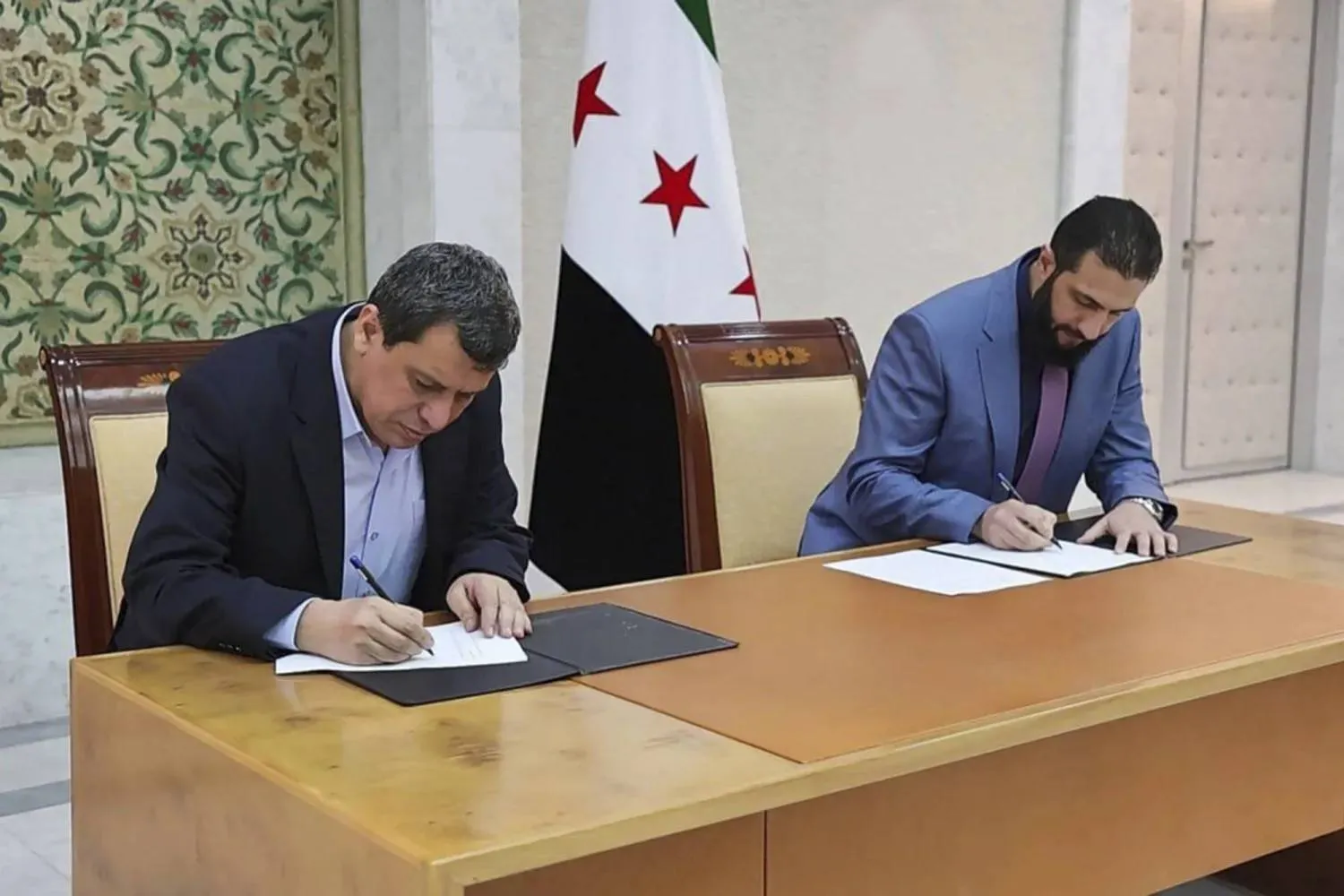
The Syrian President and SDF commander signing an integration deal (AP)
TT

Damascus Quits Paris Talks with SDF after Hasakah Dispute

The Syrian President and SDF commander signing an integration deal (AP)

The Syrian government said it will boycott planned talks in Paris with the Kurdish-led Syrian Democratic Forces (SDF), accusing the group of undermining a March unity deal by hosting a conference in the northeastern city of Hasakah.

The event, organized on Friday by the self-administration in northeast Syria under the banner “Unity of Position,” called for a decentralized state and a constitution guaranteeing ethnic, religious and cultural diversity.

Its final statement affirmed Syria’s territorial integrity, but Damascus dismissed it as an attempt to “internationalize the Syrian issue, invite foreign intervention and reinstate sanctions.”

In a statement on Saturday, the government said it would not sit down with “any party seeking to revive the era of the defunct regime under any guise,” in a reference to remnants of the former ruling order toppled in late 2024.

It accused the SDF of hosting separatist figures involved in hostile acts, calling this a “clear breach” of the March 10 agreement, and held the group “fully responsible” for the consequences.

A senior Syrian official told state news agency SANA that ethnic or religious groups have the right to form political parties and express their views, but only through peaceful means, without bearing arms or imposing their vision of the state.

The shape of the state, he said, should be decided in a permanent constitution approved by popular referendum, not through “factional understandings, threats or armed force.”

He described the SDF conference as a “fragile alliance of actors damaged by the Syrian people’s victory and the fall of the old regime,” backed by foreign powers and seeking to evade future political obligations.

The dispute has cast doubt on French- and US-backed mediation efforts announced last month by Paris, Washington and Damascus.

Political analyst Bassam Suleiman told Asharq al-Awsat that France had sought to insert itself into the Damascus-SDF track by leveraging unrest in southern Syria, but the Hasakah meeting had backfired, deepening mistrust.

The conference drew more than 500 participants from political, military and security institutions in northeast Syria, as well as representatives from the coastal and southern regions - including Druze cleric Hikmat al-Hijri from Sweida and Alawite religious leader Ghazal al-Ghazal, both known for opposing the new Syrian authorities. It was the first such gathering to bring together figures from areas that saw violent unrest after the Assad regime’s fall.

Suleiman said the event’s sectarian and tribal overtones reinforced internal divisions, with some participants linked to Israel or armed groups resisting state authority. “Whether France can pressure the SDF to repair the damage and resume talks in Paris remains unclear,” he added.

Another analyst, Thabet Salem, said the Hasakah conference aimed to legitimize emerging power centers, amend the March deal and signal to the international community that Syria should be divided under a decentralized model.

He warned that Syria faced a stark choice between becoming “a stable state stripped of military power but accommodating to international economic interests” or “a fragmented state serving Israel’s security agenda, particularly in water and defense.”

According to Salem, fragmentation would foster extremist groups that could destabilize the entire region, including Israel. “This makes the policies of Syria’s new authorities extremely sensitive, especially as trusting international promises has proved disastrous,” he said.


Netanyahu will Meet Trump on Gaza on December 29, Spokesperson Says

US President Donald Trump and Israeli Prime Minister Benjamin Netanyahu reach to shake hands at a joint press conference in the State Dining Room at the White House in Washington, DC, US, September 29, 2025. REUTERS/Jonathan Ernst/ File Photo
TT

Netanyahu will Meet Trump on Gaza on December 29, Spokesperson Says

US President Donald Trump and Israeli Prime Minister Benjamin Netanyahu reach to shake hands at a joint press conference in the State Dining Room at the White House in Washington, DC, US, September 29, 2025. REUTERS/Jonathan Ernst/ File Photo

Israeli Prime Minister Benjamin Netanyahu will meet US President Donald Trump on December 29 to discuss the next steps of the Gaza ceasefire, an Israeli government spokesperson said on Monday, Reuters reported.

On Sunday, Netanyahu said that he will be discussing with Trump the second phase of a US plan to end the war in Gaza later this month. A ceasefire between Israel and Hamas came into effect in October.

Both sides have repeatedly accused each other of violating the truce and wide gaps remain on key issues yet to be discussed under Trump's plan to end the war, including Hamas disarmament, the governance of post-war Gaza and the composition and mandate of an international security force in the enclave.

"The Prime Minister will meet with President Trump on Monday, December 29 they will discuss the future steps and phases and the international stabilization force of the ceasefire plan," government spokesperson Shosh Bedrosian said in an online briefing to reporters.

The prime minister's office said on December 1 that Trump had invited Netanyahu to the White House. Israeli media have since reported that the two leaders may meet in Florida.


Iraq Shuts Down Lukoil West Qurna 2 Field Due to Leak

FILE PHOTO: A general view shows the West Qurna-2 oilfield in southern Basra, Iraq, April 17, 2017. REUTERS/Essam Al-Sudani/File Photo/File Photo
TT

Iraq Shuts Down Lukoil West Qurna 2 Field Due to Leak

FILE PHOTO: A general view shows the West Qurna-2 oilfield in southern Basra, Iraq, April 17, 2017. REUTERS/Essam Al-Sudani/File Photo/File Photo

Iraq has shut down the entire oil production at Lukoil's West Qurna 2 oilfield, one of the world's largest, due to a leak on an export pipeline, two Iraqi energy officials told Reuters on Monday.

Lukoil declared force majeure last month at West Qurna 2 as it was hit with sanctions alongside Rosneft as part of US President Donald Trump's push to end the war in Ukraine.

The field, with output of around 460,000 barrels per day, accounts for about 0.5% of world oil supply and 9% of total output in Iraq, OPEC's second-largest producer.

Lukoil's 75% operational stake in the field is its largest foreign asset.

Iraq has frequently produced above its output target agreed with OPEC and allies including Russia, known as OPEC+.

The sanctions have drawn a growing list of potential bidders for Lukoil's global assets that includes oil majors.


UN Palestinian Aid Agency Says Israeli Police ‘Forcibly Entered’ Compound in Jerusalem 

Offices of the United Nations agency for Palestinian refugees, known as UNRWA, are seen in the Shuafat refugee camp in Jerusalem, Monday, Jan. 27, 2025. (AP)
TT

UN Palestinian Aid Agency Says Israeli Police ‘Forcibly Entered’ Compound in Jerusalem 

Offices of the United Nations agency for Palestinian refugees, known as UNRWA, are seen in the Shuafat refugee camp in Jerusalem, Monday, Jan. 27, 2025. (AP)

Israeli police forcibly entered the compound of the United Nations agency for Palestinian refugees in East Jerusalem early Monday, escalating a campaign against an organization that has been banned from operating on Israeli territory.

The UN Relief and Works Agency for Palestinian Refugees in the Near East, or UNRWA, said in a statement that “sizeable numbers” of Israeli forces including police on motorcycles, trucks and forklifts entered the compound in the Palestinian neighborhood of Sheikh Jarrah and cut communications to the compound.

“The unauthorized and forceful entry by Israeli security forces is an unacceptable violation of UNRWA’s privileges and immunities as a UN agency,” the agency said.

Photos taken by an Associated Press photographer show police cars on the street and an Israeli flag planted on the compound's roof. Photos provided by UNRWA staff show a group of Israeli police officers inside the compound.

Police said in a statement they entered for a “debt-collection procedure” spearheaded by Jerusalem's municipal government, which did not immediately respond to a request for comment.

The raid was the latest action in Israel's campaign against the agency, which provides aid and services to some 2.5 million Palestinian refugees in Gaza, the occupied West Bank and east Jerusalem, as well as 3 million more refugees in Syria, Jordan and Lebanon.

The agency was established to help the estimated 700,000 Palestinians who fled or were driven out of what is now Israel during the 1948 war surrounding Israel’s creation. UNRWA supporters say Israel hopes to erase the Palestinian refugee issue by dismantling the agency. Israel says the refugees should be permanently resettled outside its borders.

For more than a year of the Israel-Hamas war that began Oct. 7, 2023, UNRWA was the main lifeline for Gaza's population, which was largely reliant on aid because of humanitarian crisis unleashed by heavy Israeli bombardment and restrictions on the entry of goods.

Throughout the war, Israel has accused the agency of being infiltrated by Hamas, allegations the UN has denied. After months of mounting attacks from Prime Minister Benjamin Netanyahu and his far-right allies, Israel formally banned it from operating on its territory in January.

The US, formerly the largest donor to UNRWA, halted funding to the agency in early 2024.

UNRWA receives assistance from other agencies UNRWA has since struggled to continue its work in Gaza, with other UN agencies including WFP and UNICEF stepping in to help compensate for a gap UNRWA says is unfillable.

“If you squeeze UNRWA out, what other agency can fill that void?” said Tamara Alrifai, UNRWA’s director of external relations and communications, on the sidelines of the Doha Forum on Saturday.

The agency has been excluded from US-led talks on Phase 2 of the ceasefire, she added.

UNRWA shut down its Jerusalem compound in May after far-right protesters, including at least one member of Israeli Parliament, overran its gate in view of the police. Israel’s far-right has pushed to turn the compound into a settlement and the country's housing minister said last year he had instructed the ministry to “examine how to return the area to the state of Israel and utilize it for housing.”
