

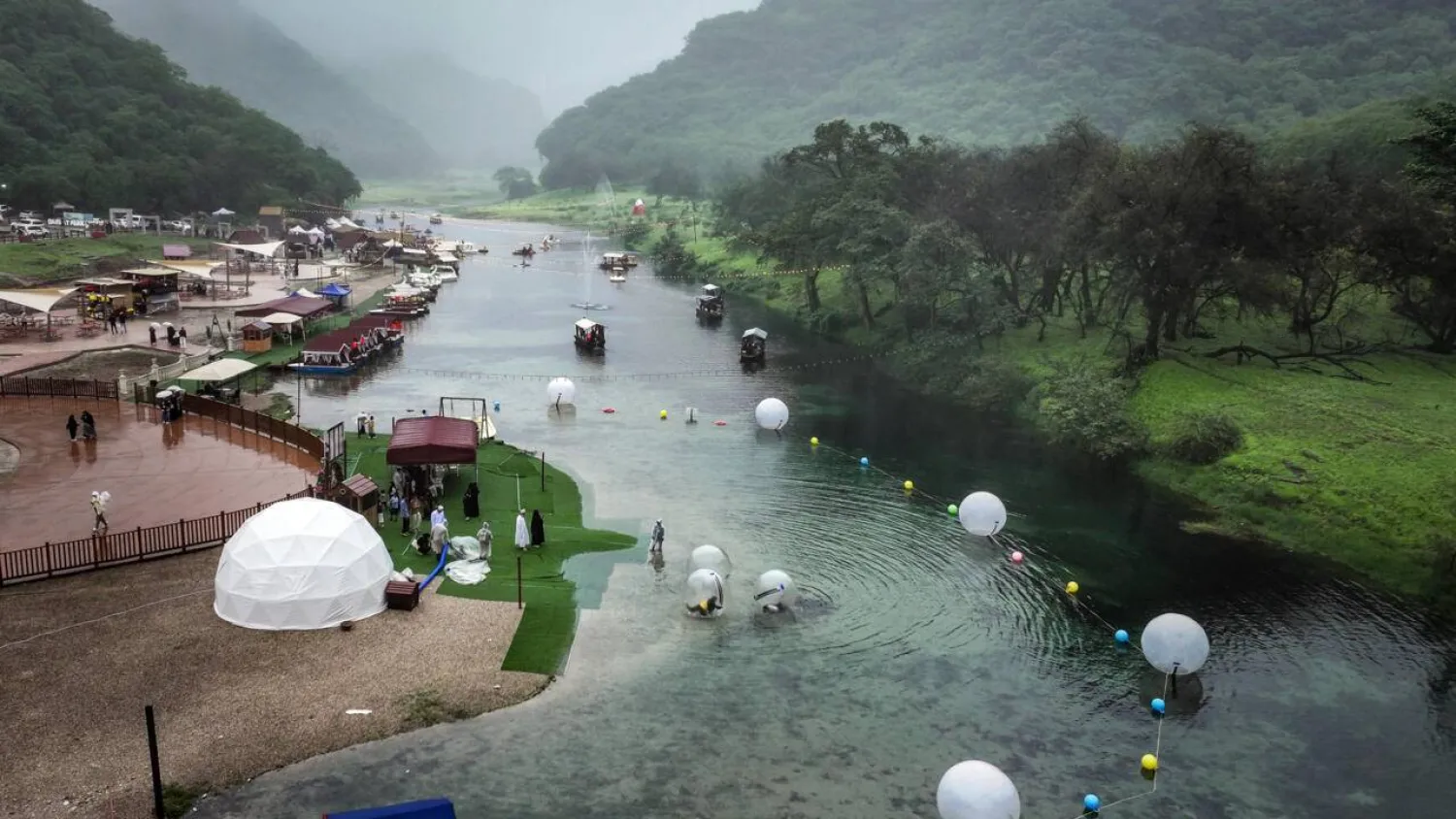

With Poetry and Chants, Omanis Strive to Preserve Ancient Language

There have been recent efforts towards studying Jibbali, with Oman's Vision 2040 economic plan prioritizing heritage preservation. AFP
TT

With Poetry and Chants, Omanis Strive to Preserve Ancient Language

There have been recent efforts towards studying Jibbali, with Oman's Vision 2040 economic plan prioritizing heritage preservation. AFP

Against the backdrop of southern Oman's lush mountains, men in traditional attire chant ancient poems in an ancient language, fighting to keep alive a spoken tradition used by just two percent of the population.

Sitting under a tent, poet Khalid Ahmed al-Kathiri recites the verses, while men clad in robes and headdresses echo back his words in the vast expanse.

"Jibbali poetry is a means for us to preserve the language and teach it to the new generation," Kathiri, 41, told AFP.

The overwhelming majority of Omanis speak Arabic, but in the mountainous coastal region of Dhofar bordering Yemen, people speak Jibbali, also known as Shehri.

Researcher Ali Almashani described it as an "endangered language" spoken by no more than 120,000 people in a country of over five million.

'Protected by isolation'

While AFP was interviewing the poet, a heated debate broke out among the men over whether the language should be called Jibbali -- meaning "of the mountains" -- or Shehri, and whether it was an Arabic dialect.

Almashani said it was a fully-fledged language with its own syntax and grammar, historically used for composing poetry and proverbs and recounting legends.

The language predates Arabic, and has origins in Semitic south Arabian languages, he said.

He combined both names in his research to find a middle ground.

"It's a very old language, deeply rooted in history," Almashani said, adding that it was "protected by the isolation of Dhofar".

"The mountains protected it from the west, the Empty Quarter from the north, and the Indian Ocean from the south. This isolation built an ancient barrier around it," he said.

But remoteness is no guarantee for survival.

Other languages originating from Dhofar like Bathari are nearly extinct, "spoken only by three or four people," he said.

Some fear Jibbali could meet the same fate.

Thirty-five-year-old Saeed Shamas, a social media advocate for Dhofari heritage, said it was vital for him to raise his children in a Jibbali-speaking environment to help keep the language alive.

Children in Dhofar grow up speaking the mother-tongue of their ancestors, singing along to folk songs and memorizing ancient poems.

"If everyone around you speaks Jibbali, from your father, to your grandfather, and mother, then this is the dialect or language you will speak," he said.

Not yet documented

The ancient recited poetry and chants also preserve archaic vocabulary no longer in use, Shamas told AFP.

Arabic is taught at school and understood by most, but the majority of parents speak their native language with their children, he said.

After the poetry recital, a group of young children nearby told AFP they "prefer speaking Jibbali over Arabic".

But for Almashani, the specter of extinction still looms over a language that is not taught in school or properly documented yet.

There have been recent efforts towards studying Jibbali, with Oman's Vision 2040 economic plan prioritizing heritage preservation.

Almashani and a team of people looking to preserve their language are hoping for support from Dhofar University for their work on a dictionary with about 125,000 words translated into Arabic and English.

The project will also include a digital version with a pronunciation feature for unique sounds that can be difficult to convey in writing.



Italy Uncovers Basilica Designed by Vitruvius, the 'Father of Architecture'

A handout photo made available by Regione Marche press office shows the excavations in Piazza Andrea Costa from which large columns emerge, remains believed of the Basilica of Vitruvius, in Fano, Italy, 19 January 2026. (EPA/Regione Marche press office)
TT

Italy Uncovers Basilica Designed by Vitruvius, the 'Father of Architecture'

A handout photo made available by Regione Marche press office shows the excavations in Piazza Andrea Costa from which large columns emerge, remains believed of the Basilica of Vitruvius, in Fano, Italy, 19 January 2026. (EPA/Regione Marche press office)

Italian officials on Monday hailed the discovery of a more than 2,000-year-old public building attributed to Vitruvius, the ancient Roman architect and engineer known as the "father of architecture."

"It is a sensational finding ... something that our grandchildren will be talking about," Italian Culture Minister Alessandro Giuli told a press conference.

Vitruvius, who lived in the ‌1st century BC, ‌is celebrated for having written "De architectura," ‌or ⁠The Ten ‌Books on Architecture, the oldest surviving treatise on the subject.

His teachings on the classical proportions of buildings have inspired artists over centuries, including Leonardo da Vinci, whose famous drawing of the human body is known as the "Vitruvian Man."

Archaeologists believe they have found ⁠the remains of an ancient basilica, or public building, in the central ‌Italian city of Fano northeast of ‍Rome, that was created ‍by Vitruvius.

"I feel like this is the discovery ‍of the century, because scientists and researchers have been searching for this basilica for over 500 years," said the Mayor of Fano Luca Serfilippi.

"We have absolute match" between what was discovered and the descriptions given by Vitruvius in his books, regional archaeological superintendent Andrea Pessina told reporters.

The basilica had a rectangular layout, with 10 columns on the long side, and four on the short ones, Pessina said.

During excavation, when traces of four columns emerged, archaeologists used Vitruvius' descriptions to calculate where the top right column should be. When they started digging, they found it immediately, Pessina said.

"The are few certainties in archaeology ... but we were impressed by the precision" of the match, he added.

Further digging will determine whether more of the ‌basilica lies underground and if the site can be shown to the public, the superintendent said.


French TV Broadcasts Louvre Robbery Images

People wait for the Louvre museum to open as employees at the Louvre Museum vote to extend a strike that has disrupted operations at the world's most visited museum, Thursday, Dec. 18, 2025 in Paris. (AP)
TT

French TV Broadcasts Louvre Robbery Images

People wait for the Louvre museum to open as employees at the Louvre Museum vote to extend a strike that has disrupted operations at the world's most visited museum, Thursday, Dec. 18, 2025 in Paris. (AP)

Footage of the spectacular robbery at the Louvre Museum has been broadcast for the first time on French television, showing the brazen jewel thieves breaking into display cases.

The images, filmed by surveillance cameras, were shown by the TF1 and public France Televisions channels on Sunday evening, three months after the hugely embarrassing break-in in October.

They show the two burglars, one wearing a black balaclava and a yellow high-visibility jacket, the other dressed in black with a motorcycle helmet, as they force their way into the Apollo Gallery.

After breaking in through a reinforced window with a high-powered disk cutters, they begin slicing into display cases under the eyes of several staff members who do not intervene.

Managers at the Louvre have stressed that staff are not trained to confront thieves and are asked to prioritize the evacuation of visitors.

During the roughly four minutes that the two men were inside the gallery, one staff member can be seen holding a bollard used to orient visitor through the gallery, according to France Televisions.

The images form a key part of the ongoing criminal investigation into the October 19 heist.

Details of the footage have been reported in French newspapers, including Le Parisien.

Four suspects are in police custody, including the two suspected thieves, but the eight stolen items of French crown jewels worth an estimated $102 million have not been found.

The security failures highlighted by the break-in on a Sunday morning in broad daylight have lead to major pressure on director Laurence des Cars, who has apologized.

Metal bars have since been installed over the windows of the Apollo Gallery.


Cultural Development Fund Highlights Economic Value of Saudi Culture in Davos

The Cultural Development Fund (CDF) logo
TT

Cultural Development Fund Highlights Economic Value of Saudi Culture in Davos

The Cultural Development Fund (CDF) logo

The Cultural Development Fund (CDF) is participating in the Saudi House pavilion initiative, led by the Ministry of Economy and Planning, during the Annual Meeting of the World Economic Forum 2026, held in Davos, Switzerland, from January 19 to 23.

Through this participation, CDF aims to showcase the economic value of Saudi culture, highlight its role in diversifying the national economy and enhancing quality of life, attract international investment in the cultural sector, and spotlight Saudi cultural entrepreneurship.

According to a statement from the fund, the CDF’s participation includes a networking breakfast bringing together global economic leaders and investors from various countries, with the aim of raising awareness of Saudi culture as an economic force and a key pillar of Saudi Vision 2030.

The event will also provide a platform for exchanging perspectives and opportunities with international investors and financial institutions, while offering a closer look at the enablers of the Saudi cultural sector and its investment opportunities.

As part of the event, the CDF will host a panel discussion titled “Investing in Culture as an Economic Engine” that will feature CEO of the Cultural Development Fund Majed bin Abdulmohsen Al-Hugail, alongside Deputy Minister of Cultural Strategies and Policies at the Ministry of Culture Albara Al-Auhali.

The discussion will address the economic value of culture globally and locally, highlighting the CDF’s role in providing financial solutions that support cultural enterprises and enable their contribution to GDP growth and quality of life. The session will also explore cultural policies and their impact on strengthening the sector’s economic and investment potential.

Within the NextOn dialogue series organized by the Saudi House in Davos, the Cultural Development Fund will enable supported cultural projects to share their success stories and highlight their role in enhancing cultural production and increasing its economic value.

Participating entrepreneurs include Co-Founder of AlMashtal Creative Incubator Princess Noura bint Saud bin Naif, and CEO of Arabian Housing and Building company (AHB) Khalid Henaidy, who will speak about the role of entrepreneurship in shaping the future of the Kingdom’s cultural economy.

‏This participation underscores the CDF’s role as a center of excellence and financial enabler for the cultural sector in the Kingdom, and forms part of its efforts to strengthen the presence of Saudi cultural dynamism on the global stage. It aligns with the CDF’s objectives to maximize the cultural sector’s economic and social impact, increase its contribution to GDP, quality of life, and advance the goals of Saudi Vision 2030.