


South Korean, US Militaries Begin Annual Summertime Drills to Cope with North Korean Threats 

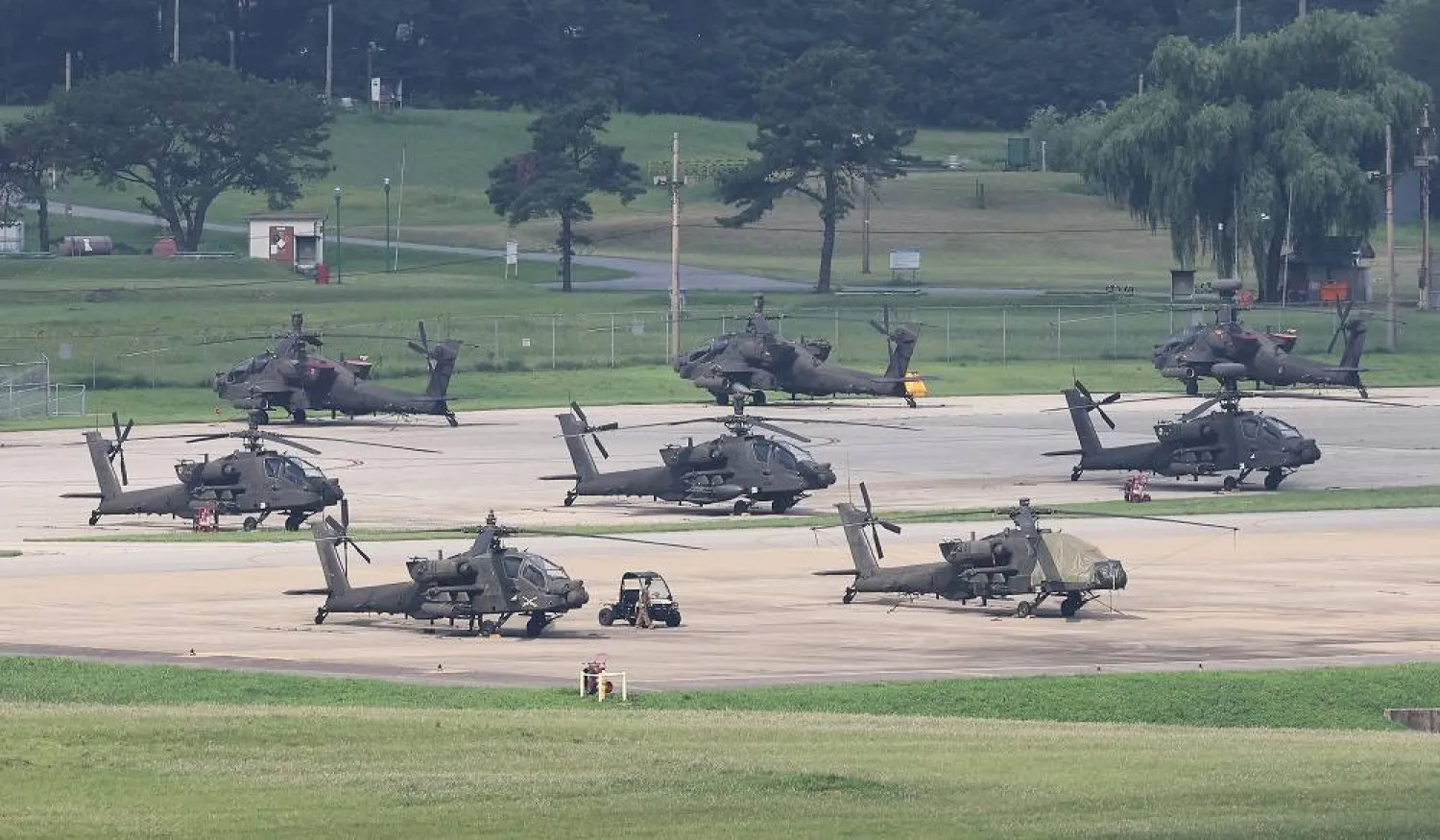
Apache attack helicopters are parked at US Camp Humphreys in Pyeongtaek, south of Seoul, on Aug. 18, 2025, as South Korea and the United States began a major joint exercise, the annual Ulchi Freedom Shield exercise, to strengthen their combined readiness posture. (YNA/dpa)
TT

South Korean, US Militaries Begin Annual Summertime Drills to Cope with North Korean Threats 

Apache attack helicopters are parked at US Camp Humphreys in Pyeongtaek, south of Seoul, on Aug. 18, 2025, as South Korea and the United States began a major joint exercise, the annual Ulchi Freedom Shield exercise, to strengthen their combined readiness posture. (YNA/dpa)

South Korea and the United States began their annual large-scale joint military exercise on Monday to better cope with threats by nuclear-armed North Korea, which has warned the drills would deepen regional tensions and vowed to respond to “any provocation” against its territory.

The 11-day Ulchi Freedom Shield, the second of two large-scale exercises held annually in South Korea, after another set in March, will involve 21,000 soldiers, including 18,000 South Koreans, in computer-simulated command post operations and field training.

The drills, which the allies describe as defensive, could trigger a response from North Korea, which has long portrayed the allies’ exercises as invasion rehearsals and has often used them as a pretext for military demonstrations and weapons tests aimed at advancing its nuclear program.

In a statement last week, North Korean Defense Minister No Kwang Chol said the drills show the allies’ stance of “military confrontation” with the North and declared that its forces would be ready to counteract “any provocation going beyond the boundary line.”

Ulchi Freedom Shield comes at a pivotal moment for South Korea’s new liberal President Lee Jae Myung, who is preparing for an Aug. 25 summit with US President Donald Trump in Washington. Trump has raised concerns in Seoul that he may shake up the decades-old alliance by demanding higher payments for the American troop presence in South Korea and possibly reducing it as Washington shifts its focus more toward China.

Tensions on the Korean Peninsula remain high as North Korea has brushed aside Lee’s calls to resume diplomacy with its war-divided rival, with relations having soured in recent years as North Korean leader Kim Jong Un accelerated his weapons program and deepened alignment with Moscow following Russia’s invasion of Ukraine.

“What's needed now is the courage to steadily take steps toward easing tensions, grounded in a firmly maintained state of ironclad security readiness,” Lee said during a Cabinet meeting on Monday. South Korea also on Monday began a four-day civil defense drill involving thousands of public workers, often scheduled alongside the allies’ summertime military exercises.

Seoul’s previous conservative government responded to North Korean threats by expanding military exercises with the United States and seeking stronger US assurances for nuclear deterrence, drawing an angry reaction from Kim, who last year renounced long-term reconciliation goals and rewrote the North’s constitution to label the South a permanent enemy.

In his latest message to Pyongyang on Friday, Lee, who took office in June, said he would seek to restore a 2018-inter-Korean military agreement designed to reduce border tensions and called for North Korea to respond to the South’s efforts to rebuild trust and revive talks.

The 2018 military agreement, reached during a brief period of diplomacy between the Koreas, created buffer zones on land and sea and no-fly zones above the border to prevent clashes.

But South Korea suspended the deal in 2024, citing tensions over North Korea’s launches of trash-laden balloons toward the South, and moved to resume frontline military activities and propaganda campaigns. The step came after North Korea had already declared it would no longer abide by the agreement.

When asked whether the Lee government’s steps to restore the agreement would affect the allies’ drills, the South’s Defense Ministry said Monday that there are no immediate plans to suspend live-fire training near the Koreas’ disputed western maritime border.

While the allies have postponed half of Ulchi Freedom Shield’s originally planned 44 field training programs to September, US military officials denied South Korean media speculation that the scaled-back drills were meant to make room for diplomacy with the North, citing heat concerns and flood damage to some training fields.

Dating back to his first term, Trump has regularly called for South Korea to pay more for the 28,500 American troops stationed on its soil. Public comments by senior Trump administration officials, including Undersecretary of Defense Elbridge Colby, have suggested a push to restructure the alliance, which some experts say could potentially affect the size and role of US forces in South Korea.

Under this approach, South Korea would take a greater role in countering North Korean threats while US forces focus more on China, possibly leaving Seoul to face reduced benefits but increased costs and risks, experts say.

In a recent meeting with reporters, Gen. Xavier Brunson, commander of US Forces Korea, stressed the need to “modernize” the alliance to address the evolving security environment, including North Korea’s nuclear ambitions, its deepening alignment with Russia, and what he called Chinese threats to a “free and open Indo-Pacific.”



Governor of Russia’s Belgorod Region Says 600,000 without Power, Heat, or Water After Ukrainian Strike

 A residential building and cars during a power blackout, that according to local authorities was caused by a recent Ukrainian missile attack targeting the regional energy system, amid the Russia-Ukraine military conflict in Belgorod, Russia, January 9, 2026. (Reuters)
A residential building and cars during a power blackout, that according to local authorities was caused by a recent Ukrainian missile attack targeting the regional energy system, amid the Russia-Ukraine military conflict in Belgorod, Russia, January 9, 2026. (Reuters)
TT

Governor of Russia’s Belgorod Region Says 600,000 without Power, Heat, or Water After Ukrainian Strike

 A residential building and cars during a power blackout, that according to local authorities was caused by a recent Ukrainian missile attack targeting the regional energy system, amid the Russia-Ukraine military conflict in Belgorod, Russia, January 9, 2026. (Reuters)
A residential building and cars during a power blackout, that according to local authorities was caused by a recent Ukrainian missile attack targeting the regional energy system, amid the Russia-Ukraine military conflict in Belgorod, Russia, January 9, 2026. (Reuters)

The governor of Russia's Belgorod region, which borders Ukraine, said on Saturday that 600,000 residents were without electricity, heating and water after a Ukrainian missile strike.

In a statement posted on Telegram, Vyacheslav Gladkov said that work was ‌underway to ‌restore supplies, ‌but ⁠that the situation ‌was "extremely challenging".

Footage filmed by Reuters in Belgorod city showed streetlights extinguished and locals finding their way using hand-held torches and car headlights.

Belgorod region, ⁠which adjoins Ukraine's Kharkiv region ‌and had a pre-war ‍population of ‍1.5 million, has come ‍under regular attack from Kyiv's forces since Russia ordered tens of thousands of troops into Ukraine in February 2022.

Russia has frequently bombarded Ukraine's power infrastructure, causing ⁠rolling daily blackouts, and has also targeted heating systems this winter. An overnight strike on Thursday left about half of Kyiv's apartment blocks without heat.

Temperatures in most of Russia and Ukraine have been well below freezing in ‌recent days.


Venezuela Says in Talks with US to Restore Diplomatic Ties

The city of Caracas, days after the US launched a strike on Venezuela and captured President Nicolas Maduro and his wife Cilia Flores, Venezuela January 7, 2026. (Reuters)
TT

Venezuela Says in Talks with US to Restore Diplomatic Ties

The city of Caracas, days after the US launched a strike on Venezuela and captured President Nicolas Maduro and his wife Cilia Flores, Venezuela January 7, 2026. (Reuters)

Venezuela was set to hold talks on Saturday with US envoys in Caracas on restoring diplomatic ties, days after US forces deposed Nicolas Maduro as its president.

Venezuela said Friday it had launched discussions with US diplomats in the capital, the latest sign of cooperation following the leftist leader's capture and US President Donald Trump's claim to be "in charge" of the South American country.

Officials said the US envoys were in Caracas to discuss reopening the country's embassy, while in Washington Trump met with oil companies over his plans to access Venezuela's huge crude reserves.

The government of interim President Delcy Rodriguez "has decided to initiate an exploratory diplomatic process with the government of the United States of America, aimed at re-establishing diplomatic missions in both countries," Foreign Minister Yvan Gil said in a statement.

John McNamara, the top US diplomat in neighboring Colombia, and other personnel "traveled to Caracas to conduct an initial assessment for a potential phased resumption of operations," a US official said on customary condition of anonymity.

Venezuela said it would be reciprocating by sending a delegation to Washington.

Rodriguez in a statement condemned "the serious, criminal, illegal and illegitimate attack" by the United States and vowed: "Venezuela will continue to confront this aggression through the diplomatic route."

- Prisoners' release -

Anxious relatives waited outside Venezuelan jails for a glimpse of their loved ones as the authorities began releasing political prisoners -- a move Washington claimed credit for.

"When I heard the news, I broke down," said Dilsia Caro, 50, waiting for the release of her husband Noel Flores, who was jailed for criticizing Maduro.

Venezuela began releasing prisoners on Thursday in the first such gesture since US forces removed and detained Maduro in the deadly January 3 raid.

Some relatives still gathered outside the prison had waited more than 36 hours to see their family members.

"We've been living with this uncertainty for several days now... We are worried, we are very distressed, filled with anxiety," said one woman, awaiting the release of her brother.

In Nicaragua, meanwhile, authorities have arrested at least 60 people for reportedly expressing support for Maduro's capture, according to a local human rights group.

Trump told Fox News he would meet next week with Venezuelan opposition leader Maria Corina Machado, whom he earlier brushed aside as lacking the "respect" to lead Venezuela.

Exiled Venezuelan opposition figurehead Edmundo Gonzalez Urrutia said that any democratic transition in the country must recognize his claim to victory in 2024 presidential elections.

Maduro was proclaimed the winner of the vote, but his re-election was widely seen as fraudulent.

Gonzalez was hoping Friday for the release of his son-in-law, who was detained a year ago in Caracas.

- Protests in Caracas -

Maduro was seized in a US special forces raid accompanied by airstrikes, operations that left 100 people dead, according to Caracas.

US forces took Maduro and his wife Cilia Flores to New York to face trial on drug-trafficking and other charges.

Rodriguez insisted Thursday her country was "not subordinate or subjugated" despite her pledge to cooperate with Trump.

Angry protesters rallied in the streets of Caracas on Friday demanding Maduro's release in the latest of a daily series of demonstrations.

"We don't have to give one little drop of oil to Trump after all that he has done to us," said one protester, Josefina Castro, 70, a member of a civil activists' group.

"Our Venezuelan brothers died (in the attack), and that hurts."


Son of Ousted Iran Shah Urges Protesters to 'Prepare to Seize' City Centers

FILE - Reza Pahlavi, the son of Iran's toppled Shah Mohammad Reza Pahlavi, speaks during a news conference, June 23, 2025 in Paris. (AP Photo/Thomas Padilla, File)
TT

Son of Ousted Iran Shah Urges Protesters to 'Prepare to Seize' City Centers

FILE - Reza Pahlavi, the son of Iran's toppled Shah Mohammad Reza Pahlavi, speaks during a news conference, June 23, 2025 in Paris. (AP Photo/Thomas Padilla, File)

The US-based son of Iran's ousted shah urged Iranians on Saturday to stage more targeted protests with the aim of taking and then holding city centers.

"Our goal is no longer just to take to the streets. The goal is to prepare to seize and hold city centers," Reza Pahlavi said in a video message on social media, urging more protests on Saturday and Sunday and adding he was also "preparing to return to my homeland" in a day he believed was "very near".
Iran was largely cut off from the outside world on Friday after authorities blacked out the internet to curb growing unrest, as video showed buildings aflame in anti-government protests raging in cities across the country.

Rights groups have already documented dozens of deaths of protesters in nearly two weeks and, with Iranian state TV showing clashes and fires, the semi-official Tasnim news agency reported that several police officers had been killed overnight.

In a televised address, Supreme Leader Ali Khamenei vowed not to back down, accusing demonstrators of acting on behalf of émigré opposition groups and the United States, and a public prosecutor threatened death sentences.